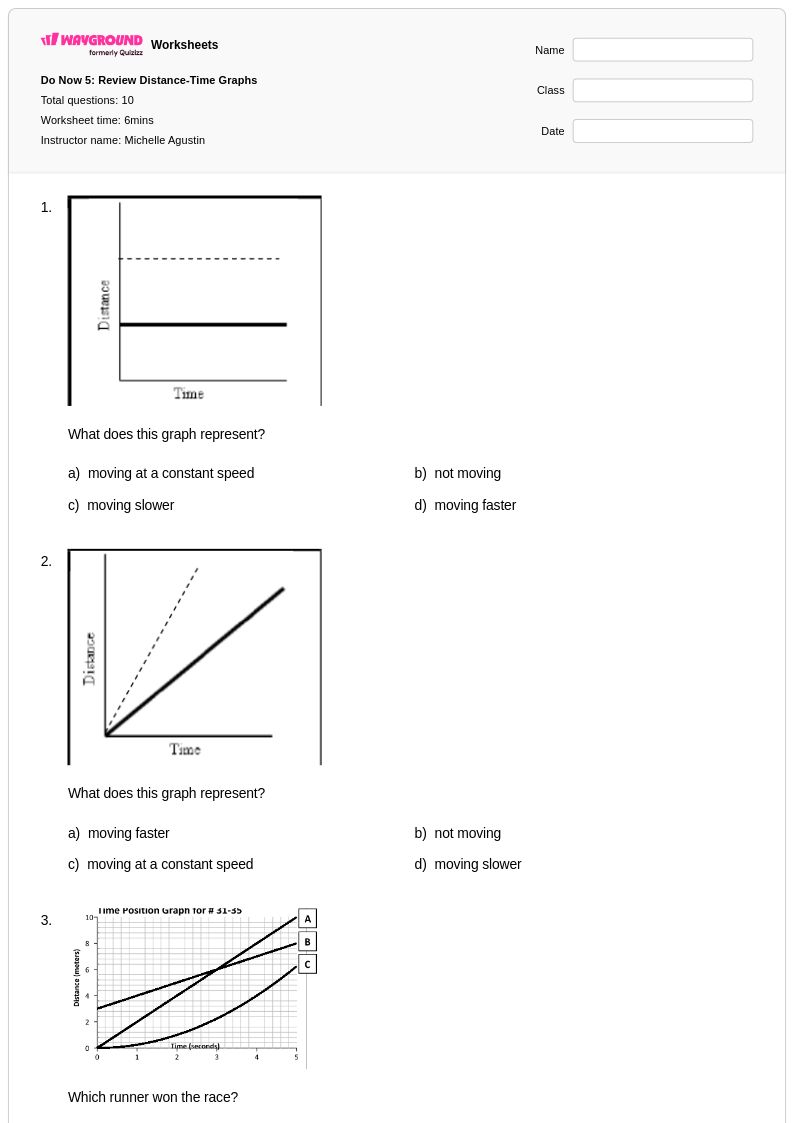
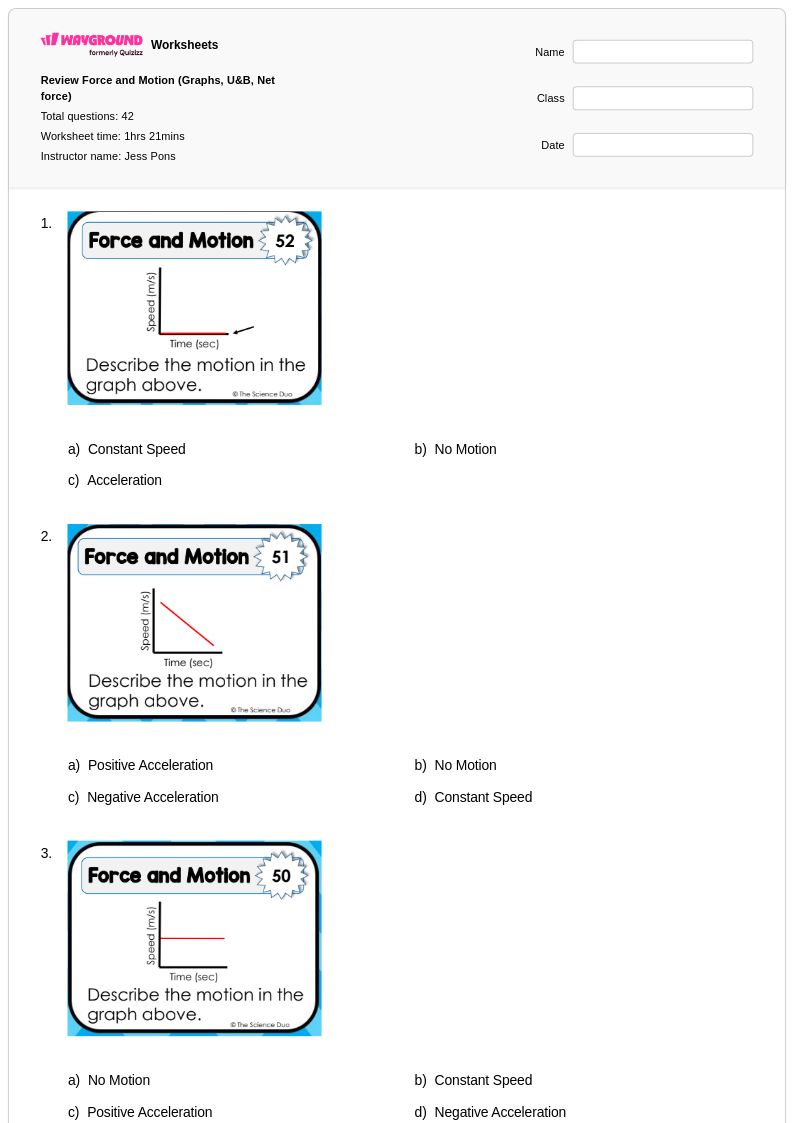
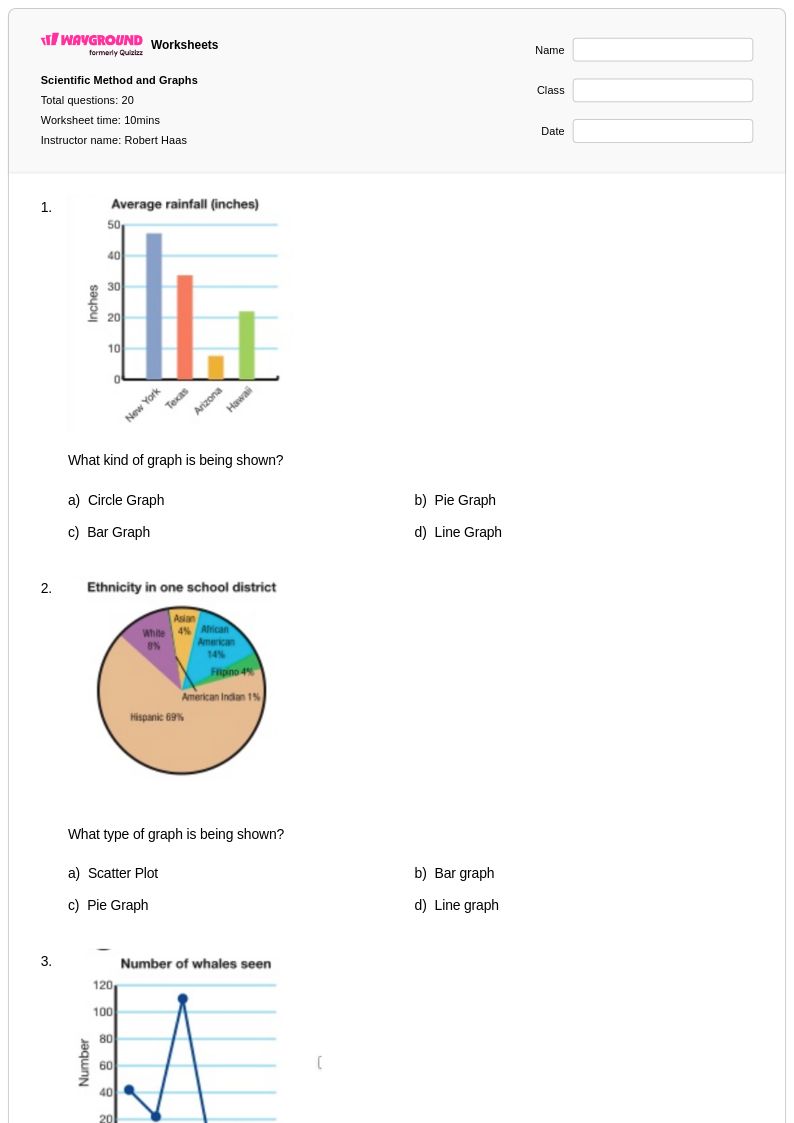
Explore Wayground's comprehensive collection of Class 7 physics graphs worksheets, featuring free printables and PDFs with answer keys to help students master data interpretation, plotting coordinates, and analyzing scientific relationships through engaging practice problems.
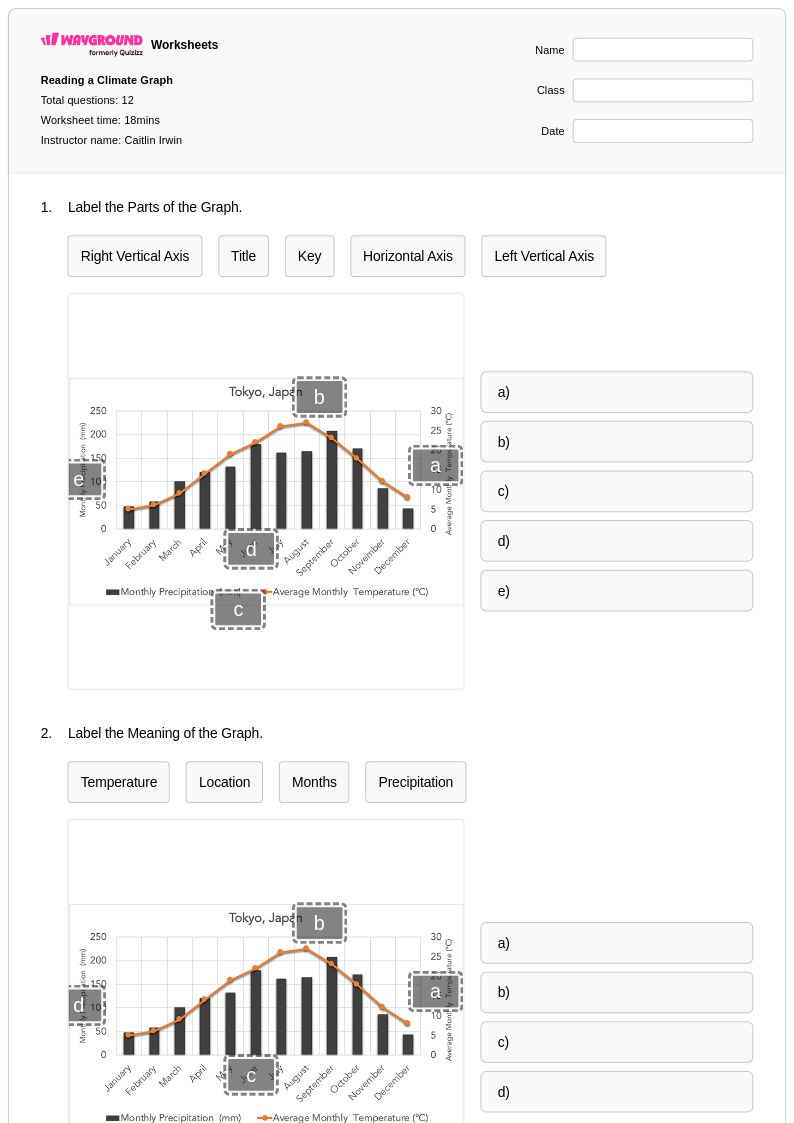
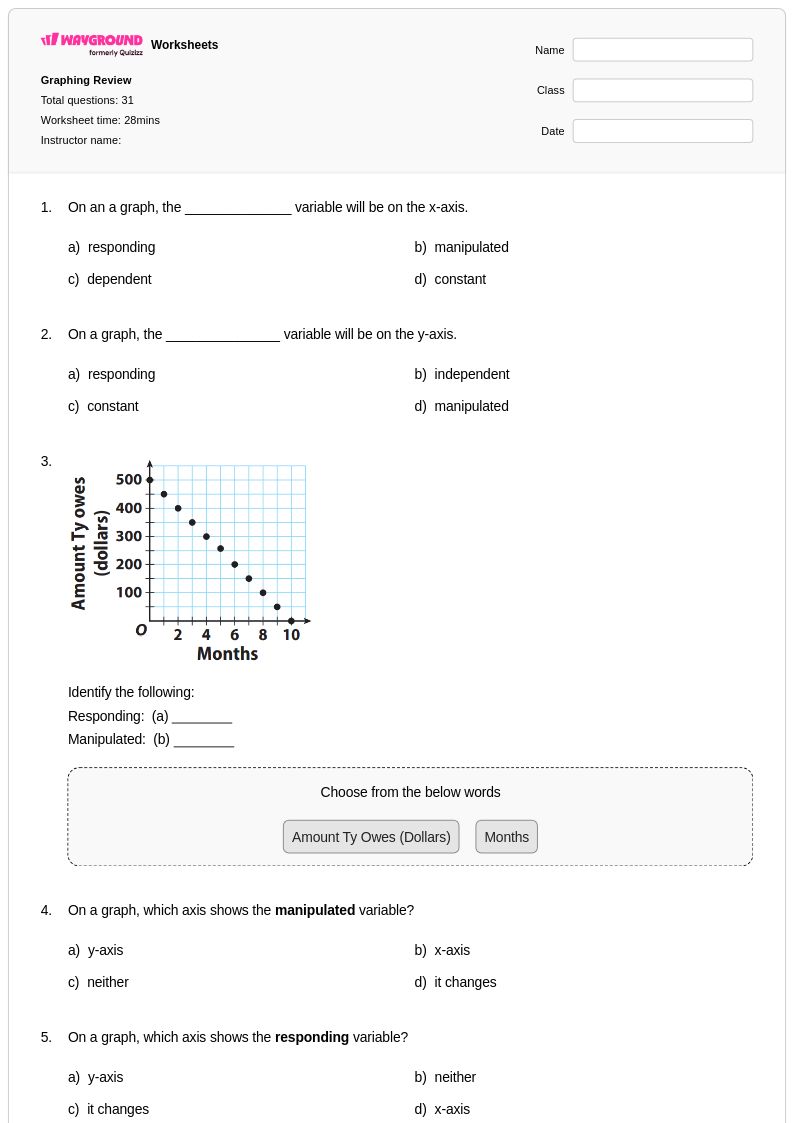
Class 7 physics graphs worksheets available through Wayground (formerly Quizizz) provide comprehensive practice in interpreting, creating, and analyzing various types of scientific graphs essential for middle school physics education. These carefully designed worksheets strengthen students' abilities to read position-time graphs, velocity-time graphs, and acceleration graphs while developing critical skills in data interpretation and scientific reasoning. Each worksheet includes detailed answer keys that help teachers provide immediate feedback and support student self-assessment, while the free printable format ensures accessibility for diverse classroom needs. The practice problems systematically build from basic graph reading to more complex analysis tasks, helping seventh graders master the fundamental relationship between mathematical representations and physical phenomena.
Wayground (formerly Quizizz) supports physics educators with an extensive collection of millions of teacher-created graph worksheets that can be easily searched and filtered by specific physics concepts, difficulty levels, and educational standards. The platform's robust differentiation tools allow teachers to customize worksheet content for students with varying ability levels, while the flexible format options include both printable pdf versions for traditional classroom use and digital formats for technology-enhanced learning environments. These resources prove invaluable for lesson planning, targeted remediation for students struggling with graph interpretation, enrichment activities for advanced learners, and regular skill practice that reinforces the connection between mathematical thinking and physics understanding. Teachers benefit from the standards-aligned content that seamlessly integrates with curriculum requirements while providing the adaptability needed to meet individual student needs.
FAQs
How do I teach students to read and interpret physics graphs?
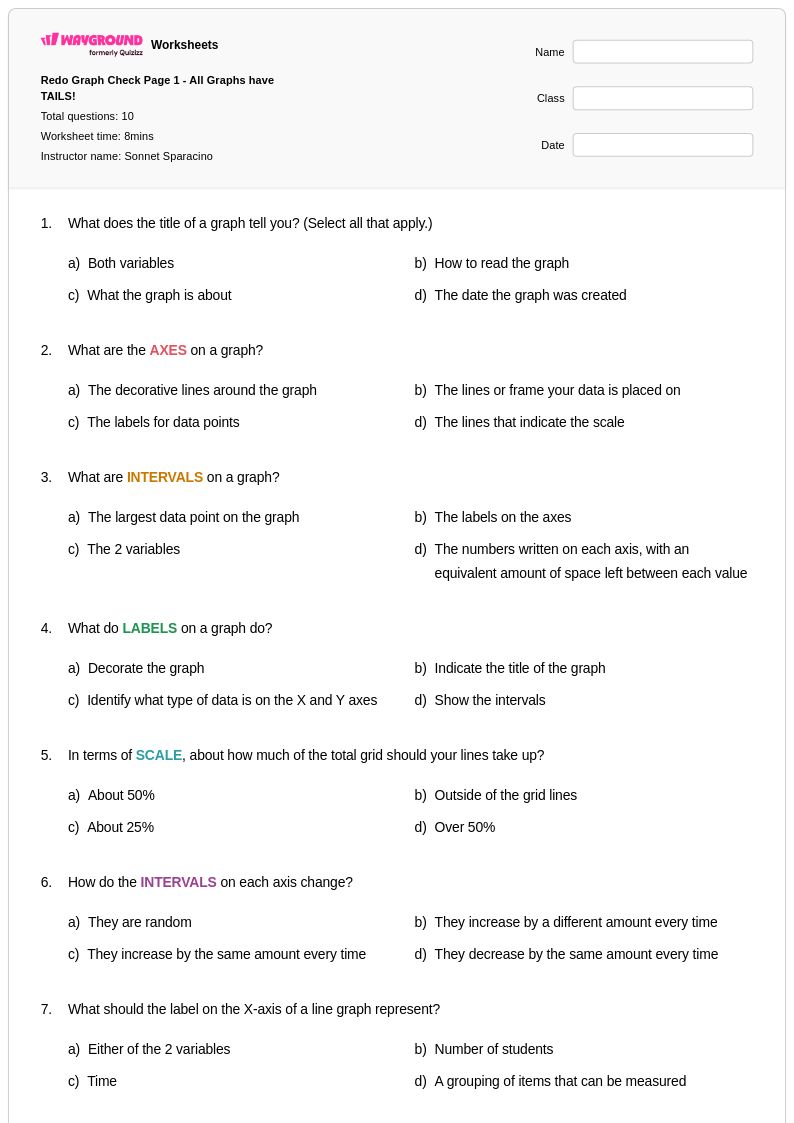
Start by teaching students to identify and label all graph components: axes, units, scale, and title. Then guide students through extracting specific values by reading coordinates, calculating slope as a rate of change, and identifying patterns such as linear, curved, or flat regions. Worked examples using position-time and velocity-time graphs are especially effective because they connect abstract motion concepts to visible trends students can reason through step by step.
What types of graphs do students need to master in physics?
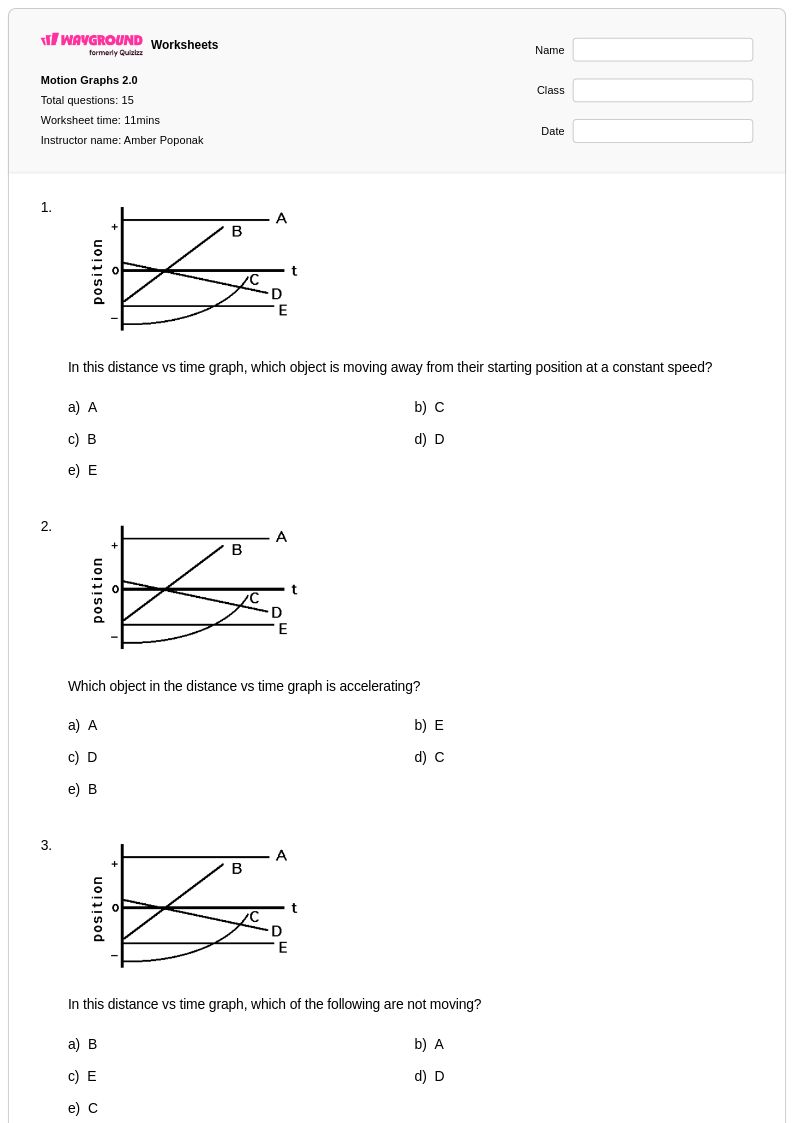
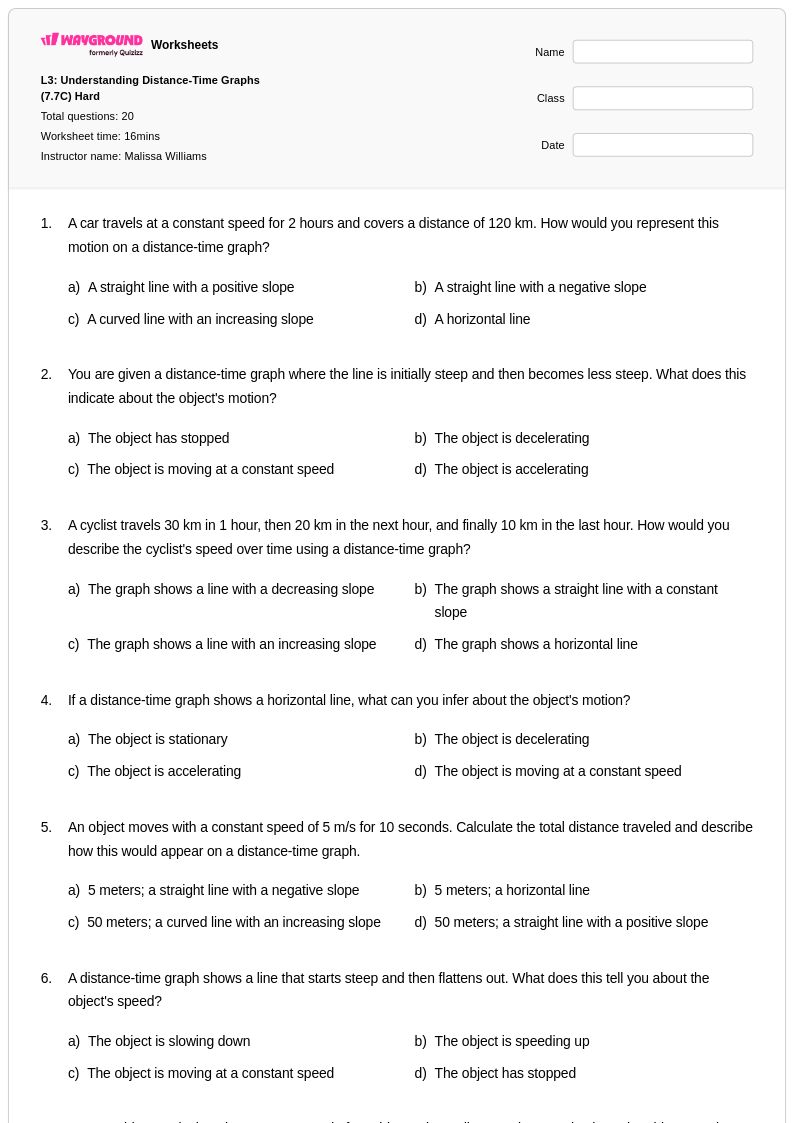
Physics students need to work fluently with position-time graphs, velocity-time graphs, acceleration-time diagrams, and force versus displacement plots. Each graph type encodes different physical relationships, so students must learn not only how to read values but also how to interpret slope and area under the curve as meaningful physical quantities. Building familiarity across all four types ensures students can navigate graphical data in mechanics, waves, and other core physics domains.
What practice exercises help students get better at analyzing physics graphs?
Effective practice exercises include reading specific coordinate values, calculating slope between two points, sketching a matching graph from a written description of motion, and translating between a graph and its corresponding equation. Multi-step problems that ask students to connect two graph types, such as deriving a velocity-time graph from a position-time graph, build the deeper analytical skills assessed on physics exams. Varied problem formats prevent rote memorization and push students toward genuine understanding.
What mistakes do students commonly make when interpreting physics graphs?
The most persistent misconception is treating the shape of a graph as a literal picture of motion, for example assuming a curved position-time graph means the object moved in a curved path. Students also frequently confuse slope with the value of a point, misread scales when intervals are not labeled on every gridline, and ignore units when calculating rates. Explicitly addressing these errors before independent practice significantly reduces persistent misunderstandings.
How can I use Wayground's graphs worksheets in my classroom?
Wayground's physics graphs worksheets are available as printable PDFs for traditional classroom use and in digital formats for technology-integrated learning environments, giving teachers flexibility across instructional settings. Teachers can assign them as direct instruction support, independent practice, homework, or review, and can host any worksheet as a live quiz on Wayground for real-time student participation. Complete answer keys are included with every worksheet, making formative assessment and self-correction straightforward without additional preparation time.
How do I differentiate physics graph instruction for students at different skill levels?
For struggling learners, begin with single-variable graphs that have clearly labeled scales and guide students through a structured reading protocol before introducing calculation tasks. Advanced students benefit from open-ended problems that require them to construct graphs from raw data, identify anomalies, or compare two graph types representing the same physical event. On Wayground, teachers can apply individual accommodations such as read aloud, reduced answer choices, and extended time to specific students, ensuring each learner engages with graphical content at an appropriate level of challenge.