Free Printable Particle Motion in Two Dimensions Worksheets for Class 6
Explore Wayground's free Class 6 particle motion in two dimensions worksheets with printable PDFs, practice problems, and answer keys to help students master physics concepts involving objects moving in multiple directions.
Explore printable Particle Motion in Two Dimensions worksheets for Class 6
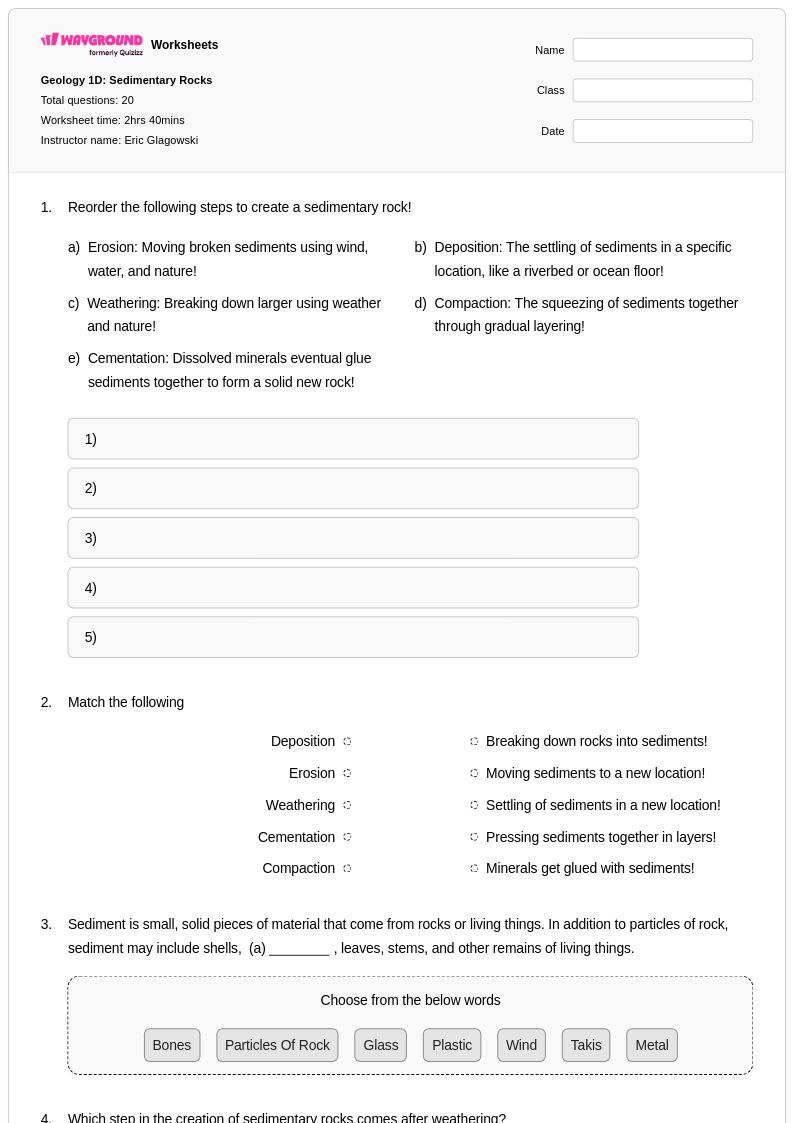
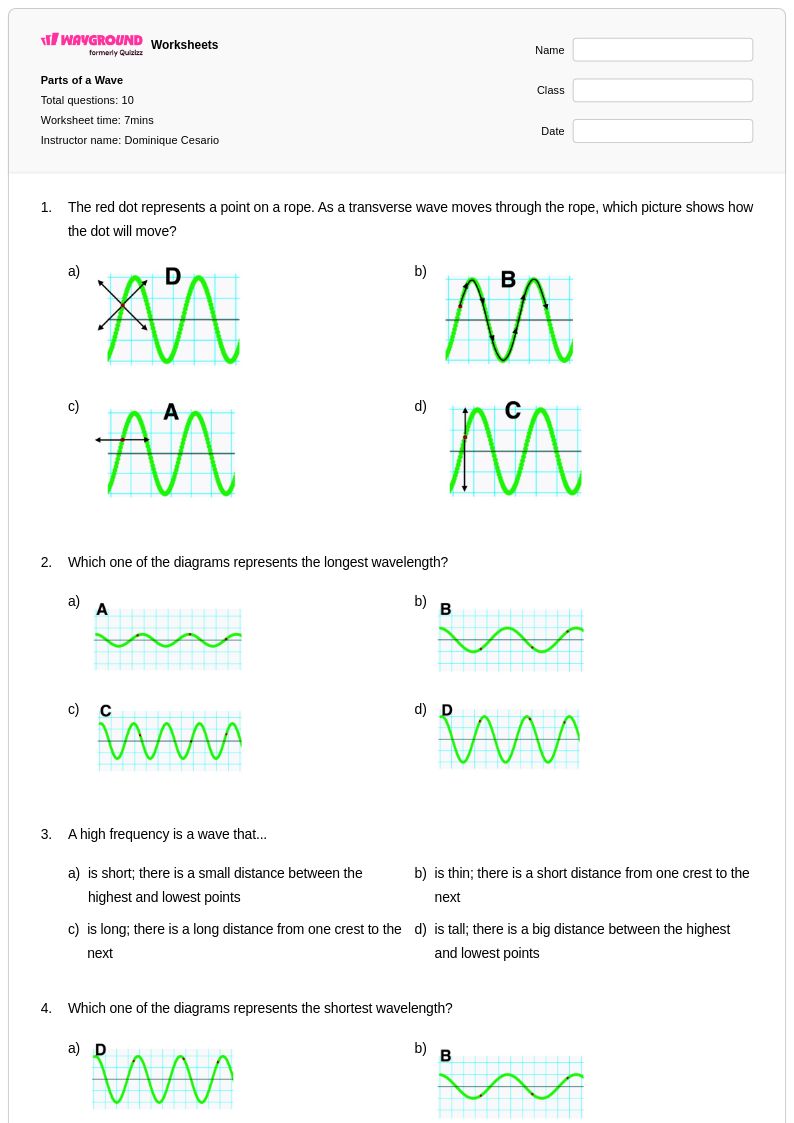
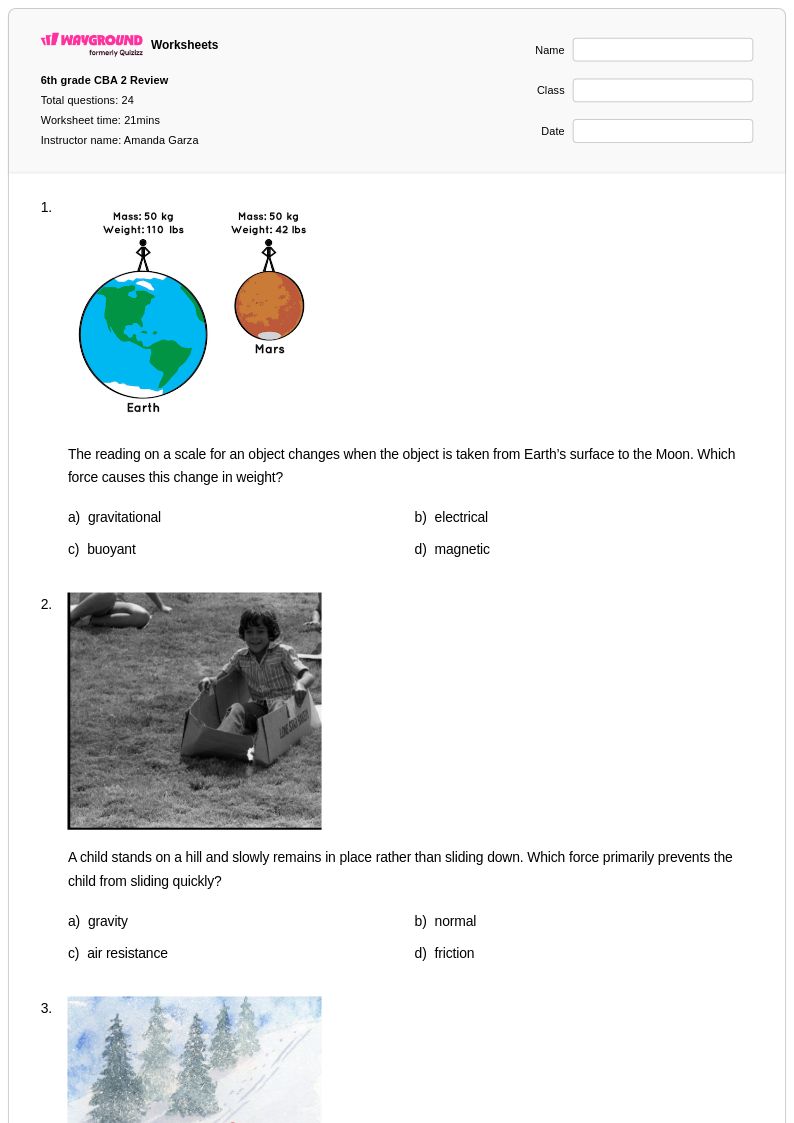
Particle motion in two dimensions represents a fundamental concept in Class 6 physics that challenges students to understand how objects move through space along multiple axes simultaneously. Wayground's comprehensive collection of particle motion in two dimensions worksheets provides educators with expertly crafted resources that guide students through the complexities of analyzing motion that occurs in both horizontal and vertical directions. These worksheets strengthen essential skills including vector analysis, coordinate system interpretation, trajectory prediction, and the application of kinematic principles to real-world scenarios such as projectile motion and orbital mechanics. Each worksheet collection includes detailed answer keys and is available as free printables in pdf format, ensuring teachers have immediate access to practice problems that progressively build student understanding of how velocity, acceleration, and displacement interact in two-dimensional space.
Wayground's extensive library, featuring millions of teacher-created resources, empowers educators to effectively teach particle motion in two dimensions through robust search and filtering capabilities that align with physics standards and curriculum requirements. The platform's differentiation tools allow teachers to customize worksheets based on individual student needs, while flexible formatting options provide both printable and digital pdf versions to accommodate diverse classroom environments. These features streamline lesson planning by offering immediate access to targeted practice materials, support remediation efforts for students struggling with vector concepts, and provide enrichment opportunities for advanced learners ready to explore complex motion scenarios. Teachers can confidently rely on this comprehensive resource collection to deliver systematic skill practice that helps students master the mathematical and conceptual foundations necessary for understanding how particles move through two-dimensional space.
FAQs
How do I teach particle motion in two dimensions to physics students?
Start by ensuring students have a solid grasp of one-dimensional kinematics before introducing vector decomposition, since two-dimensional motion is built on resolving horizontal and vertical components independently. Use real-world contexts like projectile launches, satellite orbits, and circular motion to make abstract vector relationships concrete. Gradually increase complexity by introducing relative velocity and multiple reference frames only after students can confidently handle basic trajectory calculations.
What practice problems best help students master two-dimensional motion?
Effective practice should span a range of problem types, from decomposing velocity vectors into components to analyzing full projectile trajectories with given launch angles and speeds. Students also benefit from problems involving relative velocity between two moving objects and circular motion dynamics, which reinforce how the same vector principles apply across different physical scenarios. Sequenced problem sets that begin with conceptual questions and build toward multi-step calculations are particularly effective for developing durable understanding.
What mistakes do students commonly make when solving two-dimensional motion problems?
The most frequent error is treating horizontal and vertical motion as dependent rather than independent, causing students to mix up velocity components or incorrectly apply vertical acceleration to horizontal calculations. Students also frequently forget that horizontal velocity remains constant in projectile motion while only vertical velocity changes due to gravity. A third common misconception is failing to correctly decompose an initial velocity vector using trigonometry before setting up equations, which cascades into errors throughout the entire problem.
How do I differentiate particle motion worksheets for students at different skill levels?
For struggling students, begin with scaffolded problems that provide the vector diagram or decomposed components, so they can focus on applying kinematic equations rather than the decomposition step itself. Advanced learners benefit from open-ended scenarios involving multiple reference frames or non-standard launch conditions that require them to build their own problem-solving framework. On Wayground, teachers can also apply accommodations such as read aloud support and reduced answer choices for individual students, helping those who need additional accessibility support engage with the same rigorous content.
How can I use Wayground's particle motion in two dimensions worksheets in my classroom?
Wayground's particle motion in two dimensions worksheets are available as printable PDFs for traditional classroom use and in digital formats for technology-integrated instruction, making them flexible across different teaching environments. Teachers can assign them as individual practice assessments, use them for collaborative problem-solving sessions, or host them as a quiz directly on the Wayground platform. Each worksheet includes a complete answer key, so students can self-assess independently or teachers can use them for efficient grading.
How does projectile motion fit within the broader topic of particle motion in two dimensions?
Projectile motion is one of the most foundational applications of two-dimensional kinematics, serving as the entry point for understanding how horizontal and vertical motion components interact under the influence of gravity. Mastering projectile motion builds the vector reasoning skills students need for more advanced topics like relative velocity, circular motion, and eventually orbital mechanics. It is typically introduced early in a two-dimensional motion unit precisely because it isolates the key conceptual challenge of treating perpendicular motion components independently.