
 Worksheets
AP Bio Fall exam
Total questions: 109
Worksheet time: 1hrs 4mins
Name
Class
Date
1.
2 energy rich molecules created by Light Dependent Reactions of Photosynthesis are:
a)
ATP and ADP
b)
ATP and NADPH
c)
ADP and FADH
d)
ADP and NADP
2.
Where does Photosystem II get its electrons?
a)
photosystem I
b)
splitting of water
c)
ATP
d)
NADPH
3.
During chemiosmosis
a)
Carbon is fixed.
b)
ATP is synthesized from ADP
c)
NADPH is synthesized from NADP+
d)
Electrons are removed from chlorophyll molecules.
4.
Where do the light-dependent reactions occur?
a)
thylakoid membrane
b)
stroma
c)
lumen
d)
mitochondria
5.
compounds with NH3; acts as a base
a)
carbonyl
b)
slfhydryl
c)
amino
d)
phosphate
6.
The monomer of a nucleic acid is
a)
Monosaccharide
b)
Amino Acid
c)
Nucleotide
d)
Triglyceride (3 Fatty Acids and 1 Glycerol)
7.
What are the carbohydrates in the cell membrane for?
a)
to form channels and pumps
b)
to help cells identify one another
c)
to make the membrane strong
8.
C double bonded to O and single bonded to OH group; acts as acids
a)
hydroxyl
b)
carbonyl
c)
carboxyl
d)
phosphate
9.

What type of transport is shown in the picture?
a)
Osmosis
b)
Diffusion
c)
Endocytosis
d)
Exocytosis
10.

The cell below is in a _________ solution.
a)
Hypotonic
b)
Hypertonic
c)
Isotonic
11.

What type of transport is shown in the picture?
a)
Osmosis
b)
Diffusion
c)
Endocytosis
d)
Exocytosis
12.
If a molecule passes through a protein, but goes down a gradient, it is called
a)
active transport
b)
endocytosis
c)
facilitated diffusion
d)
exocytosis
13.
How many ATP molecules are created by fermentation?
a)
0
b)
2
c)
12
d)
36
14.
What are the reactants for cellular respiration?
a)
oxygen and lactic acid
b)
water and glucose
c)
carbon dioxide and water
d)
glucose and oxygen
16.
Which reactant is used as the final electron acceptor in cellular respiration?
a)
water
b)
carbon dioxide
c)
oxygen
d)
glucose
16.
Which reactant is used as the final electron acceptor in cellular respiration?
a)
water
b)
carbon dioxide
c)
oxygen
d)
glucose
17.
Lipids are made up of which of the following?
a)
glycerol and fatty acids
b)
glycerol and monolipids
c)
fatty acids and phosolipids
d)
amino acids and nucleotides
18.

Identify the functional group:
a)
steroid
b)
phosphate
c)
carbonyl
d)
carboxyl
19.

Which macromolecule is shown?
a)
phospholipid
b)
protein
c)
steroid
d)
glucose (carbohydrate)
20.
A sugar, a phosphate group, and a nitrogen base form the building blocks of which organic compound?
a)
carbohydrates
b)
nucleic acids
c)
lipids
d)
proteins
21.
Microtubles make up all of the following structures except ____.
a)
cilia
b)
centrioles
c)
flagella
d)
mitchondria
22.
Which of these is NOT a cell junction?
a)
Plasmodesmata
b)
desmosome
c)
tight junction
d)
proteoglycan
23.
ATP synthesis
a)
chloroplast
b)
mitochondria
c)
lysosome
d)
ribosome
24.
All of the following are important characteristics of water in biology EXCEPT which?
a)
cohesion provides surface tension
b)
it is a nonpolar solvent
c)
it is a medium for complex chemical reactions in organisms
d)
it has a high specific heat that stabilizes ambient temperature
25.

Which letter represents the activation energy of a non-catalyzed reaction?
a)
a
b)
b
c)
c
d)
d
26.
Catabolism is the net ____ of energy and Anabolism is the net ____ of energy
a)
output;input
b)
input;output
c)
output;output
d)
input;input
27.
Which of the following is the process used to bond the monomers together?
a)
Hydrolysis
b)
Water Removal
c)
Dehydration Synthesis
d)
Water Synthesis
28.
A liquid with a pH of 4 is _x more concentrated in H+ than a liquid with a pH of 6.
a)
10
b)
100
c)
1,000
d)
10,000
29.
Which of the following is correct about water?
a)
it is a polar molecule and contains polar bonds
b)
it is a polar molecule and contains non-polar bonds
c)
it is a non-polar molecule and contains polar bonds
d)
it is a non-polar molecule and contains non-polar bonds
30.
Which are enzymes?
a)
simple carbohydrates
b)
proteins that speed up chemical reactions
c)
lipids that make up the cell membrane
d)
a building block of DNA
31.
Which macromolecule stores energy, insulates us, and makes up the cell membrane?
a)
lipids
b)
proteins
c)
carbohydrates
d)
nucleic acids
32.
Which organelle is the site of protein synthesis?
a)
Ribosome
b)
Lysosome
c)
Vacuole
d)
Mitochondrion
33.
What is the name for the diffusion of water across a selectively permeable membrane?
a)
Facilitated diffusion
b)
Hydro-diffusion
c)
Endocytosis
d)
Osmosis
34.
This type of process requires oxygen.
a)
Aerobic
b)
Anaerobic
c)
Cell transport
d)
None of the above
35.
All living things are organized. What is the correct order smallest to largest in multicellular organisms
a)
tissues, organs, organisms, cells
b)
Cells, Tissues, Organs, Systems, Organisms
c)
Sytems, Cells, Organs, Tissues
36.
Two structures found in plant cells that are not found in animal cells
a)
cytoplasm, cell wall
b)
cytoplasm, cell membrane
c)
chloroplast, cell membrane
d)
chloroplast, cell wall
37.
Keeping your internal body temperature the same is called
a)
excretion
b)
homeostasis
c)
respiration
d)
metabolism
38.
What part of cellular respiration is the most efficient?
a)
Kreb's cycle
b)
ETC
c)
Glycolysis
d)
fermentation
39.
The macromolecule that provides short term energy and glucose is an example.
a)
carbohydrate
b)
lipid
c)
protein
d)
nucleic acid
40.

The part of the neuron that conducts action potentials is the:
a)
Axon
b)
Dendrite
c)
Axon Terminal
d)
Cell Body
41.

The part of the neuron that receives signals is the:
a)
Axon
b)
Dendrite
c)
Axon Terminal
d)
Cell Body
42.

Heartbeat would be accomplished by which branch of the nervous system?
a)
Sensory
b)
Autonomic
c)
Motor
d)
Pineal
43.
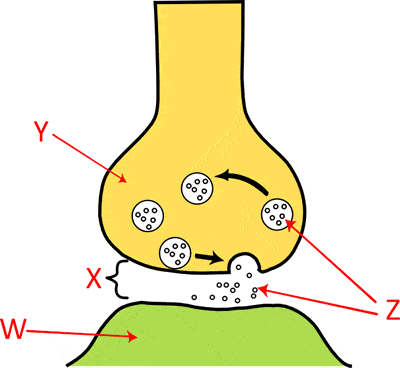
W
a)
Axon Terminal Button
b)
Neurotransmitters
c)
Dendrite
d)
Synapse
44.

Y
a)
Axon
b)
Neurotransmitters
c)
Dendrite
d)
Synapse
45.

Z
a)
Dendrite
b)
Axon Terminal
c)
Neurotransmitters
d)
Synapse
46.
Which system controls body movements?
a)
Autonomic Nervous System
b)
Central Nervous System
c)
Peripheral Nervous System
d)
Somatic Nervous System
47.
Which is the correct nerve pathway?
a)
dendrite > axon > cell body > synapse > dendrite
b)
dendrite > cell body > axon > synapse > dendrite
c)
axon > cell body > dendrite > synapse > axon
d)
axon > cell body > dendrite > synapse > axon
48.
1. Each of the following numbered processes are involved in signal transduction pathways:
I. Response
II. Amplification
III. Reception
IV. Transduction
Which of the following represents the sequence of events in a typical signal transduction pathway?
I. Response
II. Amplification
III. Reception
IV. Transduction
Which of the following represents the sequence of events in a typical signal transduction pathway?
a)
I, II, III, IV
b)
III, I, IV, II
c)
II, IV, I, III
d)
III, IV, II, I
49.

G proteins are a family of proteins involved in transmitting chemical signals originating from outside a cell into the inside of the cell. G proteins function as molecular switches.
Which of the following best describes the role in which the G protein is most intimately involved in the process shown above?
Which of the following best describes the role in which the G protein is most intimately involved in the process shown above?
a)
Production of the ligand molecule.
b)
Reception of the signal.
c)
Transduction of the signal.
d)
Production of response to signal.
50.
Which of the following can activate a protein by transferring a phosphate group to it?
a)
cAMP
b)
G Protein
c)
protein kinase
d)
protein phosphatase
51.
What do second messengers do?
a)
transport a signal through the lipid bilayer
b)
relay a signal from the outside to the inside of the cell
c)
relay message from the inside of the mebrane throughout the cytoplasm
d)
dampen the message
52.
Which of the following is an example of a second messenger?
a)
cAMP
b)
GTP
c)
insulin
d)
epinephrine
53.
Signal amplification is most often achieved by
a)
an enzyme cascade
b)
binding of multiple signals
c)
branching pathways
d)
action of adenylyl cyclase
54.
Organisms reproduce asexually by budding, ____________, and binary fission.
a)
replication
b)
mutation
c)
cytokinesis
d)
regeneration
55.
The phase in the cell cycle in which the chromosomes line up across the center of the cell.
a)
metaphase
b)
cytokinesis
c)
prophase
d)
interphase
56.
The step in the cell cycle following mitosis, in which the cytoplasm divides.
a)
cytokinesis
b)
telophase
c)
prophase
d)
metaphase
57.
The process of mitosis results in two genetically _________ daughter cells.
a)
engineered
b)
different
c)
mutated
d)
identical
58.
During this time the cell grows and makes copies of its organelles and DNA.
a)
interphase
b)
anaphase
c)
telophase
d)
metaphase
59.
if a cell has 24 chromosomes at the beginning of meiosis how many chromosomes will it have at the end of meiosis?
a)
6
b)
12
c)
24
d)
the number varies with the species.
60.
if a cell has 24 chromosomes how many will it have at the end of mitosis
a)
6
b)
12
c)
24
d)
48
61.
What is another reason we need meiosis?
a)
So the offspring has genes from both parents
b)
So the offspring has genes from one parent
c)
So the offspring has genes from neither parents
d)
So the offspring makes its own genes
62.
In a prokaryotic cell, what replaces the nucleus?
a)
Deoxyribonucleic acid
b)
Nucleoid region
c)
Nuclear envelope
d)
Chromatin
63.
Which type of cell has membrane bound organelles?
a)
Prokaryotic
b)
Eukaryotic
c)
Bacteria
d)
Archaeabacteria
64.
The result of meiosis is:
a)
two diploid cells
b)
two haploid cells
c)
four diploid cells
d)
four haploid cells
65.
What are two parts of the innate immune system?
a)
barriers and phagocytes
b)
B-cells and mast cells
c)
antibodies and phagocytes
d)
T cells and B cells
66.
These cells are responsible for making antibodies
a)
Plasma cells and memory cells
b)
Killer T Cells
c)
Helper T Cells
d)
Macrophages
67.
Enzyme in saliva and tears that kills certain kinds of bacteria. (new)
a)
histamine
b)
lysozyme
c)
cytokines
d)
basophil
68.
Disease-causing microorganism, such as a bacterium or virus.
a)
pathogen
b)
allergen
c)
toxin
d)
antigen
69.
A substance or part of a substance (living or nonliving) that the immune system recognizes as foreign and activates the immune system and reacts with immune cells or their products, such as antibodies.
a)
pathogen
b)
allergen
c)
antigen
d)
antibody
70.
What initiates an immune response?
a)
antibody
b)
antigen
c)
histamine
d)
antibiotic
71.
Antigens prepared in such a way that when injected or taken orally they induce active immunity without causing disease.
a)
antigen
b)
spleen
c)
B cell
d)
vaccine
72.
Types of lymphocytes
a)
B cells, Cytotoxic T cells, Helper T cells
b)
Macrophages and Neutrophils
c)
erythrocytes and leukocytes
d)
erythrocytes and B cells
73.
What function does mucus play in the immune system?
a)
traps foreign particles from entering the body
b)
moistens food
c)
produces WBCs
d)
acts as a lubricant
74.
_____ are the major organs of the endocrine system?
a)
Blood
b)
Hormones
c)
Glands
75.
Endocrine glands secrete dive off chemical messenger called _____.
a)
Hormones
b)
Glands
c)
None of the above
76.
Usually triggered when you're scared by something in your enviornment?
a)
Pancreas
b)
Adrenal glands
77.
Is it true the Adrenal Glands helps your body prepare for the "Fight or Flight" reflex?
a)
True
b)
False
78.
What produces the hormones insulin?
a)
Liver
b)
Ovary
c)
Pancreas
d)
Hormones
79.
What produces male hormones?
a)
Ovaries
b)
Sperm
c)
Testis
d)
None of the above
80.
Where is the the Pituitary gland located?
a)
Stomach
b)
Throat
c)
Not this one
d)
Brain
81.
Which plant hormone is a gas?
a)
auxin
b)
gibberellin
c)
ethylene
d)
cytokinin
82.
Which plant hormone is heavily involved in cell division and metabolism?
a)
auxin
b)
cytokinin
c)
gibberellin
d)
ethylene
83.
Which hormone promotes seed germination?
a)
abscisic acid
b)
ethylene
c)
gibberellin
d)
auxin
84.
Oxytocin
a)
Hypothalamus
b)
Anterior Pituitary
c)
Adrenal
d)
Thyroid
85.
what dose malatonin help regulate?
a)
blood pressure
b)
back pain
c)
female production
d)
sleep cycles
86.
what hormone is secreted from the ovaries ?
a)
estrogen
b)
testrone
c)
eggstrone
d)
estroganie
87.
What is glucagon's major role in the body?
a)
to raise blood sugar
b)
to lower blood sugar
c)
to receive signals from the pituitary
88.
The metabolic rate is controlled by which hormone?
a)
thyroid stimulating hormone
b)
prolactin
c)
growth hormone
d)
adrenocorticortitropic hormone
89.

The pancreas produces _____ when your blood sugar level is high.
a)
GH
b)
ADH
c)
Glucagon
d)
Insulin
90.
When glucose levels in the blood rise, your brain sends a signal to your pancreas. The pancreas releases insulin, which opens channels in cell membranes to allow glucose to enter the cell, lowering blood sugar levels.
a)
Positive Feedback Response
b)
Negative Feedback Loop
91.
increase reabsorption of water by kidney
a)
ACTH
b)
ADH
c)
PTH
d)
glucagon
92.
Controls the thyroid gland
a)
TSH
b)
T3
c)
T4
d)
Thyroxine
93.
Causes milk production
a)
oxytocin
b)
progesterone
c)
prolactin
d)
LH
94.

Prokaryotes (bacteria) reproduce asexually via -
a)
spore formation
b)
bud creation
c)
vegetative propagation
d)
binary fission
95.
The uncontrolled division of cells...
a)
meiosis
b)
cancer
c)
nondisjunction
d)
crossing over
96.
As a cell increases in size, the surface area to volume ratio _________________.
a)
increases
b)
decreases
c)
stays the same
97.
When an animal cell goes through cytokinesis,__________
a)
a cell plate forms dividing the 2 new nuclei.
b)
the cell membrane pinches off the 2 new cells.
c)
4 new cells are formed.
d)
None of the above
98.

Substage of Interphase in which the cell copies its DNA in preparation for cell division
a)
G1
b)
Synthesis
c)
G2
d)
Interphase
99.
Cyclins bind to CDK's during interphase and mitosis.
a)
True
b)
False
100.
Definition of oogenisis
a)
the production or development of an ovum
b)
he production or development of mature spermatozoa
c)
the process in which cells undergo meiosis to form gametes
101.
"Programmed cell death."
a)
diffusion
b)
cancer
c)
apoptosis
d)
meiosis
102.
Which is a very important check point in the regulation of the cell cycle.
a)
anaphase to telophase
b)
S to G2
c)
G2 to Mitosis
103.
"A diploid cell resulting from the fusion of two haploid gametes."
a)
tumor
b)
zygote
c)
ovum
d)
sperm
104.
Which of the following binds to the active site of an enzyme?
a)
substrate
b)
product
c)
codon
d)
none of the above
105.
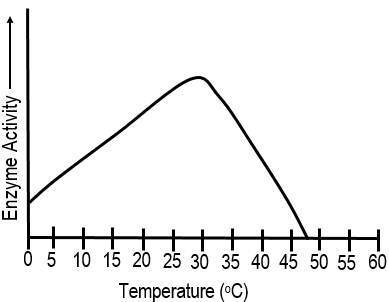
Based on the graph, what temperature does this enzyme work best?
a)
15 C
b)
40 C
c)
30 C
106.
What happens when enzymes are heated to a high temperature?
a)
The enzymes die.
b)
The shapes of the enzyme are altered or denatured
c)
The enzymes' amino acid sequence changes.
d)
The enzymes remain the same
107.

Most enzymes have the ending:
a)
-ase
b)
-ose
c)
-ic acid
d)
-ate
108.

Is this reaction endergonic or exergonic?
a)
Exergonic
b)
Endergonic
109.

Is this reaction endergonic or exergonic?
a)
Exergonic
b)
Endergonic
100 %

