
 Worksheets
Ch 2 Study Guide
Total questions: 66
Worksheet time: 43mins
Name
Class
Date
1.
What is the arrow in a chemical equation...
H2 + O --> H2O
H2 + O --> H2O
a)
Reactants
b)
Products
c)
Yields
d)
Chemical Equation
2.
The substances at the beginning of a chemical equation are called the ____
a)
product
b)
yield
c)
chemical symbol
d)
reactants
3.
What does the Law of Conservation of Mass state?
a)
Matter cannot be gained or lost in a chemical reaction.
b)
Matter can only be lost in a chemical reaction.
c)
Matter can only be gained in a chemical reaction.
d)
Matter can be gained and lost in a chemical reaction.
4.
Is this balanced?...
Fe + S --> FeS
Fe + S --> FeS
a)
YES!
b)
NO!
5.
Is this balanced?...
Al + O2 --> 2Al2O3
Al + O2 --> 2Al2O3
a)
Yes!
b)
NO!
6.
Balance this equation...
Sb2S3 + O2 --> Sb + SO2
Sb2S3 + O2 --> Sb + SO2
a)
It is balanced
b)
Sb2S3 + 3O2 --> 2Sb + 3SO2
c)
Sb2S3 + O2 --> 2Sb + SO2
d)
I don't know...Oh well!
7.
Name this reaction: Cl2 + 2KI --> I2 + 2KCl
a)
Synthesis
b)
Single Replacement
c)
Double Replacement
d)
Decomposition
8.
Name this reaction: CO2 + H2O --> H2CO3
a)
Decomposition
b)
Single Replacement
c)
Synthesis
d)
Combustion
9.
How many atoms of carbon (C) are in C6H12O6?
a)
3
b)
6
c)
12
d)
24
10.
How many O's are in Al₂(SO₄)₃
a)
4
b)
12
c)
7
d)
24
11.
Number of H in 3(NH₄)₂CrO₄
a)
4
b)
2
c)
8
d)
24
12.

The red numbers in the image below represent ________
a)
subscripts
b)
coefficients
c)
I don't know, and don't want to try
d)
None of the answers are correct
13.

The blue numbers in the image below represent ________
a)
I don't know, and don't want to try
b)
coefficients
c)
subscripts
d)
none of the answers are correct
14.
In a chemical reaction, everything to the right of the arrow is called ______________.
a)
Products
b)
Yields
c)
Molecules
d)
Reactants
15.
In the equation, 2Mg + O2 --> 2MgO, which are the reactants?
a)
Mg and O
b)
MgO
c)
Mg and MgO
d)
O and MgO
16.
How many atoms of aluminum are on each side of the following equation: 4Al + 3O2 --> 2Al2 O3
a)
2
b)
6
c)
1
d)
4
17.
Is the following equation balanced or unbalanced?
Fe + S --> FeS
Fe + S --> FeS
a)
balanced
b)
unbalanced
18.
Which of the following is evidence of a chemical reaction?
a)
fizzing
b)
water changing to ice
c)
saltwater
d)
paper being cut in half
19.
How many elements are in C6H12O6?
a)
1
b)
2
c)
3
d)
4
20.
Balance this equation...
HgO --> 2Hg + O2
HgO --> 2Hg + O2
a)
It is balanced
b)
2HgO --> Hg + O2
c)
2HgO --> 2Hg + O2
21.
What coefficient should be used to make the following equation balanced?
N2+O2--> _NO
N2+O2--> _NO
a)
1
b)
2
c)
3
d)
4
22.
When balancing equations a ____ can be placed to the left of a formula of a substance to make the equations balanced
a)
charge
b)
subscript
c)
random number
d)
coefficient
23.
What is the little number after an element in a chemical equation called.
Example: H2
Example: H2
a)
Coefficient
b)
Subscript
c)
Atom
d)
Equation
24.
Balance this equation:
2Li + Cl2 -> LiCl
2Li + Cl2 -> LiCl
a)
2Li + Cl2 -> 4LiCl2
b)
2Li + Cl2 -> LiCl2
c)
2Li + Cl2 -> 2LiCl
25.
A __________ is when substances go through a chemical change to form a new substance.
a)
chemical reaction
b)
mixture
c)
phase change
d)
physical change
26.
A substance that increases speed of chemical reaction without being being changed is called:
a)
Catalyst
b)
Acid
c)
Base
d)
pressure
27.
Activation energy is required to start a chemical reaction. What is activation energy?
a)
The energy needed for a reaction to occur
b)
The minimum amount of energy needed for a reaction to potentially occur
c)
The energy added by a catalyst
d)
The energy possessed by the products
28.
Increase in temperature of the reactants can do one of the following
a)
Slow collision frequency
b)
Allow less effective collision between the particles
c)
Cause particles to lose speed
d)
Increase collision between the particles thus increasing the rate.
29.
The amount of a substance in a given volume.
a)
concentration
b)
temperature
c)
surface area
d)
catalyst
30.
Grinding an alka-seltzer tablet into powder increases the rate of reaction due to increased
a)
concentration
b)
surface area
c)
temperature
d)
reactants
31.
Increasing the concentration increases the speed of reaction by
a)
lowering activation energy
b)
increasing collisions
c)
speeding up the reactants
d)
exposing more reactant
32.
Which factors increase the rate of a reaction.
a)
increasing temperature
b)
increasing concentration
c)
increasing surface area
d)
all of these
33.
Which of the following slows down the rate of a chemical reaction?
a)
Place the reactants in hot water
b)
Place the products in ice bath
c)
Place the reactants in a ice bath
d)
Keep stirring the reactants with a stirring rod
34.
Rate of chemical reaction means
a)
amount of product formed
b)
speed of reaction
c)
concentration of reacting particles
d)
combining reactants with products
35.
To show how surface area affects rate of reaction you will use one of the following methods.
a)
Add catalyst
b)
Increase the temperature
c)
Decrease the pressure of reactants
d)
Finely divide the reacting substances
36.
Reactions that give out heat to the surrounding are classified as one of the following:
a)
Spontaneous
b)
Sluggish
c)
Exothermic
d)
Endothermic
37.
One of the signs of a chemical reaction taking place is:
a)
Bubbles are produced in the reacting vessel
b)
Reactants are not combining
c)
Products are not forming
d)
Colour is not changing
38.
A solution is heated and bubbles form. Do you assume a chemical reaction took place?
a)
Yes
b)
No
39.
You observe bubbles after adding metal to a solution. Do you assume a chemical reaction took place?
a)
Yes
b)
No
40.
Two clear and colorless solutions are combined within a test tube. The result is very cloudy. Do you assume a chemical reaction took place?
a)
Yes
b)
No
41.
Two clear and colorless solutions are combined within a test tube. The resulting solution is purple. Do you assume a chemical reaction took place?
a)
Yes
b)
No
42.
Metal is added to a solution in a test tube. The test tube now feels cooler. Do you assume a chemical reaction took place?
a)
Yes
b)
No
43.
A beaker containing a solution is heated. The beaker now feels warm. Do you assume a chemical reaction took place?
a)
Yes
b)
No
44.
What type of reaction is this?
a)
Endothermic
b)
Exothermic
45.
What type of reaction occurs in a hand warmer
a)
Exothermic
b)
Endothermic
46.
What is the purpose of an enzyme?
a)
give permission for the reaction
b)
raise activation energy
c)
speed up reactions
d)
control how many reactions occur
47.
How do enzymes speed up chemical reaction?
a)
Increasing activation energy
b)
Decreasing activation energy
c)
Increasing deactivation energy
d)
Decreasing deactivation energy
48.
Reactions that absorb energy are called-
a)
endothermic
b)
exothermic
c)
mesothermic
d)
activation
49.
Reactions that release energy are called-
a)
activation
b)
endothermic
c)
mesothermic
d)
exothermic
50.

This chart shows what type of reaction?
a)
endothermic
b)
mesothermic
c)
exothermic
d)
hotothermic
51.
This speeds up chemical reactions in living cells.
a)
activist
b)
enzyme
c)
diamine
d)
solute
52.
This slows down or even stops a chemical reaction.
a)
de-activator
b)
catalyst
c)
enzyme
d)
inhibitor
53.

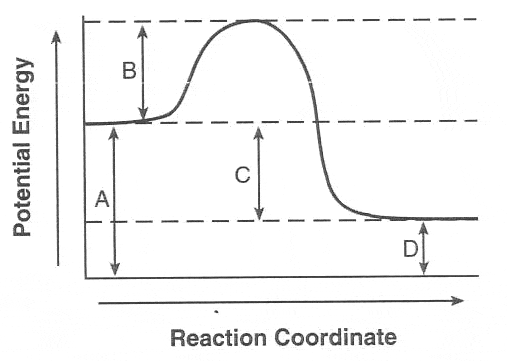
Which shows the activation energy required for this reaction?
a)
A
b)
B
c)
C
d)
D
54.
The activation energy required for a reaction with an inhibitor is __________ than the regular reaction
a)
higher
b)
lower
c)
neither
d)
both
55.
In an endothermic reaction, the initial energy is _______________ the final energy after the reaction
a)
lower than
b)
higher than
c)
the same as
56.
To measure the speed of a reaction you will use one of the following equipment.
a)
Petri dish
b)
Stop watch
c)
stirring rod
d)
Universal indicator
57.
Another term for burning is
a)
Fire triangle
b)
Magnesium oxide
c)
Combustion
d)
Bustion
58.
8.7: Combustion is when a __________ reacts with oxygen
a)
petrol
b)
fuel
c)
fire triangle
d)
carbon dioxide
59.
Which of these isn't in the fire triangle?
a)
Fuel
b)
Heat
c)
Oxygen
d)
Carbon dioxide
60.
What part of the fire triangle do you remove by spraying water onto a fire?
a)
Heat
b)
Oxygen
c)
Fuel
61.
How often should I test my smoke detector?
a)
Once a year
b)
Every six months
c)
Once a month
d)
Once every two years
62.
When it comes to a kitchen grease fire what should you NOT use to extinguish it
a)
Pan lid
b)
Baking soda
c)
Class K extinguisher
d)
Water
63.
When putting out a fire you are to move ___________?
a)
Backward away from fire
b)
Forward as you are putting out the fire
c)
Around the fire
d)
To the right
64.
When using the fire extinguisher you are to start at the ____________ of the fire?
a)
Top and work down
b)
To the left
c)
To the right
d)
Base
65.
What are the three parts of The Fire Triangle?
a)
fuel, nitrogen, and heat
b)
heat, coal, and water
c)
combustion, fuel, and coal
d)
fuel, oxygen, and heat
66.
What does activation energy have to do with chemical reactions?
a)
The mass of the reactants and products is the activation energy
b)
All chemical reactions need some activation energy to begin
c)
Activation energy is the energy after the reaction has occurred
d)
Activation energy has nothing to do with chemical reactions
100 %

