
 Worksheets
Muscle Physiology Test Review
Total questions: 89
Worksheet time: 43mins
Name
Class
Date
1.
What organs make up the muscular system
a)
Muscles
b)
Nerves
c)
Tendons
d)
Ligaments
2.
The primary function of the muscular system is to?
a)
Move the body
b)
Communicate with the body
c)
Digest nutrients
d)
Reproduce
3.

Which muscle tissues are striated?
a)
Cardiac
b)
Skeletal
c)
Smooth
d)
Cardiac and Skeletal
4.
Which muscle tissues are not striated?
a)
Cardiac
b)
Skeletal
c)
Smooth
d)
Cardiac and Skeletal
5.
Which muscle tissue has a squamous shape?
a)
Cardiac
b)
Skeletal
c)
Smooth
d)
Cardiac and Skeletal
6.
Which muscle tissue has a branching shape?
a)
Cardiac
b)
Skeletal
c)
Smooth
d)
Cardiac and Skeletal
7.
Which muscle tissue has a rod-like shape?
a)
Cardiac
b)
Skeletal
c)
Smooth
d)
Cardiac and Skeletal
8.
Which muscle tissue has 1 nuclei per cell?
a)
Cardiac
b)
Skeletal
c)
Smooth
d)
Cardiac and smooth
9.
Which muscle tissue has many nuclei per cell?
a)
Cardiac
b)
Skeletal
c)
Smooth
d)
Cardiac and smooth
10.
Which muscle tissue contracts involuntarily
a)
Cardiac
b)
Skeletal
c)
Smooth
d)
Cardiac and smooth
11.
Which muscle tissue moves blood
a)
Cardiac
b)
Skeletal
c)
Smooth
d)
none of these
12.
Which muscle tissue moves food
a)
Cardiac
b)
Skeletal
c)
Smooth
d)
none of these
13.
Which muscle tissue moves bones (the body)
a)
Cardiac
b)
Skeletal
c)
Smooth
d)
none of these
14.

The connective tissue that covers all organs (including muscles) is called?
a)
Fascia
b)
Epimysium
c)
Perimysium
d)
Endomysium
15.

The connective tissue that is found just above the muscle is called?
a)
Fascia
b)
Epimysium
c)
Perimysium
d)
Endomysium
16.

The connective tissue that surrounds each fascicle is called?
a)
Fascia
b)
Epimysium
c)
Perimysium
d)
Endomysium
17.

The connective tissue that surrounds each muscle fiber is called?
a)
Fascia
b)
Epimysium
c)
Perimysium
d)
Endomysium
18.

Which of the following does not have a connective tissue covering?
a)
Muscle
b)
Fasicles
c)
Muscle Fibers
d)
Myofibrils
19.

A muscle is made up of many?
a)
Muscle Fibers
b)
Fasicles
c)
Myofibrils
d)
Cells
20.

A fascicle is made up of many?
a)
Muscle Fibers
b)
Fasicles
c)
Myofibrils
d)
Cells
21.

Muscle fibers contain organelles and many ________________.
a)
Muscle Fibers
b)
Fasicles
c)
Myofibrils
d)
Cells
22.

Myofibrils are made up of two types of proteins known as?
a)
Actin and Myosin
b)
Troponin and Tropomyosin
c)
Myoglobin and hemoglobin
d)
none of these
23.

A sheath like tendon that connects two muscles together is known as a
a)
Fascicle
b)
Perimysium
c)
Aponeurosis
d)
Myofibril
24.

A muscle fiber is
a)
A specialized cell that contracts.
b)
A specialized muscle that contracts.
c)
A specialized organelle that contracts.
d)
A specialized organ that contracts.
25.
What structure(s) is 1 pointing to?
a)
Nuclei
b)
Mitochondria
c)
Myofibrils
d)
Sarcomeres
26.
What structure(s) is 2 pointing to?
a)
Nuclei
b)
Mitochondria
c)
Myofibrils
d)
Sarcomeres
27.
What structure(s) is 3 pointing to?
a)
Sarcolemma
b)
Sarcoplasm
c)
Sarcomere
d)
Sarcoma
28.
What structure(s) is 4 pointing to?
a)
Sarcolemma
b)
Sarcoplasm
c)
Sarcomere
d)
Sarcoma
29.
What structure(s) is 5 pointing to?
a)
Nuclei
b)
Mitochondria
c)
Myofibrils
d)
Sarcomeres
30.
What structure(s) is 6 pointing to?
a)
T-Tubules
b)
Sarcoplasmic Reticulum
c)
Terminal Cisternae
d)
Triads
31.
What structure(s) is 7 pointing to?
a)
T-Tubules
b)
Sarcoplasmic Reticulum
c)
Terminal Cisternae
d)
Triads
32.
What structure(s) is 8 pointing to?
a)
T-Tubules
b)
Sarcoplasmic Reticulum
c)
Terminal Cisternae
d)
Triads
33.
What structure(s) is 9 pointing to?
a)
T-Tubules
b)
Sarcoplasmic Reticulum
c)
Terminal Cisternae
d)
Triads
34.
What structure(s) is 10 pointing to?
a)
Thin Filaments (Actin)
b)
Thick Filaments (Myosin)
c)
Troponin
d)
Tropomyosin
35.
What structure(s) is 11 pointing to?
a)
Thin Filaments (Actin)
b)
Thick Filaments (Myosin)
c)
Troponin
d)
Tropomyosin
36.
The function of structure(s) 1 is
a)
To store DNA
b)
To create ATP
c)
To contract
d)
To determine what goes in and out of the cell
37.
The function of structure(s) 2 is
a)
To store DNA
b)
To create ATP
c)
To contract
d)
To determine what goes in and out of the cell
38.
The function of structure(s) 3 is
a)
To store DNA
b)
To create ATP
c)
To contract
d)
To determine what goes in and out of the cell
39.
The function of structure(s) 4 is
a)
To store DNA
b)
To create ATP
c)
To contract
d)
Fluid of the cell; provides a medium for organelles to exist and communicate through
40.
The function of structure(s) 5 is
a)
To store DNA
b)
To create ATP
c)
To contract
d)
Fluid of the cell; provides a medium for organelles to exist and communicate through
41.
The function of structure(s) 6 is
a)
Store and release Calcium Ions (Ca2+)
b)
Deliver muscle impulse throughout entire muscle fiber
c)
provide binding sites and be moved during contraction
d)
attach and move a fiber during contraction
42.
The function of structure(s) 7 is
a)
Store and release Calcium Ions (Ca2+)
b)
Deliver muscle impulse throughout entire muscle fiber
c)
provide binding sites and be moved during contraction
d)
attach and move a fiber during contraction
43.
The function of structure(s) 10 is
a)
Store and release Calcium Ions (Ca2+)
b)
Deliver muscle impulse throughout entire muscle fiber
c)
provide binding sites and be moved during contraction
d)
attach and move a fiber during contraction
44.
The function of structure(s) 11 is
a)
Store and release Calcium Ions (Ca2+)
b)
Deliver muscle impulse throughout entire muscle fiber
c)
provide binding sites and be moved during contraction
d)
attach and move a fiber during contraction
45.
A sarcomere is
a)
A protein filament or fiber
b)
The basic contractile unit of muscle contraction
c)
An organelle
d)
An organ
46.
Sarcomeres are found on
a)
Fascicles
b)
Muscle Fibers
c)
Myofibrils
d)
Actin and Myosin Filaments
47.

The part of the sarcomere that A (green) refers to is the?
a)
Z Line
b)
M Line
c)
H Line
d)
A Line
48.
The part of the sarcomere that B (Orange) refers to is the?
a)
Z Line
b)
M Line
c)
H Line
d)
A Line
49.
The part of the sarcomere that C (Blue) refers to is the?
a)
Actin
b)
Myosin
c)
Troponin
d)
Tropomyosin
50.
The part of the sarcomere that D (Red) refers to is the?
a)
Actin
b)
Myosin
c)
Troponin
d)
Tropomyosin
51.

What zone/band of the sarcomere is represented by yellow.
a)
I Zone/Band
b)
A Zone/Band
c)
H Zone/Band
d)
M Zone/Band
52.
What zone/band of the sarcomere is represented by light brown.
a)
I Zone/Band
b)
A Zone/Band
c)
H Zone/Band
d)
M Zone/Band
53.
Which zone/band consists of Actin and the Z line?
a)
I Zone/Band
b)
A Zone/Band
c)
H Zone/Band
d)
M Zone/Band
54.
Which zone/band consists of Actin and Mysoin ?
a)
I Zone/Band
b)
A Zone/Band
c)
H Zone/Band
d)
M Zone/Band
55.
Which zone/band consists of Myosin and the M line?
a)
I Zone/Band
b)
A Zone/Band
c)
H Zone/Band
d)
M Zone/Band
56.
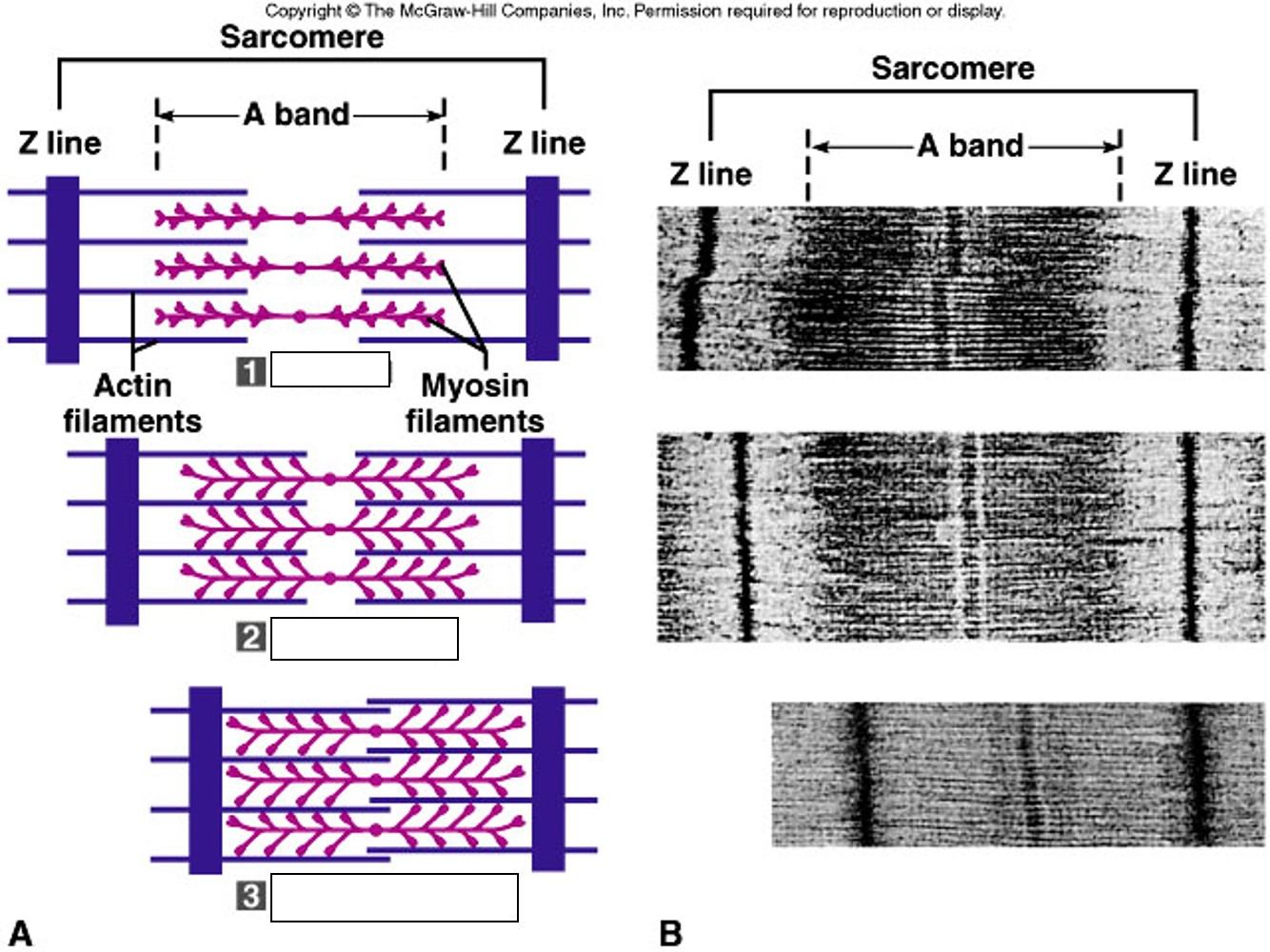
What state is the sarcomere in #1
a)
Relaxed
b)
Contracting
c)
Fully Contracted
d)
None of the above
57.
What state is the sarcomere in #1
a)
Relaxed
b)
Contracting
c)
Fully Contracted
d)
None of the above
58.
What state is the sarcomere in #3
a)
Relaxed
b)
Contracting
c)
Fully Contracted
d)
None of the above
59.
What happens to the H zone during a sarcomere contraction?
a)
It disappears
b)
It gets closer together
c)
It gets bigger
d)
None of these
60.
What happens to the A zone during a sarcomere contraction?
a)
It disappears
b)
It gets closer together
c)
It gets bigger
d)
None of these
61.
What happens to the Z lines during a sarcomere contraction?
a)
It disappears
b)
gets closer together
c)
It gets bigger
d)
None of these
62.
What happens to the I zones during a sarcomere contraction?
a)
It disappears
b)
gets closer together
c)
It gets bigger
d)
None of these
63.

The striations found on skeletal muscle fibers are created by zones of the sarcomere. Which zone creates the dark bands of a muscle fiber?
a)
A zone
b)
H Zone
c)
Both A and H Zone
d)
I zone
64.
The striations found on skeletal muscle fibers are created by zones of the sarcomere. Which zone creates the light bands of a muscle fiber?
a)
A zone
b)
H Zone
c)
Both A and H Zone
d)
I zone
65.

A neuromuscular junction is
a)
The place where the nervous and muscular system interact
b)
Where a muscle fiber and motor neuron connect
c)
Both of these
d)
None of these
66.
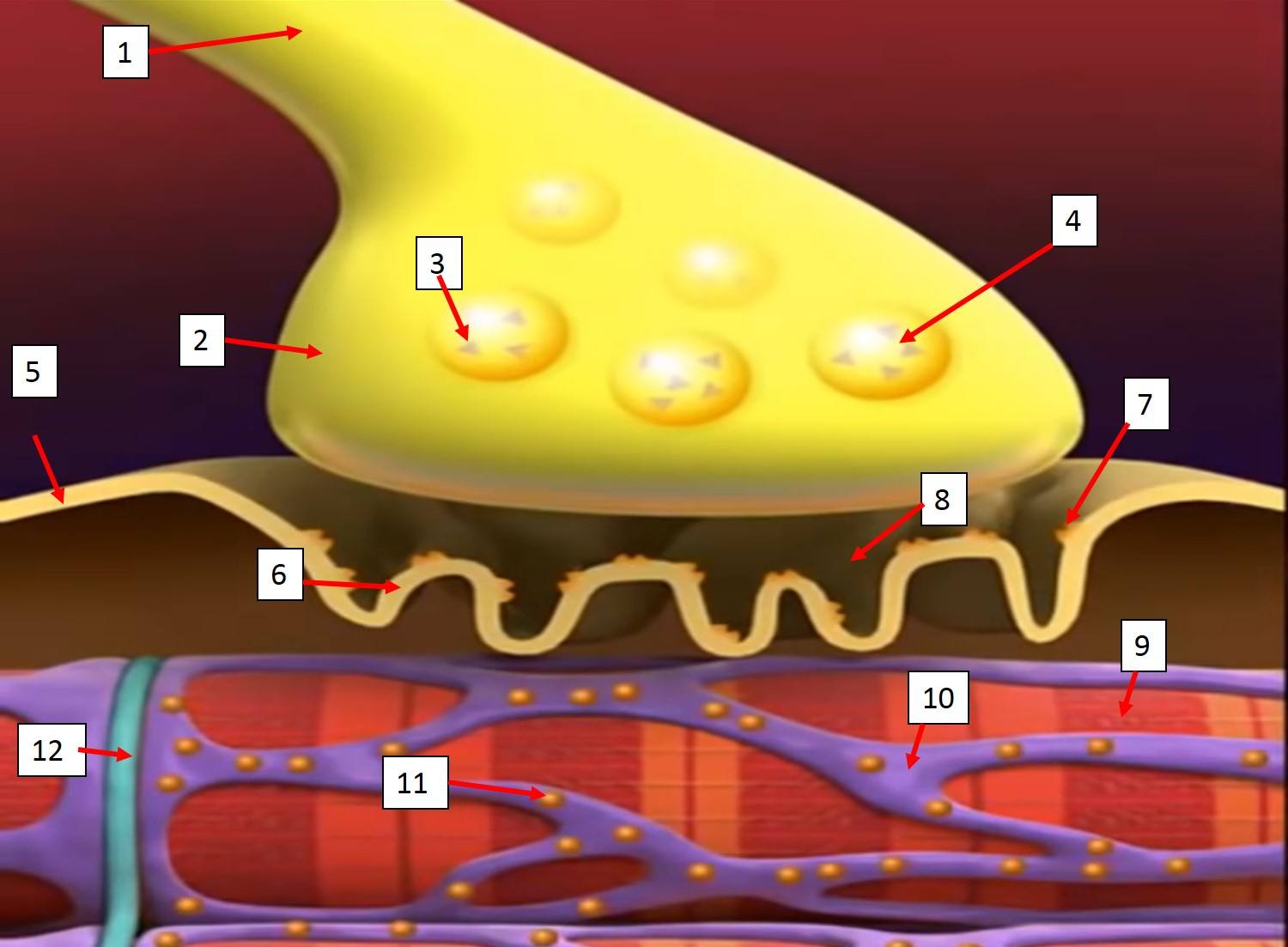
Identify Structure 1
a)
Motor Neuron
b)
Axon Terminal of Motor Neuron
c)
Sarcolemma
d)
Synaptic Vesicle
67.
Identify Structure 2
a)
Motor Neuron
b)
Axon Terminal of Motor Neuron
c)
Sarcolemma
d)
Synaptic Vesicle
68.
Identify Structure 3
a)
Acetylcholine
b)
Protein Channel
c)
Calcium Ion (Ca2+)
d)
Syanptic Cleft
69.
Identify Structure 4
a)
Motor Neuron
b)
Axon Terminal of Motor Neuron
c)
Sarcolemma
d)
Synaptic Vesicle
70.
Identify Structure 5
a)
Motor Neuron
b)
Axon Terminal of Motor Neuron
c)
Sarcolemma
d)
Synaptic Vesicle
71.
Identify Structure 6
a)
Motor End Plate
b)
Sarcoplasmic Reticulum
c)
T-Tubule
d)
Myofibril
72.
Identify Structure 7
a)
Acetylcholine
b)
Protein Channel
c)
Calcium Ion (Ca2+)
d)
Syanptic Cleft
73.
Identify Structure 8
a)
Acetylcholine
b)
Protein Channel
c)
Calcium Ion (Ca2+)
d)
Syanptic Cleft
74.
Identify Structure 9
a)
Motor End Plate
b)
Sarcoplasmic Reticulum
c)
T-Tubule
d)
Myofibril
75.
Identify Structure 10
a)
Motor End Plate
b)
Sarcoplasmic Reticulum
c)
T-Tubule
d)
Myofibril
76.
Identify Structure 11
a)
Acetylcholine
b)
Protein Channel
c)
Calcium Ion (Ca2+)
d)
Syanptic Cleft
77.
Identify Structure 12
a)
Motor End Plate
b)
Sarcoplasmic Reticulum
c)
T-Tubule
d)
Myofibril
78.
The nerve impulse travels along this structure
a)
Motor Neuron
b)
Sarcolemma
c)
Myofibril
d)
T-Tubule
79.
This structure stores the synaptic vesicles
a)
Axon Terminal
b)
Sarcoplasmic Reticulum
c)
Synaptic Cleft
d)
Synaptic Vesicles
80.
This is a neurotransmitter used to create a muscle impulse
a)
Acetylcholine
b)
Calcium Ions (Ca2+)
c)
Motor End Plate
d)
Protein Channels
81.
This structure resides in the axon terminal and contains acetylcholine
a)
Axon Terminal
b)
Sarcoplasmic Reticulum
c)
Synaptic Cleft
d)
Synaptic Vesicles
82.
This is the cell membrane of the muscle fiber
a)
Motor Neuron
b)
Sarcolemma
c)
Myofibril
d)
T-Tubule
83.
This is a modified portion of the sarcolemma where the motor neuron's axon terminal connects.
a)
Acetylcholine
b)
Calcium Ions (Ca2+)
c)
Motor End Plate
d)
Protein Channels
84.
This is a gate that must be opened by acetylcholine to create a muscle impulse
a)
Acetylcholine
b)
Calcium Ions (Ca2+)
c)
Motor End Plate
d)
Protein Channel
85.
This is the space between the axon terminal and the motor endplate
a)
Axon Terminal
b)
Sarcoplasmic Reticulum
c)
Synaptic Cleft
d)
Synaptic Vesicles
86.
This structure contains sarcomeres and fills up the majority of the muscle fiber
a)
Motor Neuron
b)
Sarcolemma
c)
Myofibril
d)
T-Tubule
87.
This is an organelle that wraps around myofibrils and contains Calcium ions (Ca2+) which it will release when triggered by a muscle impulse.
a)
Axon Terminal
b)
Sarcoplasmic Reticulum
c)
Synaptic Cleft
d)
Synaptic Vesicles
88.
This is an ion that is released by the sarcoplasmic reticulum.
a)
Acetylcholine
b)
Calcium Ions (Ca2+)
c)
Motor End Plate
d)
Protein Channel
89.
This is a tube that spreads the muscle impulse throughout the entire muscle fiber.
a)
Motor Neuron
b)
Sarcolemma
c)
Myofibril
d)
T-Tubule
100 %

