
 Worksheets
MCA Review 1
Total questions: 94
Worksheet time: 2hrs 25mins
Name
Class
Date
1.
The monomer or building block of a protein is a (an):
a)
Nucleotide
b)
Monosaccharide
c)
Amino acid
d)
Enzyme
2.

Which of the following organisms represents a secondary consumer in a food web?
a)
Rabbits
b)
Herbivorous insects
c)
Snakes
d)
Spiders
3.
Which organelle converts the energy in food into energy for the cell (cellular respiration)?
a)
Ribosomes
b)
Nucleolus
c)
Mitochondria
d)
Golgi Body
4.
ALL living cells have this in common
a)
Nucleus
b)
Cell Membrane
c)
Cell Wall
d)
Mitochondria
5.

This picture represents what type of cell transport?
a)
endocytosis
b)
exocytosis
c)
osmosis
d)
passive transport
6.
Which is true about active transport?
a)
It requires energy
b)
it does not require energy
c)
It moves substances down the concentration gradient
d)
it moves material from high to low concentration
7.
Where are proteins made?
a)
Golgi apparatus
b)
Mitoichondria
c)
Chromosomes
d)
Ribosomes
8.
Primary consumer's energy is 54,000 joules. How much energy was provided to secondary consumers?
a)
53,460 J
b)
540 J
c)
5,400 J
d)
54 J
9.
Organisms that can capture energy from inorganic, nonliving sources.
a)
Producers
b)
Consumers
c)
Detritivores
d)
Carnivores
10.
The amount of energy that usually transfers from one trophic level to the next...
a)
10%
b)
20%
c)
80%
d)
50%
11.

A symbiotic relationship in which both organisms benefit
a)
competition
b)
Mutualism
c)
nitrogen fixation
d)
energy pyramid
12.
An organism that produces its own food supply from inorganic compounds is called a(an)
a)
heterotroph
b)
consumer
c)
detritivore
d)
autotroph
13.

In the graph of the two populations, which line represents the predator population?
a)
Solid Line
b)
Dotted Line
14.
Organisms which break down organic matter in an ecosystem are called?
a)
Autotrophs
b)
Decomposers
c)
Scavengers
d)
Primary consumers
15.
If the death rate exceeds the birth rate in a population, the population size will:
a)
Be stable
b)
Increase
c)
Decrease
16.

If T=Tall & t=short, what is the genotypic ratio?
a)
1:3
b)
3:1
c)
1:2:1
d)
2:2
17.

A corn plant heterozygous for tall sprouts mates with a corn plant with short sprouts. If tall sprouts are dominant, how many different phenotypes are possible in the offspring?
a)
1
b)
2
c)
3
d)
4
18.

Which process and type of resulting cells are represented?
a)
mitosis, gametes
b)
mitosis, body cells
c)
meiosis, gametes
d)
meiosis, body cells
19.

Which best describes the process shown?
a)
mutation in which the DNA content of the gene is altered
b)
segregation of sister chromatids
c)
condensation and segregation of the alleles
d)
crossing-over in which alleles are exchanged
20.
What is one advantage of sexual reproduction?
a)
offspring are identical to parents
b)
offspring are resistant to viruses
c)
offspring are born live, rather than from eggs
d)
offspring show variation from parents
21.

What is happening in this pictures and what phase is it?
a)
anaphase 1: homologous chromsomes are splitting apart
b)
anaphase 2: sister chromatids are splitting apart
c)
metaphase 1: homologous chromosomes are lined up down the middle of the cell
d)
telophase 1: homologous chromosomes are at opposite ends of the cell
22.
Which sequence of DNA bases would pair with this partial strand
ATG TGA CAG
ATG TGA CAG
a)
ATG TGA CAG
b)
TAC ACT GTC
c)
GTA AGT GAC
d)
CAT TCA CTG
23.
Which of the following units are repeatedly joined together to form a strand of DNA?
a)
amino acids
b)
nucleotides
c)
fatty acids
d)
polysaccharides
24.

In a molecule of double-stranded DNA, the amount of Adenine present is always equal to the amount of
a)
cytosine
b)
guanine
c)
thymine
d)
uracil
25.
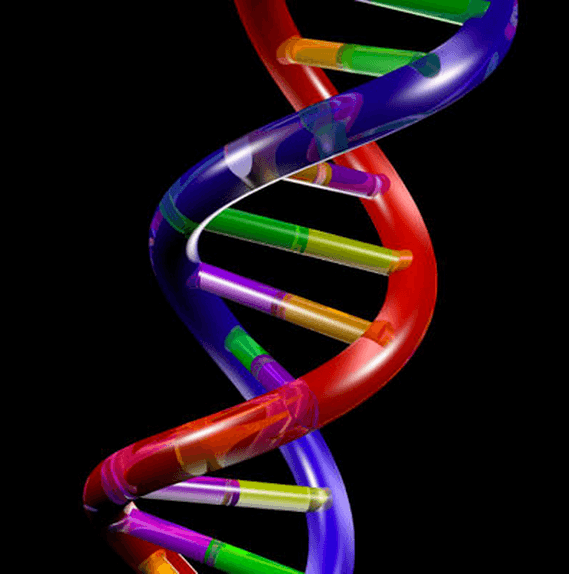
What determines the code, or information, of a DNA molecule?
a)
the shape (structure) of the nitrogen bases
b)
the order (sequence) of the nitrogen bases
c)
the color of the nitrogen bases
d)
the frequency (number) of nitrogen bases
26.
The enzyme that unzips the DNA to prepare for replication is
a)
helicase
b)
replicase
c)
DNA polymerase
d)
synthase
27.
Which process is used to make mRNA from the DNA in the nucleus?
a)
transcription
b)
translation
c)
replication
28.
Which RNA bases would pair with TACGAA in transcription?
a)
AUGCUU
b)
ATGCTT
c)
GCATCC
d)
GCAUCC
29.
Where does transcription take place?
a)
nucleus
b)
cytoplasm
c)
ribosome
30.
When does DNA replication happen?
a)
Before Mitosis begins
b)
During prophase
c)
During metaphase
d)
During anaphase
31.
Translation is the process where
a)
mRNA is created in the Nucleus
b)
mRNA is decoded to form a protein
c)
glucose molecules are made
d)
is where lipids are synthesised
32.
_______ is made during transcription and ________ is made during translation.
a)
mRNA / a protein
b)
a protein / mRNA
c)
Ribosome / Nucleus
d)
mRNA / tRNA
33.
The job of tRNA is to
a)
carry amino acids to the ribisomes
b)
carry ribisomes to the ER
c)
carry glucose to mitochondria
d)
carry mRNA out of the nucleus
34.
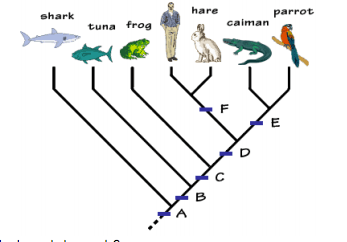
On the cladogram, which organism is the closest relative of the human?
a)
Frog
b)
Hare
c)
Caiman
d)
Parrot
35.
Charles Darwin’s observation that finches of different species on the Galápagos Islands have many similar physical characteristics supports the hypothesis that these finches
a)
have the ability to interbreed.
have the ability to interbreed.
have the ability to interbreed.
b)
acquired traits through use and disuse.
c)
all eat the same type of food.
d)
descended from a common ancestor.
36.

Farmers breed cows to produce high amounts of milk. This is an example of...
a)
Natural Selection
b)
Variations in a species
c)
Selective Breeding
d)
Genetic engineering
37.
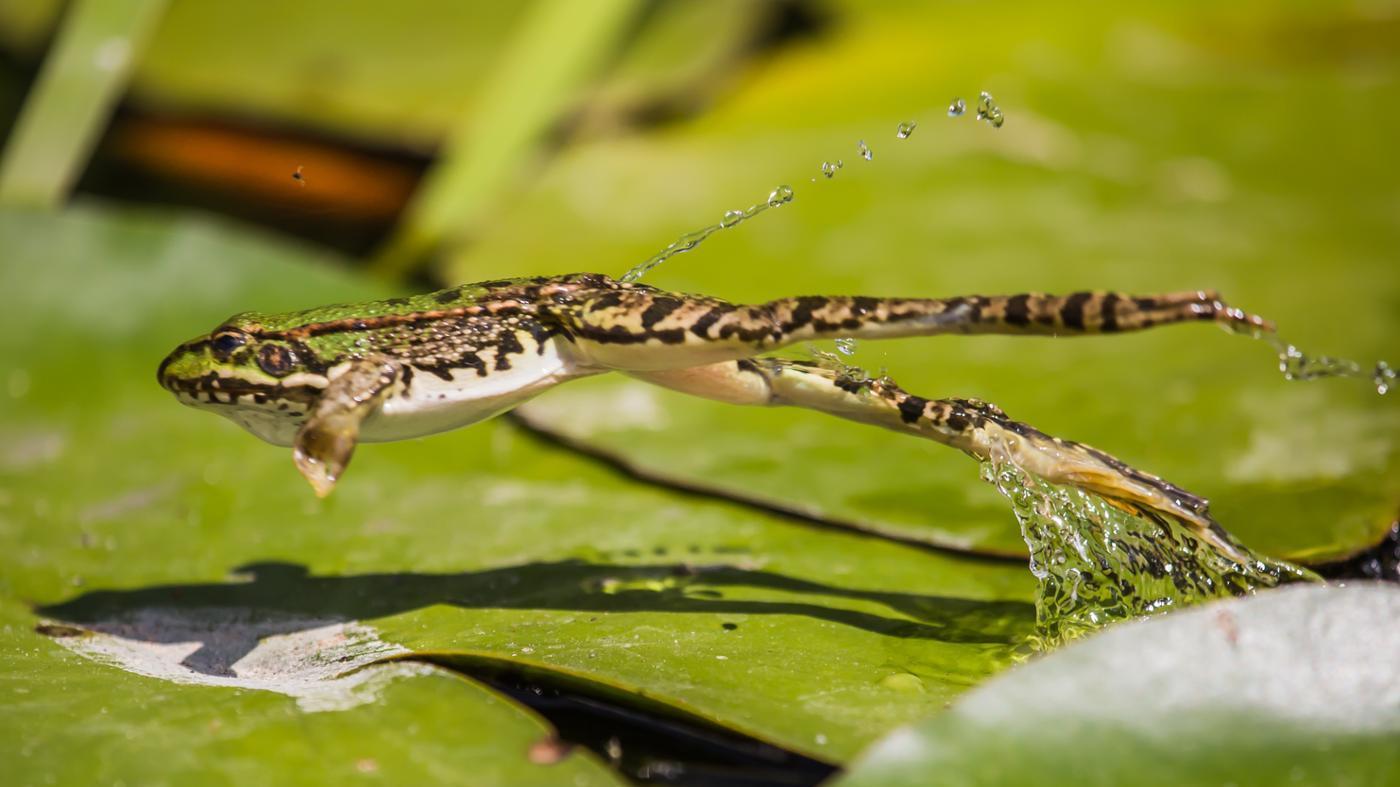
Frogs have webbed feet that help them to swim in water. Webbed feet in frogs are an example of a
a)
niche
b)
variation
c)
adaptation
d)
learned behavior
38.
A fossil of an extinct dinosaur is found and the anatomy of the fossil shows similarities to that of a bird. What could this mean?
a)
This is purely by chance and isn't significant
b)
The extinct dinosaur and modern bird share a common ancestor
c)
All dinosaurs evolved into birds and that's why there aren't any dinosaurs alive today
d)
Dinosaurs choose to fly, and evolved into birds to escape predation and capture food
39.

What did Charles Darwin observe in finch populations of the Galapagos Islands off the coast of South America?
a)
different species on different islands
b)
all species on one of the islands
c)
identical species on all the islands
d)
the same species as North America
40.
Evolution is a change in _________ over time.
a)
Populations
b)
Individuals
c)
Ecosystems
41.
__________ are nucleic acid functions
a)
store & transfer genetic info
b)
store & create energy
c)
structure & energy for cells
d)
membrane structure and nutrient transfer
42.
___________ are some functions of lipids.
a)
storing energy and cell membrane structure
b)
providing movement and enzyme catalysis
c)
cellulose structure and digestive assistance
d)
storing & transferring genetic info
43.
Sugars (glucose) and starch are examples of this organic molecule:
a)
Carbohydrates
b)
Lipids
c)
Proteins
d)
Nucleic Acids
44.
A substance with a pH of 4 is considered a(n)
a)
base
b)
neutral
c)
acid
45.
Which of the following statements about enzymes is NOT true?
a)
enzymes are reusable
b)
enzymes work best at specific pH and temperatures
c)
enzymes are lipids
d)
enzymes are proteins
46.
Which is not a use or function of protein?
a)
forms enzymes and hormones
b)
forms transport channel in cell membrane
c)
forms structural proteins in the body
d)
quick energy
47.
Which property makes water molecules stick to other water molecules?
a)
adhesion
b)
cohesion
c)
capillary action
d)
polarity
48.
When a carbohydrate breaks apart using water it is called ______________
a)
hydrolysis
b)
carbolysis
c)
dehydration synthesis
d)
metabolism
49.

Which macromolecule is shown?
a)
lipid
b)
protein
c)
nucleic acid
d)
carbohydrate
50.
Carbohydrates are made of...
a)
C H O
b)
C H O N
c)
C H O N P
d)
C H O N S
51.
Also known as simple sugars, these are the carbohydrate monomers.
a)
lipids
b)
nucleotide
c)
monosaccharide
d)
monomer
52.
What happens to an enzyme when it is exposed to high temperature and pH?
a)
the enzyme stays the same
b)
the enzyme is denatured
c)
the enzyme creates sulfur-sulfur bonds
d)
creates amino acids
53.
What does an enzyme act on directly?
a)
active sites
b)
catalysts
c)
substrates
d)
proteins
54.
Plants make food using ____________ and _________ in the presence of sunlight.
a)
water, oxygen
b)
water, carbon dioxide
c)
glucose, oxygen
d)
minerals, carbon dioxide
55.
Plant loses water through the ________.
a)
roots
b)
stomata
c)
chlorophyll
d)
stem
56.
what is the function of xylem in vascular tissue?
a)
transport tissue
b)
transport air
c)
transport glucose
d)
transport water
57.
Which of the following is NOT a density-dependent limiting factor?
a)
flood
b)
disease
c)
predation
d)
competition
58.

The image represents a population of organisms in a pattern of _____________ growth.
a)
logistic
b)
exponential
59.
What are the products of photosynthesis?
a)
Carbon dioxide and water
b)
Carbon dioxide and oxygen
c)
Glucose and oxygen
d)
Glucose and water
60.
Where does cellular respiration take place in the cell?
a)
Cell Membrane
b)
Nucleus
c)
Mitochondria
d)
Vacuole
61.
The overall equation for cellular respiration is:
a)
C6H12O6 + energy -> 6CO2 + 6H2O + energy
b)
CH2O + O2 -> CO2 + 6H2O + energy
c)
C6H12O6 + 6O2 -> 6CO2 + 6H2O + energy
d)
C6H12O6 + 6CO2 -> 6O2 + 6H2O + energy
62.
The concentration of water is higher in the soil than in plant root cells. Water moves into root cells of a plant by...
a)
Facilitated Diffusion
b)
Simple Diffusion
c)
Active Transport
d)
Osmosis
63.

The cell below is in a _____________ solution.
a)
Hypertonic
b)
Hypotonic
c)
Isotonic
64.
What does it mean that a cell membrane is semi-permeable?
a)
It allows all substances in
b)
It allows some substances in
c)
It allows nothing in
65.
What is the difference between active and passive transport?
a)
Active does not need energy and passive uses ATP (energy)
b)
Active uses ATP (energy) and passive does not need energy
c)
Active stores transport proteins and passive releases
d)
Active uses hormones and passive does not
66.
A molecule that diffuses down a concentration gradient goes from an area of ______ concentration into an area of ______ concentration.
a)
high, low
b)
low, high
c)
passive, active
d)
active, passive
67.
What is it called when molecules move across the cell membrane from an area of high concentration to an area of low concentration through a carrier protein?
a)
Diffusion
b)
Osmosis
c)
Active Transport
d)
Facilitated Diffusion
68.
In which phase do the sister chromatids become visible because the nuclear membrane disappears?
a)
Interphase
b)
Prophase
c)
Metaphase
d)
Anaphase
69.

Name the phase:
a)
Prophase
b)
Metaphase
c)
Anaphase
d)
Telophase
70.

The stages of mitosis in order
a)
Metaphase, Anaphase, Prophase, Telophase
b)
Prophase, Anaphase, Metaphase, Telophase
c)
Prophase, Metaphase, Anaphase, Telophase
d)
Anaphase, Prophase, Telophase, Metaphase
71.
If a parent cell has 22 chromosomes, how many will each daughter cell have?
a)
11
b)
46
c)
19
d)
22
72.
How many cells are made in the process of MITOSIS?
a)
one
b)
two
c)
four
d)
eight
73.
Uncontrolled cell growth is called___.
a)
Mitosis
b)
DNA Replication
c)
Cancer
d)
Radiation
74.
True or false. Cancer begins when mutations disrupt the normal cell cycle, causing cells to divide in an uncontrolled way.
a)
True
b)
False
75.

What type of structures are these?
a)
analogous
b)
homologous
c)
vestigial
d)
adaptable
76.

Starting in 1954, commercial fishers in the northwest Pacific were paid by weight, rather than by the individual fish, for pink salmon. The fishers increased the use of a type of net that selectively catches larger fish. Which of the following effects did this change in fishing technique most likely have on the salmon population over the next 20 years?
a)
The average body size of the salmon population decreased significantly.
b)
The average body size of the salmon population increased significantly.
c)
The average body size of the males in the salmon population increased, and the females stayed the same.
77.

Comparing human hemoglobin of chimpanzees, horses, kangaroos, and chickens, reveal that humans have the fewest amino acid differences with
a)
Kangaroos
b)
Horses
c)
chickens
d)
chimpanzees
78.

The formation of new species is a process known as ____________________, which is typically the product of divergence.
a)
gradualism
b)
speciation
c)
reproductive isolation
d)
subspecies
79.
___ are mistakes in the DNA that cause variation within a species.
a)
mutations
b)
adaptations
c)
speciations
d)
isolations
80.

What is the correct explanation for what is happening in this graph?
a)
There are a lot of average-sized beaks
b)
There are no beaks
c)
There are a lot of small beaks only
d)
There are a lot of small and large beaks, but not average-sized ones
81.
A horse and a donkey can successfully mate to produce offspring known as a mule. Mules are sterile . Would mules be classified as a species?
a)
Yes, mules have enough of their own traits to be considered a species.
b)
Yes, the fact that have different number of chromosomes makes them a different species
c)
No, mules are too similar to the parent species
d)
No, due to their inability to reproduce successfully.
82.
Jamie is testing the effect of time in the sun on plant growth. What is her independent variable
a)
time in the sun
b)
plant growth
c)
strength of sunlight
d)
plant type
83.

When experimenting with the growth of a plant, a scientist uses three (of the same type of) plants, two different fertilizers, equal light, and equal water. What type of variable is the fertilizer?
a)
Dependent
b)
Independent
c)
Control
d)
Constant
84.

If a company claims that its product has been proven scientifically, which of the following should have taken place if the results are to be considered?
a)
The company should have held discussions with leading industry scientists.
b)
Technology should have been used in both the gathering of data and data analysis.
c)
Results should have been peer reviewed and repeated producing the same findings
d)
The results of the investigation should have been published in popular magazines
85.

A student conducting an investigation to determine the effect of temperature on the metabolism of yeast. Yeast and sugar are added to water, the gas produced is captured, and its volume is recorded. Which variables should be held constant during this investigation?
a)
Mass of sugar and water temperature
b)
Mass of yeast and mass of sugar
c)
Volume of gas and water temperature
d)
Volume of gas and mass of yeast
86.

Michael wants to test the effect that different concentrations of stomach acid will have on the dissolution of a particular kind of oral medication. As he sets up and completes his experiment, which of the following experimental designs would be most likely to help him answer his question?
a)
Allow several pills to soak in different amounts of acid of a single concentration and then measure the amount of dissolution on each.
b)
Prepare solutions of different acid concentrations, measure 50 mililiters of each into different beakers, and place the same type of pill of the same mass into the beakers.
c)
After allowing a pill to be exposed to one acid concentration, place it in different acid concentrations, and then measure the surface area that is dissolved.
d)
Prepare solutions of different acid concentrations, measure 50 milliliters of each into different beakers, and place different types of pills of the same mass into the beakers.
87.
A scientist wanted to find out if the height of a shrub would make it more prone to frost damage. He found a hillside covered with shrubs and trimmed all the shrubs located at the bottom to one meter tall. He left the shrubs growing at the top of the hill untrimmed. They ranged from one to three meters tall. After a heavy frost, he found that 90% of the shorter shrubs had frost damage while only 10% of the tall shrubs did. He concluded that short shrubs were more likely to suffer frost damage than tall shrubs. When he submits his research report for review by other scientists, which of the following are they likely to criticize about his experiment?
a)
His hypothesis that shrub height might influence frost damage is not a question worth testing.
b)
His conclusion is inaccurate because the location of the shrubs on the hillside might also have contributed to where frost damage occurred.
c)
His methods of recording frost damage must have been biased toward tall shrubs since there was such a large difference in frost damage.
d)
His results are not valid because he had some shrubs in the tall group that were close to each other.
88.
I want to see if putting fertilizer on my sunflower plants helps them grow taller. What is the dependent variable?
a)
amount of sunlight
b)
amount of water
c)
fertilizer
d)
how tall they grow
89.
Plant absorbs water through the _________.
a)
stem
b)
roots
c)
leaves
d)
all of the above
90.
Vascular tissue that transports water and minerals UPWARDS from a plant's roots is know as ______.
a)
Chlorophyll
b)
Phloem
c)
Stomata
d)
Xylem
91.
Sugars made in leaves are transported in:
a)
xylem
b)
Phloem
c)
chloroplast
d)
stomata
92.
When the plant responds to light, it is known as:
a)
Phototropism
b)
Gravitropism
c)
Thigmotropism
d)
Hydrotropism
93.

What type of tropism response to gravity?
a)
Hydrotropism
b)
Phototropism
c)
Thigmotropism
d)
Gravitropism
94.

Which type of tropism?
a)
hydrotropism
b)
thigmotropism
c)
phototropism
d)
gravitropism
100 %

