
 Worksheets
Semester 2 Exam Review
Total questions: 105
Worksheet time: 2hrs 32mins
Name
Class
Date
1.

The diagram shows fossils in different rock layers. Which of these statements about the age of these fossils is most likely correct?
a)
Fossil A and C are the same age
b)
Fossil B is older than fossil C
c)
Fossils A is older than fossil B
d)
Fossil D is older than fossil C
2.
Charles Darwin’s observation that finches of different species on the Galápagos Islands have many similar physical characteristics supports the hypothesis that these finches
a)
have the ability to interbreed.
have the ability to interbreed.
have the ability to interbreed.
b)
acquired traits through use and disuse.
c)
all eat the same type of food.
d)
descended from a common ancestor.
3.

Which of the following is a term for a group of similar organisms that can reproduce fertile offspring?
a)
individual
b)
population
c)
species
d)
fossil
4.
Natural selection is the process by which
a)
change occurs in the
genetic characteristics of individuals that live together in an environment
from one generation to another
b)
organisms with traits
well-suited to their environment reproduce at a greater rate than less
well-adapted organisms in the same environment
c)
use and disuse of a
characteristic leads to evolutionary change
d)
baseball players pass on
the trait for strong arm muscles to children
5.
What is the advantage of having different shaped beaks?
a)
To look different from other species.
b)
To be able to eat the food readily available in the environment.
c)
To protect itself against predators.
d)
To protect itself against prey.
6.
What characteristic did Darwin observe about the finches on the Galapagos Islands?
a)
Their feathers
b)
Genotypes
c)
Their beaks
d)
Their body sizes
7.
Change over time is
a)
evolution
b)
generation
c)
growth
d)
biogenesis
8.
Relative dating
a)
gives the exact age of rocks and fossils
b)
is when you date your cousin
c)
gives the approximate age of rocks
d)
tells us who to trust
9.

The difference in the physical traits of an individual from those of other individuals in a group is called a(n)
a)
change
b)
adaption
c)
species
d)
variation
10.

If an organism has a vestigial structure, that structure likely once had a function in a(n)
a)
close relative
b)
early ancestor
c)
unrelated organism
d)
embryological stage
11.
What is speciation?
a)
combining of tow species to form one with different traits
b)
isolation that affects mating behaviors
c)
timing of mating that prevents normal sexual selection
d)
divergence of two or more species from an existing one
12.
Humans, birds, whales, and lizards all have similar arm bones. What is the reason for this?
a)
The function of these bones is the same in all animals
b)
They live in similar environments
c)
They have a common ancestor
d)
All organisms resemble humans
13.
Bird wings and butterfly wings are an example of
a)
Homologous structure
b)
Analogous structure
c)
Mimicry
d)
Camoflague
14.
Shark fins and dolphin fins are examples of analogous structures.
a)
True
b)
False
15.
Analogous structures show common ancestry.
a)
True
b)
False
16.
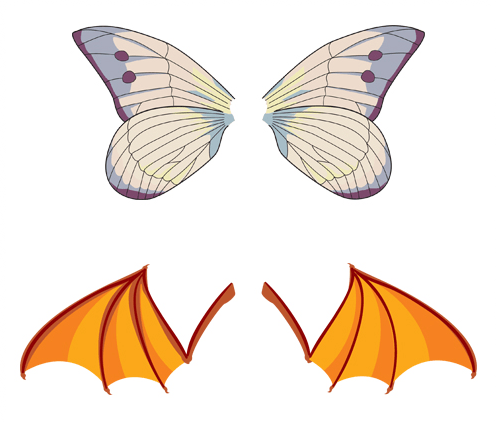
How would you describe this evolution?
a)
Homologous structure
b)
Analogous structure
c)
Structural adaption
d)
Functional adaption
17.
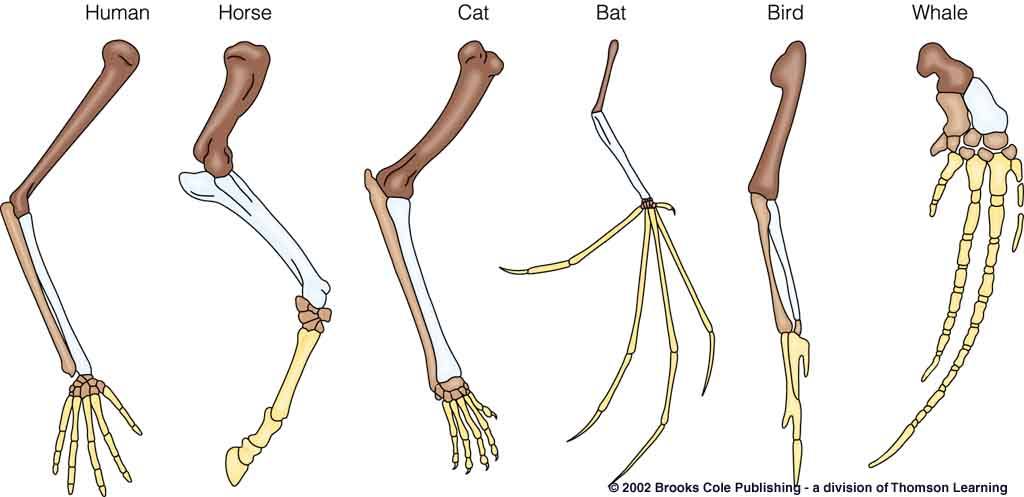
The structures shown are_________
a)
homologous
b)
heterologous
c)
analogous
d)
vestigial
18.
Structures that are inherited from a common ancestor are homologous.
a)
True
b)
False
19.

Which of the three graphs shows stabilizing selection?
a)
A
b)
B
c)
C
20.

Which of the three graphs shows disruptive selection?
a)
A
b)
B
c)
C
21.
If finches with large beaks and finches with small beaks increase in a population while finches with average sized beaks decreases, which pattern of natural selection has occurred?
a)
Directional selection
b)
Disruptive selection
c)
Stabilizing selection
22.

What type of selection?
a)
Directional
b)
Stabilizing
c)
Disruptive
23.

What type of natural selection is this?
a)
Disruptive Selection
b)
Directional Selection
c)
Stabilizing Selection
d)
Sexy Selection
24.

What type of selection is depicted in the picture?
a)
stabilizing
b)
directional
c)
disruptive
d)
the answer is not here
25.

Which rock layer in the diagram seems to be the oldest?
a)
F
b)
E
c)
B
d)
A
26.
Which best describes radiometric dating?
a)
using instruments that detect radioactivity to figure out how old something is
b)
measuring the relative amounts of a radioactive isotope and a daughter product to figure out the age of a sample
c)
measuring how quickly the different radioactive isotopes in a sample decay to figure out the age of the sample
d)
using short-wavelength electromagnetic radiation to determine the age of a sample
27.
An organism that produces its own food supply from inorganic compounds is called a(an)
a)
heterotroph
b)
consumer
c)
detritivore
d)
autotroph
28.
What is the original source of almost all energy in most ecosystems?
a)
carbohydrates
b)
sunlight
c)
water
d)
carbon
29.
What is the term for each step in the transfer of energy and matter within a biological community?
a)
energy path
b)
food web
c)
trophic level
d)
food pyramid
30.
Autotrophs make up the _______ level in all ecosystems.
a)
First
b)
Second
c)
Third
d)
Fourth
31.

which symbiosis is this
a)
parasitism
b)
mutualism
c)
commensalism
d)
nonalism
32.

symbiotic relationship in which both organisms benefit
a)
competition
b)
Mutualism
c)
nitrogen fixation
d)
energy pyramid
33.

A living relationship between two species in which one organism is harmed is called...
a)
mutualism
b)
commensalism
c)
parasitism
d)
niche
34.

What does a food web represent?
a)
All connections of energy flow throughout all organisms in a habitat.
b)
The specific ways that mutualism is carried out.
c)
A single pathway or energy flow between organisms.
d)
How carnivores get their food.
35.

The image provided is an example of a(n):
a)
Producer
b)
Autotroph
c)
Consumer
d)
Insect
36.
The amount of energy that usually transfers from one trophic level to the next...
a)
10%
b)
20%
c)
80%
d)
50%
37.
An illustration that uses arrows to show the many possible directions in which matter and energy can pass through the organisms in an ecosystem.
a)
Food chain
b)
Food web
c)
Energy Pyramid
d)
Succession Map
38.
The nonliving aspects of an ecosystem.
a)
Abiotic factors
b)
Biotic factors
39.
The living portions of the ecosystem.
a)
Biotic factors
b)
Abiotic factors
40.
Water temperature would be an example of ...
a)
A biotic factor
b)
An abiotic factor
41.
A place where an organism lives.
a)
Terrain
b)
Habitat
c)
Community
d)
Population
42.
Organisms that can capture energy from inorganic, nonliving sources.
a)
Producers
b)
Consumers
c)
Detritivores
d)
Carnivores
43.
Organisms that feed on both living producers and other consumers.
a)
Carnivores
b)
Omnivores
c)
Herbivores
d)
Detritivores
44.
The general name for organisms like animals and fungi that get their energy from eating other organisms.
a)
Producers
b)
Consumers
c)
Detritivores
d)
Carnivores
45.
An organism at the second trophic level would be considered a...
a)
Top carnivore
b)
Producer
c)
Herbivore
d)
Carnivore
46.
True or False: It is possible for a carnivore to be a producer.
a)
False
b)
True
47.

All of the living and nonliving things in an area that interact with each other are called a/an ______.
a)
community
b)
habitat
c)
population
d)
ecosystem
48.

An area where an organism finds food, shelter and water in a specific arrangement
a)
niche
b)
biosphere
c)
biome
d)
habitat
49.

Organisms that look similar and can produce fertile offspring
a)
Species
b)
Fish
c)
Community
d)
Trees
50.
What is an heterotroph?
a)
An organism that can produce its own form of energy (via the Sun)
b)
An organism that consumes only plants for energy
c)
Various organisms that consume other organisms for energy
d)
An organism that decomposes other organisms
51.
What are the correct types of Trophic levels?
a)
Producers
Primary
Secondary
Primary
Secondary
b)
Primary
Secondary
Secondary
c)
Producers
Consumers
Decomposers
Consumers
Decomposers
d)
Producers
Primary
Secondary
Tertiary
Primary
Secondary
Tertiary
52.

What are the plants in this picture?
a)
Heterotrophs
b)
Autotrophs
c)
Carnivores
d)
Herbivores
53.
What is commensalism?
a)
a symbiosis where one species is helped and the other is harmed
b)
a symbiosis where one species is helped and the other is neither helped nor harmed
c)
a symbiosis where both species are helped
d)
a symbiosis between 2 or more organisms
54.
An animal that is hunted and eaten for food is a
a)
predator
b)
prey
55.
An organism's niche is
a)
the entire role an organism has in the place it lives
b)
the range of temperatures that the organism needs to survive
c)
all the physical and biological factors in the organism's environment
d)
the nutrients that flow from the organism to the environment
56.
Organisms that breaks down and absorbs nutrients from dead organisms
a)
consumer
b)
trophic level
c)
decomposer
d)
species
57.

symbiotic relationship in which one organisms benefits and the other organism is not affected
a)
invasive (non-native) species
b)
mutualism
c)
nitrogen fixation
d)
commensalism
58.

Which graph shows that a population has already reached it carrying capacity for that environment?
a)
Graph A
b)
Graph B
59.
Which graph is a representation of logistical growth?
a)
Graph A
b)
Graph B
60.
Barnacles live on the skin of whales. The barnacles have a place to live and the whale is not affected. This is an example of what term?
a)
parasitism
b)
commensalism
c)
predation
d)
mutualism
61.
Bacteria live in the human intestinal track and help humans break down food. This is an example of what term?
a)
mutualism
b)
predation
c)
competition
d)
parasitism
62.

What is the carrying capacity of the following graph?
a)
1000
b)
8000
c)
800
d)
600
63.

What type of growth is represented behind?
a)
exponential
b)
logistics
c)
a good kind
d)
representative
64.
As a population grows, it will most likely stop growing at what size?
a)
Growth limit
b)
Exponential limit
c)
Carrying Capacity
d)
It won't stop growing
65.
The carrying capacity of an environment for a particular species at a particular time is determined by the
a)
number of individuals
in the species.
b)
distribution of the
population.
c)
reproductive
potential of the species.
d)
supply of the most
limited resources
66.
Which kind of growth does the human population follow? It is described as a J-shaped curve.
a)
Exponential Growth
b)
Logistic Growth
c)
Outstanding Growth
d)
Minimal Growth
67.
A population is...
a)
A group of one species in one area
b)
Multiple species that live in one area
c)
All of the living and nonliving things in an area
d)
None of these
68.
Which dispersion pattern is described by organisms being spaced out equally?
a)
Uniform
b)
Random
c)
Clumped
d)
None of these
69.
Which dispersion pattern usually is a result of resources not being evenly spread out in the environment?
a)
Uniform
b)
Random
c)
Clumped
d)
None of these
70.
What will happen to the population when the death rate is larger than the birth rate?
a)
grow
b)
shrink
c)
stay the same
d)
None of these
71.
What will happen to the population when the birth rate is larger than the death rate?
a)
grow
b)
shrink
c)
stay the same
72.
Which will add more organisms to a population?
a)
5 animals die
b)
0 animals are born
c)
3 animals immigrate to the population
d)
2 animals emmigrate from the population
73.
Which factor is a density-dependent limiting factor on the population of a species?
a)
seasonal variation
b)
natural disasters
c)
unusual weather
d)
predation
74.

Which kind of dispersion is #1?
a)
clumped
b)
random
c)
uniform
75.
The graph of logistic growth can be described as...
a)
S-shaped
b)
J-shaped
c)
W-shaped
d)
U-shaped
76.
What factor describes when populations increase because animals are moving into a population?
a)
Emigration
b)
Limiting Factors
c)
Immigration
d)
Exponential Growth
77.
What factor describes when populations decrease because animals are moving out of a population?
a)
Emigration
b)
Limiting Factors
c)
Immigration
d)
Exponential Growth
78.
Which limiting factor would increase due to the number of individuals in a population?
a)
Unusual weather
b)
Natural disaster
c)
Births
d)
Disease
79.
Which limiting factor is independent of the number of individuals in a population?
a)
competition
b)
parasitism/disease
c)
stress
d)
natural disasters
80.
Population A has a population density of 652 people per square mile. Population B has a population density of 17 people per square mile. Which population is at higher risk of a disease outbreak?
a)
A
b)
B
c)
Equal chances
d)
No way to know
81.
This measures the number of individuals in a population per unit of area.
a)
Population density
b)
Population Size
c)
Population Growth
d)
Biodiversity
82.
An environmental factor such as predation, disease, and competition that depends on the number of members in a population per unit
a)
dispersion
b)
density- independent factor
c)
density- dependent factor
d)
population growth rate
83.
An environmental factor such as storms and extreme heat or cold that affects population regardless of their density
a)
density- dependent factor
b)
population density
c)
dispersion
d)
density- independent factor
84.
What kind of factor: flood?
a)
density-independent
b)
density-dependent
85.
What kind of factor: temperature?
a)
density-independent
b)
density-dependent
86.

What kind of factor: disease?
a)
density-independent
b)
density-dependent
87.
Which of the following is an example of a population?
a)
all trees in a forest.
b)
all plants in a forest.
c)
all maple trees in a forest.
d)
all animals in a forest.
88.

Which of the following countries have the highest birth rate?
a)
Nigeria
b)
United States
c)
Germany
d)
All have the same birth rate
89.
What body system breaks down food for energy?
a)
Urinary System
b)
Digestive System
c)
Lymphatic System
d)
Respiratory
Respiratory System
Respiratory System
90.

This system carries oxygen, nutrients and waste around the body.
a)
Lymphatic
b)
Urinary
c)
Respiratory
d)
Circulatory
91.

What is the main function of the respiratory system?
a)
to provide oxygen and remove carbon dioxide from the body
b)
to bring oxygen to the body
c)
to break down food and absorb nutrients
d)
to remove oxygen from the body and deliver carbon dioxide
92.
The mouth, esophagus and large intestine belong to what system?
a)
Nervous System
b)
Digestive System
c)
Integumentary System
d)
Lymphatic System
93.
Small muscular pouch responsible for storing bile
a)
pancreas
b)
mechanical
c)
amylase
d)
gallbladder
94.
Which organs help you breathe?
a)
Lungs
b)
Heart
c)
Kidney
95.
Which organ cleans your blood?
a)
Kidneys
b)
Liver
c)
Stomach
96.
Which organ removes poisons from the body?
a)
Liver
b)
Brain
c)
Stomach
97.
The heart...
a)
pumps blood around the body
b)
helps you digest food
c)
helps you think
98.
Which body part is designed to move the blood around your body?
a)
Lungs
b)
Liver
c)
Heart
d)
Digestive System
99.
The stomach, small intestines, and large intestines are all part of what?
a)
Your Kidneys
b)
The Digestive System
c)
Your Lungs
100.
What is another name for the windpipe?
a)
Small intestines
b)
Large intestines
c)
Trachea
d)
Esophagus
101.
When you swallow food, what does it travel through to get to your stomach?
a)
Small intestines
b)
Large intestines
c)
Esophagus
102.
This chamber of the heart sends blood to the lungs or to the body
a)
Atrium
b)
Ventricle
103.
This organ contains the reproductive eggs of the female.
a)
Testes
b)
Ovaries
c)
Bladder
d)
Rectum
104.
The connective tissue that surrounds the heart, offers protection
a)
Atrium
b)
Ventricle
c)
Pericardium
105.
Organ where the most extensive part of digestion occurs. Most food products are absorbed here
a)
Stomach
b)
Small intestine
c)
Large intestine
d)
Mouth
100 %

