
 Worksheets
Honors Unit 2 Review
Total questions: 110
Worksheet time: 1hrs 21mins
Name
Class
Date
1.
Which of the following is NOT an example of a compound?
a)
CO2
b)
H2O
c)
F2
d)
ClO4
2.
Which of the following is NOT an example of a molecule?
a)
CO2
b)
H2O
c)
Co
d)
ClO4
3.
Which of the following is NOT an example of an element?
a)
Ca
b)
Cl
c)
CO
d)
Co
4.

Which of the diagrams could be an element, but NOT a molecule?
a)
A
b)
B
c)
C
d)
D
5.
Which of the diagrams can be classified as an element?
a)
Only A
b)
A & B
c)
Only B
d)
Neither A nor B
6.
Which of the diagrams would be the most dense, why?
a)
D, because there are more particles in the diagram
b)
A, because it is a gas
c)
B, because there are two atoms bonded together
d)
C, because there are three atoms bonded together
7.
Which of the diagrams would be the least dense, why?
a)
C, because there are only 4 particles
b)
A, because there are only 5 particles
c)
B, because there are only 5 particles
d)
A, because there are only 4 atoms
8.

All mixtures are defined as "heterogeneous."
a)
TRUE
b)
FALSE
9.

Mixtures are always combinations of compounds that are in different states of matter.
a)
TRUE
b)
FALSE
10.

Which of these is not a mixture?
a)
oil and water
b)
sand and soda
c)
diet soda
d)
all are mixtures
11.

What are the two types of mixtures?
a)
element and sub-atomic
b)
atoms and compounds
c)
homogeneous and heterogeneous
d)
element
12.

How many classification of mixtures there are?
a)
one
b)
two
c)
three
d)
four
13.

A glass of Kool Aid/ Tang juice can be classified as
a)
element
b)
homogeneous
c)
heterogeneous
d)
suspension
14.
13. silver spoon
a)
A. MIXTURE
b)
B. COMPOUND
c)
C. ELEMENT
15.
11. . hydrogen peroxide
a)
A. MIXTURE
b)
B. COMPOUND
c)
C. ELEMENT
16.
12. an aluminum pie plate
a)
A. MIXTURE
b)
B. COMPOUND
c)
C. ELEMENT
17.
14. a milk shake
a)
A. MIXTURE
b)
B. COMPOUND
c)
C. ELEMENT
18.
15. gold
a)
A. MIXTURE
b)
B. COMPOUND
c)
C. ELEMENT
19.
16. baking soda
a)
A. MIXTURE
b)
B. COMPOUND
c)
C. ELEMENT
20.
17. potting soil
a)
A. MIXTURE
b)
B. COMPOUND
c)
C. ELEMENT
21.
25. Italian dressing
a)
A. HOMOGENEOUS
b)
B. HETEROGENEOUS
22.
26. Cereal
a)
A. HOMOGENEOUS
b)
B. HETEROGENEOUS
23.
27. Sugar water.
a)
A. HOMOGENEOUS
b)
B. HETEROGENOUS
24.
28. Salt water
a)
A. HOMOGENEOUS
b)
B. HETEROGENOUS
25.

CALCIUM
a)
C
b)
Ca
c)
Cu
d)
Cl
26.

CARBON
a)
C
b)
Ca
c)
Cl
d)
Cu
27.

SULFUR
a)
Su
b)
S
c)
Sf
d)
Si
28.

SILICON
a)
S
b)
Si
c)
Su
d)
Sc
29.

SODIUM
a)
S
b)
So
c)
N
d)
Na
30.

HELIUM
a)
H
b)
He
c)
Hl
d)
Hm
31.

HYDROGEN
a)
H
b)
He
c)
Hy
d)
Hd
32.

NICKEL
a)
N
b)
Ni
c)
Nc
d)
Nl
33.

FLUORINE
a)
F
b)
Fl
c)
Fu
d)
Fe
34.

BORON
a)
B
b)
Be
c)
Bo
d)
Br
35.

ALUMINUM
a)
Al
b)
Au
c)
Ag
d)
Am
36.

NEON
a)
N
b)
Ne
c)
No
d)
Nn
37.

NITROGEN
a)
N
b)
Ne
c)
Ni
d)
Nt
38.

OXYGEN
a)
O
b)
Ox
c)
Oy
d)
Og
39.

BERYLLIUM
a)
B
b)
Bo
c)
Be
d)
Br
40.

POTASSIUM
a)
P
b)
Ka
c)
K
d)
Pt
41.

CHLORINE
a)
C
b)
Ca
c)
Cl
d)
Cu
42.
LITHIUM
a)
L
b)
Li
c)
Lt
d)
Lh
43.
A ___________ is an arrangement of elements in columns
a)
columns
b)
rows
c)
periodic table
d)
electron shell
44.
Each column in the periodic table is called a
a)
period
b)
group
c)
cluster
d)
unit
45.
Elements which are shiny, conduct electricity and heat are called
a)
metal
b)
nonmetal
c)
metalloid
d)
nonexistent
46.
Which element is not a metal?
a)
H
b)
Re
c)
Al
d)
B
47.

The atoms along the staircase are called
a)
metals
b)
nonmetals
c)
metalloids
d)
noble gases
48.
Which is a halogen?
a)
Helium
b)
Chlorine
c)
Oxygen
d)
Neptune
49.
Which is an alkali metal?
a)
Magnesium
b)
Iron
c)
Sodium
d)
Europium
50.
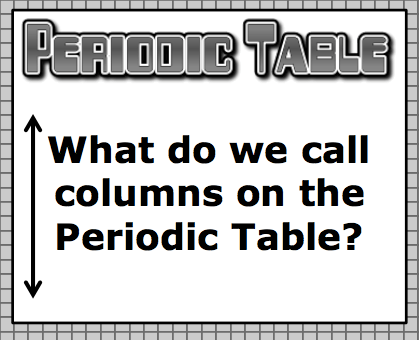
a)
Periods
b)
Groups
51.
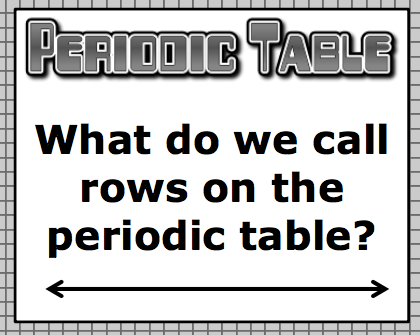
a)
Periods
b)
Groups
52.

What does the 1.00794 stand for?
a)
Hydrogen
b)
atomic number
c)
atomic mass
d)
atomic explosion
53.

The blue atoms are called
a)
metals
b)
nonmetals
c)
metalloids
d)
noble gases
54.
Calcium is most like which of the following?
a)
Barium
b)
Potassium
c)
Cesium
d)
Nitrogen
55.
In the modern periodic table elements are arranged by:
a)
atomic mass
b)
atomic number
c)
valence electrons
d)
number of isotopes
56.
Which element is not in the Alkali metal family?
a)
Li
b)
H
c)
Fr
d)
Cs
57.
The modern periodic table is arranged by increasing atomic number, which was proposed by who?
a)
Mosely
b)
Mendeleev
c)
Lavosier
d)
Meyer
58.
What element can be found in period 4, group 2?
a)
calcium
b)
carbon
c)
chlorine
d)
cobalt
59.
What element can be found in period 2, group 14?
a)
calcium
b)
carbon
c)
chlorine
d)
cobalt
60.
T/F: Most of the elements on the periodic table are metalloids
a)
True
b)
False
61.
T/F: Most of the elements on the periodic table are metals
a)
True
b)
False
62.
T/F: Most of the elements on the periodic table are nonmetals
a)
True
b)
False
63.

Which of the diagrams most represents a liquid pure substance?
a)
A
b)
B
c)
C
d)
D
64.
Which of the diagrams most represents a gas pure substance?
a)
A
b)
B
c)
C
d)
D
65.
Which of the diagrams most represents a solid pure substance?
a)
A
b)
B
c)
C
d)
D
66.
Which of the diagrams most represents a liquid mixture?
a)
A
b)
B
c)
C
d)
D
67.
What is the only nonmetal that is liquid at room temperature?
a)
bromine
b)
mercury
c)
boron
d)
hassium
68.
What is the only metal that is liquid at room temperature?
a)
bromine
b)
mercury
c)
boron
d)
hassium
69.
Jack has a rock. The rock has a mass of 14g and a volume of 2cm3. What is the density of the rock?
a)
7 mL
b)
7 g/cm3
c)
28 g/cm3
d)
1/7 g/cm3
70.
The tool used to measure the mass of a substance or object is a ______________.
a)
balance
b)
graduated cylinder
c)
ruler
d)
thermometer
71.
Which lab tool might you use to measure the volume of a liquid?
a)
electric scale
b)
bunsen burner
c)
test tube
d)
graduated cylinder
72.
What is the formula for density?
a)
density = mass x volume
b)
density = mass / volume
c)
density = mass + volume
d)
density = mass - volume
73.

Put the liquids in order from most dense to least dense?
a)
4, 3, 2, 1
b)
1, 2, 3, 4
c)
3, 4, 2, 1,
d)
4, 3, 1, 2
74.

Which liquid is the least dense?
a)
oil
b)
water
c)
syrup
d)
plastic bottle
75.

Which box has a higher density?
a)
Box A
b)
Box B
c)
cannot be determined
d)
they are the same
76.

Calculate the density of the cube.
a)
3 g/cm3
b)
4 g/cm3
c)
2 g/cm3
d)
5 g/cm3
77.
An empty beaker has a mass of 60 grams. When mercury is added to the beaker, it has a mass of 200 grams. What is the mass of the mercury?
a)
140 grams
b)
200 grams
c)
140 mL
d)
260 g
78.
Objects that are _______ dense than water will float.
a)
less
b)
more
79.
Objects that are _______ dense than water will sink.
a)
less
b)
more
80.
The density of water is _________.
a)
100 g/mL
b)
50 g/mL
c)
30 g/mL
d)
1.0 g/mL
81.

Which liquid has the highest density?
a)
corn syrup
b)
lamp oil
c)
rubbing alcohol
d)
honey
82.

What do we know about the density of lamp oil, rubbing alcohol, and vegetable oil?
a)
The density is greater than 1.0 g/mL
b)
The density is less than 1.0 g/mL
c)
The density is equal to 1.0 g/mL
d)
The density can not be determined
83.
True or False: The density of a specific type of material never changes.
a)
True
b)
False
84.
A crayon has a density of 4.0 g/mL, if the crayon is cut in half each half will have a. density of...
a)
2.0 g/mL
b)
8.0 g/mL
c)
4.0 g/mL
d)
Hard to tell
85.
T/F: Plasmas are similar to gases
a)
True
b)
False
86.
T/F: Bose-Einstein condensates are similar to liquids
a)
True
b)
False
87.
T/F: All molecules are compounds
a)
True
b)
False
88.
T/F: All compounds are molecules
a)
True
b)
False
89.
What is 50 C in Kelvin?
a)
223
b)
323
c)
100
d)
50
90.
What will happen to the volume of a gas under constant temperature if the pressure increases?
a)
Increase
b)
Decrease
c)
Nothing
d)
Explosion!
91.
If you increase the pressure of a constant volume of gas, what will happen to the temperature?
a)
Increase
b)
Decrease
c)
Stay the same
d)
It will Blow Up
92.
What is the device that measures atmospheric pressure?
a)
Aerometer
b)
Annemeter
c)
Barometer
d)
Humidity Detector
93.
How are pressure and volume related?
a)
Directly
b)
Indirectly
c)
They aren't related
94.
Which of the following would increase the pressure on a system?
a)
Increase the Temperature
b)
Pump in more gas
c)
Decrease the volume
d)
All of these
95.
What does Boyle's law relate to?
a)
Temperature and Volume
b)
Volume and Pressure
c)
Temperature and Pressure
96.
What is the equation for Charles' Law?
a)
P1V1=P2V2
b)
V1/T1=V2/T2
c)
V1/n1=V2/n2
d)
P1/T1=P2/T2
97.
What is the equation for Boyle's Law?
a)
P1V1=P2V2
b)
V1/T1=V2/T2
c)
V1/n1=V2/n2
d)
P1/T1=P2/T2
98.
What type of relationship is Charles' Law?
a)
Inverse
b)
Direct
c)
Not enough information
d)
#goals
99.
What law describes the relationship between volume of a gas and its pressure?
a)
Boyle's
b)
Charles's
c)
Gay-Lussac's
d)
Graham's
100.
Boyle's law : The pressure and volume of a gas show a _____ relationship.
a)
No relationship
b)
Direct
c)
Inverse
d)
Equal
101.
If a balloon is cooled what will happen to the volume?
a)
Volume will increase
b)
Volume will decrease
c)
Volume will not change
102.
Boyle's law : When _______ is held constant, the pressure and volume of a gas are ________ proportional
a)
temperature, equally
b)
mass, inversely
c)
temperature, inversely
d)
mass, equally
103.
5. As per Charles' Law if temperature of any gas is increased its volume will -
a)
increase
b)
decrease
c)
remains the same
104.
When the temperature of matter increases the particles...
a)
speed up and move closer
b)
speed up and move farther apart
c)
slow down and move closer together
d)
slow down and move farther apart
105.

The following graph shows ______ law.
a)
Charles
b)
Boyle's
c)
Gay Lussac's
d)
Newtons
106.

What happens to the average kinetic energy of matter when it is heated?
a)
It increases
b)
It decreases
c)
It doesn't change
d)
It cannot be determined
107.
What type of relationship is Charles' Law?
a)
Inverse
b)
Direct
c)
Not enough information
d)
#goals
108.
What is the constant in Charles' Law?
a)
Temperature
b)
Pressure
c)
Volume
d)
None of the above
109.

The following graph shows what type of relationship?
a)
Direct
b)
Inverse
c)
No relationship
d)
Positive
110.

Balloons can be twisted into shapes because
a)
the force exerted changes the number of particles
b)
the volume of a gas is constant
c)
particles of gas can be compressed
100 %

