
 Worksheets
Chemistry Midterm Review 2
Total questions: 130
Worksheet time: 2hrs 4mins
Name
Class
Date
1.
Type of matter made of two or more elements...
a)
element
b)
mixture
c)
compound
2.
Amount of space an object takes up...
a)
Mass
b)
Volume
3.
Amount of matter in a solid, liquid, or gas...
a)
mass
b)
volume
4.

Liquid form is measured with a graduated cylinder...
a)
mass
b)
volume
5.
Which particles are found in the energy rings (levels) surrounding an atom's nucleus?
a)
Protons
b)
Neutrons
c)
Electrons
d)
Both protons and electrons
6.
True or False: A CHEMICAL CHANGE is a change in some properties of matter WITHOUT forming a different kind of matter.
a)
True
b)
False
7.
True or False: A PHYSICAL CHANGE does NOT create a different kind of matter.
a)
True
b)
False
8.
Breaking a window or crumpling a piece of paper are examples of a....
a)
Physical Change
b)
Chemical Change
9.
Baking a cake is an example of a...
a)
Physical Change
b)
Chemical Change
10.
Boiling
a)
liquid to gas
b)
gas to solid
c)
gas to liquid
d)
solid to liquid
11.
Particles (molecules) in a ______________________ have more energy than the other states of matter.
a)
gas
b)
solid
c)
liquid
12.
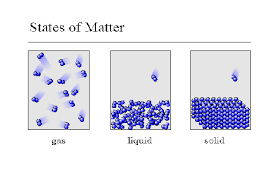
At higher temperatures
a)
particles in an object have less energy
b)
particles in an object move faster
c)
a gas contracts
13.
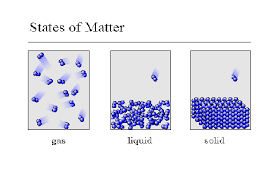
A gas
a)
has a definite shape but no definite volume
b)
has a definite volume but no definite shape
c)
has fast-moving particles
14.
Freezing
a)
Solid to gas
b)
Liquid to solid
c)
Gas to solid
d)
Liquid to gas
15.
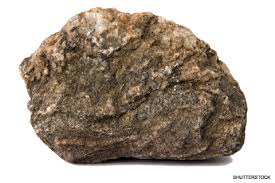
Which state of matter has tightly packed molecules?
a)
solid
b)
liquid
c)
gas
16.
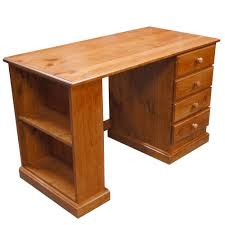
Which state of matter has a definite shape?
a)
solid
b)
liquid
c)
gas
17.
What is happening when my ice cream changes from a solid to a liquid?
a)
freezing
b)
melting
c)
burning
d)
evaporation
18.
The state of matter that has no definite size or shape is
a)
Solid
b)
Liquid
c)
Gas
19.
Particles of a liquid
a)
are tightly packed together and stay in a fixed position.
b)
have no viscosity.
c)
decrease in volume with increasing temperature.
d)
are free to move around one another but still touch.
20.
What term describes a solid changing to a gas?
a)
Deposition
b)
Sublimation
c)
Evaporation
d)
Freezing
21.
What is condensation?
a)
gas to solid
b)
gas to liquid
c)
liquid to solid
d)
solid to liquid
22.
Which has a greater distance between particles?
a)
Solid
b)
Liquid
23.
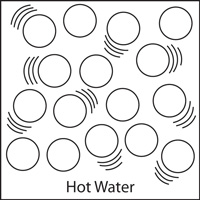
The speed of the molecules determines the _____.
a)
volume
b)
density
c)
pressure
d)
temperature
24.
The slower the particles in a substance move,
a)
the colder it is.
b)
the warmer it is.
c)
the more energy it has.
d)
the less energy it has.
25.
Thermal energy is...
a)
heat energy.
b)
the energy of motion
c)
energy of nuclear processes.
d)
an indication of physical change.
26.
What is the noble gas shorthand electron for Sulfur atom?
a)
[Ar] 3p4
b)
[He] 3s23p4
c)
[Ne] 3s23p4
d)
[Na] 3s23p4
27.
The electron configuration of an atom is 1s22s22p6. The number of electrons in the atom is
a)
3
b)
6
c)
8
d)
10
28.
What atom matches this electron configuration?
1s22s22p63s23p64s23d10
1s22s22p63s23p64s23d10
a)
Zinc
b)
Copper
c)
Nickel
d)
Germanium
29.
Which of the following is the smallest in size?
a)
K
b)
Na
c)
Li
d)
Cs
30.
What electron configuration matches an oxygen ion?
a)
1s22s22p63s2, 3p64s23d104p5
b)
1s22s22p4
c)
1s22s22p6
d)
1s22s22p63s23p64s23d1
31.

How many valence electrons does Si contain? (click to see image)
a)
14
b)
28
c)
2
d)
4
32.
How many electrons can the first energy level hold?
a)
1
b)
2
c)
8
d)
0
33.
The electron configuration of an atom is 1s22s22p6. The number of valence electrons in the atom is
a)
3
b)
6
c)
8
d)
10
34.

What atom is represented here?
a)
Carbon
b)
Nitrogen
c)
Oxygen
d)
Fluorine
35.

How many valence electrons are represented here?
a)
7
b)
5
c)
2
d)
8
36.
Valence electrons are:
a)
Electrons farthest away from the nucleus
b)
Electrons closest to the nucleus
c)
Electrons that just come and go - they don't stay with the atom
37.
Magnesium's ion
a)
Mg+
b)
Mg2+
c)
Mg-
d)
Mg2-
38.
When an atom loses a valence electron, it becomes a(n) _____________ ion.
a)
positive
b)
negative
c)
neutral
d)
polyatomic
39.
When an atom gains a valence electron, it becomes a(n) _____________ ion.
a)
positive
b)
negative
c)
neutral
d)
polyatomic
40.
Atoms that gain & lose electrons are called _________
a)
ions
b)
isotopes
c)
radioactive
d)
corrosive
41.
What is the charge of an atom that has lost one electron?
a)
-1
b)
-2
c)
+1
d)
+2
42.
What is the charge of an atom that has gained one electron?
a)
-1
b)
-2
c)
+1
d)
+2
43.
Cations are _______ that form ____________ ions and __________ electrons.
a)
nonmetals, positive, lose
b)
nonmetals, negative, gain
c)
metals, positive, gain
d)
metals, positive, lose
44.
Anions are _______ that form ____________ ions and __________ electrons.
a)
nonmetals, positive, lose
b)
nonmetals, negative, gain
c)
metals, positive, gain
d)
metals, positive, lose
45.
How many unpaired electrons would lithium have?
a)
1
b)
2
c)
3
d)
0
46.
What atom matches this electron configuration?
1s22s22p63s2
1s22s22p63s2
a)
Neon
b)
Magnesium
c)
Aluminum
d)
Potassium
47.
The chemical formula of magnesium phosphide is
a)
MgP
b)
Mg₂P₃
c)
Mg₃P₂
d)
Mg₃(PO₄)₂
48.
K+, O-2
a)
KO
b)
K2O
c)
K-2O2
d)
O2K
49.
Ionic compounds are written with
a)
cation (+ ion) first then anion (- ion)
b)
anion (- ion) first then cation (+ ion)
c)
either way is fine
d)
polyatomic ions first
50.
How do the following two elements bond together?
Pb4+ O2-
Pb4+ O2-
a)
PbO
b)
Pb4O2
c)
PbO2
d)
Pb2O4
51.
What is the formula for sodium phosphate?
a)
Na3PO4
b)
Na3PO3
c)
Na3P
d)
Na3PO
52.
Whats the formula
Sr+2 + (CO3)-2
Sr+2 + (CO3)-2
a)
Sr(CO3)
b)
Sr2 (CO3)2
c)
Sr1(CO)5
d)
Sr(CO5)
53.
What is the formula for calcium carbonate?
a)
CaCO
b)
CaCO2
c)
CaCO3
d)
Ca3CO3
54.
What is the FORMULA for
calcium chloride
calcium chloride
a)
CaCl2
b)
Cl2Ca
c)
Ca2Cl
d)
CaCl
55.
What is the formula for Copper II Sulfide?
a)
CuS
b)
Cu₂S
c)
CuS₂
d)
CuSO₃
56.
Name this compound:
NaBr
NaBr
a)
Bromide sodide
b)
Sodium bromide
c)
Sodium bromate
d)
Sodium bromite
57.
Ionic Compounds are made up of
a)
cation and anion
b)
cation and cation
c)
anion and anion
d)
doesn't matter
58.
Covalent compounds
a)
transfer electrons
b)
keep electrons
c)
release electrons
d)
share electrons
59.
What does the Roman numeral represent in naming ionic compounds with a transition metal?
a)
number of atoms
b)
number of metals
c)
charge of the metal
d)
charge of the non-metal
60.
What is the name for N2O5?
a)
Dinitrogen pentoxide
b)
Dinitrogen oxide
c)
Nitrogen pentaoxide
d)
Nitrogen oxide
61.
What is the formula for Disulfide trichloride?
a)
Su2Cl3
b)
2S3Cl
c)
S2Cl3
d)
Si2Cl3
62.
What is the formula for Calcium phosphate?
a)
CaPO4
b)
Ca3(PO4)2
c)
Ca2PO4
d)
CaP
63.
What is the formula for Copper (III) fluoride?
a)
Cu3F
b)
CuF3
c)
Cu3F3
d)
Cu2F3
64.
What is the formula for Potassium fluoride?
a)
K2F
b)
KF
c)
KF2
d)
K2F2
65.
A measure of the size of an atom, and is generally defined as the distance from the nucleus to the outermost electron orbit
a)
chemical reactivity
b)
atomic radius
c)
energy levels
d)
orbit
66.
The core of an atom where most of the mass of an atom exists; contains protons and neutrons
a)
nucleus
b)
electron shell
c)
proton
d)
electron
67.
The chart scientists use to organize and classify all the known elements
a)
elements chart
b)
the chart
c)
Periodic Table of the Elements
d)
Period table
68.
Which has the greater EN:
Cl or Al?
Cl or Al?
a)
Cl
b)
Al
69.
Which has the greater EN:
H or F?
H or F?
a)
H
b)
F
70.
Which of the following will have a larger radius than Zinc?
a)
Gallium
b)
Aluminum
c)
Magnesium
d)
Strontium
71.
Which of the following will have a higher electronegativity than arsenic (As)?
a)
Carbon (C)
b)
Neon (Ne)
c)
Antimony (Sb)
d)
Germanium (Ge)
72.
As you move across the periodic table atoms tend to get smaller because, ______________.
a)
the atoms have more mass.
b)
the atoms have less mass
c)
the atoms have more protons.
d)
the atoms have less electrons.
73.
The element with the lowest electronegativity in Period 3 is -
a)
Na
b)
Cl
c)
Ar
d)
Mg
74.
A group of elements that includes the most active of the elements is the -
a)
halogens.
b)
noble gases.
c)
nitrogen group.
d)
alkaline earth metals.
75.
Which is larger:
Ca or Ca+2
Ca or Ca+2
a)
Ca
b)
Ca+2
c)
both are same size
76.
Put the following elements in order of decreasing ionization energy:
O, Te, Po, S.
O, Te, Po, S.
a)
O, S, Po, Te
b)
O, S, Te, Po
c)
O, Te, Po, S
d)
O, Po, Te, S
77.
Which is larger:
P or P-3
P or P-3
a)
P
b)
P-3
c)
both are same size
78.

The atoms along the staircase are called
a)
metals
b)
nonmetals
c)
metalloids
d)
noble gases
79.
The element with the largest electronegativity in the halogens is -
a)
At
b)
F
c)
Cl
d)
Br
80.
Fill in the blanks with coefficient:
PCl5+_ H2O→_ HCl+H3PO4
PCl5+_ H2O→_ HCl+H3PO4
a)
4, 5
b)
1, 6
c)
3, 8
d)
2,2
81.
Which side of a chemical equation is the product side?
a)
Left (before the yields sign)
b)
Right (after the yields sign)
82.
Balance this equation.
_Mg + _Cl2 --> _MgCl2
_Mg + _Cl2 --> _MgCl2
a)
1, 2,1
b)
already balanced
c)
2,1,1
d)
1,1,2
83.
Balance this equation
_Zn+_HCl-->_ZnCl2 +_H2
_Zn+_HCl-->_ZnCl2 +_H2
a)
1,1,2,1
b)
1,1,1,2
c)
1,2,1,1
d)
2,1,1,1
84.
Balance this equation
_N2 + _H2 --> _NH3
_N2 + _H2 --> _NH3
a)
1,2,3
b)
1,3,2
c)
1,1,2
d)
2,1,1
85.
What is a coefficient?
a)
The small number on the right of the chemical symbol.
b)
The large number to the left of a formula.
86.
How many atoms of aluminum are on each side of the following equation: 4Al + 3O2 --> 2Al2 O3
a)
2
b)
6
c)
1
d)
4
87.

The blue numbers in the image below represent ________
a)
Charges
b)
coefficients
c)
subscripts
d)
none of the answers are correct
88.
Balance this equation,
Al2O3 --> Al + O2
Al2O3 --> Al + O2
a)
Cannot be balanced
b)
2Al2O3 --> 2Al+3O2
c)
2Al2O3--> 4Al+3O2
d)
3Al2O3--> 2Al+O2
89.
Balance this equation:
P4+O2 --> P2O3
P4+O2 --> P2O3
a)
3 P4+ O2 --> 2 P2O3
b)
P4+ O2 --> 2 P2O3
c)
P4+ 3 O2 --> 2 P2O3
d)
P4+ 2 O2 --> 3 P2O3
90.
At the end of chemical reactions, what is the total mass of the reactants compared to the total mass of the products?
a)
the product is doubled
b)
the product is half the mass of the reactants
c)
the mass is the same
d)
the mass changes depending on the reaction
91.
Which elements are(is) not balanced?
LiNO3 +CaBr2 --> Ca(NO3)2 + LiBr
LiNO3 +CaBr2 --> Ca(NO3)2 + LiBr
a)
Li
b)
Ca and Li
c)
O and N
d)
Ca
92.
What does the Law of Conservation of Mass state?
a)
Matter cannot be gained or lost in a chemical reaction.
b)
Matter can only be lost in a chemical reaction.
c)
Matter can only be gained in a chemical reaction.
d)
Matter can be gained and lost in a chemical reaction.
93.
What would be the proper chemical formula for combining Al3+ and Cl- :
a)
AlCl3
b)
Al3Cl
c)
AlCl
d)
Al3Cl3
94.
Name this formula:
HgF
HgF
a)
Hydrogen Fluoride
b)
Hydrogen (II) Fluoride
c)
Hydrogen (IV) Fluoride
d)
Mercury(I) Fluoride
95.
Name this formula:
Al2O3
Al2O3
a)
Aluminum Oxide
b)
Aluminum Oxygen
c)
Antimony Oxide
d)
Aluminum (VII) Oxide
96.
Name this formula:
Fe2O
Fe2O
a)
Iron Oxygen
b)
Ferrous Oxide
c)
Iron Oxide
d)
Iron (I) Oxide
97.
What is the correct name for the compound PH3?
a)
Monophosphorus trihydride
b)
Phosphorus hydride
c)
Trihydrogen monophosphide
d)
Phosphorus trihydride
98.
What is the correct name for the compound N2O?
a)
Dinitrogen monoxide
b)
Dinitrogen oxide
c)
Nitrogen oxide
d)
Nitrogen dioxide
99.

This picture represents:
a)
Element
b)
Compound
c)
Mixture of Elements
d)
Mixture of Compounds
100.
A substance with two or more elements that are combined in a fixed proportion
a)
colloid
b)
compound
c)
element
d)
solution
101.
A substance in which all the atoms are the same
a)
colloid
b)
homogeneous mixture
c)
solution
d)
element
102.
A mixture in which different materials can be identified easily
a)
element
b)
heterogeneous mixture
c)
homogeneous mixture
d)
solution
103.
A mixture that contains two or more substances blended evenly throughout
a)
heterogeneous mixture
b)
homogeneous mixture
c)
suspension
d)
colloid
104.
Which of the following is an element?
a)
Sugar
b)
Salt
c)
Water
d)
Oxygen
105.
A mixture that is so evenly mixed you can't see the parts. Such as Kool-Aid
a)
Homogeneous Mixture
b)
Heterogeneous Mixture
c)
Pure Substance
106.
If you change a substance into a new substance...
a)
Partial Change
b)
Physical Change
c)
Chemical Change
d)
Freezing
107.

Is burning wood a chemical or physical change?
a)
chemical
b)
physical
108.
A gold bar is an example of a.....
a)
pure element
b)
pure compound
c)
heterogeneous mixture
d)
homogeneous mixture
109.

What line segment represents only the solid state?
a)
A-B
b)
B-C
c)
C-D
d)
D-E
110.

This type of graph is called a:
a)
Phase diagram
b)
Heating curve
c)
State of matter
d)
Temperature chart
111.
Phase change from a solid to a gas.
a)
sublimation
b)
deposition
c)
condensation
d)
evaporation
112.
What is the phase change of a solid to a liquid?
a)
freezing
b)
melting
c)
boiling
d)
condensation
113.

A gas
a)
has a definite shape but no definite volume
b)
has a definite volume but no definite shape
c)
has fast-moving particles
114.
The opposite phase of melting is
a)
freezing
b)
sublimation
c)
condensation
d)
deposition
115.

Which process takes the longest to occur?
a)
melting
b)
boiling
c)
freezing
d)
heating the solid
116.

What state(s) of matter are present at D-E?
a)
Solid-liquid
b)
Liquid
c)
Liquid-gas
d)
Gas-Solid
117.

What state of matter is X?
a)
solid
b)
liquid
c)
gas
d)
supercritical fluid
118.
What state of matter is Y?
a)
solid
b)
liquid
c)
gas
d)
supercritical fluid
119.
What state of matter is Z?
a)
solid
b)
liquid
c)
gas
d)
supercritical fluid
120.
What is point A?
a)
triple point
b)
critical point
c)
equilibrium point
d)
normal melting point
121.
What is point B?
a)
triple point
b)
critical point
c)
equilibrium point
d)
normal melting point
122.
What change occurs from F to E?
a)
sublimation
b)
deposition
c)
melting
d)
condensation
123.
What change occurs from C to D?
a)
condensation
b)
vaporization
c)
melting
d)
sublimation
124.

What would happen to the liquid substance if the pressure were decreased until a phase change occurred? It would undergo...
a)
melting
b)
vaporization
c)
condensation
d)
sublimation
125.
What is the normal boiling point of this substance?
a)
150 °C
b)
100 °C
c)
-50 °C
d)
0 °C
126.

Water exists as a _____________ at 3 mmHg and 50 °C.
a)
solid
b)
liquid
c)
gas
d)
supercritical fluid
127.
Water exists as a _____________ at 700 mmHg and 50 °C.
a)
solid
b)
liquid
c)
gas
d)
supercritical fluid
128.
What is the normal melting point of this substance?
a)
150 °C
b)
100 °C
c)
-50 °C
d)
0 °C
129.

What section of the phase change graph would you find a gas being heated?
a)
A-B
b)
C-D
c)
D-E
d)
E-F
130.
What section of the phase change graph would you find a solid being heated?
a)
A-B
b)
B-C
c)
C-D
d)
D-E
100 %

