Wayground logo

Free Printable Worksheets

Font size

S
M
L
XL
Worksheets

Axial Skeletal and More

Total questions: 84

Worksheet time: 1hrs 11mins
Name
Class
Date
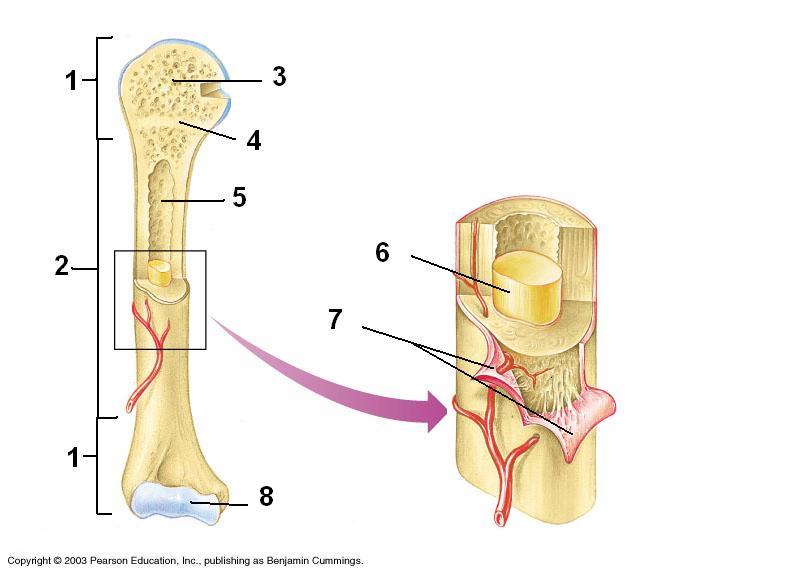
1.
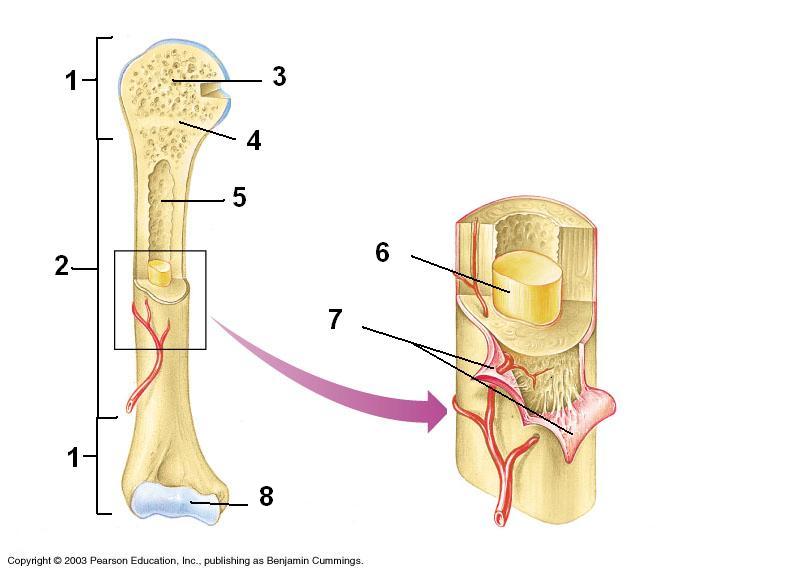
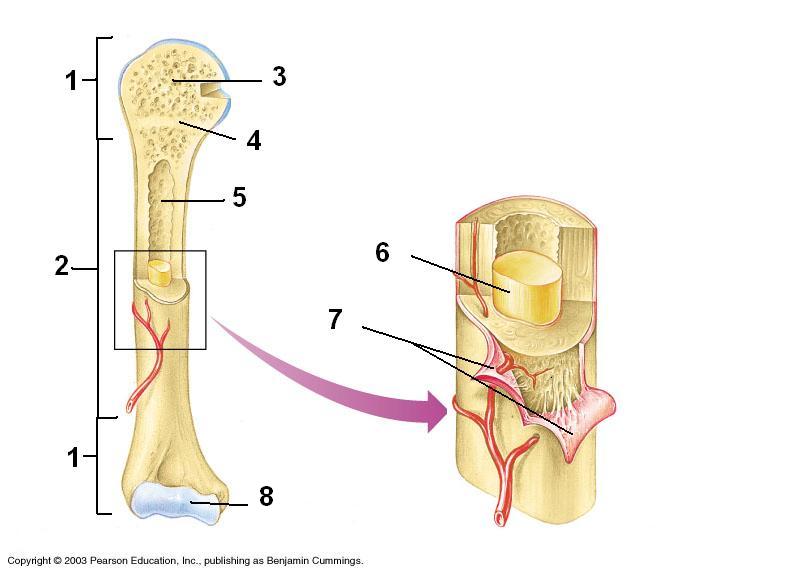
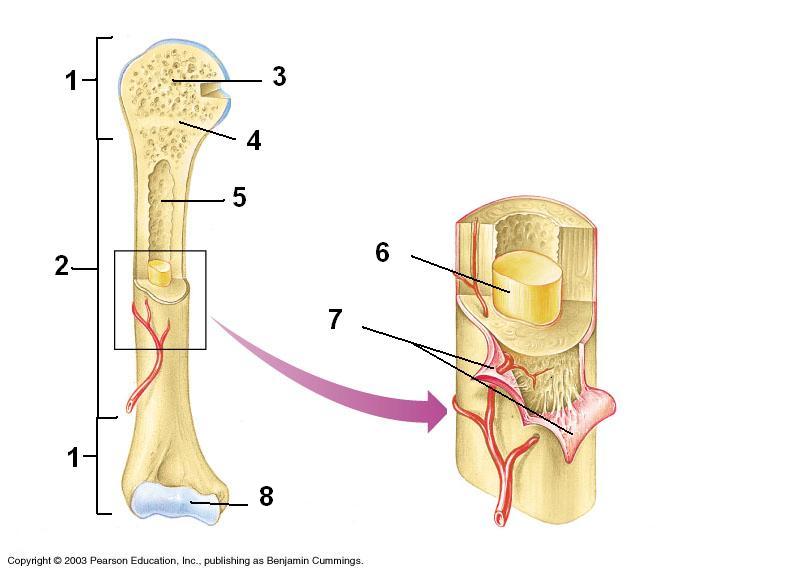
Structure #5 is the 
a)
medullary cavity
b)
periosteum
c)
epiphysis
d)
diaphysis
2.
Structure #7 is the 
a)
medullary cavity
b)
periosteum
c)
epiphysis
d)
diaphysis
3.
In adults, the substance at #6 would be 
a)
red marrow
b)
yellow marrow
c)
spongy bone
d)
clotted blood
4.
The epiphysis is 
a)
The shaft of a bone
b)
a bone cell
c)
the end of a long bone
d)
the covering of a bone
5.
Periosteum
a)
the membrane lining the bone cavity
b)
the tough membrane covering the shaft of the bone
c)
the shiny, articulating cartilage on the ends of a bone
d)
the blood vessels inside a bone
6.
Where are blood cells made? 
a)
Yellow marrow 
b)
Red marrow
c)
Spongy Bone 
d)
Periosteum
7.
Spongy bone would primarily be found where in a bone?
a)
diaphysis
b)
epiphysis
c)
periosteum
d)
endosteum
8.

What type of bone makes up a majority of the diaphysis?

a)

spongy bone

b)

compact bone

c)

rigid bone

d)

soft bone

9.
Structure #2 is the 
a)
medullary cavity
b)
periosteum
c)
epiphysis
d)
diaphysis
10.
The shiny white substance at #8 is the 
a)
articular cartilage
b)
periosteum
c)
yellow marrow
d)
diaphysis
11.
Osteon is...
a)
A microscopic cylindrical-shaped unit of compact bone. 
b)
Knobby end of a long bone 
c)
Strong, tough, fibrous connective tissue covering the bone. 
d)
porous units pf spongy bone 
12.
what are the rings around the haversian canal called?
a)
lacunae
b)
lamella
c)
osteocyte
d)
volkmann's canal
13.
Osteocyte
a)
a cavity in a bone
b)
a bone cell
c)
an orifice
14.
Mature bone cells that live in tiny cavities within the bone are called?
a)
osteocytes
b)
osteoblasts
c)
osteoclasts
d)
osteons
15.
An osteocyte "lives" in __.
a)
lacunae
b)
lamellae
c)
Haversian canals
d)
Volkmann's canals
16.
Canaliculi are for 
a)
providing protection 
b)
housing osteocytes
c)
providing nourishment
d)
holding bone together
17.
Structures #2 are
a)
osteons
b)
perforating (Volkmann's) canals
c)
Central (Haversian) canals
d)
canaliculi
18.
Structure #3 is a/n
a)
osteon
b)
perforating (Volkmann's) canals
c)
Central (Haversian) canals
d)
canaliculi
19.
Structure #4 is a/n
a)
osteon
b)
osteocyte
c)
lacuna
d)
osteoblast
20.
Structures #6 are  
a)
osteons
b)
lamellae
c)
lacunae
d)
canaliculi
21.
What feature has been created in stage D of this diagram
a)
Soft Callus
b)
Blood Clot
c)
Hard Callus
d)
Fibrous CT
22.
Bone breaks incompletely, occurs most commonly during the infantile stages of life.
a)
Greenstick Fracture
b)
Stable Fracture
c)
Bluestick Fracture
d)
Comminuted Fracture 
23.
Which fracture is where the bone is visible through the skin?
a)
Compound Fracture
b)
Stable Fracture
c)
Kevin Ware
d)
Horse
24.
_________ is an exaggerated lateral ( side to side) curve of the spine
a)
hyperkyphosis
b)
hyperlordosis
c)
scoliosis
25.
Bones of the wrist could be classified as 
a)
Short Bones
b)
Long Bones
c)
Irregular Bones
d)
Flat Bones
26.
The femur and humerus could be classified as
a)
Short Bones
b)
Long Bones
c)
Irregular Bones
d)
Flat Bones
27.
Bones of the cranium could be classified as
a)
Short Bones
b)
Long Bones
c)
Irregular Bones
d)
Flat Bones
28.
Which of the following is not a function of bones
a)
Calcium Storage
b)
Production of red blood cells
c)
protection
d)
synthesis of vitamin D
29.
Osteoclasts are only used in bone formation not in fracture healing.
a)
True
b)
False
30.
A break in bone that does not penetrate the skin
a)
stress fracture
b)
closed fracture
c)
compound fracture
d)
open fracture
31.
Which of the following cells are responsible for laying down new bone tissue?  
a)
Osteoblasts
b)
Calcium 
c)
Cartilage 
d)
Osteoclasts
32.
A small crack in the bone caused by repetitive excessive impact is called a  ____________ fracture.
a)
stress
b)
greenstick 
c)
Colle's
d)
compression
33.
Type of fracture that the bone is pressed inward
a)
depressed
b)
spiral
c)
compression
d)
greenstic
34.
Trabeculae are found in __ bone.
a)
spongy
b)
Compact
35.
The bone indicated by #2 is the 
a)
parietal bone
b)
temporal bone
c)
ethmoid bone
d)
occipital bone
36.
The bone indicated by #4 is the 
a)
frontal bone
b)
nasal bone
c)
ethmoid bone
d)
temporal bone
37.
The bone indicated by #3 is the 
a)
frontal bone
b)
nasal bone
c)
ethmoid bone
d)
temporal bone
38.
The suture indicated by #13 is the 
a)
coronal suture
b)
sagittal suture
c)
lamdoid suture
d)
squamous suture
39.
The suture indicated by #14 is the 
a)
coronal suture
b)
sagittal suture
c)
lamdoid suture
d)
squamous suture
40.
The structure indicated by #9 is the 
a)
zygomatic process
b)
mastoid process
c)
styloid process
d)
inferior conchae
41.
The structure indicated by #10 is the 
a)
zygomatic process
b)
mastoid process
c)
styloid process
d)
inferior conchae
42.
The bone indicated by #1 is the 
a)
parietal bone
b)
temporal bone
c)
ethmoid bone
d)
occipital bone
43.
The bone indicated by #5 is the 
a)
frontal bone
b)
sphenoid bone
c)
ethmoid bone
d)
temporal bone
44.

The bone seen in green is the

a)

Mandible

b)

Parietal

c)

Temporal

d)

Sphenoid

45.
a)
Zygomatic
b)
Temporal
c)
Parietal
d)
Lacrimal
46.

The bone seen in green is the

a)

Lacrimial

b)

Sphenoid

c)

Maxilla

d)

Zygomatic

47.
Identify bone 10. 
a)
Nasal 
b)
Lacrimal 
c)
Vomer
d)
Inferior nasal conchae
48.
Butterfly shaped bone; houses the pituitary gland; base of the skull
a)
Parietal 
b)
Temporal 
c)
Sphenoid
d)
Occipital 
49.

The bone marking seen in green on the inferior surface are the

a)

Occipital Condyles

b)

Vomers

c)

Occipitals

d)

Frontals

50.
What suture is shown by arrow A?
a)
Coronal suture
b)
Squamous suture
c)
Lambdoidal suture
d)
Temporo-mandibular joint 
51.
What process is labeled C?
a)
Zygomatic process
b)
Styloid process
c)
Parietal
d)
Mastoid process
52.
What feature is this?
a)
External Aditory Meatus
b)
Superior Orbital Fissure
c)
Optic Canal 
d)
Styloid Process
53.
What feature is this?
a)
Optic Canal
b)
Carotid Canal
c)
Foramen Magnum
d)
Jugular Foramen
54.
The hard palate is made of which bones?
a)
maxilla and palatine
b)
maxilla and mandible
c)
palatine and mandible
d)
vomer and palatine
55.
The occipital condyles of the skull articulate with...
a)
axis (2nd vertebrae)
b)
atlas (1st vertebrae)
c)
mandible
d)
Temporal bone
56.
What bone is #1?
a)
Atlas
b)
Axis
c)
Parietal
d)
Clavicle
57.
What vertebral section is #6?
a)
Cervical
b)
Thoracic
c)
Lumbar
d)
Sacral
58.
What vertebral section is #5?
a)
Cervical
b)
Thoracic
c)
Lumbar
d)
Sacral
59.
How many bones are in #5?
a)
7
b)
12
c)
5
d)
3
60.
What vertebral section is #7?
a)
Cervical
b)
Thoracic
c)
Lumbar
d)
Sacral
61.
How many bones are in #6?
a)
7
b)
12
c)
5
d)
3
62.
How many bones are in #7?
a)
7
b)
12
c)
5
d)
3
63.

What is abnormal lateral curvature of the spine?

a)

scoliosis

b)

lordosis

c)

kyphosis

64.

What is abnormal curvature of the thoracic spine?

a)

scoliosis

b)

lordosis

c)

kyphosis

65.

What specific type of vertebrae is seen here

a)

Cervical

b)

Thoracic

c)

Lumbar

d)

Sacral

66.
Identify "A"
a)
Spinous process
b)
Lamina
c)
Pedicle
d)
Transverse process
67.
Identify "E"
a)
Transverse Foramen
b)
Transverse Process
c)
Vertebral Foramen
d)
Vertebral body
68.

What specific type of vertebrae is seen here?

a)

Cervical

b)

Thoracic

c)

Lumbar

d)

Sacral

69.
Which is the vertebral body?
a)
B
b)
H
c)
G
d)
F
70.
Which is the pedicle?
a)
H
b)
B
c)
C
d)
F
71.
The middle, flat section of the sternum. 
a)
clavicle 
b)
head 
c)
glenoid cavity 
d)
Body 
72.
Bones of the thoracic cavity that are attached to vertebrae only (not attached to sternum or another rib by costal cartilage); lowest two false ribs
a)
floating ribs
b)
false ribs
c)
true ribs
d)
loose ribs
73.
Letter G is pointing to what type of rib?
a)
Vertebral
b)
Vertebralsternal
c)
Vertebralchondral
d)
Mc
74.
Thick, upper portion of the sternum; articulates with clavicles
a)
xiphoid process
b)
coraoid process
c)
glenoid cavity 
d)
manubrium 
75.
Bones of the thoracic cavity that are not attached to the sternum; 5 lower ribs 
a)
small rib
b)
floating rib
c)
true rib
d)
false rib
76.
How many floating ribs are there? 
a)
12
b)
2
c)
4
77.
What bone are the arrows pointing to?
a)
coccyx
b)
sacrum
78.
How many lumbar vertebrae are there?
a)
5
b)
7
c)
12
79.
Curvatures we are born with are ___ curvatures.
a)
primary
b)
sacral
c)
thoracic
d)
all of these
80.
The fibrous membranes between the bones of a fetal skull are ___.
a)
osteocytes
b)
fontannels
c)
fountains
d)
chondrocytes
81.

The point on a vertebrae that the rib articulates with is called the __.

a)

facet

b)

manubrium

c)

sternum

d)

xiphoid process

82.

Which portion of the rib that articulates with vertebrae?

a)

body

b)

head

c)

xiphoid process

d)

glenoid cavity

83.

The suture seen at #15 is the

a)

lamboidal suture

b)

coronal

c)

frontal

d)

sagittal

84.

Which portion of the rib articulates with the body of the vertebrae?

a)

head

b)

body

c)

tubericle

d)

neck