
 Worksheets
Physical Science Semester Exam Review
Total questions: 127
Worksheet time: 3hrs 51mins
Name
Class
Date
1.
What is the oxidation number of Fe in FeO?
a)
+1
b)
-1
c)
+2
d)
-2
2.
What is oxidation number of Ca in CaCl2 ?
a)
-1
b)
-2
c)
+1
d)
+2
3.
What is oxidation number of O in O2 ?
a)
0
b)
-2
c)
+1
d)
+2
4.
What is oxidation number of Na in Na+ ?
a)
0
b)
+1/2
c)
+1
d)
-1
5.
What is the oxidation number of Br in BrO3-1?
a)
+3
b)
-2
c)
+5
d)
+2
6.
The sum of all oxidation numbers in a neutral compound is ___.
a)
0
b)
1
c)
-1
d)
depends on the compound
7.
Nobel gases have an oxidation of
a)
-1
b)
-2
c)
-3
d)
Nobel gases never gain or lose electrons, no exceptions.
8.
A cation is a ____ ion.
a)
negative
b)
positive
9.
A anion will be a ____ ion.
a)
negative
b)
positive
10.
Ionic bonds form between metals and ____.
a)
metalloids
b)
metals
c)
nonmetals
11.
What element always has an oxidation number of +1?
a)
Hydrogen
b)
Fluorine
c)
Chlorine
d)
Iodine
12.
How many valence electrons does carbon (C) have?
a)
3
b)
4
c)
5
d)
6
13.
How many valence electrons does chlorine (Cl) have?
a)
2
b)
5
c)
6
d)
7
14.

This is the correct dot diagram for sodium (Na)
a)
true
b)
false
15.

This is a correct dot diagram for fluorine (F)
a)
true
b)
false
16.

This is a correct dot diagram for oxygen (O)
a)
true
b)
false
17.

This is the correct dot diagram for nitrogen (N)
a)
true
b)
false
18.

This is a correct dot diagram for nitrogen (N)
a)
true
b)
false
19.

This is a correct dot diagram for neon (Ne)
a)
true
b)
false
20.

This could be the dot diagram of
a)
Ne
b)
H
c)
C
d)
F
21.

This could be the dot diagram of
a)
Mg
b)
Cl
c)
C
d)
O
22.

This could be the dot diagram of
a)
O
b)
B
c)
Li
d)
Ne
23.

This could be the dot diagram of
a)
Be
b)
B
c)
C
d)
Ne
24.
Looking at the Periodic Table, how many valence electrons does lithium (Li) have?
a)
1
b)
2
c)
3
d)
8
25.
How many valence electrons does neon (Ne) have?
a)
1
b)
5
c)
7
d)
8
26.

What element is this?
a)
Helium
b)
Hydrogen
c)
Argon
d)
Silver
27.

How many electrons does Si contain? (click to see image)
a)
14
b)
28
c)
2
d)
None of these
28.

How many electrons does potassium K contain? (click to see image)
a)
19
b)
39
c)
20
d)
40
29.

What element is represented in this Bohr Model?
a)
Carbon
b)
Hydrogen
c)
Aluminum
d)
Lithium
30.

Carbon-12 has 6 protons and 6 neutrons. How many electrons will orbit the nucleus?
a)
12
b)
6
c)
3
d)
18
31.
What is the charge of a neutron?
a)
Positive
b)
Negative
c)
Neutral/no charge
32.
What is the center of the atom called?
a)
Orbital
b)
Nucleus
c)
Proton
d)
Electron shell
33.
The positive particles of an atom are
a)
electrons
b)
positrons
c)
neutrons
d)
protons
34.
an atom with atomic number 6 would have how many protons
a)
6
b)
12
c)
3
d)
cannot be determined
35.
True or False? Neutrons have a negative charge
a)
True
b)
False
36.
A particle that moves around the nucleus is a(n)...
a)
Proton
b)
Neutron
c)
Electron
d)
Quark
37.

What does the 1.00794 stand for?
a)
Hydrogen
b)
atomic number
c)
atomic mass
d)
atomic explosion
38.
In the modern periodic table elements are arranged by:
a)
atomic mass
b)
atomic number
c)
valence electrons
d)
number of isotopes
39.
a)
Periods
b)
Groups
40.
a)
Periods
b)
Groups
41.

a)
energy levels
b)
valence electrons
c)
protons
d)
neutrons
42.
a)
energy levels
b)
valence electrons
c)
protons
d)
neutrons
43.
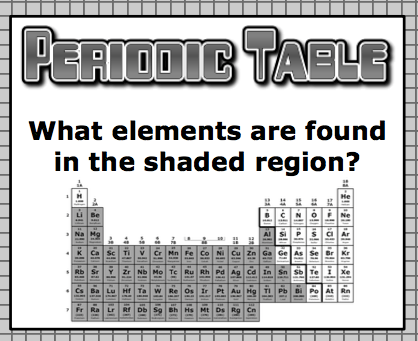
a)
Metals
b)
Nonmetals
c)
Metalloids
44.
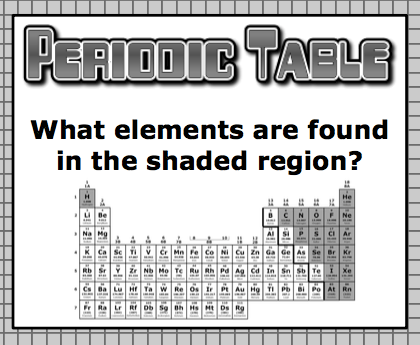
a)
Metals
b)
Nonmetals
c)
Metalloids
45.
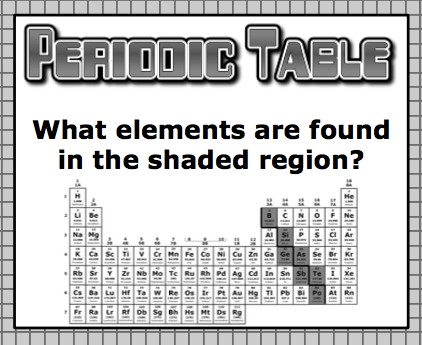
a)
Metals
b)
Nonmetals
c)
Metalloids
46.
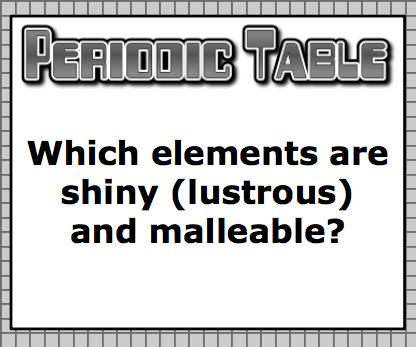
a)
Metals
b)
Nonmetals
c)
Metalloids
47.
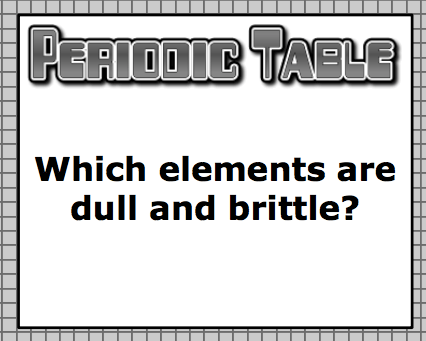
a)
Metals
b)
Nonmetals
c)
Metalloids
48.
Which is an alkali metal?
a)
Magnesium
b)
Iron
c)
Sodium
d)
Europium
49.

In what section would Transition Metals be found?
a)
orange
b)
light blue
c)
blue
d)
white
50.

Which two families on the periodic table react aggressively?
a)
noble gases and alkali metals
b)
alkali metals and halogens
c)
noble gases and halogens
d)
metals and halogens
51.
Which element is found in group 16 period 3?
a)
Sulfur (S)
b)
Selenium (Se)
c)
Chlorine (Cl)
d)
Carbon (C)
52.
Which element is found in period 3 group 2?
a)
Sodium (Na)
b)
Magnesium (Mg)
c)
Yttrium (Y)
d)
Boron (B)
53.
Non-metals are good conductors of heat and electricity.
a)
TRUE
b)
FALSE
54.
Which of the following is a good conductor of heat?
a)
Metal
b)
Nonmetal
c)
Metalloid
55.
A molecule is
a)
two or more atoms bonded together
b)
one type of atom
c)
smaller than an atom
d)
an element
56.

Name this compound: H2O
a)
Water
b)
Carbon dioxide
c)
Hydrogen peroxide
d)
Sulfuric acid
57.
What atoms make up a water molecule
a)
1 hydrogen, 1 oxygen
b)
1 hydrogen, 2 oxygen
c)
2 hydrogen, 1 oxygen
d)
1 water
58.
What is in the nucleus of an atom?
a)
Protons and Neutrons
b)
electrons
c)
nothing
d)
All of the above
59.

What is the atomic number of K?
a)
19
b)
39.098
60.
Bromine (Br)
a)
alkali metal
b)
alkaline earth metal
c)
halogen
d)
noble gas
61.
Potassium (K)
a)
alkali metal
b)
alkaline earth metal
c)
halogen
d)
noble gas
62.
Argon (Ar)
a)
alkali metal
b)
alkaline earth metal
c)
halogen
d)
noble gas
63.
Radium (Ra)
a)
alkali metal
b)
alkaline earth metal
c)
halogen
d)
noble gas
64.
Iodine (I)
a)
alkali metal
b)
alkaline earth metal
c)
halogen
d)
noble gas
65.
Which is a noble gas?
a)
Fluorine
b)
Hydrogen
c)
Iodine
d)
Krypton (Kr)
66.
Which is an alkaline earth metal?
a)
Calcium
b)
Rubidium
c)
Carbon
d)
Iodine
67.
1. The flammability of a substance is
a)
A. a chemical property.
b)
B. related to the density
c)
C. a physical property.-
d)
D. changeable.
68.
3. 1. What is formed when particles of two or more substances are distributed evenly among each other?
a)
A. compound
b)
B. suspension
c)
C. solution
d)
D. element
69.
4. 1. What is a pure substance made of two or more elements that are chemically combined called?
a)
A. element
b)
B. compound
c)
C. mixture
d)
D. solution
70.
5. When materials combine to form a mixture, they
a)
A. keep their original properties.
b)
B. react to form a new substance with new properties.
c)
C. combine in a specific ratio.
d)
D. always change their physical state.
71.
6. When elements form mixtures, the elements
a)
A. keep their
original properties.
b)
B. react to form a new substance with new properties.
c)
C. combine in a specific mass ratio.
d)
D. always change their physical state.
72.
7. 1. If a spoonful of salt is mixed in a glass of water, what is the water called?
a)
A. solute
b)
B. solution
c)
C. solvent
d)
D. element
73.
9.. The particles in both a suspension and colloid can
a)
A. scatter light.
b)
B. settle out.
c)
C. be soluble.
d)
D. pass through a fine filter.
74.
13. silver spoon
a)
A. MIXTURE
b)
B. COMPOUND
c)
C. ELEMENT
75.
14. a milk shake
a)
A. MIXTURE
b)
B. COMPOUND
c)
C. ELEMENT
76.
20. Sugar water
a)
A. SOLUTION
b)
B. SUSPENSION
c)
C. COLLOID
77.
25. Italian dressing
a)
A. HOMOGENEOUS
b)
B. HETEROGENEOUS
78.
27. Sugar water.
a)
A. HOMOGENEOUS
b)
B. HETEROGENOUS
79.
If you spilled nails in a sandbox, what separation tool/method could you use to clean out the sandbox so it would be safe for children to play in?
a)
Filter
b)
Screen
c)
Magnet
d)
Evaporation
80.

Which form of matter has a definite shape and takes up space (has definite volume)?
a)
liquid
b)
solid
c)
gas
d)
clay
81.

Which form of matter take the shape of a container like this juice?
a)
liquid
b)
solid
c)
glass
d)
gas
82.

Which form of matter fills the space like it has in the balloon?
a)
liquid
b)
string
c)
solid
d)
gas
83.
What are the states of matter?
a)
solid, liquid, and juice
b)
solid and liquid
c)
solid and gas
d)
solid, liquid, and gas
84.
What is happening when my ice cream changes from a solid to a liquid?
a)
freezing
b)
melting
c)
burning
d)
evaporation
85.
What is happening when my water bottle in the freezer goes from a liquid state to a solid state?
a)
melting
b)
evaporating
c)
freezing
d)
cutting
86.
What happens when my glass of water is sitting in the sun and disappears into a gas?
a)
evaporation
b)
burning
c)
melting
d)
freezing
87.
My glass of ice water is sitting in the sun and has droplets of water on the outside of the glass. What is happening?
a)
condensation
b)
evaporation
c)
melting
d)
freezing
88.
Which has a greater distance between particles?
a)
Solid
b)
Liquid
89.
The slower the particles in a substance move,
a)
the colder it is.
b)
the warmer it is.
c)
the more energy it has.
d)
the less energy it has.
90.
A chemical change
a)
doesn't really change much.
b)
creates a new substance
c)
is a change in the state of matter
91.
A physical change is...
a)
a change that doesn't change the identity
b)
a change that makes something new.
c)
a chemical reaction
92.
Flammability (burns): Chemical or Physical Property
a)
Chemical Property
b)
Physical Property
93.
Density: Chemical or Physical Property
a)
Chemical Property
b)
Physical Property
94.
Blue Color: Chemical or Physical Property
a)
Chemical Property
b)
Physical Property
95.
Solubility (dissolves): Chemical or Physical Property
a)
Chemical Property
b)
Physical Property
96.
Reacts with Acid: Chemical or Physical Property
a)
Chemical Property
b)
Physical Property
97.
Brittleness: Chemical or Physical Property
a)
Chemical Property
b)
Physical Property
98.
Sour Taste: Chemical or Physical Property
a)
Chemical Property
b)
Physical Property
99.
Hardness: Chemical or Physical Property
a)
Chemical Property
b)
Physical Property
100.
Boiling Point: Chemical or Physical Property
a)
Chemical Property
b)
Physical Property
101.
Luster: Chemical or Physical Property
a)
Chemical Property
b)
Physical Property
102.
Odor: Chemical or Physical Property
a)
Chemical Property
b)
Physical Property
103.

What is the volume of Object X?
a)
10.0 cm3
b)
15.0 cm3
c)
20.0 cm3
d)
25.0 cm3
104.
What is the formula for density?
a)
density = mass x volume
b)
density = mass / volume
c)
density = mass + volume
d)
density = mass - volume
105.
Identify the type of reaction:
ZnCl2(aq) + Mg(s) --> Zn(s) + MgCl2(aq)
ZnCl2(aq) + Mg(s) --> Zn(s) + MgCl2(aq)
a)
Precipitate
b)
Single Replacement
c)
Double Displacement
d)
Decomposition
106.
Identify the reaction type:
HCl(aq) + KOH(aq) --> H2O(l) + KCl(aq)
HCl(aq) + KOH(aq) --> H2O(l) + KCl(aq)
a)
Double displacement
b)
Combustion
c)
Redox
d)
Precipitate
107.
Identify the reaction type:
C2H5OH(l) + O2(g) --> CO2(g) + H2O(g)
C2H5OH(l) + O2(g) --> CO2(g) + H2O(g)
a)
Double displacement
b)
Synthesis
c)
Acid base
d)
Combustion
108.
What is the generic equation for a double replacement reaction?
a)
AB + CD ---> AD + CB
b)
AB + CD ---> DA + CB
c)
AB + CD ---> A + BC
d)
AB + CD ---> D + CBA
109.
What is a double replacement?
a)
Two compounds react to form two new compounds.
b)
One compound reacts to form two separate elements.
c)
Two elements reacting to form a single compound.
d)
A hydrocarbon and
110.
How many elements are in C6H12O6?
a)
1
b)
2
c)
3
d)
4
111.
How many atoms of carbon (C) are in C6H12O6?
a)
3
b)
6
c)
12
d)
24
112.
Element or compound?
H2O
H2O
a)
element
b)
compound
113.

The red numbers in the image below represent ________
a)
subscripts
b)
coefficients
c)
I don't know, and don't want to try
d)
None of the answers are correct
114.

The blue numbers in the image below represent ________
a)
I don't know, and don't want to try
b)
coefficients
c)
subscripts
d)
none of the answers are correct
115.
The substances at the beginning of a chemical equation are called the ____
a)
product
b)
yield
c)
chemical symbol
d)
reactants
116.
In the equation, 2Mg + O2 ---> 2MgO, which are the reactants?
a)
Mg and O
b)
MgO
c)
Mg and MgO
d)
O and MgO
117.

Black = Carbon (C)
White = Hydrogen (H)
What would be the formula for ethane?
White = Hydrogen (H)
What would be the formula for ethane?
a)
CH4
b)
CH6
c)
C2H2
d)
C2H6
118.
Number of H in 3(NH₄)₂CrO₄
a)
4
b)
2
c)
8
d)
24
119.
Balance this equation...
HgO --> 2Hg + O2
HgO --> 2Hg + O2
a)
It is balanced
b)
2HgO --> Hg + O2
c)
2HgO --> 2Hg + O2
d)
I don't know...Oh well!
120.
Balance this equation...
Sb2S3 + O2 --> Sb + SO2
Sb2S3 + O2 --> Sb + SO2
a)
It is balanced
b)
Sb2S3 + 3O2 --> 2Sb + 3SO2
c)
Sb2S3 + O2 --> 2Sb + SO2
d)
I don't know...Oh well!
121.
Name this reaction, Cl2 + 2KI --> I2 + 2KCl
a)
Synthesis
b)
Single Replacement
c)
Double Replacement
d)
Decomposition
122.
Name this reaction, CO2 + H2O --> H2CO3
a)
Decomposition
b)
Single Replacement
c)
Synthesis
d)
Combustion
123.
At the end of chemical reactions, what is the total mass of the reactants compared to the total mass of the products?
a)
the product is doubled
b)
the product is half the mass of the reactants
c)
the mass is the same
d)
the mass changes depending on the reaction
124.
Why is the following chemical equation not balanced?
H2 + O2 --> H2O
H2 + O2 --> H2O
a)
each side of the equation has a different number of oxygen atoms
b)
each side of the equation has a different number of hydrogen atoms
c)
each side has the same mass
125.
What does the Law of Conservation of Mass state?
a)
Matter cannot be gained or lost in a chemical reaction.
b)
Matter can only be lost in a chemical reaction.
c)
Matter can only be gained in a chemical reaction.
d)
Matter can be gained and lost in a chemical reaction.
126.
Which is a Decomposition Reaction?
a)
AB --> A + B
b)
ab ----> a + B
c)
AB + CD ----> AC +BC
d)
AB+ C ----> AC + B
127.
Which is a Synthesis Reaction?
a)
A + B ----> AB
b)
AB -----> A + B
c)
AB + CD ----> AC +BC
d)
AB+ C ----> AC + B
100 %

