
 Worksheets
Otsego - ATP-photo
Total questions: 125
Worksheet time: 2hrs 54mins
Name
Class
Date
1.
What is the function of ATP in living things?
a)
provides energy for cells
b)
stores genetic information
c)
provides structure in the nucleus
2.
Energy is released from ATP when
a)
a phosphate group is added
b)
adenine bonds to ribose
c)
ATP is exposed to sunlight
d)
a phosphate group is removed
3.
Which of the following can be compared to a battery in need of recharging? (empty wallet)
a)
ADP
b)
ATP
c)
Ribose
d)
Adenosine
4.
ATP is broken down into ADP during the Calvin Cycle.
a)
True
b)
False
5.
ATP is broken down into ADP by an enzyme called _______________.
a)
ATPase
b)
ATP Synthase
6.
ATP = adenine + ribose + 3Pi
a)
True
b)
False
7.
Ribose is a type of __________.
a)
acid
b)
sugar
8.
ADP can become ATP in an endothermic reaction.
a)
True
b)
False
9.
ATP is created from ADP in the light-dependent reactions in the thylakoid membrane.
a)
True
b)
False
10.

What is the source of energy for photosynthesis?carbohydrates-chemicalsunlightheat-thermalelectrical
a)
electrical energy
b)
sunlight
c)
carbohydrates - chemical engery
d)
heat -thermal energy
11.
The organelle inside every plant cell where photosynthesis takes place is called _________________.
a)
stroma
b)
mitochondria
c)
thylakoid
d)
chloroplast
12.
Where do the light-dependent reactions occur?
a)
thylakoid
b)
stroma
c)
mesophyll
d)
mitochondria
13.
Another name for the light-independent stage is the _____________________.
a)
water cycle
b)
rock cycle
c)
Calvin cycle
d)
reproductive cycle
14.
What molecule absorbs sunlight for photosynthesis?
a)
chloroplast
b)
thylakoid
c)
grana
d)
chlorophyll
15.
Plants need carbon dioxide from their environment to produce glucose during which stage of photosynthesis?
a)
The light-dependent stage
b)
The light-independent stage
c)
The electron transport chain
d)
ATP formation
16.
What are the products of photosynthesis?
a)
water and carbon dioxide
b)
oxygen and glucose
c)
oxygen and carbon dioxide
d)
oxygen and water
17.
What type of energy is glucose?
a)
carbohydrate
b)
protein
c)
nucleic acid
d)
lipid
18.
Which of the following is the correct equation for PHOTOSYNTHESIS?
a)
carbon dioxide + water --> oxygen + glucose
b)
carbon dioxide + glucose + water --> oxygen
c)
oxygen + water --> carbon dioxide + glucose
d)
glucose+ oxygen ---> water + carbon dioxide
19.
Which organelle does photosynthesis take place in?
a)
Mitochondrion
b)
Chloroplast
c)
Cytoplasm
d)
Nucleus
20.
Which term is the part of photosynthesis which uses ATP from the first stage in order to produce glucose? Hint: Occurs in the stroma!
a)
light- independent reactions
b)
cellular respiration
c)
photosynthesis
d)
thermal reactions
21.

Which bond of the ATP molecule is broken in order to release energy?
a)
A
b)
B
c)
C
d)
D
22.

Which structures shown in the Figure make up the ADP molecule?
a)
A and B
b)
A, B and C
c)
A, B, C, and D
d)
C and D
23.
Organisms that cannot make their own food and must obtain energy from external sources are called
a)
autotrophs
b)
heterotrophs
c)
thylakoids
d)
plants
24.

Autotroph or heterotroph?
a)
Autotroph
b)
Heterotroph
25.

Autotroph or Heterotroph?
a)
Autotroph
b)
Heterotroph
26.
What is an autotroph?
a)
an organism that can make their own food.
b)
an organism that cannot make their own food
c)
Herbivore
d)
Omnivore
27.
Which term is synonymous (means the same thing) with producer?
a)
autotroph
b)
heterotroph
c)
consumer
d)
decomposer
28.
Which term is synonymous (means the same thing) with consumer?
a)
autotroph
b)
heterotroph
c)
consumer
d)
decomposer
29.
The worst thing you can do for the health of a green-leafed plant is to illuminate it with only
a)
red light
b)
green light
c)
blue light
d)
all are equally bad
30.
Which wavelengths of light are absorbed by chlorophyll?
a)
yellow and red
b)
red
c)
blue and yellow
d)
red and blue
31.
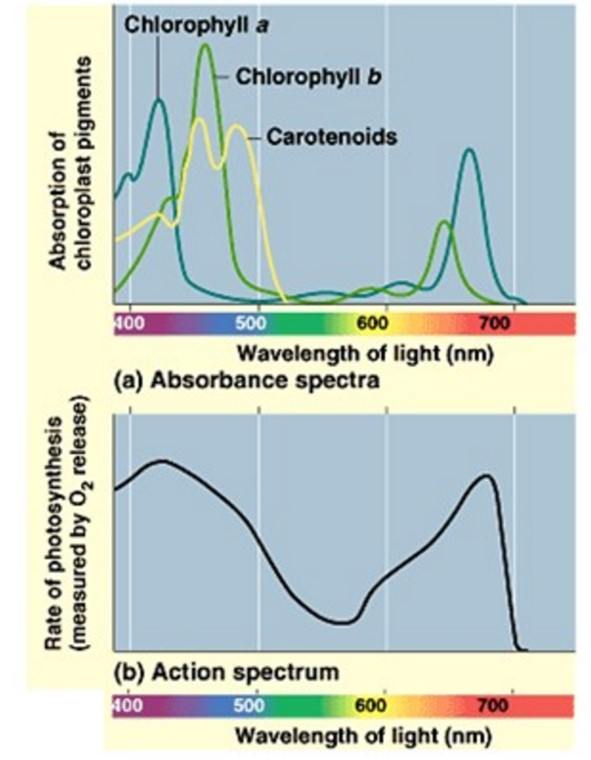
What wavelengths of light does chlorophyll reflect?
a)
blue
b)
yellow
c)
red
d)
green
32.
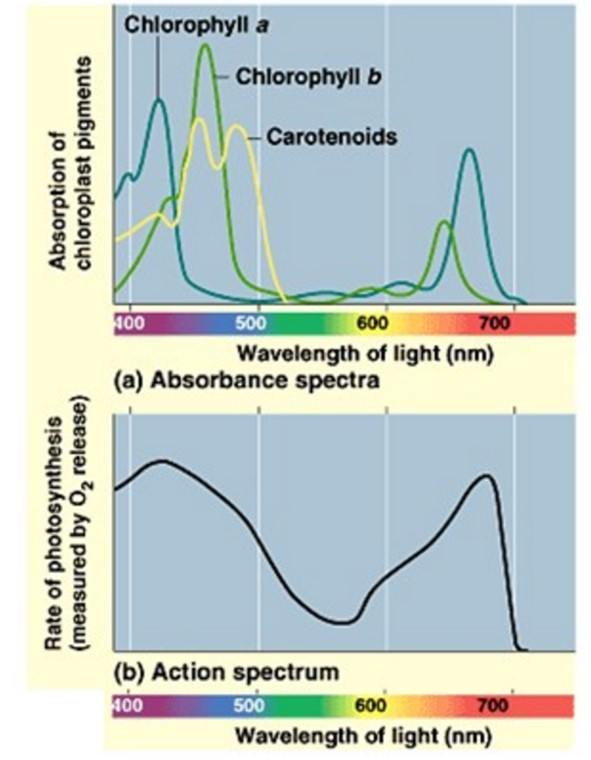
According to the graph, which pair of colors of light has the highest rate of photosynthesis?
a)
green and yellow
b)
violet and yellow
c)
red and violet
d)
green and orange
33.
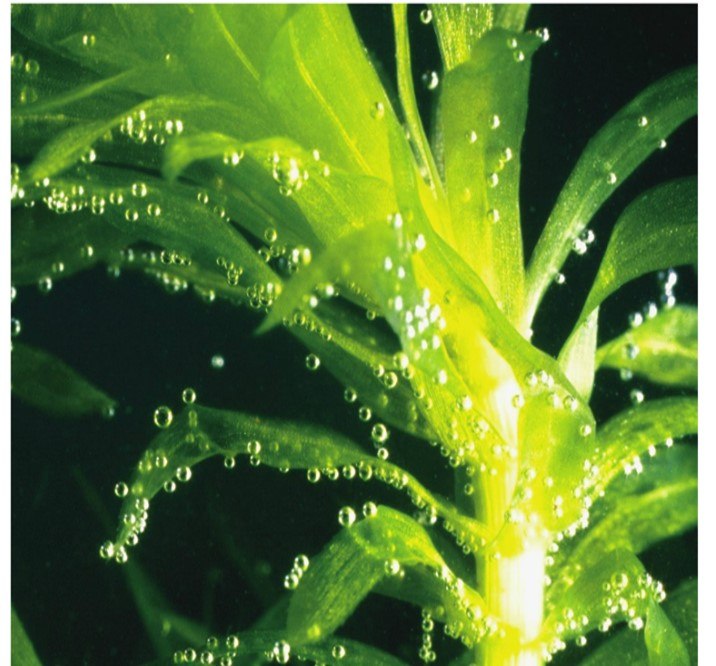
If this was a plant in a lake, what would these bubbles be composed of?
a)
oxygen gas
b)
carbon dioxide gas
c)
glucose
d)
water
34.
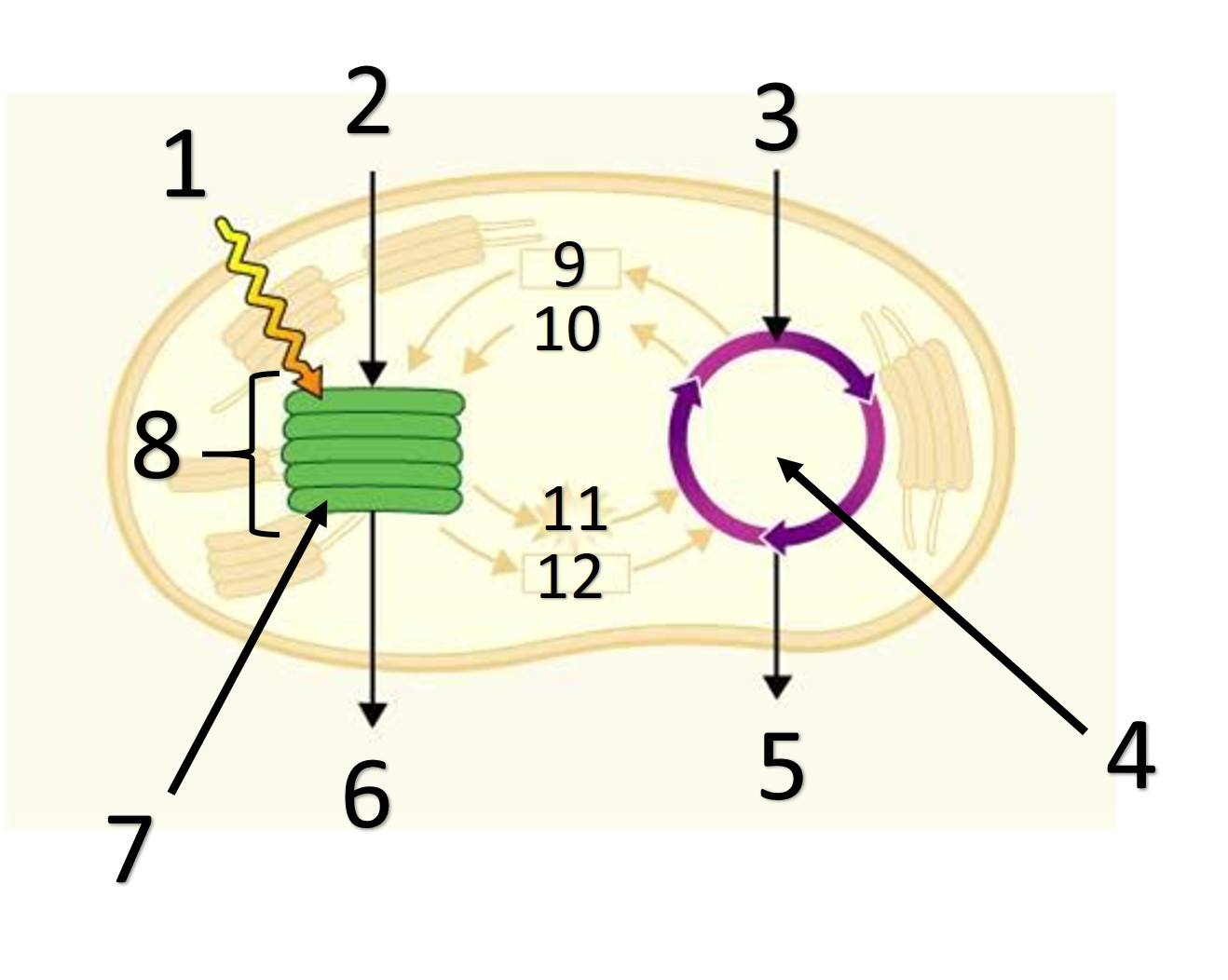
Which process occurs in the area marked "4"?
a)
stroma
b)
thylakoid
c)
light-dependent reaction
d)
light-independent reaction
35.

Which process occurs in the area marked "7"?
a)
stroma
b)
thylakoid
c)
light-dependent reaction
d)
light-independent reaction
36.
Where does the light independent stage of photosynthesis occur?
a)
grana
b)
stroma
c)
thylakoid membranes
d)
cytosol
37.
The leaf has a shiny, waxy cuticle around it to
a)
increase the rate of photosynthesis
b)
attract more light
c)
control water loss
d)
stop carbon dioxide and oxygen gases escaping
38.

Where are the stomata found on the leaf?
a)
On the cuticle
b)
In the mesophyll layer
c)
On the underside of the leaf
d)
In the vascular tissue
39.
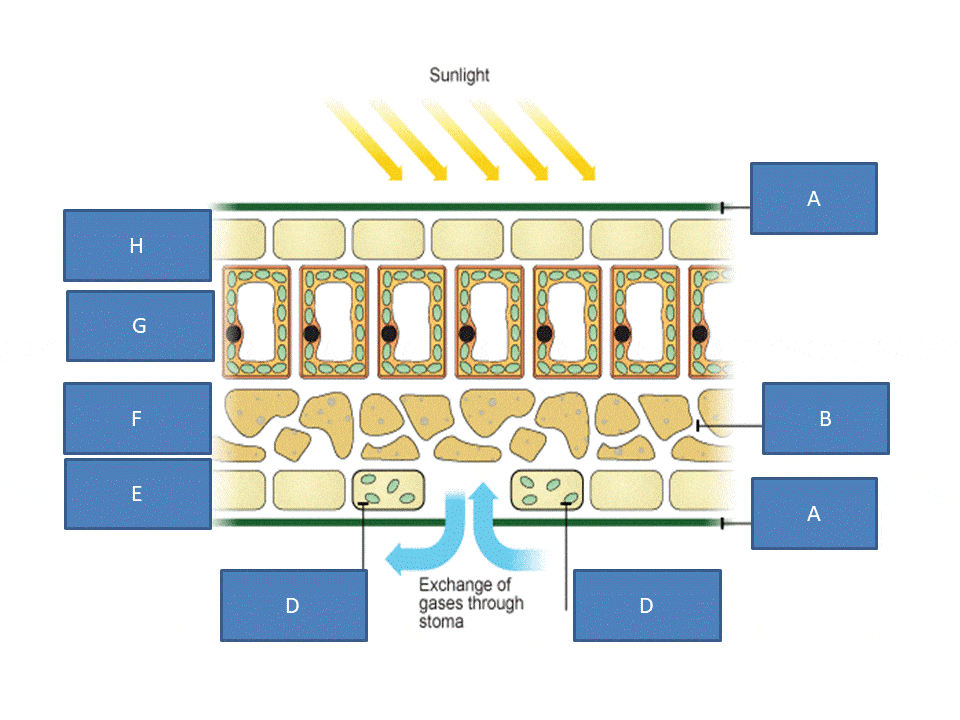
What is the name of part D?
a)
Palisade cells
b)
Guard cell
c)
Spongy layer
d)
Lower epidermis
40.
What is the name of the clear layer, part H?
a)
Cuticle
b)
Air space
c)
Guard cell
d)
Upper epidermis
41.
The role of the guard cell is to
a)
help control the temperature of the plant
b)
control how much water enters the leaf
c)
control how much glucose is stored
d)
control the movement of water vapour & gases
42.
What is the name of part A?
a)
Wax cuticle
b)
Air space
c)
Guard cell
d)
Upper epidermis
43.
What is a stack of thylakoids called? These stacks are in the stroma of the chloroplast.
a)
grain
b)
grana
c)
grandma
d)
grandfather
44.
Before NADPH accepts the two electrons and a hydrogen proton (H+) it is called ____________________.
a)
ADP
b)
NADP+
45.
Each NADPH molecule carries two electrons. NADPH is called an _________________
a)
electron destroyer
b)
electron carrier
46.
What is the main purpose of the light reactions?
a)
To provide the energy and electrons for the Calvin cycle
b)
To "fix" carbon dioxide
c)
To release energy from NADPH and ATP
d)
To produce sugar
47.

The granum is labeled...
a)
10
b)
6
c)
11
d)
5
48.

What is 3 pointing to?
a)
Thylakoid space
b)
Thylakoid
c)
Stroma
d)
Stomata
49.

What is 4 pointing to?
a)
Stroma
b)
Thylakoid
c)
Granum
d)
Stomata
50.

What is 5 pointing to?
a)
Thylakoid
b)
Granum
c)
Thylakoid Space
d)
Stroma
51.
Which substance from the light-dependent reactions of photosynthesis is a source of energy for the light-independent reactions?
a)
ADP
b)
H2O
c)
NADPH
d)
pyruvic acid
52.
What is the ultimate source of energy for life on Earth?
a)
glucose
b)
sunlight
c)
ATP
d)
H2O
53.
What is the function of NADP+?
a)
It absorbs light
b)
It is an electron carrier
c)
It is a light-reflecting pigment
d)
It acts as long-term energy storage
54.
Which of the following is NOT a product of the light reactions?
a)
ATP
b)
NADPH
c)
Oxygen
d)
Glucose
55.

What are the two products of the light reactions that are needed for the calvin cycle?
a)
NAD and NADPH
b)
NADP + and Glucose
c)
NADPH and ATP
d)
Oxygen and NADPH
56.
What gas does the process of photosynthesis release into the atmosphere?
a)
oxygen
b)
carbon dioxide
c)
water
d)
nitrogen
57.
What are the reactants of photosynthesis?
a)
carbon dioxide and oxygen
b)
water and oxygen
c)
carbon dioxide and water
d)
water and glucose
58.
Which gas is removed from the atmosphere during photosynthesis?
a)
hydrogen
b)
oxygen
c)
nitrogen
d)
carbon dioxide
59.
What does carbon combine with to form glucose?
a)
NADPH
b)
ATP
c)
RuBP
d)
G3P
60.
What does NADPH do?
a)
carries electrons to the Calvin cycle
b)
carries electrons to the ETC
61.
Where do the dark reactions take place?
a)
thylakoid membrane
b)
lumen
c)
stroma
62.
What happens to NADPH and ATP after they are used in the Calvin Cycle?
a)
they recycle back to the light reactions
b)
they are used to make G3P
63.
The two main stages of photosynthesis are the
a)
light reactions and respiration
b)
dark reactions and the Calvin cycle
c)
light reactions and the Calvin cycle
d)
dark reactions and fermentation
64.
In green plants, the primary function of the Calvin cycle is to
a)
Use ATP to release carbon
b)
Split water to release oxygen.
c)
Construct simple sugars from carbon dioxide.
d)
Use NADPH to release carbon
65.
Which of the following is NOT a reactant of the dark reactions?
a)
NADPH
b)
ATP
c)
Oxygen
d)
Carbon dioxide
66.
TRUE or FALSE. The Calvin Cycle can happen during the day.
a)
True
b)
false
67.
True or False. The Calvin Cycle can happen at night.
a)
true
b)
false
68.
How does temperature affect photosynthesis?
a)
Increases the rate at which enzymes work
b)
Gives the plant energy to perform photosynthesis
c)
Stops certain enzymes that interfere with photosynthesis working
69.
Which of these will not affect photosynthesis?
a)
Light
b)
Temperature
c)
Glucose Availability
d)
Carbon Dioxide
70.
Which of these is an example of how a plant can adapt to lose less water?
a)
Have a waxy layer on the leaves
b)
Store water in the petals
c)
Have leaves spread out
71.
If a plant receives more carbon dioxide, what happens to the rate of photosynthesis?
a)
Increases
b)
Decreases
c)
Stays the same
72.
How can greenhouses increase the rate of photosynthesis?
a)
Controlling and trapping heat to increase photosynthesis
b)
Stopping rainfall affecting plant growth
c)
Surrounding plants in the colour green makes them more likely to photosynthesise
d)
Plants are only given what they need instead of just taking everything they can find
73.
What are the products of aerobic respiration?
a)
Glucose and oxygen
b)
Carbon dioxide and water
c)
Lactic acid
d)
Carbon monoxide
74.
What are the products of anaerobic respiration?
a)
Glucose and oxygen
b)
Carbon dioxide and water
c)
Lactic acid
d)
Carbon monoxide
75.
What type of respiration requires oxygen?
a)
Aerobic
b)
Anaerobic
76.
What type of respiration does not require oxygen?
a)
Aerobic
b)
Anaerobic
77.
Which type of respiration is most efficient?
a)
Aerobic
b)
Anaerobic
78.
Where in the cell does aerobic respiration take place?
a)
Nucleus
b)
Cytoplasm
c)
Mitochondria
d)
Cell membrane
79.
How many ATP are created during the Electron Transport Chain
a)
32 or more
b)
2
c)
4
d)
500
80.
How many ATP are created in the Krebs cycle?
a)
2
b)
32
c)
16
d)
none
81.
In the absence of oxygen, the pyruvate passes from glycolysis directly into ____.
a)
Krebs Cycle
b)
Fermentation
c)
Electron transport chain
d)
Mitochondria
82.
Which one is NOT an advantage of glycolysis?
a)
There is a net gain of 2 ATP
b)
The process is really fast
c)
No oxygen is required
d)
It is aerobic.
83.
During glycolysis, a glucose enters the cytoplasm and breaks in half to form ______.
a)
nicotine
b)
2 pyruvic acids
c)
ADP
d)
mitochondria
84.
How much ATP does aerobic respiration make from one glucose?
a)
2 ATP
b)
6 ATP
c)
38 ATP
d)
500 ATP
85.
Why do we use yeast to bake bread?
a)
Their waste gas - CO2 helps bread rise
b)
The alcohol that they form makes bread dangerous
c)
They consume all the oxygen which would ruin the bread
86.
What cells in the body are very good at undergoing lactic acid fermentation?
a)
Muscle cells
b)
Fat cells
c)
Liver cells
d)
Skin cells
87.
What is a disadvantage of fermentation?
a)
It produces too much ATP
b)
It only produces 2 ATP
c)
It occurs in the absence of oxygen
d)
It is only for quick bursts of energy
88.
What molecule does both respiration begin with?
a)
oxygen
b)
carbon dioxide
c)
glucose
d)
light
89.
Glucose is broken down into pyruvate in a process known as
a)
glycolysis
b)
electron transport
c)
the Krebs cycle
d)
phosphorylation
90.
This is the "powerhouse" of the cell. Most of an eukaryotic cell's energy is made here.
a)
mitochondria
b)
ribosomes
c)
chloroplasts
d)
nucleus
91.
This term refers to the production of ATP without oxygen being present.
a)
anaerobic
b)
prokaryotic
c)
biogenic
d)
organic
92.
Fermentation occurs in the cell's
a)
cytoplasm
b)
nucleus
c)
cell membrane
d)
cristae
93.
The two main types of fermentation are called
a)
alcoholic and aerobic
b)
aerobic and anaerobic
c)
alcoholic and lactic acid
d)
lactic acid and anaerobic
94.
The air bubbles and spongy texture of bread are due to which process?
a)
lactic acid fermentation
b)
glycolysis
c)
alcoholic fermentation
d)
the Krebs cycle
95.
What is a disadvantage of fermentation as a process?
a)
It produces too much ATP
b)
It only produces 2 ATP
c)
It occurs in the absence of oxygen
d)
It is only for quick bursts of energy
96.
Lactic acid fermentation occurs in your muscles after a workout because your cells are struggling to get
a)
Glucose
b)
Sunlight
c)
Oxygen
d)
Water
97.
What molecule is broken down to provide energy for life processes?
a)
oxygen
b)
carbon dioxide
c)
glucose
d)
water
98.

The purpose of cellular respiration is to make
a)
food from energy
b)
ATP from glucose
c)
heat for the organism
d)
oxygen
99.
Where in the cell does aerobic respiration take place?
a)
Nucleus
b)
Cytoplasm
c)
Mitochondria
d)
Cell membrane
100.
Which type of respiration is most efficient?
a)
Aerobic
b)
Anaerobic
101.

If all four plants were watered daily but placed in a closet, receiving no sunlight, what process would NOT occur?
a)
Ingestion of carbon dioxide
b)
Filtration of water through the soil
c)
Photosynthesis
d)
Water absorbtion
102.

What three things are needed for a plant to do photosynthesis?
a)
Glucose, Oxygen, Sunlight
b)
CO2, Oxygen, Sunlight
c)
CO2, Water, Sunlight
d)
Oxygen, Water, Sunlight
103.
Aerobic respiration yields about ___ ATP molecules per glucose, whereas anaerobic respiration yields ____ ATP molecules per glucose.
a)
36; 2
b)
2; 36
c)
6; 2
d)
36; 18
104.
How are cellular respiration and photosynthesis related, in terms of energy?
a)
The energy captured in photosynthesis is used to power cellular respiration.
b)
The energy transformed in cellular respiration is used to power photosynthesis.
c)
Photosynthesis and respiration perform the same task in terms of energy transformation
d)
Energy is not involved in either photosynthesis or cellular respiration.
105.

Name the space designated by D
a)
matrix
b)
stroma
c)
intermembrane space
d)
cytoplasm
106.
During which step of cellular respiration is carbon dioxide released?
a)
Calvin Cycle
b)
Glycolysis
c)
Kreb's cycle
d)
electron transport
107.
What are the three stages that make up cellular respiration?
a)
light reactions, calvin cycle and electron transport
b)
glycolysis, kreb's cycle and Calvin cycle
c)
Glycolysis, Kreb's cycle and electron transport
d)
Light Reactions, Calvin Cycle and Glycolysis
108.

Name the space designated by B
a)
stroma
b)
matrix
c)
intermembrane space
d)
cytoplasm
109.
All living things do which of the following?
a)
Chemosynthesis
b)
Respiration
c)
photosynthesis
d)
all of the answers
110.
The mitochondria is responsible for ...
a)
photosynthesis
b)
anaerobic respiration
c)
aerobic respiration
d)
fermentation
111.
The expression "feel the burn" means that a person exercising is doing
a)
lactic acid fermentation
b)
alcoholic fermentation
c)
photosynthesis
d)
aerobic respiration
112.
In photosynthesis ...
a)
water is chloronated
b)
light energy is changed to glucose
c)
osmosis happens
d)
ATP is made
113.
How many ATP are produced in Alcoholic respiration?
a)
2
b)
33
c)
4
d)
36
114.

This is
a)
cross section of a leaf
b)
stomata
c)
roots
d)
stem cross section
115.
What are the reactants in the equation for cellular respiration?
a)
oxygen and lactic acid
b)
carbon dioxide and water
c)
glucose and oxygen
d)
water and glucose
116.
Where does glycolysis occur?
a)
Inner mitochondrial membrane
b)
Mitochondrial Matrix
c)
Cytosol
d)
At a ribosome
117.

site of the krebs cycle
a)
1
b)
2
c)
3
d)
4
118.

site of ATP synthase
a)
1
b)
2
c)
3
d)
4
119.

The diagram shows the relationship between photosynthesis and cellular respiration and the organelles in which they occur.
Which statement describes how photosynthesis and cellular respiration are interrelated?
Which statement describes how photosynthesis and cellular respiration are interrelated?
a)
Oxygen is produced during cellular respiration and stored during photosynthesis.
b)
Carbon dioxide and water released by cellular respiration are used in photosynthesis.
c)
Photosynthesis releases the energy that is stored during the process of cellular respiration.
d)
Glucose is used during cellular respiration to produce food that is broken down during photosynthesis.
120.
What are the products of the ETC?
a)
ATP and NADPH
b)
Glucose and oxygen
c)
Co2 and water
d)
water and ATP
121.
The three stages of cellular respiration include glycolysis, krebs cycle, and the...
a)
carb cycle
b)
light reaction
c)
electron transport chain
d)
calvin cycle
122.
The Krebs cycle produces..
a)
32 ATPs, NADH and Sugar
b)
2 ATPs, CO2, NADH and FADH2
c)
4 ATPs and oxygen gas
d)
2 ATPs, FADH2 and carbon dioxide
123.
What is cellular respiration?
a)
the breakdown of glucose to release ATP
b)
the breakdown of glucose to release NADH
c)
the breakdown of glucose to release FADH
d)
the breakdown of glucose to release carbon
124.
What is the purpose of cellular respiration?
a)
to break down food
b)
to create energy in the body
c)
to release energy from food
d)
there is none; it's a waste of time
125.
Why do we eat food?
a)
to provide energy/fuel to make ATP
b)
to eliminate waste products
c)
to prevent diseases
d)
to kill pathogens
100 %

