
Font size
S
M
L
XL
 Worksheets
Benchmark Review: Reactions, Acids/Bases, Radioactivity
Total questions: 93
Worksheet time: 1hrs 9mins
Name
Class
Date
1.
In a chemical equation, is it true that -
a)
the reactant side and product side can have different numbers of atoms for each element
b)
there can be different elements on the reactant side and the product side
c)
an element or compound must be accompanied by a phase change
d)
the coefficients indicate the number of molecules of each reactant used and the number of molecules of each product made
2.
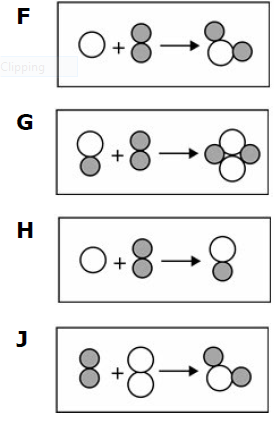
Which of the following models best demonstrates a balanced chemical equation?
a)
F
b)
G
c)
H
d)
J
3.

Which of the following equations demonstrates an actual chemical reaction that forms a new substance?
a)
A
b)
B
c)
C
d)
D
4.

Which of these formulas contain equal numbers of nitrogen atoms?
a)
Formulas I and III
b)
Formulas I and IV
c)
Formulas II and III
d)
Formulas I, II, and V
5.

How many atoms in all are in a molecule of serotonin?C10H12N2O
a)
22
b)
24
c)
25
d)
4
6.
The reactants are on the left side of the chemical equation.
a)
True
b)
False
7.
Which of the following BEST describes a chemical reaction?
a)
A compound is crushed into a fine powder.
b)
Atoms break apart into even smaller particles.
c)
Existing electron bonds creak and reattach to other atoms
d)
Molecules move faster until they fly apart from each other
8.
Which of the following BEST describes a chemical reaction?
a)
A compound is crushed into a fine powder.
b)
Atoms break apart into even smaller particles.
c)
Existing electron bonds creak and reattach to other atoms
d)
Molecules move faster until they fly apart from each other
9.
In an endothermic reaction energy is...
a)
released
b)
absorbed
c)
protons
d)
neutrons
10.
Which of the following will increase the rate of a reaction?
a)
raising the temperature of reactants
b)
grinding the reactants into a powder
c)
increasing the concentration of reactants
d)
all of the above
11.

What type of reaction is shown in image?
a)
exothermic reaction
b)
endothermic reaction
c)
single displacement reaction
d)
double displacement reaction
12.

What type of reaction is shown in image?
a)
exothermic reaction
b)
endothermic reaction
c)
synthesis reaction
d)
decomposition reaction
13.

What do we call a substance that increases the rate of a reaction without participating in the reaction?
a)
catalyst
b)
inhibitor
c)
accelerator
d)
decelerator
14.

According to the law of conservation of mass...
a)
sometimes atoms are lost
b)
sometimes atoms are gained
c)
atoms are never lost nor gained
d)
atoms are lost and gained
15.

What is a shorthand notation that represents a compound or molecule called?
a)
Chemical Equation
b)
Chemical Formula
c)
Chemical Reaction
d)
Chemical
16.

What is the small number written after a chemical symbol called?
a)
Coefficient
b)
Subscript
c)
Product
d)
Reactant
17.

What is the large number written before a chemical formula called?
a)
Coefficient
b)
Subscript
c)
Reactant
d)
Product
18.

What are the products of the chemical reaction pictured?
a)
CH4 and CO2
b)
CH4 and O2
c)
CO2 and H2O
d)
O2 and H2O
19.
Which of the following is NOT an example of a chemical reaction?
a)
Wood Burning
b)
A cake baking in an oven
c)
Melting Ice Cream
d)
Mixing Vinegar and Baking Soda
20.

What type of reaction involves one element replacing another element in a compound?
a)
Single Displacement Reaction
b)
Double Displacement Reaction
c)
Synthesis Reaction
d)
Decomposition Reaction
21.

What type of reaction involves the breaking down of a substance into simpler substances?
a)
Single Displacement Reaction
b)
Double Displacement Reaction
c)
Synthesis Reaction
d)
Decomposition Reaction
22.

A molecule made of 2 atoms is called a ____________________.
a)
Diatomic Molecule
b)
Chemical Bond
c)
Product
d)
Reactant
23.

The force that holds 2 atoms together is called a ________________.
a)
Chemical Reaction
b)
Chemical Bond
c)
Diatomic Chemical
d)
Glue
24.

What type of reaction involves 2 substances combining to form 1 new compound?
a)
Decomposition Reaction
b)
Single Displacement Reaction
c)
Double Displacement Reaction
d)
Synthesis Reaction
25.

is this object acidic or base
a)
Acidic
b)
Base
c)
neither
d)
neutral
26.
Values from 0-14 that determine the acidity of a solution
a)
Molarity
b)
Electronegativity
c)
pH scale
d)
Solubility
27.
Tastes Sour
a)
Acids
b)
Bases
c)
Salts
d)
All
28.
Which of the following word pairs correctly completes the sentence below?
_______ are corrosive substances characterized as having a strong smell, a sour taste, and a _______.
_______ are corrosive substances characterized as having a strong smell, a sour taste, and a _______.
a)
Acids; pH less than 7
b)
Acids; pH greater than 7
c)
Bases; pH greater than 7
d)
Bases; pH less than 7
29.
If an acid is combined with a base of equal strength, the result will most likely be
a)
a neutral solution.
b)
a stronger acid.
c)
impossible to tell without testing the pH.
d)
a stronger base
30.
Holly has an unknown substance in a beaker. She wants to determine the relative pH of the unknown substance. She places a piece of blue litmus paper into the substance, and the litmus paper stays blue.
The substance in the beaker
The substance in the beaker
a)
is a base.
b)
has a neutral pH.
c)
is an acid.
d)
does not have a pH.
31.
Litmus paper can be used to determine the _______ of a substance.
a)
relative volume
b)
temperature
c)
relative pH
d)
chemical formula
32.
Which of the following statements is correct?
a)
Blue litmus paper turns red when placed in a base.
b)
Red litmus paper turns blue when placed in a base.
c)
Blue litmus paper stays blue when placed in an acid.
d)
Red litmus paper stays red when placed in a base.
33.
Which of the following is an acid?
a)
shampoo
b)
baking soda
c)
orange juice
d)
water
34.
The pH of a solution is tested, and it is found to be a basic solution. Of the following choices, what could the pH have been?
a)
3
b)
9
c)
7
d)
5
35.
When using pH paper, the pH of a solution can be determined by looking at the _______ of the paper.
a)
texture
b)
color
c)
length
d)
mass
36.
Values from 0-14 that determine the acidity of a solution
a)
Punnett Square
b)
Matrix
c)
pH scale
d)
Math number line
37.
Values from 0-14 that determine the acidity of a solution
a)
Molarity
b)
Electronegativity
c)
pH scale
d)
Solubility
38.
Tastes bitter.
a)
Acids
b)
Bases
c)
Salts
d)
All
39.
What is the range of pH values in an acidic solution?
a)
0-7
b)
7-14
c)
15-239058204958
d)
pH = 7
40.
Which of the following is most likely to be basic:
a)
Lemon juice
b)
Vinegar
c)
Laundry detergent
d)
Coke
41.
Which is the stronger acid?
a)
pH 1
b)
pH 4
c)
pH 8
d)
pH 13
42.
A solution with a pH of 7 is________
a)
increasing
b)
neutral
c)
decreasing
d)
apple juice
43.
A ( ) is a substance that either contains hydroxide ions (OH-) or reacts with water to form hydroxide ions.
a)
acid
b)
base
c)
hydronium ion
d)
water
44.
A hydrogen ion, H+, is the same as a(n):
a)
neutron
b)
electron
c)
proton
d)
hydroxide ion
45.
OH- is called the:
a)
hydrate ion
b)
hydrogen ion
c)
hydronium ion
d)
hydroxide ion
46.
Forms hydroxide ions (OH-) in water
a)
Acids
b)
Bases
c)
All
47.
What is a base?
a)
Has a pH of 3
b)
Has a pH of 7
c)
substances that are slippery to the touch; turns red litmus paper blue
48.
Name the acid: HNO3
a)
hydronitrous acid
b)
hydronitric acid
c)
nitric acid
d)
nitrous acid
49.
Which of the following describes an acid?
a)
turns litmus blue
b)
low pH
c)
bitter
d)
high pH
50.
Water and Kool-Aid are mixed together. Hot water, coffee and sugar are mixed together. Which substance is the solvent in both?
a)
Water
b)
Coffee
c)
Kool-aid
d)
Sugar
51.
A combination of two or more substances that cannot easily be separated--
a)
mixture
b)
solution
c)
solute
d)
solvent
52.

All are solutes except
a)
sugar
b)
pepper
c)
salt
d)
powdered chocolate
53.
If I added 27 grams of salt to water and separated the solution with a hot plate, what amount of salt would be left behind?
a)
20 grams
b)
0 grams
c)
27 grams
d)
10 grams
54.
What is a substance that is dissolved in another substance?
a)
solution
b)
solute
c)
solvent
d)
compound
55.
Which of the following is a method of separating solutions?
a)
hand seperation
b)
filtering
c)
screening
d)
evaporation
56.
To separate a mixture of salt and water what separation tool/method is used?
a)
Filter
b)
Screen
c)
Magnet
d)
Evaporation
57.
If you spilled nails in a sandbox, what separation tool/method could you use to clean out the sandbox so it would be safe for children to play in?
a)
Filter
b)
Screen
c)
Magnet
d)
Evaporation
58.
Which of the following is not a way to increase the rate of dissolving
a)
evaporation
b)
stirring
c)
increasing temperature
d)
using a smaller particle size
59.
substance that dissolves the solute
a)
solution
b)
solvent
c)
saturation
d)
so
60.
If a spoonful of sugar is mixed in a glass of water, what is the water called?
a)
solute
b)
solution
c)
solvent
d)
element
61.
Sugar water is a
a)
solution
b)
suspension
c)
colloid
62.
To dissolve more material in a saturated solution:
a)
Add water or boil it
b)
Shake or stir faster
c)
Evaporate it
d)
You can only add water. Boiling it won't help.
63.
Milk is a
a)
solution
b)
suspension
c)
colloid
64.
A saturated solution is______
a)
No more solute can be dissolved
b)
More solute can be dissolved
c)
The solvent and solution
65.
How does a solution become supersaturated?
a)
dissolve lots of solute in it.
b)
dissolve a little solute in it.
c)
dissolve more solute than you should be able to.
d)
dissolve a super amount of solvent in it.
66.
What type of mixture separates upon standing?
a)
Solution
b)
Alloy
c)
Colloid
d)
Suspension
67.

The light is spread out by flour and water, and does not go through the mixture. What is the mixture called.
a)
Solution
b)
Suspension
c)
Colloid
68.
Solution that contains less solute than a saturated solution under the same conditions
a)
Saturated
b)
unsaturated
c)
supersaturated
d)
solution
69.

Sand floating in water, but most of the sand is settled at the bottom this an example of which type of mixture?
a)
A solution
b)
A colloid
c)
A suspension
d)
A compound
70.
Where does radioactivity have application in our lives?
a)
Medicine
b)
Energy (electricity)
c)
Agriculture
d)
All of the above
71.
The rate at which a radioactive element decays is its ____.
a)
quarter life
b)
whole life
c)
wonderful life
d)
half life
72.
Energy in the sun is produced as a result of nuclear ____ reactions.
a)
fusion
b)
fission
c)
waste
d)
sub
73.
The three types of nuclear radiation in order of increasing penetrating power are
a)
alpha, beta, gamma
b)
alpha, gamma, beta
c)
beta, alpha, gamma
d)
gamma, alpha, beta
74.
The process by which nuclei having small masses are united to form a single larger nucleus is called nuclear ____.
a)
fusion
b)
fission
c)
reactivity
d)
waste
75.
Name the instrument used to detect radioactivity.
a)
voltmeter
b)
ohmeter
c)
seismograph
d)
geiger counter
76.
Name the type of radioactive particle that can be stopped by a sheet of paper.
a)
alpha
b)
beta
c)
gamma
d)
lambda
77.
Name the most penetrating type of radiation.
a)
alpha
b)
beta
c)
gamma
d)
lambda
78.
What is nuclear fission?
a)
Big nucleus splits to small nuclei
b)
Small nuclei fuse into a bigger nucleus
c)
Stars
d)
Making compounds
79.
How do nuclear power-plants work?
a)
Fusion
b)
Half-life
c)
Fission
d)
Fusion or fission
80.
_______________ is the process by which unstable atoms emit radiation until they become stable.
a)
Radiation
b)
Chemical Reaction
c)
Radioactive Decay
d)
Isotopes
81.
A helium nucleus with two protons and two neutrons is called a(n) ____ particle
a)
alpha
b)
beta
c)
gamma
d)
lambda
82.
Name the instrument used to detect radioactivity.
a)
voltmeter
b)
ohmeter
c)
seismograph
d)
geiger counter
83.
Negatively charged particles emitted from a nucleus at a high speed are ____ .
a)
protons
b)
neutrons
c)
electrons
d)
protons and neutrons
84.
The three types of nuclear radiation in order of increasing penetrating power are
a)
alpha, beta, gamma
b)
alpha, gamma, beta
c)
beta, alpha, gamma
d)
gamma, alpha, beta
85.
Each element with an atomic number greater than 83 is ____.
a)
stable
b)
synthetic
c)
lighter than air
d)
radioactive
86.
Which type(s) of radiation would be affected by a magnet?
a)
alpha only
b)
beta only
c)
alpha and beta
d)
gamma only
87.
The rate at which a radioactive element decays is its ____.
a)
quarter life
b)
whole life
c)
wonderful life
d)
half life
88.
Energy in the sun is produced as a result of nuclear ____ reactions.
a)
fusion
b)
fission
c)
waste
d)
sub
89.
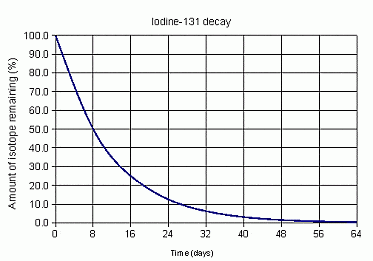
What is the half-life of iodine-131?
a)
32 days
b)
8 days
c)
16 days
d)
24 days
90.

What percent of carbon-14 would be left after 5730 years?
a)
100%
b)
75%
c)
50%
d)
25%
91.

What percent of carbon-14 would be left after 11,460 years?
a)
100%
b)
75%
c)
50%
d)
25%
92.
True or false, bubbling is a sign of a chemical reaction?
a)
True
b)
False
93.
8.7: Combustion is when a __________ reacts with oxygen
a)
petrol
b)
fuel
c)
fire triangle
d)
carbon dioxide
Reset

