wayground logo

Free Printable Worksheets

NEW

Font size

S
M
L
XL
Worksheets

Question Bank: Natural Selection

Total questions: 65

Worksheet time: 2hrs 35mins

Name
Class
Date
1.
All mutations and adaptations usually lead to what process?
a)
selective breeding
b)
behavioral
c)
natural selection
d)
genetic engineering
2.
There are three species of birds on an island. These three species are shown below. Bird A has a heavy bill for eating big seeds. Bird B has a sharply pointed bill for eating insects. Bird C has a sharp bill for eating insects and small seeds. If the insect populations suddenly disappeared one season, which bird or birds would probably be the least affected that season?
a)
A
b)
B
c)
C
d)
A and B
3.
An octopus can change its color to match its surroundings. This is an example of which type of behavior?
a)
camouflage
b)
mimicry
c)
cooperative behavior
d)
estivation
4.
A woodpecker has a long, thin, pointed beak. How would this adaptation help it survive? 
a)
It can swim fast.
b)
It can catch other animals.
c)
It can easily catch fish. 
d)
It can easily pick bugs out of the bark in the trees.
5.
A penguin's layer of blubber is an adaptation that helps a bird survive in this environment.
a)
the desert
b)
a hot environment
c)
a cold environment
d)
the water
6.
Which feature of a rose helps it grow without being eaten by large animals?
a)
flowers with bright colors
b)
sharp thorns
c)
small seeds
d)
deep roots
7.
Which organism has an advantage in its environment?
a)
The fastest
b)
The strongest
c)
The best adapted
d)
The most tamed
8.
Jaguars with slightly larger jaws and teeth are better able to eat shelled reptiles in addition to mammals.  These Jaguars are likely to survive longer and leave more offspring than jaguars that eat only mammals.  Which scientific concept explains how large jaws and teeth became typical  characteristics of jaguars?
a)
Natural selection
b)
Artificial selection
c)
asexual reproduction
d)
biogeography
9.
The graph below shows the changes in the populations of beetles and wasps.  The wasp larvae feed on  the beetle larvae.  The beetle population is highest when the wasp population is—
a)
low
b)
high
c)
steady
d)
at zero
10.
Also known as natural selection
a)
Fossil
b)
Artificial Selection
c)
Survival of the fittest
d)
Adaptation 
11.
A well supported-testable explanation
a)
Theory
b)
Recombination
c)
Fitness
d)
Embryology
12.
Do organisms "decide" to evolve and change?
a)
Yes, they know they need to change in order to survive.
b)
No, they change because of natural selection.
13.
The differences in a species, such as different bird beaks, are called
a)
genes.
b)
variations.
c)
traits.
d)
theories.
14.
Why are advantageous traits more likely to be passed onto offspring?
a)
Because organisms with those traits are more likely to survive and reproduce.
b)
Because they come from more important DNA.
c)
Because they come from the mother AND the father.
d)
Because organisms with those traits are less likely to survive and reproduce.
15.
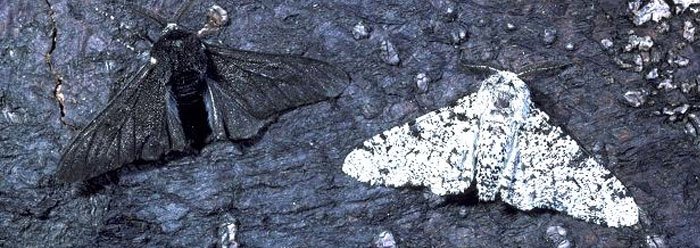
The trees these moths used to live on were white, but have been covered in soot pollution from coal factories. Which moth will be more successful in this changed, darker environment?
a)
Dark moth
b)
Light moth
c)
Both will be equally successful
d)
Neither will be successful
16.
Since the 1800s, humans have stopped burning coal, and the trees have returned to their original white color. Which moth will be more successful in this current environment?
a)
Dark moth
b)
Light moth
c)
Both will be equally successful
d)
Neither will be successful
17.
Which of these terms means "change over time?"
a)
Natural Selection
b)
Selective Breeding
c)
Homeostasis
d)
Evolution
18.
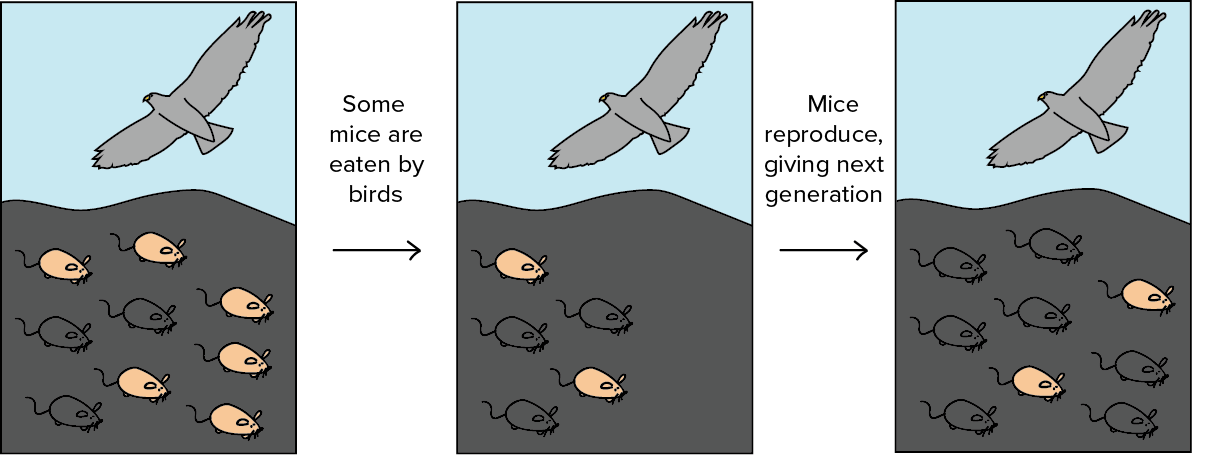
What process is being shown in these images?
a)
Variation
b)
Natural Selection
c)
Selective Breeding
d)
Homeostasis
19.
Why is the mouse population changing over time?
a)
The light mice can reproduce more successfully than the dark mice.
b)
The hawks eat more dark mice than light mice because the dark mice taste better.
c)
The hawks eat more light mice than dark mice because they can see the light mice more easily.
d)
The hawks eat more dark mice than light mice because they can see the dark mice more easily.
20.
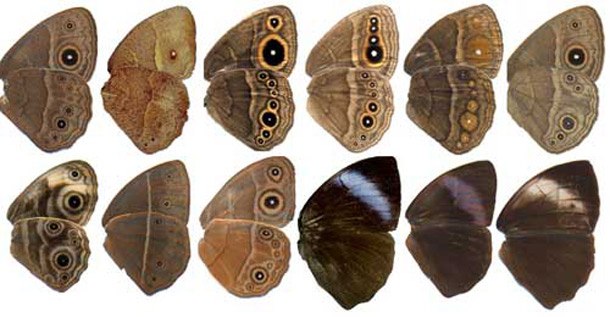
These moths are all the same species. The differences between their wings is an example of ________________
a)
Natural Selection
b)
Variation
c)
Homeostasis
d)
Extinction
21.
What was the name of the scientist who wrote the Theory of Evolution?
a)
Lamarck
b)
Einstein
c)
Washington
d)
Darwin
22.
Which color of foxes would be safest from foxes in an arctic area covered with snow?
a)
grey
b)
black
c)
white
d)
brown
23.
What is the advantage of different bird species having beaks of different shapes?
a)
To look different from other species
b)
To be able to eat the food readily available in the environment
c)
To protect itself against predators
d)
To protect itself against prey
24.
Natural selection can best be defined as the _____.
a)
survival of the biggest and strongest in a population
b)
survival and reproduction of those in the largest area
c)
elimination of the smallest organism by the biggest
d)
survival and reproduction of those that are best adapted
25.
An organism's reproductive success
a)
Fitness
b)
Recombination
c)
Theory
d)
Embryology
26.
What word describes a trait that helps an organism survive in its environment?
a)
natural selection
b)
mutation
c)
camouflage
d)
adaptation
27.
Why do frogs and other organisms reproduce so many eggs or offspring?
a)
so that their babies can have friends to play with
b)
the more offspring the more likely the offspring will survive
c)
the more offspring the less likely offspring will survive 
d)
the more offspring the less competition
28.
Which organisms are most likely to survive?
a)
the best adapted
b)
the fastest
c)
the strongest
d)
the most domesticated (tamed)
29.

Every so often, an organism is born with a mutation that helps it survive. In other words, it is a good mutation. What do we call this type of mutation?

a)

Awesome

b)

Beneficial

c)

Camouflage

d)

Malignant

30.

A(n) ____________ is a change in an organism which makes it better able to survive in its environment.

a)

Adaptation

b)

Cancer

c)

Evolution

d)

Replication

31.
True or False: Natural Selection acts on existing variation
a)
False
b)
True
32.

The more genetic variation a population has,

the more likely it is for some individuals to

a)

evolve

b)

migrate

c)

survive

d)

mutate

33.
Genetic variation can arise from a random change in the DNA of a gene.  The change is called a(n)
a)
mutation
b)
gene flow
c)
gene pool
d)
allele
34.
What is a change in an organism that allows for it to survive in its environment?
a)
homologous
b)
vestigial
c)
variation
d)
adaptation
35.
A _____________________ involves a change in the genetic code of an organism.  Because this change occurs in the genetic code, it is passed on to future generations.
a)
Morphology
b)
Mutation
c)
Gene Flow
d)
Genetic Drift
36.
Gene flow happens as a result of _____________________, members of a population exchange genes with one another.
a)
Mating
b)
Speciation
c)
Recombination
d)
Gene Exchange
37.
What does the image represent?
a)
Founder effect
b)
Bottleneck effect
c)
Natural Selection
d)
Mutations
38.
What does the image represent?
a)
Gene flow
b)
Genetic drift
c)
Mutation
d)
Adaptation
39.
A permanent change in DNA is called what?
a)
Genetic disorders
b)
Mutation
c)
Gene Expression
d)
Mutagen
40.
Are all mutations harmful?
a)
Yes, they are caused by toxic chemicals and radiation
b)
No, all mutations are beneficial
c)
Yes, mutations cause fatal diseases
d)
No, some can be useful in a changing environment
41.
Why is DNA important?
a)
it is very small and very complicated
b)
it's in everything
c)
it serves as the blueprint for traits of all living things
d)
because we eat it every day for energy
42.

The differences among a species, like different bird beaks, are called

a)

genes.

b)

variations.

c)

traits.

d)

theories.

43.

What word describes a trait that helps an organism survive in its environment?

a)

natural selection

b)

mutation

c)

camouflage

d)

adaptation

44.
The trees these moths used to live on were white, but have been covered in soot from coal factories. Which moth will be more successful in this environment?
a)
Dark moth
b)
Light moth
c)
Both will be equally successful
d)
Neither will be successful
45.
Since the 1800s humans have stopped burning coal, and the trees have returned to their original color. Which moth will be more successful in this environment?
a)
Dark moth
b)
Light moth
c)
Both will be equally successful
d)
Neither will be successful
46.
Predict which moth would increase in population
a)
light 
b)
dark
47.
The cause of artificial selection is…
a)
The environment
b)
Humans
c)
Mutation
d)
Gene Flow
48.
Darwin wrote that organisms with traits that are best suited to the environment will ________________
a)
increase in number
b)
become extinct
49.

The environment around Manchester, England, changed during the Industrial Revolution. How did this change affect peppered moths living in the area?

a)

Natural selection favored moths with dark wings because predators could not see them on the soot-colored trees.

b)

Natural selection favored moths with white wings that were easy for predators to see.

c)

Natural selection favored moths with white wings because predators could not see them on the soot-colored trees.

d)

Natural selection caused moths with white wings to become extinct.

50.
The ability of an organism to survive and reproduce in its specific environment 
a)
diversity.
b)
evolution
c)
adaptation
d)
 fitness
51.
Who was the naturalist that traveled the world to study plants and animals?
a)
Albert Einstein
b)
Charles Darwin
c)
Charles Barkley
d)
Isaac Newton
52.
The white feathers of a snowy owl allow it to blend in with its environment during the winter months (snow). This is an example of ________________
a)
Species
b)
Environmental Change
c)
Adaptation
d)
Variation
53.
Which of the following is NOT a factor that affects the process of natural selection?
a)
Overpopulation
b)
Fossils
c)
Competition
d)
Variations
54.
Genetic variation can arise from a random change in the DNA of a gene.  The change is called a(n)
a)
mutation
b)
gene flow
c)
gene pool
d)
allele
55.
Mutations are important because they bring about
a)
death of the organism in which they develop
b)
genetic variation needed for a population to evolve
c)
benefits for the individual, not for the population
d)
Hardey-Weinberg equilibrium within a population
56.

Natural selection could not occur without

a)

geographic isolation

b)

variation in the population

c)

stable environments

d)

competition for unlimited resources

57.
Which of the following statements best explains why some mosquitoes survived after the first spraying?
a)
Some mosquitoes had a genetic mutation that made them resistant to the insecticide
b)
A.  All mosquitoes had a genetic mutation that made them resistant to the insecticide
c)
A.  None of the mosquitoes had a genetic mutation that made them resistant to the pesticide
58.
The table shows the survival rate of two types of beetles in the same environment over a period of three years.  

Which statement about the beetles in this environment is best supported by the data?

a)
Brown beetles have a shorter life cycle than green beetles have
b)
Green beetles are more fit for their environment than brown beetles
c)
 brown beetles are undergo more unfavorable mutations than green beetles
59.
Mutations are__________
a)
Harmful
b)
Harmful or beneficial
c)
Neutral
d)
Harmful, neutral, or beneficial
60.
Why do frogs and other organism reproduce so many eggs or offspring?
a)
so that their babies can have friends to play with
b)
the more offspring the more likely the offspring will survive
c)
the more offspring the less likely offspring will survive 
d)
the more offspring the less competition
61.
Which organisms are most likely to survive?
a)
the best adapted
b)
the fastest
c)
the strongest
d)
the most domesticated (tamed)
62.
Almost all adaptations started off as?
a)
selective breeding
b)
physiological
c)
structural
d)
mutation
63.
Any inherited trait that gives an organism an advantage in its environment is called ___.
a)
a mutation
b)
an adaptation
c)
evolution
d)
natural selection
64.
Which of the following means "genetic change over time"
a)
natural selection
b)
speciation
c)
evolution
d)
fitness
65.
Do organisms "decide" to evolve and change?
a)
Yes, they know they need to change to survive 
b)
No, they change because of natural selection