
 Worksheets
Cell Unit TEST
Total questions: 101
Worksheet time: 2hrs 32mins
Name
Class
Date
1.
Do you want to do well?
a)
Yes
b)
No
2.
Which grade do you want?
a)
A
b)
B
c)
C
3.

A molecule with electrically charged areas is called a _______________.
a)
magnet
b)
polar molecule
c)
solution
d)
electrical molecule
4.

What property of water helps to moderate earth's temperature?
a)
adhesion
b)
chohesion
c)
Specific heat capacity
d)
Latent heat of vaporization
5.
What is sucrose made up of?
a)
Glucose and Fructose
b)
Fructose and Lactose
c)
Galactose and Glucose
d)
Glucose and Lactose
6.
Which of the following words is incorrectly matched with its meaning?
a)
Di = Two
b)
Mono = One
c)
Poly = Four
d)
Tri = Three
7.
This process removes a water molecule in order to bond monomers together:
a)
Dehydration Synthesis
b)
Exocytosis
c)
Osmosis
d)
Hydrolysis
8.
Hydrolysis literally means
a)
To join with water
b)
To split with oil
c)
To split with water
d)
To join with oil.
9.
Humans store energy in their body in the form of
a)
Starch
b)
Glycogen
c)
Cellulose
d)
Chitin
10.
This polysaccharide is important to the structure of plant cell walls,
a)
Starch
b)
Glycogen
c)
Cellulose
d)
Chitin
11.

What molecule is this
a)
sucrose
b)
protein
c)
glucose
d)
cellulose
12.
Which biomolecule is often stored in the body's tissues as energy?
a)
proteins
b)
carbohydrates
c)
lipids
d)
nucleic acids
13.

Which of the following molecules make up the basic structure of a cell membrane?
a)
waxes
b)
steroids
c)
fatty acids
d)
phospholipids
14.
What are different examples of lipids?
a)
monosaccahrides, disaccharides, starch, cellulose
b)
dipetide, polypeptide, amino acids
c)
DNA, RNA, ATP
d)
triglycerides, waxes, steroids, phospholipds
15.
The amount of stored energy in a carbohydrate is _______________.
a)
9 kcal/g
b)
6 kcal/g
c)
0 kcal/g
d)
4 kcal/g
16.
The amount of stored energy in a lipid is ___________.
a)
9 kcal/g
b)
6 kcal/g
c)
0 kcal/g
d)
4 kcal/g
17.
Lipid based hormones are __________.
a)
Sterols (cholesterol, testosterone, estrogen and progesterone)
b)
Insulin
c)
serotonin
d)
neurotransmitters
18.

This molecule is a
a)
carbohydrate
b)
nucleic acid
c)
protein
d)
lipid
19.
Animals store glucose in the form of
a)
cellulose
b)
glycogen
c)
wax
d)
lipids
20.
Benedicts tests for ______________
a)
a lipid
b)
a complex carbohydrate
c)
cellulose
d)
a simple sugar
21.
The name of the enzyme that breaks down fats is _______________
a)
lipase
b)
amylase
c)
protease
d)
DNAase
22.
What are lipids mostly made of?
a)
Sugar and Honey
b)
Glycerol and Fatty Acids
c)
Water and Salt
d)
Oxygen
23.

This molecule is a
a)
carbohydrate
b)
nucleic acid
c)
protein
d)
lipid
24.
What are the subunits of carbohydrates?
a)
Nucleotides
b)
Amino Acids
c)
Polysaccharides
d)
Monosaccharides
25.
Which is an example of a nucleic acid?
a)
oil
b)
sugar
c)
DNA
d)
red meat
26.
What is formed from amino acids?
a)
Lipids
b)
Proteins
c)
Carbohydrates
d)
Nucleic Acids
27.
How many different amino acids are there?
a)
15
b)
20
c)
25
d)
30
28.
Enzymes are capable of increasing the rate of a chemical reaction within a living cell. Enzymes accomplish this through which of the following means?
a)
reducing the number of products
b)
reducing the activation energy
c)
increasing the temperature of the cell
d)
increasing the concentration of reactants
29.

What is being represented by the letter A in the image?
a)
Substrate
b)
Enzyme
c)
Product
d)
Complex
30.
When a protein unfolds, it is
a)
Denatured
b)
Building
c)
Adding amino acids
d)
Making food
31.
Each amino acid is different from the other due to....
a)
The R group
b)
The amino group
c)
The carboxyl group
d)
The central carbon
32.
What molecule is used to store energy in the liver and muscle cells?
a)
Glucose
b)
ATP
c)
ADP
d)
Glycogen
33.
Which of these is not part of an amino acid?
a)
Amino
b)
Phosphate
c)
Carboxyl
d)
R-group
34.

Where is the high energy bond located in ATP?
a)
Between the 2nd and 3rd phosphate
b)
There is no high-energy bond
c)
Between the nitrogen base and the sugar
d)
Between the sugar and the 1st phosphate
35.

What is the blue portion of this molecule?
a)
Sugar
b)
Phosphate
c)
Nitrogen Base
d)
Hydrogen Bond
36.

What is the orange portion of the molecule (the highest part) called?
a)
Phosphate
b)
Sugar
c)
Nitrogen Base
d)
Peptide Bond
37.

What is the yellow part of this molecule called?
a)
Phosphate
b)
Nitrogen Base
c)
Sugar
d)
RNA
38.

What type of bond holds the two strands of DNA together?
a)
Hydrogen
b)
Covalent
c)
Ionic
d)
Nitrogen
39.

Which letters are capable of forming a base pair?
a)
A and T
b)
A and G
c)
T and C
d)
C and A
40.
Polypeptide is another name for:
a)
carbohydrates
b)
lipids
c)
nucleic acids
d)
proteins
41.
Which of these is NOT found in RNA?
a)
ribose sugar
b)
uracil
c)
cytosine
d)
thymine
42.
Determined that in DNA guanine=cytosine and adenine=thymine:
a)
Erwin Chargaff
b)
James Watson
c)
Francis Crick
d)
Leonard Jacobs
43.
Together, a sugar + phosphate + nitrogen base makes up a:
a)
sunitrate
b)
amino acid
c)
polypeptide
d)
nucleotide
44.
Credited with discovering the structure of DNA:
a)
Murphy and Snead
b)
Laurel and Hardy
c)
Watson and Crick
d)
Brady and Manning
45.
A cell placed in a hypertonic solution will
a)
Stay the same
b)
Shrink- get smaller
c)
Swell- get bigger
46.
Ideally, your cells should be in a(n) _______ solution
a)
isotonic
b)
hypertonic
c)
hypotonic
d)
isometric
47.
The movement of water through a semi-permeable membrane is called?
a)
cell membrane
b)
respiration
c)
osmosis
d)
diffusion
48.
If you looked at red blood cells under a microscope and saw that several of the blood cells had burst, what would you say happened?
a)
The cells were placed in a hypotonic solution.
b)
The cells were placed in a hypertonic solution.
c)
The cells were placed in an isotonic solution.
49.
In the given scenario what will happen to the organism: salt is poured onto eggplant.
a)
Water will move out of the eggplant cells and the cells will shrink.
b)
Water will move out of the eggplant cells and the cells will swell.
c)
Water will move into the eggplant cells and the cells will swell.
50.
In the given scenario what will happen? An egg is placed in pure water for 48 hours.
a)
The egg will gain water and swell.
b)
Water will move in and out of the cell equally, and the cell with neither shrink nor swell.
c)
The egg will lose water and shrink.
51.
The sodium-potassium pump usually pumps
a)
only potassium ions and sugar molecules
b)
potassium ions out of the cell
c)
sodium ions into the cell
d)
potassium ions into the cell
52.
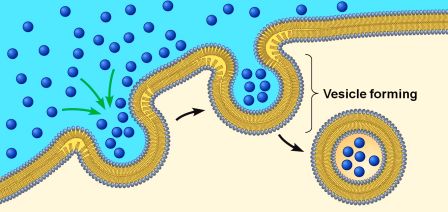
Which form of active transport is being shown?
a)
Facilitated Diffusion
b)
Exocytosis
c)
Endocytosis
d)
Protein Pumps
53.
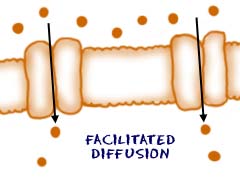
a)
Passive Transport
b)
Active Transport
54.
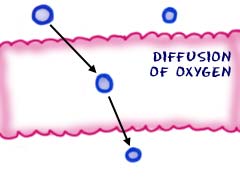
a)
Passive Transport
b)
Active Transport
55.
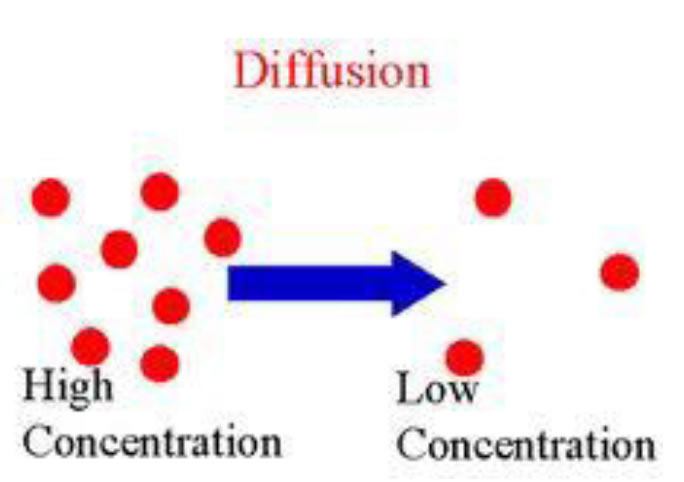
a)
Passive Transport
b)
Active Transport
56.
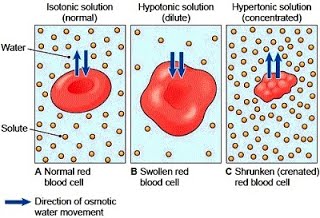
a)
Passive Transport
b)
Active Transport
57.
Endocytosis
a)
Passive Transport
b)
Active Transport
58.
Exocytosis
a)
Passive Transport
b)
Active Transport
59.
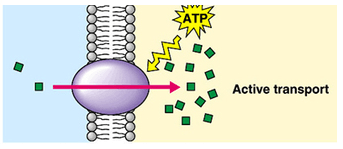
a)
Passive Transport
b)
Active Transport
60.
When cells take in a liquid through active transport, what is it called?
a)
Exocytosis
b)
Phagocytosis
c)
Pinocytosis
d)
Osmosis
61.

Movement of particles through the cell membrane from high to low
a)
passive transport
b)
active transport
c)
facilitated diffusion
d)
osmosis
62.
Two examples of passive transport are
a)
Active Transport and Facilitated Diffusion
b)
Facilitated Diffusion and Osmosis
c)
Protein Channels and Active Transport
d)
Osmosis and Endocytosis
63.

What type of transport is this?
a)
Diffusion
b)
Osmosis
c)
Facilitated Diffusion
d)
Active Transport
64.

In the image, the solution outside the cell is _____________.
a)
hypertonic
b)
hypotonic
c)
isotonic
65.

In the image, the solution outside the cell is _____________.
a)
hypertonic
b)
hypotonic
c)
isotonic
66.

In the image, the water will move
a)
into the cell.
b)
out of the cell.
c)
both in and out of the cell.
67.

In the image, the water will move
a)
into the cell.
b)
out of the cell.
c)
both in and out of the cell.
68.
A phospholipid has 2 parts. What are they called?
a)
Hydrophilic Head, Hydrophobic Tail
b)
Hydrophobic Head, Hydrophilic Tail
69.
"Water Loving"
a)
Hydrophobic
b)
Hydrophilic
c)
Hydroelectric
d)
Hydroloric
70.
___________ strengthens and stabilizes the cell membrane.
a)
Carbohydrates
b)
Proteins
c)
Phospholipids
d)
Cholesterol
71.
What forms the channels and pumps in the phospholipid bilayer?
a)
carbohydrates
b)
proteins
c)
hydrophilic heads
d)
lipids
72.

Hydrophobic region of the cell membrane?
a)
E
b)
B
c)
C
d)
A
73.

What is "I"?
a)
Carbohydrate
b)
Glycoprotein
c)
Peripheral Protein
d)
Cholesterol
74.

What is "B"?
a)
Peripheral Protein
b)
Glycoprotein
c)
Cholesterol
d)
Integral Protein
75.

What is "A"?
a)
Glycoprotein
b)
Phospholipid Bilayer
c)
Cholesterol
d)
Carbohydrate Chain
76.

What is "C"?
a)
Glycoprotein
b)
Carbohydrate
c)
Phosphate
d)
Integral Protein
77.

Identify the part of the membrane labeled B.
a)
carbohydrate
b)
cholesterol
c)
protein
d)
phospholipid
78.

Identify the part of the membrane identified as A.
a)
carbohydrate
b)
cholesterol
c)
protein
d)
phospholipid
79.

Name the structure labeled E
a)
Peripheral protein
b)
Polar region of membrane
c)
Nonpolar region of membrane
d)
Transmembrane protein
80.
Which of the following is the correct equation for PHOTOSYNTHESIS?
a)
CO2 + light + H2O --> O2 + Sugar
b)
CO2 + sugar + H2O --> O2 + light
c)
O2 + light + H2O --> CO2 + Sugar
d)
CO2 + O2 + H2O --> Light+ Sugar
81.
What is the pigment in chloroplasts that performs photosynthesis?
a)
Chlorosynthesis
b)
Chlorophyll
c)
ADP
d)
Electron Transport
82.
Which gas is removed from the atmosphere during photosynthesis?
a)
hydrogen
b)
oxygen
c)
nitrogen
d)
carbon dioxide
83.
What are the products of photosynthesis?
a)
water and carbon dioxide
b)
oxygen and glucose
c)
oxygen and carbon dioxide
d)
oxygen and water
84.

What is the function of NADPH and ATP?
a)
They absorb light
b)
They power the light-dependent reactions
c)
They are light-reflecting pigments
d)
They are short term energy carriers
85.

Where do the light-dependent reactions occur?
a)
thylakoid membrane
b)
stroma
c)
mesophyll
d)
mitochondria
86.

Which of the following is NOT a product of the light-dependent reactions?
a)
ATP
b)
NADPH
c)
Oxygen
d)
Glucose
87.

What is the primary function of the light-dependent reactions of photosynthesis?
a)
To produce glucose
b)
To produce NADPH and ATP
c)
To use ATP
d)
To produce RuBP
88.

Use the diagram to answer the question. Between which parts of the molecule must the bonds be broken to form an ADP molecule?
a)
A and B
b)
A and C
c)
B and C
d)
C and D
89.

Plants need carbon dioxide from their environment to produce glucose during which stage of photosynthesis?
a)
The light-dependent stage
b)
The light-independent stage (The Calvin Cycle)
c)
The electron transport chain
d)
ATP formation
90.

How many sugar molecules are produced from every six molecules of carbon dioxide that enter the Calvin cycle?
a)
1
b)
3
c)
6
d)
12
91.

Which product is produced during the light-dependent reactions?
a)
water
b)
oxygen
c)
glucose
d)
carbon dioxide
92.
What type of respiration requires oxygen?
a)
Aerobic
b)
Anaerobic
93.
How many ATP are produced in aerobic respiration?
a)
2
b)
33
c)
4
d)
36
94.
What is the correct equation for cellular respiration?
a)
6O2 + C6H12O6 -> 6CO2 + 6H2O + Energy
b)
6O2 + C6H12O6 + Energy -> 6CO2 + 6H2O
c)
6CO2 + 6H2O -> 6O2 + C6H12O6 + Energy
d)
6CO2 + 6H2O + Energy -> 6O2 + C6H12O6
95.
Where does the Krebs Cycle take place?
a)
mitochondria
b)
chloroplast
c)
cytoplasm
d)
nucleus
96.
Glycolysis results in a net gain of how many ATP?
a)
0
b)
2
c)
4
d)
1
97.
What are the PRODUCTS for cellular respiration?
a)
oxygen and ATP (energy)
b)
water and glucose and ATP (energy)
c)
carbon dioxide and water and ATP (energy)
d)
glucose and oxygen
98.
Which process takes place in the inner membrane of mitochondria?
a)
Krebs cycle
b)
Electron Transport Chain
c)
Light-Independent Reaction
d)
Calvin Cycle
99.
What are the three steps of cellular respiration in order?
a)
Krebs, ETC, glycolysis
b)
glycolysis, Krebs, ETC
c)
ETC, glycolysis, Krebs
d)
Krebs, glycolysis, ETC
100.
Where does Krebs cycle take place?
a)
membrane of chloroplast
b)
matrix of mitochondria
c)
cytoplasm
d)
inner membrane of mitochondria
101.

What is a?
a)
inner membrane
b)
outer membrane
c)
cristae
d)
matrix
100 %

