
 Worksheets
IS4 Benchmark
Total questions: 109
Worksheet time: 2hrs 32mins
Name
Class
Date
1.
B=brown eyes
b= blue eyes
What is true about two brothers that have brown eyes?
One has genotype BB the other Bb.
b= blue eyes
What is true about two brothers that have brown eyes?
One has genotype BB the other Bb.
a)
they have same phenotype and genotype
b)
they have different genotypes and phenotypes
c)
they have same phenotype but different genotypes
d)
they have same genotype but different phenotypes
2.
A dog gives birth to 5 puppies. What percentage of the chromosomes does each puppy share with the mother?
a)
25%
b)
50%
c)
75%
d)
100%
3.
What does heterozygous mean?
a)
An organism that has the same genes for a trait (TT or tt)
b)
An organism that has different genes for a trait (Tt)
c)
When neither gene is fully dominant; offspring is a mixture of both
d)
the different forms of a trait (hair color--> brown, blonde, red
4.
If a heterozygous tall pea plant is crossed with a short pea plant, what are the possible genotypes of the future offspring?
a)
100% Tt
b)
50% Tt, 50% tt
c)
75%Tt, 25%tt
d)
25%TT, 50%Tt, 25%tt
5.

This is an example of what?
a)
Complete dominance
b)
Incomplete dominance
c)
Codominance
d)
None of the above
6.

If T=Tall & t=short, what is the genotypic ratio?
a)
1:3
b)
3:1
c)
1:2:1
d)
2:2
7.
Snapdragon flowers come in red, pink and white. What type of inheritance is this?
a)
Complete Dominance
b)
Incomplete Dominance
c)
Codominance
d)
Polygenic Inheritance
8.

Which process and type of resulting cells are represented?
a)
mitosis, gametes
b)
mitosis, body cells
c)
meiosis, gametes
d)
meiosis, body cells
9.
Which of the following cell types is formed by meiosis?
a)
muscle cells
b)
skin cells
c)
sperm cells
d)
blood cells
10.

Which best describes the process shown?
a)
mutation in which the DNA content of the gene is ltered
b)
segregation of sister chromatids
c)
condensation and segregation of the alleles
d)
crossing-over which alleles are exchanged
11.
What is one advantage of sexual reproduction?
a)
offspring are identical to parents
b)
offspring are resistant to viruses
c)
offspring are born live, rather thna from eggs
d)
offspring inherit a wider variety of genetic information
12.
How many times in meiosis does the cell divided?
a)
2
b)
4
c)
3
d)
1
13.
The work of scientists including Griffin, Avery, Hershey & Chase and Franklin helped us to determine the __ are responsible for carrying genetic material.
a)
Amino Acids
b)
Proteins
c)
Nucleic Acids
d)
Carbohydrates
14.
If Chargaff found that a sample of DNA has 20% ADENINE, how much GUANINE would he have determined to be there?
a)
30%
b)
20%
c)
80%
d)
60%
15.
The work of Erwin Chargaff allowed Watson and Crick to determine the rules of...
a)
protein synthesis
b)
transcription
c)
hydrogen bonding
d)
nitrogen base pairing
16.
Rosalind Franklin's "Photo 51" allowed Watson and Crick to determine the ___ of DNA.
a)
Shape
b)
Backbone
c)
Nitrogen bases
d)
Hydrogen bonds
17.

Who was responsible for the experiment depicted by the image/data table?
a)
Oswald Avery, et. al.
b)
Watson and Crick
c)
Erwin Chargaff
d)
Frederick Griffith
18.

Who was responsible for the experiment depicted by the image?
a)
Friedrich (Fritz) Miescher
b)
Watson and Crick
c)
Frederick Griffith
d)
Rosalind Franklin
19.

Who was responsible for the model shown?
a)
Oswald Avery, et. al.
b)
Watson and Crick
c)
Erwin Chargaff
d)
Linus Pauling
20.

Who was responsible for the experiment depicted by the image/data table?
a)
Oswald Avery, et. al.
b)
Watson and Crick
c)
Erwin Chargaff
d)
Rosalind Franklin
21.
What did Erwin Chargaff conclude from his experiments?
a)
Nitrogen bases are held together by peptide bonds
b)
A and T, C and G always occur in equal amounts
c)
Proteins are the carriers of genetic information
d)
C and G rarely occur in eukaryotic organisms
22.

In a molecule of double-stranded DNA, the amount of Adenine present is always equal to the amount of
a)
cytosine
b)
guanine
c)
thymine
d)
uracil
23.
Which sugar is contained in DNA
a)
Dextrose
b)
Ribose
c)
Deoxyribose
d)
Glucose
24.
Guanine bonds with ______________.
a)
Adenine
b)
Guanine
c)
Cytosine
d)
Thymine
25.
What are the chemical components of DNA?
a)
A phosphate, nitrogenous base, and an amino acid
b)
A nitrogenous base, a sugar, and an amino acid
c)
A phosphate, a sugar, and a nitrogenous base
d)
A nitrogenous base, sugar, and a helix
26.
DNA from different organisms can create significantly different phenotypes because ________ and ________ can vary from organism to organism.
a)
The order of bases
b)
The length of the DNA
c)
The protein length
d)
The shape of DNA
27.
Given the following sequence - ATGCGTGACGATA
The complimentary sequence would be...
The complimentary sequence would be...
a)
ATGCGTGACGATA
b)
UACGCACUGCUAU
c)
TACGCACTGCTAT
d)
TACGTCGATATGE
28.
The bonds that hold the strands of DNA together are between the...
a)
Bases and the Sugars
b)
Bases and the Phosphates
c)
Bases and other Bases
d)
Sugars and Phosphates
29.

The image illustrates which of the following structures?
a)
Amino acid
b)
Nucleotide
c)
Protein
d)
Peptide Bond
30.
What makes up the sides, or backbone, of a DNA molecule?
a)
Alternating sugars and nitrogen bases
b)
Nitrogen base pairs
c)
A sugar, a phosphate, and a nitrogen base
d)
Alternating sugars and phosphates
31.
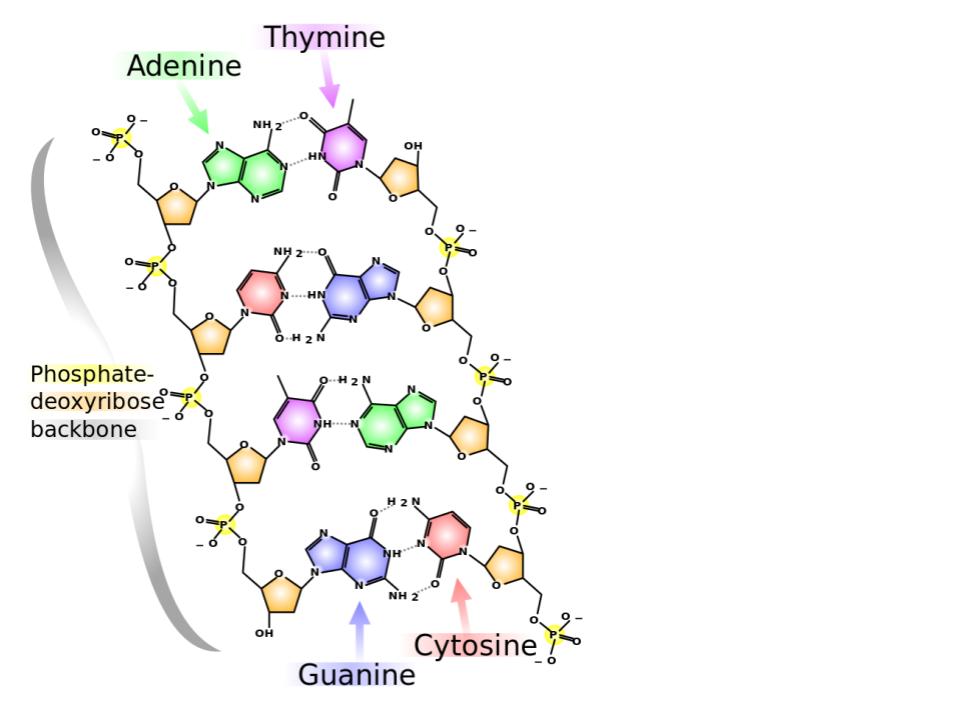
The two strands of DNA are held together by:
a)
Hydrogen Bonds
b)
Phosphodiester Bonds
c)
Glycolsyl Bonds
d)
Glycosidic Linkages
32.

DNA is a polymer made of:
a)
Nucleotides
b)
Ribosomes
c)
Purines
d)
Pyrimidines
33.

The term used to describe DNA Replication is:
a)
Semi-Conservative
b)
Conservative
c)
AntiParallel
d)
Dispersive
34.
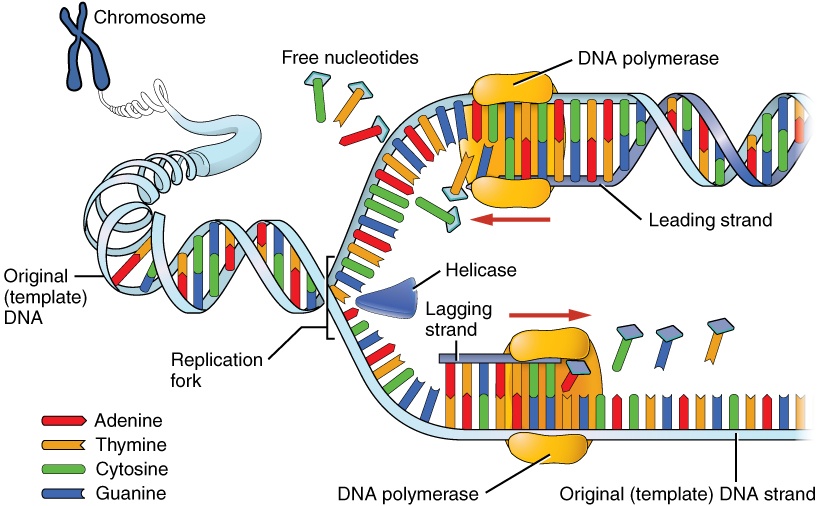
What is the complement to the DNA strand below:
5'-ATGCCAT-3'
5'-ATGCCAT-3'
a)
5'-TACGGTA-3'
b)
3'-TACGGTA-5'
c)
3'-ATGGCAT-5'
d)
5'-ATGGCAT-3'
35.

Which of the following best describes a DNA molecule?
a)
double helix
b)
contains ribose
c)
made of amino acids
d)
contains Uracil
36.
DNA polymerase is a(n)
a)
lipid
b)
enzyme
c)
sugar
d)
starch
37.

DNA codes for...
a)
bases
b)
proteins
c)
amino acids
d)
phosphates
38.
a change in the nucelotide-base sequence of a gene or DNA molecule
a)
nucleotide
b)
DNA
c)
RNA
d)
mutation
39.

For what reason does DNA copy itself?
a)
to replace worn out DNA
b)
so cells can divide
c)
to export DNA to other parts of the body
d)
more DNA is better
40.

A segment of DNA is called a
a)
chromosome
b)
gene
c)
amino acid
d)
protien
41.
This type of mutation occurs when a nitrogen base is added into a sequence and drastically changes the resulting protein.
a)
Point mutation
b)
Insertion mutation
c)
Deletion mutation
d)
Substitution
42.
This type of mutations occurs when one nitrogen base is taken out of the sequence, drastically changing the resulting protein.
a)
Point Mutation
b)
Insertion Mutation
c)
Deletion Mutation
d)
Substitution
43.
Original: ATC CAT
Mutation:ATG CAT
What mutation occurred?
Mutation:ATG CAT
What mutation occurred?
a)
deletion
b)
insertion
c)
substitution
44.
Which Hardy-Weinberg factor represents the frequency of heterozygous individuals in a population?
a)
p2
b)
2pq
c)
q2
d)
p2 + 2pq
45.
Which Hardy-Weinberg equation represents the genotype frequencies in a population?
a)
p + q = 1
b)
p2 + 2pq + q2 = 1
c)
p2 + pq2 + q2 = 1
d)
p + 2pq + q3 = 1
46.
Which of the following is NOT a condition for Hardy-Weinberg Equilibrium?
a)
No mutations
b)
Random Mating
c)
No natural selection
d)
No offspring
47.
The Hardy-Weinberg Model is...
a)
available at local hobby stores and retailers throughout the Greater Tazewell area.
b)
a mathematical tool that biologists can use to predict allele frequencies and determine whether or not evolution is occurring within a population.
c)
always occurring within individual organisms in nature.
d)
only useful in the lab and cannot be practically applied to real-world populations of organisms.
48.
When a population is in Hardy-Weinberg equilibrium, what is NOT happening to the species?
a)
Survival
b)
Reproduction
c)
Death
d)
Evolution
49.
What does the Hardy-Weinberg equilibrium measure?
a)
changes in allele frequencies
b)
numbers of mutations
c)
goodness of fit
d)
genetic diversity
50.
A population of 150 individuals has an allele frequency of 0.3 for the dominant allele (B) and a frequency of 0.7 for the recessive allele (b). Use the Hardy-Weinberg equation to determine the frequency of the genotype (bb).
a)
0.09
b)
0.42
c)
0.49
d)
0.21
51.
If a population is not evolving , it is in genetic equilibrium.
a)
True
b)
False
52.

What type of selection?
a)
Directional
b)
Stabilizing
c)
Disruptive
53.

What type of selection?
a)
Directional
b)
Stabilizing
c)
Disruptive
54.

What type of selection?
a)
Directional
b)
Stabilizing
c)
Disruptive
55.
If a heterozygous tall pea plant is crossed with a short pea plant, what are the possible genotypes of the future offspring?
a)
100% Tt
b)
50% Tt, 50% tt
c)
75%Tt, 25%tt
d)
25%TT, 50%Tt, 25%tt
56.

If green is dominant over purple, then what is the genotype for this individual?
a)
Purple
b)
Green
c)
GG
d)
gg
57.
Which factor would most likely disrupt genetic equilibrium in a large population?
a)
the production of large numbers of offspring
b)
mating that is non-random
c)
the absence of emigration and immigration
d)
the absence of mutations
58.
A human usually has xx amount of chromosomes.
a)
6
b)
22
c)
4
d)
46
59.
What is it called when a sperm and egg meet?
a)
meiosis
b)
fertilization
c)
cell division
d)
mitosis
60.

Meiosis makes sperm and egg cells. In humans, sperm and egg cells each have _____ chromosomes. Therefore a fertilized human egg cell (sperm and egg cell combined) would create a cell with _____ chromosomes.
a)
23, 46
b)
46, 23
c)
2, 4
d)
50, 100
61.
What causes genetic variation in meiosis?
a)
chromosomes lining up
b)
crossing over of chromosomes
c)
separation of chromosomes
d)
chromosomes pulling apart
62.
Unlike mitosis, meiosis in male mammals results in the formation of
a)
one haploid gamete
b)
three diploid gametes
c)
four diploid gametes
d)
four haploid gametes
63.

When an area of a chromatid is exchanged with the matching area on a chromatid of its homologous chromosome, _________________ occurs
a)
crossing over
b)
mutagenesis
c)
hybridization
d)
fertilization
64.
What kind of cells are made in MEIOSIS?
a)
Haploid Gametes
b)
Diploid Somatic Cells
c)
Skin Cells
d)
Liver Cells
65.

Which process and type of resulting cells are represented?
a)
mitosis, gametes
b)
mitosis, body cells
c)
meiosis, gametes
d)
meiosis, body cells
66.
If a somatic cell in a butterfly contains 24 chromosomes, a butterfly egg would contain
a)
3
b)
6
c)
12
d)
24
67.
The process of crossing over occurs in what phase of meiosis?
a)
anaphase 1
b)
prophase 1
c)
prophase 2
d)
telophase 1
68.
The chromosomes that pair up during meiosis, are called __________ chromosomes.
a)
homozygous
b)
asexual
c)
homologous
d)
genes
69.
Crossing over helps promote
a)
male genotype
b)
genetic variation
c)
DNA replication
d)
mitosis
70.
What is another reason we need meiosis?
a)
So the offspring has genes from both parents
b)
So the offspring has genes from one parent
c)
So the offspring has genes from neither parents
d)
So the offspring makes its own genes
71.
Why do we need meiosis?
a)
To double the number of chromosomes going into sex cells
b)
To halve the number of chromosomes going into sex cells
c)
To triple the number of chromosomes going into sex cells
d)
To not change the number of chromosomes going into sex cells
72.
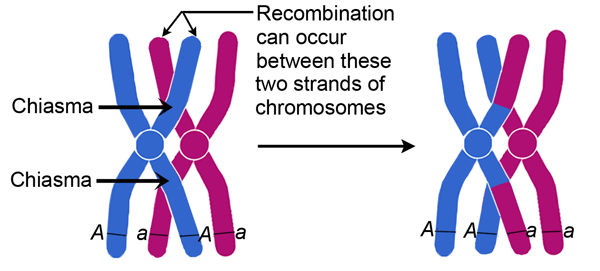
This image shows chromosomes during Prophase 1. Which of the following correctly describes the process shown?
a)
segregation of sister chromatids
b)
condensation and segregation of alleles
c)
mutationin which the DNA content of the gene is altered
d)
crossing - over in which alleles are exchanged
73.
What is one advantage of sexual reproduction?
a)
The offspring are identical to the parents
b)
the offspring are resistant to viruses
c)
the offspring are born live, instead of from eggs
d)
The offspring inherit a wider variety of genetic information
74.
Based only on the sex chromosomes in a human egg and sperm cells at fertilization, the probability of producing a female is
a)
25%
b)
50%
c)
75%
d)
90%
75.
Homozygous is when...
a)
the alleles are the same
b)
the alleles are different
c)
the alleles are absent
d)
the alleles are present
76.

What is the genotypic ratio here
a)
TT = 25% Tt= 50% tt=25%
b)
all tall
c)
TT= 75% tt = 25%
d)
Tt = 100%
77.
RR- red cattle, WW=white cattle RW= roan cattle with white and red spots. This kind of inheritance is called
a)
complete dominance
b)
sex linked inheritance
c)
incomplete dominance
d)
codominance
78.

An organism's _______ describes its genetic composition. An organism's _______ describes its appearance or observable characteristics.
a)
phenotype; genotype
b)
species; heredity
c)
heredity; species
d)
genotype; phenotype
79.
You have two dogs, one white and one brown. They have puppies, and all of the puppies are brown and white spotted!! What is the inheritance pattern?
a)
Mendelian dominant
b)
incomplete dominant
c)
polygenic
d)
co-dominant
80.
You have two rose plants, both with pink flowers. You cross the two plants and find that, while most of the offspring are pink, some are red and some are white. What kind of inheritance pattern is this?
a)
Incomplete dominant
b)
Codominant
c)
Mendellian Dominant
d)
Polygenic traits
81.
If a gene is found only on the X chromosome and not the Y chromosome, it is said to be what?
a)
sex-linked trait
b)
polygenic trait
c)
codominant trait
d)
incomplete dominance trait
82.

Duchenne muscular dystrophy is a recessive x-linked disorder.
According to the Punnett square, what percentage of offspring will have the disorder?
According to the Punnett square, what percentage of offspring will have the disorder?
a)
0%
b)
25%
c)
50%
d)
100%
83.

This is the expression of alleles. It is the observable trait we can see _________________
a)
Dominant
b)
Homozygous
c)
Genotype
d)
Phenotype
84.
A person has A blood type. What is his genotype?
a)
IAIA only
b)
IAIO only
c)
could be IAIA or IAIO
d)
IOIO only
85.
A man with blood type B has children with a woman who is blood type A. They have eight children, four have AB blood and four have type B blood. What are the parents' genotypes?
a)
IAIA and IBIB
b)
IAIO and IAIB
c)
IAIO and IBIB
d)
IAIA and IBIO
86.
Are all mutations bad?
a)
Yes
b)
No
87.
Original DNA: CAT GAT
New DNA: CAT AT
What mutation occurred?
New DNA: CAT AT
What mutation occurred?
a)
deletion
b)
substitution
c)
tranverse
d)
insertion
88.
Cell mutations within a DNA sequence are
a)
unnatural events that are harmful to genetic diversity
b)
unnatural events that always affect the phenotype
c)
natural events that produce genetic diversity
d)
natural events that always affect the phenotype
89.
Would a mutation in the DNA of a skin cell be passed on to an organism's offspring?
a)
Yes, because any change to the DNA is passed on to the offspring
b)
Maybe. Sex cells only use half of the body's genetic code. It might get the copy of a gene that wasn't mutated.
c)
No. Only mutations that occur in the gametes (sex cells) are passed on to the offspring
d)
Without knowing the animal, it would be hard to tell whether or not the mutation would be passed on.
90.
What causes mutations?
a)
Mistakes in replication or environmental substances
b)
The amino acids
c)
Passed down by genetics
d)
It's how your born
91.
Mutations are a source of _______________.
a)
Variation
b)
Disease
c)
Polypeptide
92.
Aa, DD, bB, yy are all examples of
a)
genotypes
b)
phenotypes
93.
What is another way of saying "purebred"?
a)
homozygous
b)
dominant
c)
recessive
d)
heterozygous
94.
Purple is dominant to white. A heterozygous purple flower is crossed with a white flower. What are the genotypes and phenotypes of the offspring?
a)
100% Pp (purple)
b)
50% Pp (purple); 50% pp (white)
c)
75% Pp (purple); 25% pp (white)
d)
25% PP, 50% Pp, 25% pp
75% purple, 25% white
75% purple, 25% white
95.

What gamete possibilities could come from this parent's genotype?
a)
AB, AB, aB, aB
b)
Ab, AB, Ab, ab
c)
Ab, Ab, Ab, Ab
d)
AB, aB, ab, aB
96.

What gamete possibilities could come from this parent's genotype?
a)
aB, ab, AB, Ab
b)
aB, Ab, AB, AB
c)
AB, aB, AB, Ab
d)
aB, ab, aB, ab
97.

What goes in box 1
a)
AABb
b)
AABB
c)
aabb
d)
AaBb
98.
What goes in box 3
a)
Aabb
b)
AABB
c)
AAbb
d)
aaBb
99.

What genotype is missing from this Punnett Square?
a)
RrYy
b)
RRYY
c)
rryy
d)
RrYY
100.

Based off this punnett square, what fraction of the offspring will have wrinkled, yellow seeds?
a)
9/16
b)
3/16
c)
1/16
d)
16/16
101.
Why did dark-colored rock pocket mice first appear in a population of light-colored rock pocket mice?
a)
They have a genetic mutation that affects their fur color.
b)
There is dark lava rock in the area where they live.
c)
Individuals change color to blend in with the environment.
d)
Predators eat light-colored rock pocket mice.
102.
_______________ exist between members of a population and those differences can help during a change in the environment.
a)
traits
b)
disease
c)
variations
103.
Those organisms in a species that have the more favorable traits will
a)
survive and reproduce
b)
compete for food
c)
live in symbiotic relationships
d)
eat skittles
104.
A trait that helps a species survive
a)
characteristic
b)
adaptation
c)
survival trait
105.
What word describes the process of having the advantageous traits that helps an organism survive and reproduce?
a)
natural selection
b)
adaptation
c)
mutation
d)
genetic engineering
106.
Why do peppered moths tend to be the same color as the trees on which they live?
a)
The coloring goes along with tasting like the tree.
b)
It keeps the moth the same temperature as the tree.
c)
It makes the moths faster than the birds
d)
It makes the moths harder to see.
107.
Which of these is an example of natural selection?
a)
The largest animal in a population will have more opportunities for reproduction.
b)
Several species of organisms work together so that they all succeed.
c)
One species takes all the resources in an environment leaving none for others.
d)
Organism that are best suited to an environment tend to survive and reproduce more often.
108.
Humans have been a very successful species on earth. They have very large, very diverse populations spread all around the world. As a result,
a)
Human have very limited ability to adapt to changes in the environment.
b)
Young humans have lower survival rates as compared to other species.
c)
Humans have a potential to adapt to various environmental changes.
d)
All humans are more disease resistant.
109.
A large herd of goats lives in a field full of poison ivy. Some goats are able to eat the poison ivy while others have become sick when they eat it. Over time the herd as a whole will tend to
a)
Become more likely to eat poison ivy.
b)
Become less likely to eat poison ivy.
c)
Not change in the proportion of goats that can and can not eat poison ivy.
d)
Eat all the poison ivy and leave only plants all the goats can eat.
100 %

