wayground logo

Free Printable Worksheets

Font size

S
M
L
XL
Worksheets

Characteristics, Classification, and Microscopes

Total questions: 93

Worksheet time: 2hrs 2mins

Name
Class
Date
1.
When you step out into the cold, your body shivers in order to keep its temperature at 98.6F.
a)
All living things use energy
b)
All living things contain cells
c)
All living things maintain homeostasis
d)
All living things grow
2.
Green plants produce their own food through the process of photosynthesis.
a)
All living things use energy
b)
All living things contain cells
c)
All living things maintain homeostasis
d)
All living things grow
3.
A baby song bird hatches from its egg with both parent songbirds watching.
a)
All living things reproduce
b)
All living things maintain homeostasis
c)
All living things use energy
d)
All living things grow
4.
A pill bug (roly poly) eats a carrot.
a)
All living things contain cells
b)
All living things use energy
c)
All living things maintain homeostasis
d)
All living things grow
5.
A camel has eyelashes that work to keep the dust and sand out of its eyes.
a)
All living things adapt to their environment
b)
All living things grow
c)
All living things have cells
d)
All living things use energy
6.
A caterpillar hibernates in a cocoon and emerges as a butterfly.
a)
All living things adapt to their environment
b)
All living things use energy
c)
All living things respond to their environment
d)
All living things grow
7.
An amoeba is a unicellular organism. Which characteristic of life is this?
a)
All living things use energy
b)
All living things contain cells
c)
All living things respond to their environment
d)
All living things grow
8.
A tulip opens in the morning at sunrise and closes in the evening at sunset.
a)
All living things have cells
b)
All living things use energy
c)
All living things respond to their environment
d)
All living things grow
9.
Over three years, Tim's height has increased from 5'4" to 5'11".
a)
All living things contain cells
b)
All living things maintain homeostasis
c)
All living things use energy
d)
All living things grow
10.
A cat is an organism that has a respiratory system that contains lungs and a trachea.
a)
All living things contain cells
b)
All living things maintain homeostasis
c)
All living things have different levels of organization
d)
All living things grow
11.
A sea worm drops its tail and the tail becomes a new worm.
a)
All living things contain cells
b)
All living things grow
c)
All living things have different levels of organization
d)
All living things reproduce
12.
An adult hydra is producing its offspring through budding.
a)
All living things use energy
b)
All living things reproduce
c)
All living things contain cells
d)
All living things grow
13.
The roots of a plant grow towards a source of ground water.
a)
All living things use energy
b)
All living things reproduce
c)
All living things respond to their environment
d)
All living things grow
14.
Over many hundreds of years, a population of rabbits living in the woods adapts to its surrounding with brown fur.
a)
All living things adapt to their environment
b)
All living things grow
c)
All living things use energy
d)
All living things have cells
15.
YOU are a multi-celled organism but an amoeba is a single celled organism.
a)
All living things have cells
b)
All living things grow
c)
All living things use energy
d)
All living things respond to their environment
16.
The basic unit of life is called a (n)
a)
atom
b)
compound
c)
cell
d)
energy
17.

A woman screams at the sound of thunder. This is an example of

a)

reproducing

b)

doing cellular respiration

c)

having cells

d)

responding to her environment

18.
What does reproduce mean?
a)
They grow
b)
They are living things
c)
Organisms make other organisms
19.

When something gets bigger or larger this is called?

a)

height

b)

development

c)

growth

d)

fat

20.
What is a living thing?
a)
reproduction
b)
organism
c)
development
d)
homeostasis
21.
An example of homeostasis includes maintaining :
a)
oxygen level
b)
body temperature
c)
blood sugar level
d)
all of these levels
22.
A single organism that produces offspring identical to itself.
a)
DNA
b)
asexual reproduction
c)
sexual reproduction
d)
metabolism
23.
An organism made of one cell is called
a)
unicellular
b)
multicellular
24.
Which one of the following is a characteristic of life?
a)
Growth
b)
Breathing
c)
Expelling toxins
d)
Photosynthesis
25.
All organisms have more than one cell.
a)
false
b)
true
26.
What is the main source of energy on Earth?
a)
stars
b)
moon
c)
water
d)
sun
27.
Multicellular means
a)
made of many cells
b)
made of one kind of cell
c)
made of only one cell
28.

Reproduction that involves 2 parents is called

a)

asexual

b)

spontaneous generation

c)

sexual

d)

conduction

29.

What are the 4 necessities of life?

a)

food, water, shelter, air

b)

food, water, shelter, sunlight

30.

Why is water a necessities of life?

a)

—keep their inside environments stable

b)

—break down food for energy

c)

provide a place to live

d)

provides energy and nutrients

31.

Why is air a necessities of life?

a)

—keep their inside environments stable

b)

—break down food for energy

c)

provide a place to live

d)

provides energy and nutrients

32.

Why is shelter a necessities of life?

a)

—keep their inside environments stable

b)

—break down food for energy

c)

provide a place to live

d)

provides energy and nutrients

33.

Why is food a necessities of life?

a)

—keep their inside environments stable

b)

—break down food for energy

c)

provide a place to live

d)

provides energy and nutrients

34.

What do proteins in food do?

a)

—used to build or fix parts of an organism’s body or to help reactions within a cell

b)

—DNA stores instructions for the organism

c)

—a form of stored energy such as fats and oils

d)

—provide and store energy for cells such as sugars and starches

35.

What do nucleic acids in food do?

a)

—used to build or fix parts of an organism’s body or to help reactions within a cell

b)

—DNA stores instructions for the organism

c)

—a form of stored energy such as fats and oils

d)

—provide and store energy for cells such as sugars and starches

36.

What do lipids in food do?

a)

—used to build or fix parts of an organism’s body or to help reactions within a cell

b)

—DNA stores instructions for the organism

c)

—a form of stored energy such as fats and oils

d)

—provide and store energy for cells such as sugars and starches

37.

What do carbohydrates in food do?

a)

—the molecule that carries energy and is used by cells

b)

—DNA stores instructions for the organism

c)

—a form of stored energy such as fats and oils

d)

—provide and store energy for cells such as sugars and starches

38.

What do ATP in food do?

a)

—the molecule that carries energy and is used by cells

b)

—DNA stores instructions for the organism

c)

—a form of stored energy such as fats and oils

d)

—provide and store energy for cells such as sugars and starches

39.
You can find total magnification by which of the following methods?
a)
ocular PLUS objective
b)
ocular TIMES objective
c)
ocular MINUS objective
d)
ocular DIVIDED BY objective
40.
Find the total magnification: 
Eyepiece = 10X 
Objective lens = 55X
 
a)
10x
b)
55x
c)
65x
d)
550x
41.
What is number 14?
a)
stage clips
b)
stage
c)
diaphragm
d)
light source
42.
What is number 15?
a)
light source
b)
base
c)
coarse adjustment
d)
fine adjustment
43.
What is number 17?
a)
body tube
b)
arm/neck
c)
stage
d)
base
44.
You should always carry the microscope by the
a)
arm and base
b)
arm and body tube
c)
arm only
d)
the objectives
45.
When looking at a specimen on your slide, you should always start with the
a)
low objective lens
b)
medium objective lens
c)
high objective lens
d)
super extra high power lens
46.
When looking through your microscope, you move your slide to the right- It appears
a)
to move to the right
b)
to stay the same
c)
to move to the left
d)
vanish
47.
The _______focuses the image under low power.
a)
revolving nosepiece
b)
fine adjustment knob
c)
coarse adjustment knob
d)
arm/neck
48.
The__________ sharpens the image under high magnification.
a)
the diaphragm
b)
fine adjustment knob
c)
coarse adjustment knob
d)
the ocular
49.
The lens you look through, closest to the top of the microscope, is called the
a)
objective lens
b)
ocular lens
c)
diaphragm
d)
light source
50.
The ________ of the microscope would show you the MOST zoomed in image, or the SMALLEST field of view.
a)
low power objective
b)
medium power objective
c)
high power objective
d)
stage
51.
What power do you start with when using a microscope?
a)
High power
b)
Medium power
c)
Low power
d)
Extra high power
52.
Never use this when on high power.
a)
Fine adjustment
b)
Diaphragm
c)
Course adjustment
d)
Stage clips
53.
What is the function of stage clips?
a)
To move the objectives
b)
To keep the slide secure
c)
To adjust the focus
d)
To look through
54.
A compound light microscope will use _______ or more lenses at the same time.
a)
1
b)
2
c)
3
55.
Find the total magnification: 
Eyepiece = 10X 
Objective lens = 40X
 
a)
10x
b)
50x
c)
40x
d)
400x
56.
What is number 13?
a)
revolving nosepiece
b)
eyepiece
c)
objective lens
d)
base
57.
What is number 18?
a)
stage
b)
stage clips
c)
coarse adjustment
d)
fine adjustment
58.
What is number 19?
a)
diaphragm
b)
coarse adjustment
c)
fine adjustment
d)
light source
59.
What is number 20?
a)
eyepiece
b)
body tube
c)
arm
d)
base
60.
 You would find mushrooms in which kingdom?
a)
Plantae
b)
Protists
c)
Fungi
d)
Animalia
61.
Which kingdom do humans belong to?
a)
Plantae
b)
Fungi
c)
Animalia
d)
Protista
62.
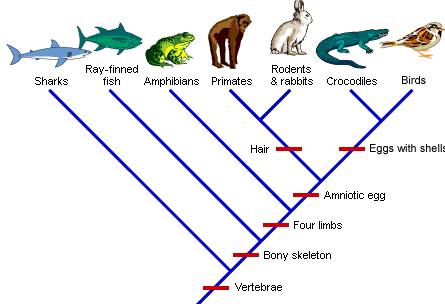
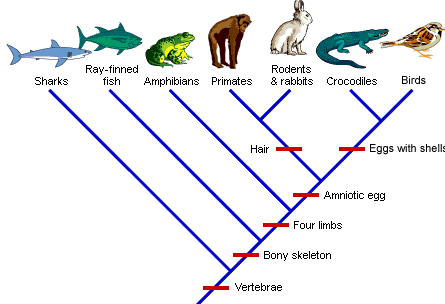
According to this cladogram, sharks are MOST closely related to which organism? 
a)
Amphibians
b)
Ray finned fish
c)
Crocodiles
d)
Birds
63.
Which two organisms have hair? 
a)
Sharks & Ray Finned Fish
b)
Primates & Rodents
c)
Birds & Crocodiles
d)
Rabbits & Birds
64.
According to this cladogram, birds are LEAST related to: 
a)
Amphibians
b)
Sharks
c)
Ray Finned Fish
d)
Crocodiles
65.
Which domain is capable of living in extreme environments like hot springs, geysers, or very salty waters?
a)
Bacteria
b)
Archaea
c)
Eukarya
66.
Which domain includes all animals and plants?
a)
Archaea
b)
Eukarya
c)
Bacteria
67.
Which two kingdoms are entirely multicellular?
a)
Animalia and Plantae
b)
Animalia and Protista
c)
Protista and Plantae
68.
To say that an organism is heterotrophic means...
a)
it cannot reproduce asexually
b)
it cannot make its own food
c)
it cannot breathe oxygen gas
69.
Organisms whose cells have NO nucleus are classified as...
a)
Eukaryotic
b)
Prokaryotic
c)
Dead
70.
True or False: All cells have DNA.
a)
True
b)
False
71.
True or False: All living things are made of one or more cells.
a)
True
b)
False
72.
If two organisms have similar traits of DNA they are probably
a)
share a common ancestor
b)
share a common environment
c)
share a common population
d)
speciation
73.
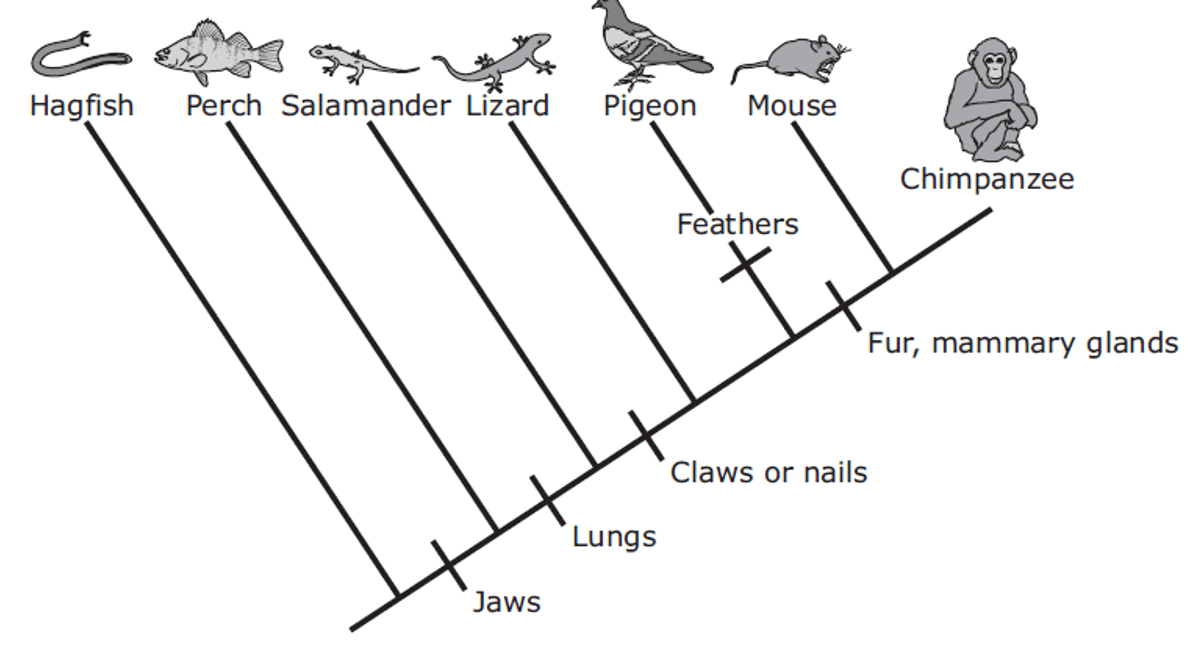
Which trait do only humans have, according to the cladogram?
a)
jaws
b)
mammary glands & hair
c)
terrestrial during all life stages
d)
opposable thumbs
74.
According to the diagram, which bird has the most similar DNA to a large tree finch?
a)
small tree finch
b)
medium tree finch
c)
large ground finch 
d)
green warbler finch
75.
All the animals to the right of the hagfish would have the common characteristic of -
a)
Fur
b)
Claws or nails
c)
Lungs
d)
Jaws
76.
I am prokaryotic and am found everywhere. What kingdom do I belong to?
a)
Eubacteria
b)
Archaebacteria
c)
Fungi
d)
Protista
77.
This organism is found in pond water.  It has a nucleus, is microscopic, unicellular and can perform photosynthesis.  What kingdom does it belong in?
a)
protista
b)
eubacteria
c)
archaebacteria
d)
plantae
78.
The broadest or most general level of classification of living organisms is 
a)
Domain
b)
Kingdom
c)
Phylum
d)
Family
79.
The most specific level of classification is 
a)
Domain
b)
Kingdom
c)
Genus
d)
Species
80.
Term given to describe the 2 name naming system is:
a)
dichotmous key
b)
binomial nomenclature
c)
2 scientific names
d)
binomial key
81.
Which is the correct order of The Levels of Taxonomy?
a)
Kingdom, Phylum, Class, Order, Family, Genus, Species
b)
Kingdom, Phylum, Order, Class, Family, Genus, Species
c)
Kingdom, Phylum, Family, Class, Order, Genus, Species
d)
Species, Genus, Family, Class, Order, Phylum, Kingdom
82.
The science of describing, classifying, and naming living things is called:
a)
Geology
b)
Biology
c)
Taxonomy
d)
Chemistry
83.
The scientific name for an organism is made from the:
a)
class and family name
b)
genus and species name
c)
domain and kingdom name
d)
kingdom and phylum name
84.
Cells that do not have a nucleus are called....
a)
eukaryote
b)
prokaryote
c)
unicellular
d)
multicellular
85.
Cells that have a nucleus are called....
a)
eukaryotes
b)
prokaryotes
c)
unicellular
d)
multicellular
86.
Fill-in-the-blank:
Domain--Kingdom--Phylum--____________
a)
Order
b)
Family
c)
Class
d)
Species
87.
What level comes immediately after "order" in the classification levels?
a)
family
b)
genus
c)
phylum
d)
class
88.
Each classification level is called a
a)
taxon
b)
group
89.
According to this cladogram, birds are LEAST related to: 
a)
Amphibians
b)
Sharks
c)
Ray Finned Fish
d)
Crocodiles
90.
An illustration and a dichotomous key are given. What is the correct classification for this organism?
a)
Class Insecta
b)
Order Amblygygi
c)
Order Araneae
d)
Order Scorpiones
91.
A dichotomous key for trees is provided. Hikers found a tree that has large brown cones and single sharp needles. What species of tree have the hikers found?
a)
Juniper
b)
Pine
c)
Spruce
d)
Fir
92.
What are the three domains?
a)
Archaea, Bacteria, and Eubacteria
b)
Archaea, Protista, and Eubacteria
c)
Archaea, Bacteria, and Eukarya
d)
Archaea, Fungi, Animalia
93.
What domain of classification includes plants, animals, fungi, protists, (all eukaryotes)?
a)
Archaea
b)
Bacteria
c)
Eukarya
d)
Plantae