wayground logo

Free Printable Worksheets

Font size

S
M
L
XL
Worksheets

Electricity Review

Total questions: 110

Worksheet time: 2hrs 33mins

Name
Class
Date
1.
What happens to the force between two charged objects when you double the distance between them?
a)
2X
b)
1/2X
c)
4X
d)
1/4X
2.
What happens to the force between two charged objects if you triple the magnitude of one charge? 
a)
1/3X
b)
3X
c)
1/9X
d)
9X
3.
What happens to the force between two charged objects if you reduce the distance between two objects from 30 cm to 10 cm?
a)
1/3X
b)
20X
c)
3X
d)
9X
4.
What happens to the force between two charged objects if you double the distance between them and double the magnitude of one charge?
a)
4X
b)
6X
c)
1/2X
d)
1/6X
5.
What happens to the force between two charged objects when you triple the magnitude of both charges?
a)
3X
b)
6X
c)
9X
d)
1/6X
6.
If the distance is reduced by half, what happens to the force?
a)
Quadruples
b)
Doubles
c)
Triples
d)
Reduces by half
7.
Electrostatic force F is directly proportional to:
a)
r^2 (distance squared)
b)
q1
c)
q2
d)
both q1 and q2
8.
When distance increases, electrostatic force ____________; we call this relationship ____________ proportional
a)
decreases;directly
b)
decreases;inversely
c)
increases;inversely
d)
increases;directly
9.
What variable is a Coulomb the unit for?
a)
Charge
b)
Force
c)
Distance
d)
Mass
10.
What variable do "Newtons" represent?
a)
Electrostatic Charge
b)
Force
c)
Distance
d)
Mass
11.
If each of the charges doubles, what happens to the force?
a)
Quadruples
b)
Doubles
c)
Stays the same
d)
Reduced by half
12.
Two oppositely charged particles are held in place near each other. When the particles are released, what will most likely happen?
a)
the will accelerate towards each other
b)
they will accelerate away from each other
c)
they will move towards each other at a constant speed
d)
they will move away from each other at a constant speed
13.
Two like charged particles are held in place near each other. When the particles are released, what will most likely happen?
a)
the will accelerate towards each other
b)
they will accelerate away from each other
c)
they will move towards each other at a constant speed
d)
they will move away from each other at a constant speed
14.
The Electric Force is strongest when charges are...
a)
close together
b)
far apart
c)
the electric force is constant everywhere
15.
An electric field has both direction and magnitude
a)
True
b)
False
16.
The distance between two charges doubles at the same time that the charge on each also doubles.  What happens to the electric force?
a)
doubles
b)
quadruples
c)
cut in half
d)
no change
17.
Two charges separated by a distance of 1 meter exert a 20-N force on each other. If the charges are pulled to a 2 meter separation distance, the force on each charge will be 
a)
10 N
b)
5 N
c)
2.5 N
d)
40 N
18.
When you draw the direction of the electric field you always use a ___________ test charge
a)
positive
b)
negative
c)
neutral
d)
radioactive
19.
If two identical charges are placed 4 m apart, what would the electric field be at the point directly between them?
a)
8 N/C
b)
2 N/C
c)
0 N/C
d)
16 N/C
20.
Particle A has twice as much charge as particle B. Compared to the force on particle A from particle B, the force on particle B from particle A is 
a)
Double
b)
Quadruple
c)
the same
d)
half
21.
Two charges separated a distance of 1.0 meter exert a 4-N force on each other. If the charges are pushed to a separation of  1/3 meter, the force on each charge will be 
a)
2 N
b)
6 N
c)
3 N
d)
36 N
22.
Calculate the force exerted between two charged objects separated by a distance of 0.6 m. One object has a charge of -5 C and the other has a charge of +2.0 C.
a)
-1.5E-11 N
b)
2.5E-11 N
c)
-2.5E11 N
d)
-7.5E-10 N
23.
A negative charge q1 = -7.4 μC is located at a point X1 = -9.0 m, a negative charge q2 = -9.7 μC is located at a point X2 = -3.0 m and a positive charge q3 = 2.1 μC is located at a point X3 = 1.0 m.
What does the free body diagram for q1 look like?
a)
<----<----
b)
---->---->
c)
<-------->
d)
----><----
24.
The force of attraction that a -40.0 μC point charge exerts on a +108 μC point charge has magnitude 4.00 N. How far apart are these two charges? (k = 1/4πε0 = 8.99 × 10⁹ N ∙ m2/C2)
a)
2.10 m
b)
3.67 m
c)
3.12 m
d)
2.49 m
25.
When 1.0-µC point charge is 15 m from a second point charge, the force each one experiences a force of 1.0 µN.  What is the magnitude of the second charge? (k = 1/4πε0 = 9.0 × 10⁹ N ∙ m2/C2)
a)
25 nC
b)
0.025 C
c)
10 nC
d)
1.0 C
26.
Two 10¢ coins (dimes) carrying identical charges are lying 2.5 m apart on a table. If each of these coins experiences an electrostatic force of magnitude 2.0 N due to the other coin, how large is the charge on each coin?  (k = 1/4πε0 = 9.0 × 10⁹ N ∙ m2/C2)
a)
52 μC
b)
5.2 μC
c)
6.7 μC
d)
26 μC
27.
Ms Jo Jo rubbed two balloons with a piece of wool. What will happen when the balloons are brought near each other?
a)
The balloons will repel each other.
b)
The balloons will attract each other.
c)
The balloons will become positively (+) charged.
d)
The balloons will pop.
28.
The difference between attract and repel is that to attract is to pull something closer and repel is to push something away.
a)
True
b)
False
29.
Static charges build up when
a)
protons move within an object
b)
electrons move within an object
c)
neutrons move within an object
d)
the nucleus moves within an object
30.
Which of these is NOT a way to create a static charge?
a)
Friction
b)
Induction
c)
Electroaction
d)
Conduction
31.
Is it possible to CREATE electrons?
a)
Yes, that's what static electricity is.
b)
No, you can move them, but they are never created or distroyed.
c)
Sometimes, it depends on the voltage.
d)
Sometimes, it depends on the element.
32.
If two objects with static charge are attracted, what do you know about them?
a)
They are both positively charged.
b)
They are both negatively charged.
c)
One is positively charged and one is negatively charged, but you won't be able to tell which is which.
d)
One is positively charged and one is negatively charged, and you can tell which is which by looking at them.
33.
Rubbing a balloon on hair is an example of static charge build up created by....
a)
conduction
b)
friction
c)
induction
d)
hairduction
34.
If a substance has a higher number of electrons than protons on its surface, what type of charge does it have?
a)
A positive charge.
b)
A negative charge.
c)
A neutral charge
d)
No charge at all
35.
Elements that are shiny and good conductors of electricity are _____.
a)
colloids
b)
metalloids
c)
metals
d)
nonmetals
36.
Which of the following an insulator?
a)
copper
b)
wood
c)
silver
d)
salt water
37.
What is the process of connecting an object to Earth with a conductor called?
a)
charging
b)
draining
c)
grounding
d)
induction
38.
Lightning is _____.
a)
a buildup of neutrons
b)
harmless
c)
a high-voltage electric current
d)
a large discharge of static electricity
39.
In static electricity,charges
a)
flow continuously
b)
flow intermittently 
c)
build up in an atom
d)
build up on an object
40.
What causes static electricity?
a)
only an object losing electrons
b)
only an object gaining electrons
c)
when positive and negative charges balance
d)
when positive and negative charges are not balanced
41.
What makes a charged balloon stick to the wall?
a)
Protons transferred to the balloon when it was rubbed on metal.
b)
Extra electrons on the surface of the balloon push away electrons in the wall, leaving a positively charged area.
c)
The rubber in the balloon has a magnetic field that pulls on the wood in the wall.
d)
Electricity in the balloon creates a magnetic field that attracts the metal in the wall.
42.
_____ is the tendency for a material to oppose the flow of electrons.
a)
Resistance
b)
Induction
c)
Transistance
d)
Conduction
43.
In the diagram below, P is a point near a negatively charged sphere. Which direction best represents the direction of the electric field at point P?
a)
Right
b)
Left
c)
Up 
d)
Down
44.
Which of the following statements is false about electric field lines
a)
electric field lines cannot cross
b)
electric field lines point away from positive charge
c)
electric field lines are always straight lines
d)
electric field lines show how a proton would move in an electric field
45.
At which point is the electric field the strongest
a)
A
b)
B
c)
C
d)
D
46.
At which point is the electric field the weakest?
a)
A because it is the furthest away
b)
A because the field lines are further apart
c)
C because the field lines are further apart
d)
C  because it is the furthest away
47.
Consider the electric field lines shown in the diagram below. From the diagram, it is apparent that object A is ____ and object B is ____.
a)
+,+
b)
+,-
c)
-,+
d)
-,-
48.
Consider the electric field lines drawn at the right for a configuration of two charges. Several locations are labeled on the diagram. Which of these shows the ranking in order of weakest to strongest correctly
a)
A, E, C
b)
D, E, C
c)
D, B, A
d)
A, D, B
49.
Which of the following is a true statement about the electric field between the two plates?
a)
The field is attractive between the plates and uniform in strength
b)
The field is repulsive between the plates and uniform in strength
c)
The field is attractive between the plates and strongest near the positive
d)
The field is repulsive between the plates and strongest near the positive
52.
An electric field points right. What is the direction of the electric force on a +3μC charge in this field?
a)
positive
b)
negative
c)
left
d)
right
53.
An electric field points north. What is the direction of the electric force on an electron in this field?
a)
positive
b)
negative
c)
north
d)
south
52.
An electric field points right. What is the direction of the electric force on a +3μC charge in this field?
a)
positive
b)
negative
c)
left
d)
right
53.
An electric field points north. What is the direction of the electric force on an electron in this field?
a)
positive
b)
negative
c)
north
d)
south
54.
What direction are the electric field lines around an electron?
a)
towards the charge
b)
away from the charge
55.
What does it mean when the electric field lines are close together?
a)
the field is positive
b)
the field is negative
c)
The field is strong
d)
the field is weak
56.
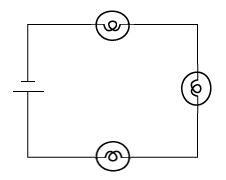
The picture shows an electrical circuit. This circuit is a series circuit because: 
a)
It has 3 light bulbs.
b)
The same current flows through all three light bulbs.
c)
It uses a single battery.
d)
The electrical current has more than one path to flow through
57.
In a parallel circuit if one light bulb goes OUT; then they ALL go out. TRUE OR FALSE?
a)
TRUE
b)
FALSE
58.
What is a Parallel circuit? 
a)
Has only one path 
b)
Has more than one path 
c)
Allows energy to travel through easily 
d)
Has only one light bulb
59.
What is a switch's function in a circuit?
a)
to make the current hotter or colder
b)
turn on and off the flow of current
c)
the pathway that current flows
d)
to add more power to the circuit
60.
Which best describes a simple series circuit?
a)
Electricity flows along one pathway.
b)
The flow of electricity comes from the switch.
c)
Electricity flows along many pathways.
d)
The flow of electricity comes from the light bulb.
61.
A material in which electrons are able to move easily
a)
Circuit
b)
Insulator 
c)
Resistance 
d)
Conductor 
62.
A material in which electrons are not able to move easily 
a)
Circuit 
b)
Insulator 
c)
Resistance 
d)
Conductor
63.
What kind of circuit is this?
a)
series
b)
parallel
64.
What type of circuit is show in the image?
a)
Series Circuit
b)
Parallel Circuit
65.
When all parts of the circuit are connected it is a ______ circuit. 
a)
open
b)
closed
66.
Electrical power can be calculated using
a)
Resistance x Voltage
b)
Voltage x Current 
c)
Voltage ÷ Current
67.
Watts is the same as...
a)
Joules per second
b)
Voltage per second
c)
Current per second
68.
The current in an appliance is 3 A and the voltage difference is 120 V. How much power is being supplied to the appliance?
a)
10000 v
b)
220 v
c)
420 v
d)
360 v
69.
This is an example of a _______ circuit
a)
open
b)
series
c)
parallel
d)
square
70.
This is an example of a ______ circuit
a)
Series
b)
Parallel
c)
Open
d)
Dihexihedral
71.
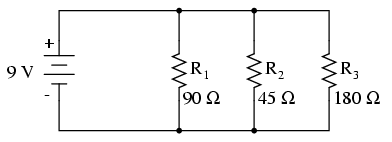
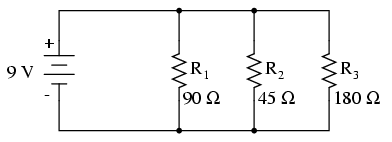
The voltage dropped across the 300 ohm resistor is 
a)
6 V
b)
9 V
c)
2 V
d)
30 V
72.
The voltage drop across the 180 ohm resistor is 
a)
9 V
b)
6 V
c)
2 V
d)
12 V
73.
The current going through the 180 ohm resistor is 
a)
0.05 amps
b)
0.2 amps
c)
0.1 amps
d)
20 amps
74.
The equivalent resistance of this circuit is 
a)
25.7 ohms
b)
315 ohms
c)
324 ohms
d)
90 ohms
75.
a)
Bulbs are in parallel - Circuit X is brighter than Circuit Y
b)
Bulbs are in parallel - Circuit Y is brighter than Circuit X
c)
Bulbs are in series - Circuit X is brighter than Circuit Y
d)
Bulbs are in series - Circuit Y is brighter than Circuit X
76.
This circuit does not work because…
a)
the bulbs are not connected properly
b)
the single cell is not powerful enough
c)
there is a break in the circuit
d)
there is a short crcuit
77.

A series circuit has ____ path(s) that the electric current can take.

a)

One

b)

Two

c)

Three

d)

Four

78.

Which best describes a parallel circuit?

a)

Electricity flows along one pathway.

b)

The flow of electricity comes from one source.

c)

Electricity flows along more than one pathway.

d)

The flow of electricity comes from more than one source.

79.

What is one problem with using a series circuit?

a)

It has a lot of series.

b)

If one goes down, they all go down!

c)

It doesn't work properly.

d)

There are no problems.

80.

In a parallel circuit which of the following is the same value throughout the circuit?

a)

Voltage

b)

Current

c)

Resistance

d)

Charge

81.

What happens to my total resistance as I add more resistors to a parallel circuit?

a)

Increases

b)

Decreases

c)

Stays the same

d)

No one really knows

82.

For the following circuit, find

total resistance

total current

total voltage

a)

VT = 9 V

I T = 3 A

RT = 14 Ω

b)

VT = 9 V

I T = 0.64 A

RT = 14 Ω

c)

VT = 9 V

I T = 6.3 A

RT = 1.4 Ω

d)

VT = 9 V

I T = 0.64 A

RT = 1.4 Ω

83.
If the current through the battery was 10A in this diagram. What would the current through each bulb be?
a)
10A
b)
5A
c)
20A
d)
0A
84.
If the voltage across the battery was 10V in this diagram. What would the voltage across each bulb be?
a)
10V
b)
5V
c)
20V
d)
0V
85.
Pick the correct sentence.
a)
This circuit will work because it is a closed circuit.
b)
Energy will freely flow in this circuit.
c)
This circuit will not work because there is no energy source.
d)
This circuit will not work because there is no switch.
86.
What is the unit of power?
a)
Amps
b)
Watts
c)
Volts
d)
Joules
87.
What is the total resistance of three 10,000 ohm resistors in series?
a)
300,000.0 ohms
b)
3,000.0 ohms
c)
30,000 ohms
d)
3.0*10^6 ohms
88.
What is the total resistance of three 10,000. ohms in parallel
a)
33,333. ohms
b)
3.1*10^7 ohms
c)
3.33333*10^14 ohms
d)
3,333.3 ohms
89.
What is the missing voltage?
a)
1.0V
b)
0.5V
c)
1.5V
d)
2.0V
90.
What is the missing voltage?
a)
2.0V
b)
1.5V
c)
1.0V
d)
0.5V
91.
What is the missing current?
a)
Both 0.25A
b)
Both 0.5A
c)
0.2A and 0.3A
d)
0.1A and 0.4A
92.
What is the missing current?
a)
Both 4.0A
b)
Both 3.0A
c)
Both 6.0A
d)
Both 1.5A
93.
What is the total resistance?
a)
19 ohms
b)
0.05 ohms
c)
2.22 ohms
d)
0.45 ohms
94.
What is the total resistance?
a)
0.04 ohms
b)
25 ohms
c)
1.84 ohms
d)
0.54 ohms
95.
Total resistance in a series circuit
a)
Rt = R1 + R+ R3 ...
b)
1/Rt = 1/R1 + 1/R2 ...
c)
R= RX R/ R1 + R2 ...
d)
R= R/ R
96.
Total resistance in a parallel circuit
a)
Rt = R1 + R+ R3 ...
b)
1/Rt = 1/R1 + 1/R2 ...
c)
R= RX R/ R1 + R2 ...
d)
R= R/ R
97.
A kilowatt is
a)
1000 Amps
b)
1000 watts
c)
1000 volts
d)
none
98.
How much does it cost to light 6 100 W light bulbs for 6 hours if the price of electrical energy is $0.09/kWh?
a)
$4.00
b)
$6.24
c)
$3.24
d)
$5.24
99.
what is this symbol for?
a)
light bulb
b)
switch
c)
battery
d)
resistor
100.
A Charging system producing 14.5 Volts with a current flow of 43.5 Amps, what is the circuit resistance
a)
58 Amps
b)
0.33 Amps
c)
13 Amps
d)
1 Amp
101.
Resistance is measured in ___. 
a)
watts. 
b)
amps.
c)
ohms.
102.
Voltage is measured in __.
a)
volts.
b)
watts.
c)
coulombs. 
103.
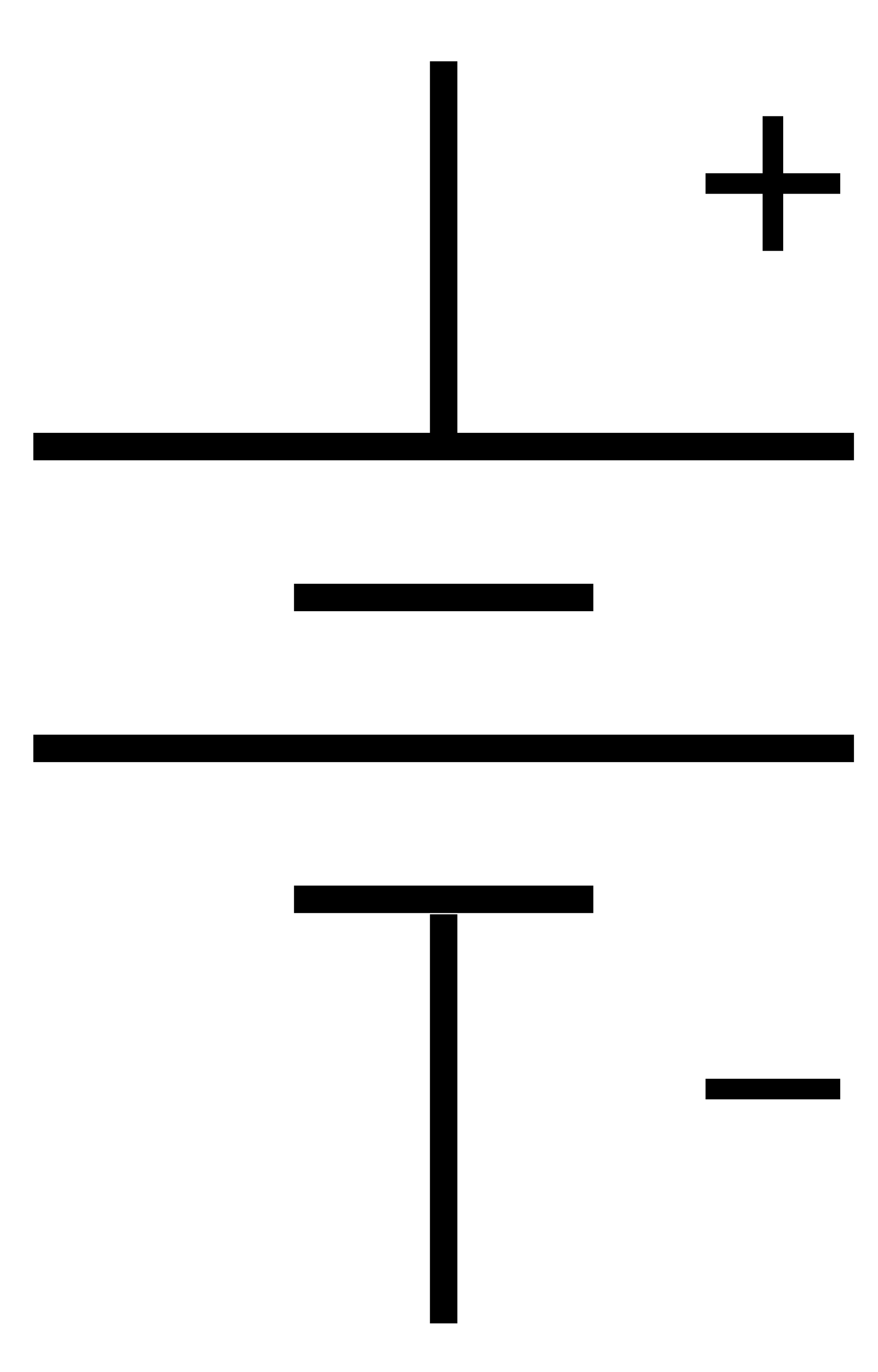
This is the symbol for a ...
a)
Wire
b)
Battery
c)
Buzzer
d)
Fuse
104.
This is the circuit symbol for ...
a)
an AC current source
b)
a DC current source
c)
an ammeter
d)
a voltmeter
105.
This is the circuit symbol for ...
a)
an AC current source
b)
a DC current source
c)
an ammeter
d)
a voltmeter
106.
This is the symbol for a _____?
a)
Lamp
b)
Water wheel
c)
Loudspeaker
d)
Motor
107.
This is the symbol for a 
a)
Closed switch
b)
Push switch
c)
Trap door
d)
AC Power supply
108.
This is the circuit symbol for a ___
a)
Open switch
b)
Closed switch
c)
Open door
d)
Thermistor
109.
Which circuit diagram matches this picture of a circuit?
a)
A
b)
B
c)
C
d)
D
110.
Would would best complete this circuit?
a)
A wire
b)
A switch
c)
A battery
d)
A light bulb