wayground logo

Free Printable Worksheets

Font size

S
M
L
XL
Worksheets

Pink Lab Book Review

Total questions: 120

Worksheet time: 1hrs 20mins

Name
Class
Date
1.
How do animals get the carbon that they need?
a)
from the air
b)
from water
c)
from the soil
d)
from their food
2.
In which organism(s) does photosynthesis occur?
a)
plants
b)
algae
c)
some bacteria
d)
all of these
3.
What gas do producers need in order to perform photosynthesis?
a)
oxygen
b)
carbon dioxide
c)
hydrogen
d)
nitrogen
4.
What gas do producers give off as a result of photosynthesis?
a)
oxygen
b)
carbon dioxide
c)
hydrogen
d)
nitrogen
5.
In which organism(s) does respiration occur?
a)
plants
b)
animals
c)
fungus
d)
all of these
6.
In which part of the cell does respiration occur?
a)
vacuole
b)
mitochondria
c)
cell wall
d)
chloroplast
7.
What gas is needed in order to perform respiration at the cellular level?
a)
oxygen
b)
carbon dioxide
c)
hydrogen
d)
nitrogen
8.
What gas is given off as a result of respiration?
a)
oxygen
b)
carbon dioxide
c)
hydrogen
d)
nitrogen
9.
How do plants get the carbon that they need?
a)
from the air
b)
from water
c)
from the soil
d)
from fertilizer
10.
How do animals get the carbon that they need?
a)
from the air
b)
from water
c)
from the soil
d)
from their food
11.
In what organelle is the genetic material found inside?
 
a)
Endoplasmic Reticulum
b)
Golgi Complex
c)
Nucleolus
d)
Nucleus
12.
What organelle is called the "powerhouse" of a cell?

a)
Endoplasmic Reticulum
b)
Nucleus
c)
Mitochondria
d)
Nucleolus
13.
Using this image, what organelle is C?
a)
Cell Wall
b)
Mitochondria
c)
Large Cell Vacuole
d)
Chloroplast
14.
What is the function of the mitochondria?
a)
Structure that manufactures ribosomes
b)
Structures that converts nutrients to energy
c)
Stack of membranes that packages chemicals
d)
Structure that contains DNA and directs the cell
15.
What is the function of the vacuole?
a)
Sac that stores water, nutrients, and waste products
b)
Sac filled with digestive chemicals
c)
Jelly-like substance within the plasma membrane
d)
stack of membranes that packages chemicals
16.
What is the function of nucleus?
a)
Structure that organizes motion of chromosomes. 
b)
Structure that contains DNA and directs the cell 
c)
Membrane that surrounds and protects the cell 
d)
Stack of membranes that packages chemicals
17.
What is the function of nucleus?
a)
Structure that organizes motion of chromosomes. 
b)
Structure that contains DNA and directs the cell 
c)
Membrane that surrounds and protects the cell 
d)
Stack of membranes that packages chemicals
18.
Where does photosynthesis occur?
a)
mitochondria
b)
stomata
c)
xylem
d)
chloroplast
19.
I store water in both plant and animal cells. What am I?
a)
cytoplasm
b)
ribosomes
c)
vacuole
d)
lysosomes
20.
I make proteins for the cell. What am I?
a)
ribosome
b)
mitochondria
c)
chloroplast
d)
lysosome
21.
The two kinds of cells are Prokaryotes and Eukaryotes. How are they different?
a)
Prokaryotes have a nucleus.
b)
Eukaryotes have a nucleus.
c)
Prokaryotes are plant cells.
d)
There is no difference.
22.
What cell part is NOT found in all cells?
a)
Cell Wall
b)
Cell Membrane
c)
Cytoplasm
d)
Genetic Material
23.
Complex cell. Can be plant or animal. Contains membrane bound organelles. 
a)
Eukaryotic Cell
b)
Prokaryotic Cell
c)
Bacteria
d)
Blood cell
24.
This organelle takes food and turns it into ENERGY for plant and animal cells.
a)
Chloroplast
b)
Mitochondria
c)
Lysosome
d)
Ribosome
25.
The site of photosynthesis
a)
ribosome
b)
mitochondria
c)
chloroplast
d)
nucleus
26.
Where are proteins made?
a)
Golgi body
b)
Mitoichondria
c)
Chromosomes
d)
Ribosomes
27.
A rigid layer that lies outside the cell's  membrane is...
a)
Cytoskeleton
b)
Cilia
c)
Cell Wall
d)
Flagella
28.
What organelle is called the "powerhouse" of a cell?

a)
Endoplasmic Reticulum
b)
Nucleus
c)
Mitochondria
d)
Nucleolus
29.
Main producer of ATP in all eukaryotes
a)
chloroplast
b)
mitochondria
c)
lysosome
d)
smooth er
30.
What is the function of the vacuole?
a)
Sac that stores water, nutrients, and waste products
b)
Sac filled with digestive chemicals
c)
Jelly-like substance within the plasma membrane
d)
stack of membranes that packages chemicals
31.
I store water in both plant and animal cells. What am I?
a)
cytoplasm
b)
ribosomes
c)
vacuole
d)
lysosomes
32.
Only eukaryotic cells have....
a)
membrane-bound organelles 
b)
DNA
c)
ribosomes
d)
cell membranes 
33.
What does this organism use for movement?
a)
Pseudopod
b)
Cilia
c)
Flagella
d)
legs
34.
What does this organism use for movement?
a)
Pseudopod
b)
Cilia
c)
Flagella
d)
legs
35.
A nucleus is found in what type of cell?
a)
Prokaryotic
b)
Eukaryotic
c)
Both prokaryotic and eukaryotic
d)
Neither prokaryotic or eukaryotic
36.

Which of the following is NOT a characteristic of all living things?

a)

Have Cellular Organization

b)

Are Able to Grow and Develop

c)

Are able to do photosynthesis

d)

Are Able to Respond to Surroundings

37.

The 1st person to observe and name cells (looking at cork).

a)

Oprah

b)

Robert Hooke

c)

Matthias Schleiden

d)

Theodor Schwann

38.

Was the 1st person to observe and describe living cells in a drop of pond water.

a)

Robert Hooke

b)

Taylor Swift

c)

Anton van Leeuwenhoek

d)

Matthias Schleiden

39.

Said the cell is the basic unit of structure in animals

(animals are made of cells).

a)

Theodor Schwann

b)

Robert Hooke

c)

Anton van Leeuwenhoek

d)

Rudolf Virchow

40.

said all living cells come from other existing cells.

a)

Rudolf Virchow

b)

Matthias Schleiden

c)

Theodor Schwann

d)

Anton van Leeuwenhoek

41.

Which of the following are needs of all living things?

a)

Water

b)

Energy

c)

Soil

d)

Nurtients

42.

Which of the follow are needs of all living things?

a)

Gasses

b)

Adequate Space

c)

A nest

d)

Correct Temperature

43.

Which of the follow is are characteristics of all living things?

a)

Have cellular organization

b)

Able to grow and develop

c)

Respond to Stimuli

d)

Able to reproduce
44.
Increasing in size or cell number
a)
Reproduction
b)
Regulation
c)
Respiration
d)
Growth
45.
Waste removal
a)
Excretion
b)
Nutrition
c)
Transport
d)
Synthesis
46.
Moving materials in, out or around the organism
a)
Respiration
b)
Reproduction
c)
Regulation
d)
Transport
47.
Energy making process where glucose is combined with oxygen to make ATP
a)
Growth 
b)
Respiration
c)
Nutrition
d)
Synthesis
48.
Allows an organism to maintain an internal balance and react to changes in its environment    
a)
Reproduction
b)
Synthesis
c)
Regulation
d)
Transport
49.
Making new individuals so that a species can survive
a)
Growth
b)
Transport
c)
Synthesis
d)
Reproduction
50.
Taking in and processing materials needed for the body (food)
a)
Transport
b)
Nutrition
c)
Synthesis
d)
Respiration
51.
The process that breaks down large food molecules into simpler molecules that the organism can use 
a)
digestion 
b)
synthesis
c)
metabolism
d)
circulation 
52.
The process by which organisms produce new organisms of the same type.
a)
reproduction 
b)
metabolism
c)
digestion
d)
synthesis 
53.
The process by which the chemical bond energy stored in nutrients is released for use in cells. 
a)
respiration 
b)
circulation 
c)
homeostasis
d)
metabolism 
54.
The process in which the size of cells or number of cells increase
a)
transport
b)
growth
c)
nutrition
d)
locomotion
55.
Responding to internal and external stimuli
a)
lococmaotion
b)
regulation
c)
organelle
d)
metablism
56.
Anything that causes a response.
a)
cell
b)
organ
c)
stimuli
d)
regulation
57.
Basic unit of structure and function for all living organisms.
a)
organelle
b)
cell
c)
organ system
58.
A group of specialized cells that perform a specific function.
a)
tissue
b)
organelle
c)
growth
d)
nutrienton
59.
A body structure made of different kinds of tissue combined to perform a specific function.
a)
organ
b)
orgnelle
c)
organ system
d)
tissue
60.
Several organs that work together to perform a major function in the body
a)
tissue
b)
organ
c)
organelle
d)
organ system
61.
The process in which nutrients are broken apart, releasing the chemical energy stored in them. 
a)
cell respiration 
b)
excretion 
c)
circulation 
d)
synthesis 
62.
A cat has a litter of six kittens.
a)
regulation
b)
nutrition
c)
growth
d)
reproduction
63.
The cells combine glucose from digested food and oxygen to produce energy and carbon dioxide.
a)
regulation
b)
cell respiration
c)
nutrition
d)
synthesis
64.
The bloodstream brings oxygen and food to the cells.
a)
cell respiration
b)
transport
c)
absorption
d)
excretion
65.
Life process that can occur through urination or perspiration (sweating).
a)
synthesis
b)
excretion
c)
cell respiration
d)
transport
66.
The human brain coordinates the various systems of the body.
a)
growth
b)
cell respiration
c)
regulation
d)
reproduction
67.
A seven pound baby becomes a 180-pound man.
a)
growth
b)
transport
c)
reproduction
d)
excretion
68.
What is diffusion?
a)
when molecules move 
b)
when molecules move from a high concentration to a low.
c)
no movement 
d)
molecules move everywhere
69.
Where is there a low concentration of dye?
a)
at the bottom of cup
b)
in the color
c)
at the top of cup 
d)
no concenteraion gradient
70.
Osmosis is the movement of _____ across a membrane.
a)
food
b)
energy
c)
oxygen
d)
water
71.
During osmosis
a)
water moves from high to low concentration
b)
large or oddly shaped molecules move across a cell membrane
c)
water moves when energy is used
d)
proteins are built
72.
Permeable means
a)
things can pass through
b)
the concentration levels are different
c)
it is permanent
d)
things are stuck
73.
What is the definition of  Selective Permeability?
a)
The movement of materials across the cell membrane that requires NO ENERGY from the cell.
b)
The movement of materials through (or across) the cell membrane
c)
The ability of the cell membrane to allow some things to pass through while preventing other things from passing through.
d)
The movement of molecules from an area of high concentration to a area of low concentration 
74.
What a cell needs to transport particles by active transport?
a)
Sun
b)
Wind
c)
Energy
d)
Channels
75.
Passive transport requires no
a)
concentration gradients
b)
osmosis
c)
motion
d)
energy
76.
What does “high concentration area” mean?
a)
Spread out
b)
Tightly packed together
c)
Uncrowded
d)
Spacious
77.
Why is diffusion and osmosis important to cells?
a)
It allows them to take in materials without using energy.
b)
It allows them to reproduce.
c)
It allows them to absorb sunlight.
d)
It allows cells to use all energy.
78.
Which process describes how large particles are removed from the cell?
a)
Diffusion
b)
Osmosis
c)
Exocytosis
d)
Endocytosis
79.
Diffusion allows cells to take in small particles that can pass through the cell membrane. How are large particles taken in?
a)
Endocytosis
b)
Exocytosis
c)
Mitosis
d)
Photosynthesis
80.
Which type of transport requires an input of energy?
a)
Passive Transport
b)
Osmosis
c)
Simple Diffusion
d)
Active Transport
81.
Active transport moves molecules from a high concentration to a low concentration
a)
True
b)
False
82.
Which form of active transport is being shown (the particles are being taken inside the cell)?
a)
Facilitated Diffusion
b)
Exocytosis
c)
Endocytosis
d)
Protein Pumps
83.
Which form of active transport is being shown?
a)
Pinocytosis
b)
Endocytosis
c)
Exocytosis
d)
Osmosis
84.
Fruit fly body cells have 8 chromosomes. After mitosis, you would expect a resulting fruit fly daughter cell to have ...
a)
16 chromosomes.
b)
46 chromosomes.
c)
8 chromosomes.
d)
4 chromosomes.
85.
Structure (b) is a ____.
a)
chromosome
b)
chromatid
c)
centromere
86.
Structure (a) is a ____.
a)
chromosome
b)
chromatid
c)
centromere
87.
Structure (c) is a ____.
a)
chromosome
b)
chromatid
c)
centromere
88.
Name the phase:
a)
Anaphase
b)
Telophase
c)
Metaphase
d)
Prophase
89.
Name the phase:
a)
Anaphase
b)
Telophase
c)
Metaphase
d)
Prophase
90.
What is the next phase of mitosis?
a)
Prophase
b)
Metaphase
c)
Anaphase
d)
Telophase
91.
What is the next phase of mitosis?
a)
Prophase
b)
Metaphase
c)
Anaphase
d)
Telophase
92.
Name the previous phase.
a)
Prophase
b)
Metaphase
c)
Anaphase
d)
Telophase
93.
Name the phase:
a)
Prophase
b)
Metaphase
c)
Anaphase
d)
Telophase
94.
Name the phase:
a)
Prophase
b)
Metaphase
c)
Anaphase
d)
Telophase
95.
The stages of mitosis in order
a)
Metaphase, Anaphase, Prophase, Telophase
b)
Prophase, Anaphase, Metaphase, Telophase
c)
Prophase, Metaphase, Anaphase, Telophase
d)
Anaphase, Prophase, Telophase, Metaphase
96.
What phase of mitosis is shown in the picture?
a)
Prophase
b)
Anaphase
c)
Telophase
d)
Metaphase
97.
Chromatid pairs line up in the middle of the cell.
a)
Metaphase
b)
Telophase
c)
Anaphase
d)
Interphase
98.
What phase of mitosis is shown in the picture?
a)
Prophase
b)
Anaphase
c)
Telophase
d)
Metaphase
99.
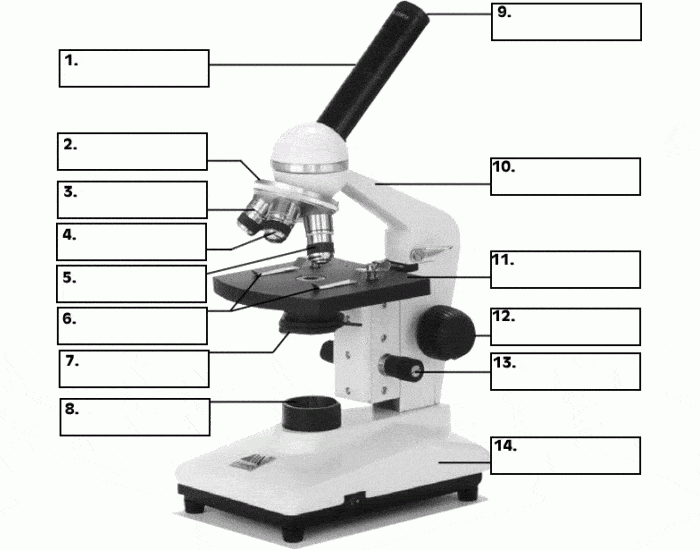
Part 9
a)
Body tube
b)
Eyepiece
c)
Objective
d)
Light Source
100.
Part 10
a)
Stage
b)
Arm
c)
Base
d)
Diaphragm
101.
Part 11
a)
Stage Clips
b)
Stage
c)
Diaphragm
d)
Illuminator
102.
Part 12
a)
Fine Adjustment Knob
b)
Coarse Adjustment Knob
c)
Diaphragm
d)
Objective
103.
This bring the specimen into sharp focus
a)
Coarse Adjustment Knob
b)
Fine Adjustment Knob
c)
Eyepiece
d)
Diaphragm
104.
Connects to the base and helps carry the microscope easily
a)
Arm
b)
Base
c)
Body Tube
d)
Revolving Nosepiece
105.
This moves the specimen up or down to adjust the slide containing specimen
a)
Fine Adjustment Knob
b)
Coarse Adjustment Knob
c)
Stage
d)
Diaphragm
106.
Used to control the amount of light reaching the specimen
a)
Illuminator
b)
Stage
c)
Eyepiece
d)
Diaphragm
107.
Used to hold the slides in place
a)
Stage
b)
Stage Clips
c)
Diaphragm
d)
Arm
108.
The flat surface where the slide with the specimen is placed
a)
Base
b)
Arm
c)
Stage
d)
Diaphragm
109.
Part 6
a)
Stage
b)
Stage Clips
c)
Diaphragm
d)
Arm
110.
Part 7
a)
Stage
b)
Stage Clips
c)
Light Source
d)
Diaphragm
111.
The cells produced via meiosis are called:
a)
sex cells
b)
somatic cells
c)
body cells
d)
skin cells
112.
This produces 2 identical cells.
a)
mitosis
b)
meiosis
113.
Meiosis makes sperm and egg cells. In humans, sperm and egg cells each have _____ chromosomes. Therefore a fertilized human egg cell (sperm and egg cell combined) would create a cell with _____ chromosomes.
a)
23, 46
b)
46, 23
c)
2, 4
d)
50, 100
114.
What causes genetic variation in meiosis?
a)
chromosomes lining up
b)
crossing over of chromosomes
c)
separation of chromosomes
d)
chromosomes pulling apart
115.
Goes through P.M.A.T two rounds 
a)
Mitosis
b)
Meiosis
c)
Osmosis
d)
Transcription
116.
Which process and type of resulting cells are represented?
a)
mitosis, gametes
b)
mitosis, body cells
c)
meiosis, gametes
d)
meiosis, body cells
117.
If a somatic cell in a butterfly contains 24 chromosomes, a butterfly egg would contain
a)
3
b)
6
c)
12
d)
24
118.
Which of these cells would be produced through meiosis?
a)
skin cells
b)
liver cells
c)
brain cells
d)
sperm cells
119.
A male shark has 40 chromosomes in each of its sex cells. How many would be present in its body cells?
a)
20
b)
40
c)
80
d)
160
120.
What is another reason we need meiosis?
a)
So the offspring has genes from both parents
b)
So the offspring has genes from one parent
c)
So the offspring has genes from neither parents
d)
So the offspring makes its own genes