wayground logo

Free Printable Worksheets

Font size

S
M
L
XL
Worksheets

Honors Biology Spring Pre-Final

Total questions: 109

Worksheet time: 1hrs 25mins

Name
Class
Date
1.
Which organelle performs PHOTOSYNTHESIS?
a)
Chloroplast
b)
Mitochondria
2.
What process occurs when light energy is captured in autotrophs and converted into sugar?
a)
Photosynthesis
b)
Cellular Respiration
3.
What is the ultimate ORIGINAL source of energy for living things
a)
Sugar
b)
Sun
c)
Moon
d)
Carbon Dioxide
4.
Which organisms perform Photosynthesis?
a)
Only Autotrophs
b)
Only Heterotrophs
c)
Autotrophs and Heterotrophs
5.
Which gas is removed from the atmosphere during photosynthesis?
a)
hydrogen
b)
oxygen
c)
nitrogen
d)
carbon dioxide
6.
What are the products of photosynthesis?
a)
water and carbon dioxide
b)
oxygen and glucose
c)
oxygen and carbon dioxide
d)
oxygen and water
7.
Plants need ________ for photosynthesis
a)
oxygen
b)
soil
c)
carbon dioxide
d)
sugar
8.
What is the function of NADPH and ATP?
a)
They absorb light
b)
They power the light-dependent reactions
c)
They are light-reflecting pigments
d)
They are short term energy carriers
9.
All living things do which of the following?
a)
Chemosynthesis
b)
Respiration
c)
photosynthesis
d)
all of the answers
10.
What is one of the reactants of cellular respiration?
a)
energy
b)
glucose
c)
carbon dioxide
d)
water
11.
______________ produces the most ATP.
a)
photosnthesis
b)
aerobic respiration
c)
anaerobic respiration
d)
glycolysis
12.
What are the products of aerobic respiration?
a)
Glucose and oxygen
b)
Carbon dioxide and water
c)
Lactic acid
d)
Carbon monoxide
13.
What type of respiration requires oxygen?
a)
Aerobic
b)
Anaerobic
14.
How many ATP are produced in aerobic respiration?
a)
2
b)
33
c)
4
d)
36
15.
In which way are photosynthesis and cellular respiration different?
a)
Cellular respiration stores ATP, while photosynthesis releases ATP.
b)
Cellular respiration produces oxygen, while photosynthesis uses oxygen.
c)
Photosynthesis releases energy, while cellular respiration stores energy.
d)
Photosynthesis used carbon dioxide, while cellular respiration produces carbon dioxide.
16.
What is the correct equation for cellular respiration?
a)
6O2 + C6H12O6 -> 6CO2 + 6H2O + Energy
b)
6O2 + C6H12O6 + Energy -> 6CO2 + 6H2O
c)
6CO2 + 6H2O -> 6O2 + C6H12O6 + Energy
d)
6CO2 + 6H2O + Energy -> 6O2 + C6H12O6
17.
Where does the Krebs Cycle take place?
a)
mitochondria
b)
chloroplast
c)
cytoplasm
d)
nucleus
18.
What is cellular respiration?
a)
the breakdown of glucose  to release ATP
b)
the breakdown of glucose to release NADH
c)
the breakdown of glucose to release FADH
d)
the breakdown of glucose to release carbon
19.
Where does glycolysis take place?
a)
Cytoplasm
b)
Stroma
c)
Thylakoid
d)
Mitochondria
20.
What does every food chain start with? (Even if it's not drawn or written there!)
a)
producers
b)
sun
c)
consumer
d)
decomposers
21.
An organism that needs to eat other organisms to obtain energy is known as a:
a)
Autotroph
b)
Producer
c)
Consumer
d)
Mutualist
22.
What does a food web represent?
a)
All connections of energy flow throughout all organisms in a habitat.
b)
The specific ways that mutualism is carried out.
c)
A single pathway or energy flow between organisms. 
d)
How carnivores get their food. 
23.
The rabbit in this food web would be considered a:
a)
Decomposer
b)
Producer
c)
Secondary Consumer
d)
Primary Consumer
24.
In this Food Web Pyramid Which type of consumer gets only 10% of the energy stored in plants?
a)
Herbivore
b)
Carnivore
c)
Omnivore
d)
Secondary Consumer
25.
What is the term for each step in the transfer of energy and matter within a biological community?
a)
energy path
b)
food web
c)
trophic level
d)
food pyramid
26.
The amount of energy that usually transfers from one trophic level to the next...
a)
10%
b)
20%
c)
80%
d)
50%
27.
An illustration that uses arrows to show the MANY possible directions in which matter and energy can pass through the organisms in an ecosystem.
a)
Food chain
b)
Food web
c)
Energy Pyramid
d)
Succession Map
28.
A graphic illustration that shows each trophic level and the amount of useable energy contained within.
a)
Food chain
b)
Food web
c)
Energy Pyramid
d)
All of these
29.
As you move upward, from level to level, in an energy pyramid, energy _____.
a)
increases
b)
decreases
c)
stays the same
d)
increases exponentially
30.
Organisms that feed on dead organic matter
a)
producers
b)
primary consumers
c)
decomposers
d)
parasites
31.
The amount of poison increases with each step up the food chain.
a)
biological magnification
b)
biological amplification
c)
biological termination
d)
biological summation
32.
Members of a species in a defined area
a)
Ecosystem
b)
community
c)
biodiversity
d)
population
33.
Study of interactions between organisms and their environment 
a)
niche
b)
community 
c)
ecology
d)
ecosystem
34.
What is the major difference between a community and an ecosystem
a)
A community involves only the biotic, not the abiotic
b)
An ecosystem only includes herbivores and carnivores-- no decomposers
c)
An ecosystem involves only the biotic, AND THE abiotic 
d)
An ecosystem is just a larger community
35.
Different populations living and interacting with each other in the same area
a)
Biome
b)
Ecosystem
c)
Community
d)
Niche
36.
Organisms that look similar and can produce fertile offspring
a)
Species
b)
Fish
c)
Community
d)
Trees
37.
Which of the following would be the definition of a detritivore?
a)
Animals that eat insects.
b)
Organisms that feed on rocks, recycling the nutrients back into the ground.
c)
Organisms that eat only pants
d)
Things that feed on dead organisms, recycling the nutrients back into the ground.
38.

A collection of ecosystems that share similar characteristics is called a ______

a)

Ecosystem

b)

Habitat

c)

Biome

d)

Niche

39.
As a population grows, it will most likely stop growing at what size?
a)
Growth limit
b)
Exponential limit
c)
Carrying Capacity
d)
It won't stop growing
40.
The major human causes of extinction today are
a)
hunting and destroying habitats.
b)
polluting and introducing non-native species.
c)
Both
d)
Neither
41.
Which kind of growth does the human population follow? It is described as a J-shaped curve.
a)
Exponential Growth
b)
Logistic Growth
c)
Outstanding Growth
d)
Minimal Growth
42.
Which dispersion pattern is described by organisms being spaced out equally?
a)
Uniform
b)
Random
c)
Clumped 
d)
None of these
43.
Which dispersion pattern usually is a result of resources not being evenly spread out in the environment?
a)
Uniform
b)
Random
c)
Clumped
d)
None of these
44.
What will happen to the population when the death rate is larger than the birth rate?
a)
grow
b)
shrink
c)
stay the same
d)
None of these
45.
What will happen to the population when the birth rate is larger than the death rate?
a)
grow
b)
shrink
c)
stay the same
46.
What type of growth is represented behind?
a)
exponential
b)
logistics
c)
a good kind
d)
representative
47.
Which kind of dispersion is #1?
a)
clumped
b)
random
c)
uniform
48.
What point on the graph represents the carrying capacity?
a)
A
b)
B
c)
C
d)
D
49.
What factor describes when populations decrease because animals are moving out of a population?
a)
Emigration
b)
Limiting Factors
c)
Immigration
d)
Exponential Growth
50.
Which limiting factor would increase due to the number of individuals in a population?
a)
Unusual weather
b)
Natural disaster
c)
Births
d)
Disease
51.
What factor describes when populations increase because animals are moving into a population?
a)
Emigration
b)
Limiting Factors
c)
Immigration
d)
Exponential Growth
52.
Which limiting factor is independent of the number of individuals in a population?
a)
competition
b)
parasitism/disease
c)
stress
d)
natural disasters
53.
Human population grew exponentially after the industrial revolution. Which of the following DOES NOT help determine patterns in human population growth?
a)
age structure
b)
births
c)
deaths
d)
limiting factors
54.
Dispersion model seen when competition is low between individuals
a)
Random
b)
Uniform
c)
Clumped
55.
A relationship between two organisms in which one organism benefits and the other is unharmed...
a)
Mutualism 
b)
Competition
c)
Parasitsm 
d)
Commensalism 
56.
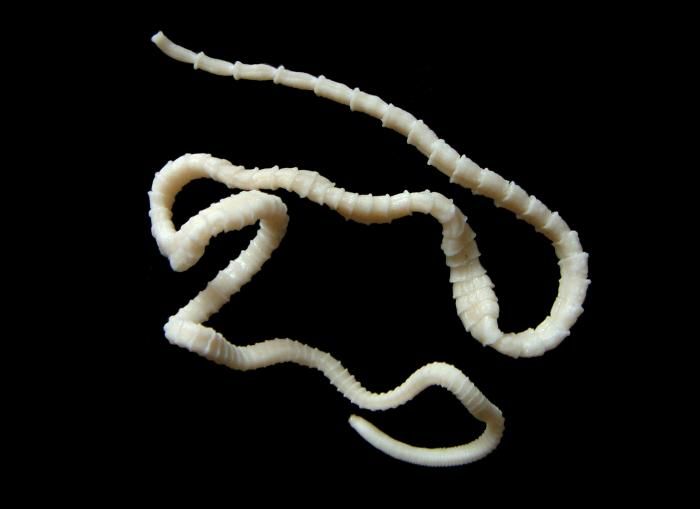
A tapeworm and a cat have this type of relationship.
a)
mutualism
b)
parasitism
c)
commensalism
d)
competition
57.
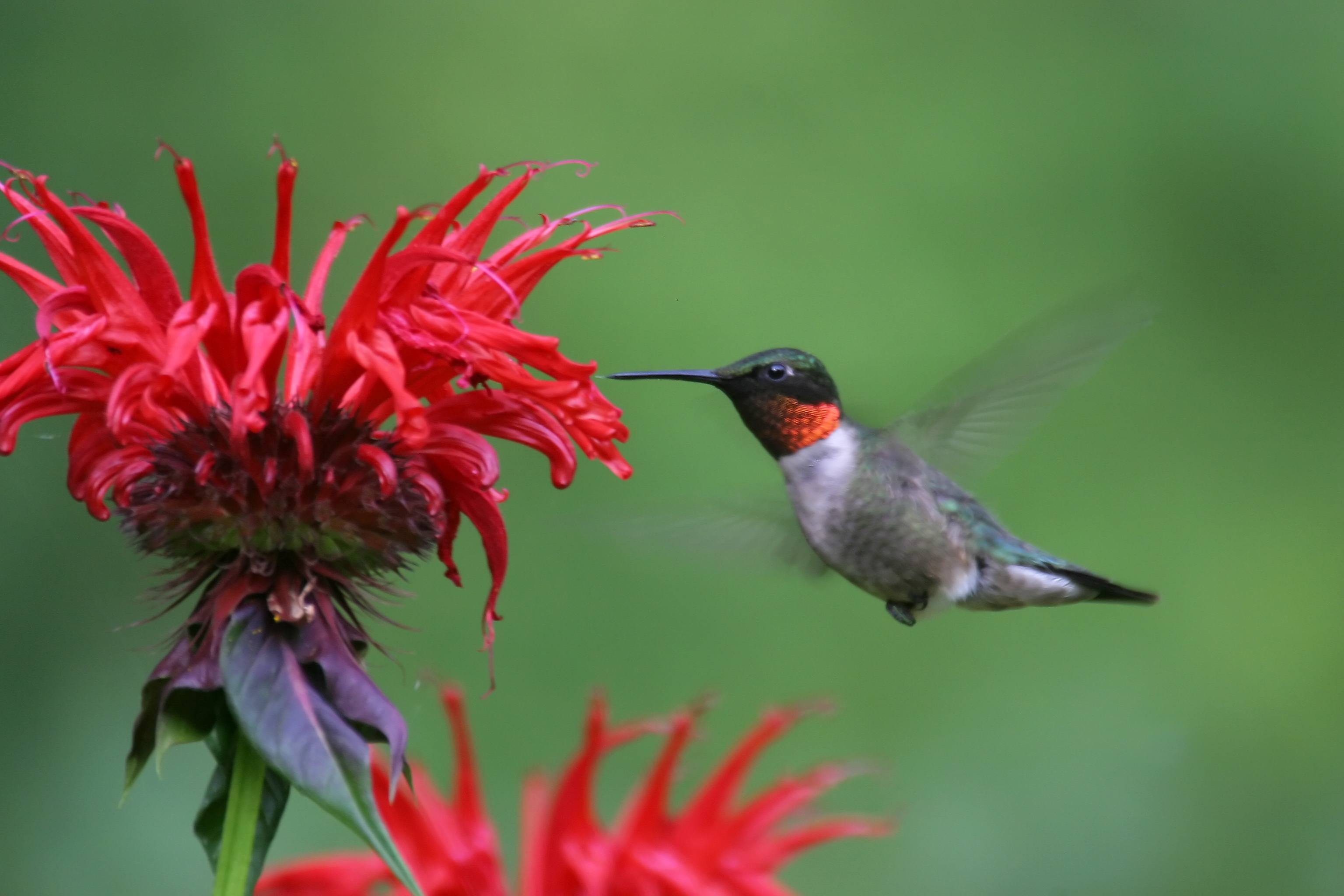
What type of symbiosis?  Hummingbirds feed on nectar from flowers.  The flowers are pollinated by hummingbirds as they move from flower to flower.
a)
commensalism
b)
mutualism
c)
parasitism
d)
predation
58.
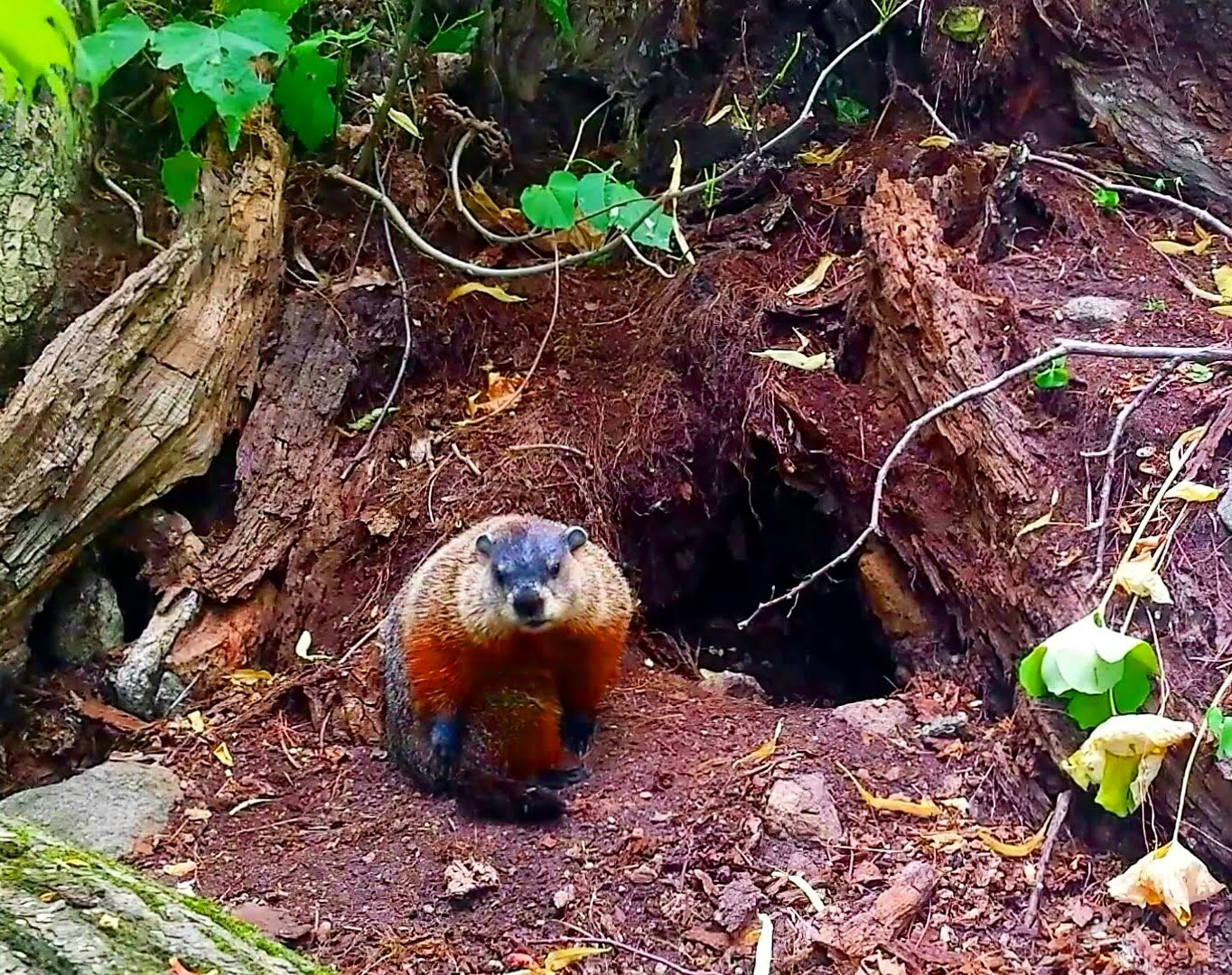
What type of symbiosis?  Skunks often live in burrows that have been dug and abandoned by woodchucks.  
a)
commensalism
b)
mutualism
c)
parasitism
d)
predation
59.
Which symbols best describe parasitism?
a)
+,+
b)
+,-
c)
+,0
d)
-,0
60.

Aphids are tiny insects that live on and eat the leaves of plants, removing vital nutrients from the plants.

a)

Predation

b)

Parasitism

c)

Commensalism

d)

Mutualism

61.
A frog eats a fly. The frog and fly are demonstrating ________.
a)
mutualism
b)
competition
c)
predator/prey
d)
parasitism
62.
Barnacles create home sites by attaching themselves to whales. This neither harms nor benefits the whales.  What kind of relationship is this?
a)
Mutualism 
b)
Parasitism 
c)
Commensalism 
63.
Which symbols best describe mutualism?
a)
+,+
b)
+,-
c)
+,0
d)
-,0
64.
Two male Giraffes are fighting over the last green leaf of a tree that is dying.  
a)
Competition
b)
Mutualsim
c)
Predation
d)
Commensalism
65.
Which symbols best describe commensalism?
a)
+,+
b)
+,-
c)
+,0
d)
0,0
66.
A close, long-term relationship in which 2 different organisms live in close association with each other. 
a)
Carrying Capacity
b)
Coexistence
c)
Limiting Factor
d)
Symbiosis
67.
The deer tick attaches to a warm blooded animal and feeds on its blood. Ticks carry Lyme disease, an illness that can cause joint damage, heart complications, and kidney problems. The tick benefits from eating the animal's blood. Unfortunately, the animal suffers from the loss of blood and nutrients and may get sick.This is an example of 
a)
mutualism
b)
commensalism
c)
parasitism
d)
predation
68.
A prairie dog, a hawk, and a badger all are members of the same ________________.
a)
niche
b)
community
c)
species
d)
population
69.
Mutualism, commensalism, and parasitism are the three types of
a)
symbiotic relationships
b)
predation
c)
competition
d)
prey adaptations
70.

When a pine tree grows real tall and blocks sunlight to a birch tree it is _______ competition.

a)

Interference

b)

Intraspecific

c)

Interspecific

d)

Exploitative

71.
When two male lions fight over a lady lion this is _______ competition.
a)
Exploitative
b)
Intraspecific
c)
Interspecific
d)
Bullying
73.
A species that is NOT indigenous (native) to an area is called a/an: 
a)
native species
b)
natural species
c)
invasive species
d)
symbiotic species
73.
A species that is NOT indigenous (native) to an area is called a/an: 
a)
native species
b)
natural species
c)
invasive species
d)
symbiotic species
74.
A species that is indigenous to a given region or ecosystem naturally.
a)
native species
b)
accidental species
c)
introduced species
d)
local species
75.
The particular role (job) of an organism in its environment including types of food it eats, how it obtains its food and how it interacts with other organisms is called a what?
a)
niche
b)
habitat
c)
home
d)
ecosystem
76.
Most invasive species move out of their native ecosystem by:
a)
the exotic pet trade
b)
being transported by humans
c)
being planted in ornamental landscapes
d)
all of these are possible
77.
Why do the populations of invasive species grow so quickly? 
a)
invasive species require more energy than other organisms
b)
invasive species are prey to many animals.
c)
invasive species have no natural predators.
d)
invasive species keep the ecosystems in equilibrium.
78.
How do invasive plants damage the environment?
a)
by competing with native species
b)
by changing plant communities
c)
by decreasing diversity
d)
all of these damage an ecosystem
79.
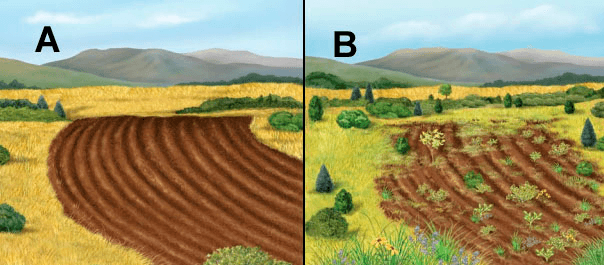
What type of succession is shown going from figure A to figure B?
a)
primary succession
b)
ecological succession
c)
secondary succession
d)
intermediate
80.
What is the goal of the pioneer species in Primary Succession?
a)
To kill the dead materials after a disaster
b)
To rebuild soil
c)
To feed Johnny
d)
To put fresh oxygen into the air
81.
After a volcanic eruption, lava covers the land. What is the order that plants grow to repopulate the area?
a)
Lichens → Shrubs → Grasses → Trees
b)
Lichens → tree → shrubs→Grasses
c)
Grasses → Lichens → Shrubs → Trees
d)
Lichens → Grasses → Shrubs → Trees
82.
Reaches a climax community quicker because soil is already present
a)
primary succession 
b)
secondary succession
c)
both types of succession
83.
What is the difference between biotic and abiotic?
a)
Biotic are non-living things
b)
Abiotic are living organisms
c)
Biotic is life,
Abiotic is non-living
d)
Biotic is non-living, Abiotic is living
84.
What does biodiversity mean?
a)
Only one species in an area.
b)
The different amount of species in an area
c)
All abiotic life
d)
Nitrogen fixation
85.

Which best explains biodiversity?

a)

The population of a species in an ecosystem

b)

The variety of species in an ecosystem

c)

The study of life

d)

The difference number of biomes on Earth

86.

Which of the following situations contributes to stability in an ecosystem?

a)

increase in biodiversity

b)

decrease in biodiversity

c)

extinction of a population from the ecosystem

d)

removal of many populations of organisms

87.

What are three things that create biodiversity?

a)

species, genetic variation, and trophic structure

b)

mutation, disorder, regression

c)

genes, cells, traits

d)

water, land, mountains

88.
Mutations that occur at a single point in the DNA sequence are:
a)
frameshift
b)
point
c)
deletion
89.
original chromosome
ABC-DEF
mutated chromosome
AC-DEF
This is a _____________ mutation.
a)
frameshift
b)
point
c)
deletion
90.
original chromosome
ABC-DEF
mutated chromosome
ABBC-DEF
a)
duplication
b)
point
c)
frameshift
91.
original chromosome
ABC-DEF
mutated chromosome
AED-CBF
a)
duplication
b)
translocation
c)
inversion
92.
original chromosome
ABC-DEF
mutated chromosome
ABC-JKL
GH-IDEF
a)
translocation
b)
duplication
c)
inversion
93.
An organism that has an extra set of chromosomes is called_____________.
a)
monoploidy
b)
diploidy
c)
polyploidy
94.
What mutation has occurred here? 
T-G-A-C-C-A
T-G-A-G-C-A
a)
Substitution
b)
Deletion
c)
Insertion
d)
Frameshift 
95.
Are all mutations bad?
a)
Yes
b)
No
96.
What is a factor that is covered up by another trait?
a)
Recessive
b)
Dominant
97.
Down syndrome is usually caused by
a)
one too many chromosomes
b)
one too few chromosomes
98.
Which of the following events causes a change in chromosome number?
a)
Duplication
b)
Mutogenesis
c)
Nondisjuction
d)
Parthenogenesis
99.
Which type of isolation occurs when organisms mate at different times?
a)
Behavioral
b)
Geographic
c)
Temporal
100.
Which type of isolation occurs when organisms do different things to attract a mate?
a)
Behavioral
b)
Geographic
c)
Temporal
101.
Which type of reproductive isolation results from a physical barrier separating two groups of a population?
a)
Behavioral
b)
Geographic
c)
Temporal
102.
Which concept suggests that organisms best suited to their environment are more likely to survive and reproduce?
a)
Artificial Selection
b)
Common Descent
c)
Inheritance of Acquired Characteristics
d)
Natural Selection
103.
Which term refers to physical or behavioral traits that enable an organism's survival?
a)
Adaptation
b)
Fitness
c)
Homologous structures
d)
Vestigial structures
104.
Which term refers to an organism's ability to survive and produce viable offspring?
a)
Adaptation
b)
Fitness
c)
Speciation
d)
Variation
105.
Which of the following processes occurs when humans select the traits they want organisms to express?
a)
Artificial selection
b)
Common descent
c)
Natural selection
d)
Reproductive isolation
106.
A population of pigs with small, medium, and long snouts lives on an island together with burrowing termites. Pigs that have the longest snouts tend to survive better. Over time, most of the pig population is made up of individuals that have very long snouts. This is an example of which type of selection?
a)
directional selection
b)
disruptive selection
c)
stabilizing selection
d)
sexual selection
107.
If finches with average sized beaks increase in a population while finches with large and small sized beaks decrease, which pattern of natural selection has occurred?
a)
Directional selection
b)
Disruptive selection 
c)
Stabilizing selection
d)
Sexual Selection
108.
If finches with large beaks and finches with small beaks increase in a population while finches with average sized beaks decreases, which pattern of natural selection has occurred?
a)
Directional selection
b)
Disruptive selection 
c)
Stabilizing selection
d)
Sexual Selection
109.
What does the image represent?
a)
Gene flow
b)
Genetic drift
c)
Mutation
d)
Adaptation