
 Worksheets
Geology Cumulative Review
Total questions: 100
Worksheet time: 2hrs 36mins
Name
Class
Date
1.
Jack has a rock. The rock has a mass of 14g and a volume of 2cm3. What is the density of the rock?
a)
7 mL
b)
7 g/cm3
c)
28 g/cm3
d)
1/7 g/cm3
2.

What is the volume of Object X?
a)
10.0 cm3
b)
15.0 cm3
c)
20.0 cm3
d)
25.0 cm3
3.
What is the formula for density?
a)
density = mass x volume
b)
density = mass / volume
c)
density = mass + volume
d)
density = mass - volume
4.
How light reflects off of a mineral is called the mineral's
a)
luster
b)
streak
c)
cleavage
d)
fracture
5.
Why is coal not a mineral?
a)
It's not a solid
b)
It is man-made
c)
It is not inorganic
d)
It is made of carbon
6.
Hardness is a property that helps identify minerals. Scientists use a scale of 1-10 to show the hardness of a mineral. What number would be given to the hardest?
a)
1
b)
5
c)
6
d)
10
7.

A mineral breaks into pieces like are shown in the picture. How would you describe its breakage?
a)
Fracture
b)
Cleavage
c)
Glassy
d)
Waxy
8.

Which mineral property is being shown here?
a)
luster
b)
hardness
c)
cleavage
d)
streak
9.
This property is the resistance of a mineral to being scratched.
a)
hardness
b)
luster
c)
streak
d)
density
10.

What mineral is used for pencils?
a)
Graphite
b)
Galena
c)
Magnetite
d)
Quartz
11.

What mineral is salt?
a)
quartz
b)
sulfur
c)
halite
d)
calcite
12.

1. What will happen if an igneous rock is put under an extreme amount of heat and pressure?
a)
it will melt into lava
b)
it will weather and erode
c)
it will become a metamorphic rock
d)
it will become a sedimentary
13.

The cooled and hardened magma from volcanoes form what rocks?
a)
igneous
b)
sedimentary
c)
metamorphic
d)
fossils
14.

This rock was formed when magma cooled very slowly inside the Earth. What specific type of rock is it?
a)
Intrusive Igneous Rock
b)
Extrusive Igneous Rock
c)
Foliated Metamorphic Rock
d)
Clastic Sedimentary Rock
15.

This rock formed when lava cooled very quickly on Earth's surface. What specific type of rock is it?
a)
Extrusive Igneous Rock
b)
Intrusive Igneous Rock
c)
Non-Foliated Metamorphic Rock
d)
Biochemical Sedimentary Rock
16.
Two ways to describe types of igneous rocks are _____
a)
Extrusive and Intrusive
b)
Foliated and Non-Foliated
c)
Clastic and Biochemical
d)
Black and Gray
17.
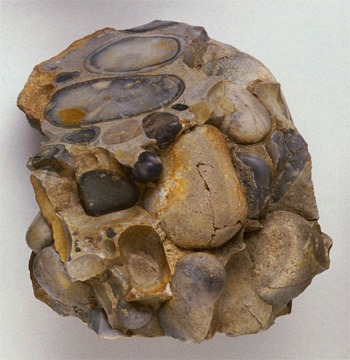
This rock was formed by smaller pieces of rock that settled at the bottom of a lake millions of years ago. What type of rock is this?
a)
Sedimentary
b)
Igneous
c)
Metamorphic
18.

When sediments are pressed together tightly, this is called ____________.
a)
Compaction
b)
Cementation
c)
Weathering
d)
Erosion
19.
What has to increase for metamorphism to occur?
a)
weathering and erosion
b)
temperature and pressure
c)
melting and cooling
d)
compaction ad cementation
20.
Which of the following is a metamorphic rock?
a)
obsidian
b)
granite
c)
gneiss
d)
sandstone
21.
Which of the following is a metamorphic rock?
a)
conglomerate
b)
pumice
c)
obsidian
d)
marble
22.
What are the two main types of metamorphic rocks and how are they different?
a)
intrusive and extrusive; intrusive rocks are formed inside the earth and extrusive rocks are formed on the surface
b)
foliated and nonfoliated; foliated rocks do not have visible bands/layers and nonfoliated rocks do have visible bands/layers
c)
intrusive and extrusive; intrusive rocks are formed on the earth's surface and extrusive rocks are formed in the Earth
d)
foliated and nonfoliated; foliated rocks have visible bands/layers and nonfoliated rocks do not have visible bands/layers
23.
In which province is Bituminous coal mined?
a)
Valley and Ridge
b)
Appalachian Plateau
c)
Blue Ridge
d)
Coastal Plain
24.

Which Virginia province is seen on this map?
a)
Piedmont
b)
Coastal Plain
c)
Blue Ridge
d)
Appalachian Plateau
25.

Karst topography includes underground caverns. Where in VA would this landscape be found?
a)
Piedmont
b)
Coastal Plain
c)
Valley and Ridge
d)
Blue Ridge
26.
Which province has the oldest rocks in VA?
a)
Coastal Plain
b)
Piedmont
c)
Blue Ridge
d)
Appalachian Plateau
27.

Going in order from EAST to WEST what are the five Virginia Provinces?
a)
Piedmont, Coastal Plain, Appalachian Plateau, Valley and Ridge
b)
Valley and Ridge, Blue Ridge, Appalachian Plateau, Piedmont
c)
Appalachian Plateau, Valley and Ridge, Blue Ridge, Piedmont, Coastal Plain
d)
Coastal Plain, Piedmont, Blue Ridge, Valley and Ridge, Appalachian Plateau
28.

the general terms for the movement of sediment by wind, water, glaciers
a)
weathering
b)
erosion
c)
deposition
29.

the breakdown of rock into smaller pieces of the same rock without any change in its composition
a)
mechanical weathering
b)
chemical weathering
c)
erosion
d)
deposition
30.

Roots grow into cracks of a rock and pry them apart
a)
mechanical weathering
b)
chemical weathering
c)
erosion
d)
deposition
31.

oxidation produces rust on some rocks containing iron
a)
chemical weathering
b)
mechanical weathering
c)
erosion
d)
deposition
32.
Which of the following is NOT a type of chemical weathering?
a)
water
b)
carbon dioxide
c)
ice wedging
d)
living organisms secreting acid to break down rocks
33.
The bold lines that appear on the map every 5th contour line with the exact elevation written on it is the ______________________
a)
Index Contour line
b)
Contour interval
c)
Relief
d)
Slope
34.
This
the study and description of the shape of the land and surface
features.
a)
Biology
b)
Topography
c)
Geology
d)
Oceanography
35.

What is the elevation of point B? (Contour interval is 100m)
a)
800 ft
b)
850 ft
c)
900 ft
d)
1000 ft
36.

Determine the contour interval:
a)
5 m
b)
10 m
c)
15 m
d)
20 m
37.

Which direction is the river flowing?
a)
north
b)
south
c)
east
d)
west
38.

What do close contour lines represent on a map?
a)
waterfall
b)
steep area
c)
gradual area
d)
river
39.

How many peaks does this map have?
a)
one
b)
two
c)
three
d)
four
40.
What is the energy source for the water cycle?
a)
the sun
b)
the earth
c)
water
d)
the moon
41.
What is an underground layer of rock or soil filled with water called?
a)
Aquifer
b)
Spring
c)
Well
d)
Reservoir
42.
What is the top of the water-filled spaces in the ground called?
a)
Groundwater
b)
Reservoir
c)
Water Table
d)
Well
43.

The stream that flows into a larger stream.
a)
gully
b)
tributary
c)
stream
d)
rill
44.

A loop like bend in the course of a river.
a)
meander
b)
oxbow lake
c)
alluvial fan
d)
delta
45.

A meander cut off from a river.
a)
alluvial fan
b)
delta
c)
flood plain
d)
oxbow lake
46.

A wide, sloping deposit of sediment formed where a stream leaves a mountain range.
a)
flood plain
b)
delta
c)
alluvial fan
d)
gully
47.

A landform made of sediment that is deposited where a river flows into an ocean or lake.
a)
delta
b)
alluvial fan
c)
flood plain
d)
oxbow lake
48.
Sediment is deposited in a river delta because the
a)
velocity of the river decreases
b)
force of gravity decreases
c)
volume of the river increases
d)
gradient of the river increases
49.

What is the main cause of weathering and erosion to make a canyons?
a)
wind
b)
ice
c)
glaciers
d)
moving water
50.
Coal is considered what type of rock?
a)
molten
b)
sedimentary
c)
metamorphic
d)
marble
51.

What geologic process can change igneous rock into metamorphic rock?
a)
Compacting and cementing
b)
Cooling
c)
Heat and pressure
d)
Melting
52.

What type of igneous rock makes up most of the ocean floor?
a)
Basalt
b)
Granite
c)
Lucite
d)
Shale
53.

When a glacier retreats and large, partially buried, ice chunks are left behind to melt, these are formed:
a)
Moraine
b)
Prairie pothole
c)
Kettle Lake
d)
Fjord
54.
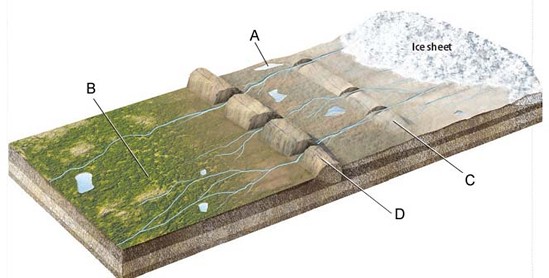
What glacial features are indicated by the labels C and D on the figure?
a)
moraines
b)
outwash plains
c)
kettle lakes
d)
ice sheets
55.
Glaciers often form V shaped valleys
a)
true
b)
false
56.
Which acid dissolves limestone beneath the surface to form a cavern?
a)
sulfuric
b)
hydrochloric
c)
carbonic
d)
phosphoric
57.

Well sorted soil...
a)
has low porosity
b)
has low pore space
c)
has high porosity
d)
means water will move through slowly
58.

Poorly sorted soil...
a)
has low porosity
b)
has high porosity
c)
has high pore space
d)
means water will move through quickly
59.
When water can pass through rock or sediment it is said to be ____.
a)
impermeable
b)
transparent
c)
permeable
d)
extrusive
60.
An artesian well relies on what to get the water to the surface?
a)
mantle
b)
atmosphere
c)
slope
d)
pressure
61.
Which represents the distribution of water on Earth?
a)
3% freshwater, 97% salt water
b)
97% freshwater, 3% salt water
c)
71% freshwater, 29% salt water
d)
29% freshwater, 71% salt water
62.
The type of plate boundary where two plates come together is a .....
a)
Convergent Boundary
b)
Divergent Boundary
c)
Transform Boundary
d)
Plate Boundary
63.
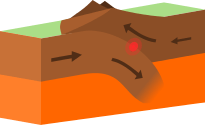
What type of plate boundary is this?
a)
Plate
b)
Divergent
c)
Convergent
d)
Transform
64.

What type of event will occur at this boundary?
a)
Earthquake
b)
Volcano Eruption
c)
Tornado
d)
Mountain Building
65.
A divergent boundary occurs when plates ....
a)
Pull apart
b)
Come together
c)
Slide past each other
d)
subducting
66.
Which of the following is the name of the ancient supercontinent formed 28 Million Years ago.
a)
Pangea
b)
Gondwanda
c)
Laurasia
d)
Neverland
67.
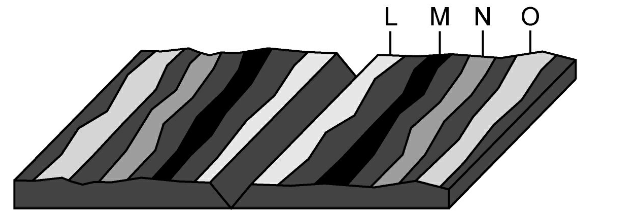
Where would the oldest rock be found?
a)
L
b)
M
c)
N
d)
O
68.
What did Wegener think happened during continental drift?
a)
continents froze over
b)
continents moved
c)
the mantle warmed
d)
convection stopped
69.
Created by a divergent boundary.
a)
Rocky Mountains
b)
Mariana Trench
c)
Mid Atlantic ridge
70.

What type of stress occurs during this fault?
a)
compression
b)
shearing
c)
tension
71.
Most geologists rejected Alfred Wegener's idea of continental drift because...
a)
it did not agree with their current theory
b)
Wegener was interested in what Earth was like millions of years ago
c)
Wegener used several different types of evidence to support his hypothesis
d)
Wegener could not identify the force that moved the continents
72.

Which layer of Earth is located above the outer core?
a)
crust
b)
inner core
c)
mantle
d)
lithosphere
73.

As you travel from the inner core to the crust, how would temperature, pressure and density of the material change?
a)
The would all increase
b)
The would all decrease.
c)
They would stay the same.
d)
Temperature would decrease, but pressure and density would increase.
74.

What stress do the arrows indicate?
a)
Shear
b)
Tension
c)
Compression
d)
Squeezing
75.

_______ are formed when two continental plates collide.
a)
Mountain ranges
b)
Transform faults
c)
Rift valleys
d)
Volcanoes
76.

The theory of seafloor spreading was first proposed by __________.
a)
Thomas Edison
b)
Harry Hess
c)
Benjamin Franklin
d)
Alfred Wegener
77.
The Earth is estimated to be _____ years old
a)
4.6 million
b)
4.6 billion
c)
46 million
d)
46 billion
78.
Which time period is the most recent?
a)
Mesozoic
b)
Cenozoic
c)
Paleozoic
79.

A bug stuck in amber is an example of what type of fossil?
a)
cast
b)
mold
c)
trace
d)
preserved remains
80.
What type of rock do fossils form in?
a)
Igneous
b)
Sedimentary
c)
Metamorphic
d)
Classic
81.

According to the law of superposition, which layer is the youngest?
a)
A
b)
B
c)
C
82.

Which letter matches with the OLDEST layer of rock?
a)
W
b)
X
c)
Y
d)
Z
83.

If the original mass of a radioactive element was 36 grams how much would be left after 1 half life?
a)
36 grams
b)
18 grams
c)
9 grams
d)
4.5 grams
84.

The start of a river is called the what?
a)
River summit
b)
River source
c)
River start
d)
River mouth
85.

Which of the following letter is at approximately 60 degrees S, 40 degrees W?
a)
A
b)
D
c)
E
d)
H
86.
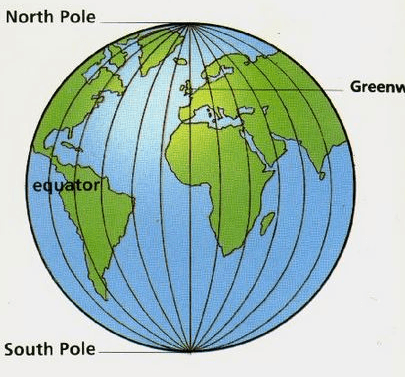
Which imaginary lines are shown by this map?
a)
The map show the lines of longitude.
b)
The map shows the lines of latitude.
87.
The highest number of degrees in latitude is
a)
45
b)
90
c)
180
d)
360
88.

The location of position C would best be described as
a)
70oW, 0o
b)
0o, 700W
c)
0oN, 70oW
d)
10oS, 70oW
89.
How many time zones are there in the world?
a)
24
b)
12
c)
6
d)
48
90.
The new t.v. show is coming on at 7 p.m. Eastern Standard Time. What time will it be on at my friends house who lives in Central Standard Time?
a)
6 p.m.
b)
8 p.m.
c)
5 p.m.
d)
4 p.m.
91.
Where is the point at which the first movement occurs during an earthquake?
a)
Epicenter
b)
Focus
c)
Fault
d)
Plate
92.
What is another term for P Wave?
a)
Compression Wave
b)
Principal Wave
c)
Shear Wave
d)
Secondary Wave
93.

The huge pieces of the earth's crust are called ____________________________.
a)
crust
b)
plates
c)
directions
d)
seismos
94.

This famous transform fault is located in the western United States creates significant earthquake activity for California
a)
New Madrid
b)
Denali Fault
c)
Ramapo Seismic Zone
d)
San Andreas
95.

The point along a fault at which the first motion of an earthquake occurs.
a)
focus
b)
s wave
c)
p wave
d)
deformation
96.

An instrument that records vibrations in the ground and determines the location and strength of an earthquake.
a)
seismograph
b)
seismogram
c)
seismic wave
d)
vibrato
97.

A seismic wave that causes particles of rock to move in a side by side motion.
a)
P wave
b)
S wave
c)
Rift zone
d)
focus
98.
point on Earth's surface directly above an earthquake's starting point
a)
focus
b)
epicenter
c)
core
d)
map
99.

What is the thinnest layer of the earth’s composition?
a)
mantle
b)
inner core
c)
crust
d)
outer core
100.

Which layer of Earth is characterized by rock that is plastic, or soft enough to flow?
a)
asthenosphere
b)
crust
c)
lithosphere
d)
inner core
100 %

