wayground logo

Free Printable Worksheets

NEW

Font size

S
M
L
XL
Worksheets

Fossils, Geologic Time Scale

Total questions: 54

Worksheet time: 2hrs 33mins

Name
Class
Date
1.

The diagrams below represent rock layers found in 2 different locations by 2 different scientists. The scientist at Location X used letters to label his rock layers, while the scientists at Location Y used Roman numerals to label her layers.

The scientists both used the same colors and patterns to represent different types of rocks. They also used the same set of black and white symbols to represent specific types of fossils in the layers. By correlating layers based on fossils and rock types, the 2 scientists have discovered that certain rock layers are present in both locations.

Which layers are the same?

a)

Layers P, Q, R, and S are the same as layers IV, V, VI and VII.

b)

Layers T and U are the same as layers I and II.

c)

Layers P, Q, R, and S are the same as layers I, II, III, IV.

d)

Layers T and U are the same as layers VI and VII.

2.
Which of the following correctly lists the layers of rock in order from youngest to oldest?
a)
A, B, C, D, E
b)
B, C, D, E, A
c)
E, D, A, B, C
d)
C, B, A, D, E
3.

Which layer is the oldest and youngest?

a)

C and B

b)

C and E, respectively

c)

D and E

d)

A and B

4.
Which layer is a result of an igneous intrusion?
a)
B
b)
C
c)
D
d)
E
5.
The geologic time scale is a record of....
a)
the history of fossils only
b)
the history of rocks
c)
the history of rock layers and fossils
d)
geologist notes
6.
The picture is an example of...
a)
trace fossil.
b)
mineralization.
c)
original fossil.
d)
mold fossil.
7.
The picture is an example of .......
a)
trace fossil.
b)
carbonization.
c)
original fossil.
d)
cast.
8.
The layers in sedimentary rock are also called
a)
strata
b)
fossils
c)
eras
d)
epochs
9.
Radiometric age is often referred to as __________ age.
a)
total
b)
absolute
c)
historic
d)
geological
10.
Fossils are most common in which rock types?
a)
sedimentary
b)
igneous
c)
metamorphic
d)
all of these commonly contain fossils
11.
_____ is any living thing, plant or animal, even you!
a)
A paleontologist
b)
An organism
c)
A fossil
d)
A rock
12.
What happens when a group of animals become extinct?
a)
All of its members have died.
b)
Only a few of its members are still living.
c)
The animals can no longer lay eggs.
d)
All of its members move to another place.
13.
Some students made a model to show one of the first steps in the formation of sedimentary rock.  The students pour 2 cm of light-colored sand into a clear plastic box.  Then they add 1 cm of gravel.  Finally, they pour 2 cm of dark-colored sand on top of the gravel.  Which characteristic of sedimentary rock does this model best show?
a)
Sedimentary rock is made of layers.
b)
Sedimentary rock is cemented bits of rock.
c)
Sedimentary rock is often limestone.
d)
Sedimentary rock is common in Texas.
14.
Which layer formed first?
a)
Rock Layer W
b)
Rock Layer X
c)
Rock Layer Y
d)
Rock Layer Z
15.
Fossils give us evidence about which of the following?
a)
plants and animals that lived long ago
b)
how weathering and erosion break down rocks
c)
the other planets in our solar system
d)
the transfer of energy from one form  to another
16.
Finding the fossils of trees in an area that is currently a desert without much life might tell us that the area, millions of years ago - 
a)
was heavily eroded by strong winds
b)
received enough rain to support a forest
c)
suffered very powerful earthquakes
d)
was destroyed by the impact of meteorites
17.
Why are there more animal fossils than plant fossils?
a)
Animals eat plants.
b)
Plants are smaller than animals.
c)
Plants have softer body parts than animals. 
d)
There were more ancient animals than ancient plants.
18.
Which is an imprint fossil?
a)
bone
b)
a cast
c)
petrified wood
d)
an animal track
19.
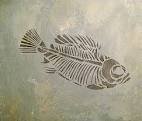
If scientists found this fossil, what could they infer?
a)
what fish are like today
b)
that this fish lacked oxygen
c)
what kind of animal ate this fish
d)
that water once covered the area
20.
Which of these must happen first for a fossil to form?
a)
A plant or animal is covered by sediment.
b)
Sediments fill a mold and form a cast.
c)
A plant or animal is eaten.
d)
Sediments are pressed together and harden.
21.
What replaces the wood of a once-living tree to form petrified wood?
a)
amber
b)
a cast
c)
a mold
d)
minerals
22.
Why are there many fossil imprints of ferns?
a)
Fern parts are hard like bone.
b)
Ferns have changed little over time.
c)
Once, most plants on Earth were ferns.
d)
Ferns were larger than other ancient plants.
23.
According to the law of superposition, the oldest fossils are found 
a)
At the top of the rock layers
b)
Near the bottom of the rock layers
c)
In the middle of the rock layers
d)
Somewhat near the surface
24.
Letter "F" is a....
a)
inclusion
b)
intrusion
c)
fault
d)
unconformity 
25.
The rock formation labeled "P" is a(n)...
a)
fault
b)
intrusion
c)
inclusion
d)
unconformity
26.
What is the youngest layer in the outcrop?
a)
A
b)
B
c)
C
d)
D
27.

Which type of rock is made from lava cooling on Earth's surface?

a)

extrusive igneous

b)

lava rock

c)

metamorphic

d)

intrusive igneous

28.
Index fossils CAN tell us the age of a rock layer.
a)
True
b)
False
29.
Rock layers can be most closely correlated if they both contain the same...
a)
Shapes
b)
Elements
c)
Fossils
d)
Types of Rocks
30.
How old do Paleontologists believe the Earth is?
a)
2015 years old
b)
3.6 billion years old
c)
4.6 billion years old
d)
4.6 million years old
31.
process where scientists compare rock lays with others to determine a rock's age
a)
relative dating
b)
absolute dating
32.
On top of Mt. Everest, there are fossilized remains of sea life; this tells us that the rocks at the top of world's highest mountain 
a)
used to be above sea level
b)
used to be below sea level
c)
used to be on Mars
d)
came from an asteroid
33.
Which type of dating method can be used on rock layers by applying the Law of Superposition?
a)
relative dating
b)
absolute dating
c)
radioactive dating
d)
radiometric dating
34.
In this rock layer diagram there are two unconformities, a fault at E and an intrusion at D. Which unconformity occurred first?  How do you know?
a)
Intrusion D occurred first because the instrusion has been moved by the fault.
b)
The fault occurred first because it has moved the intrusion D.
c)
Intrusion D occurred first because it can be seen in all of the rock layers.
d)
Fault E occurred first because it is a normal fault.
35.
An ordered arrangement of rock layers that is based on the relative ages of the rocks
a)
Superposition
b)
Unconformity
c)
Layered
d)
Geologic Column
36.
How does the law of crosscutting explain the age of a fault?
a)
The fault is younger than the rocks above it.
b)
The fault is younger than the rocks it cuts through.
c)
The fault is older than the rocks above it.
d)
The fault is older than the rocks it cuts through.
37.

The idea that sedimentary rocks are deposited in horizontal layers unless disturbed by forces within the Earth can best be explained by which principle?

a)

Principle of horizontality

b)

Principle of Superposition

c)

Principle of original lateral continuity

38.
A gap in the rock record is referred to as ___________.
a)
erosion
b)
faulting
c)
unconformity
d)
folding
39.
What can cause an unconformity between rock layers?
a)
mixing of strata
b)
erosion
c)
continuous deposition
d)
a change in fossils
40.
states that the geologic feature which cuts another is the younger of the two features
a)
law of horizontality
b)
cross cutting relationships
c)
law of superposition
d)
uniformitarianism
41.
The statement "Layer B is younger than layer E" can be determined by using which principle?
a)
Principle of Horizontality
b)
Principle of Cross-Cutting Relationships
c)
Principle of Inclusions
d)
Principle of Superposition
42.
Folded or tilted rock comes to the surface, erodes, and new sediment is deposited. 
a)
Original Horizontality 
b)
Angular unconformity
c)
Law of Superposition
d)
Nonconformity
43.
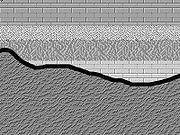
a)
Disconformity
b)
Nonconformity
c)
Angular unconformity
d)
Paraconformity
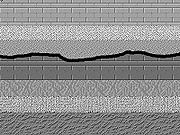
44.
a)
Disconformity
b)
Nonconformity
c)
Angular unconformity
d)
Paraconformity
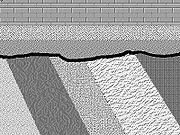
45.
a)
Disconformity
b)
Nonconformity
c)
Angular unconformity
d)
Paraconformity
46.
What is a gap in time shown in a rock sequence?
a)
An unconformity
b)
An isotope
c)
principle of superposition
d)
principle of original horizontality
47.
Which layer is the oldest?
a)
B
b)
C
c)
D
d)
E
48.

Which of the layers/events below is the youngest?

a)

B

b)

C

c)

D

d)

E

49.
The process by which running water, wind, or ice carry away bits of broken-up rock
a)
weathering
b)
sedimentation
c)
erosion
d)
cementation
50.
A break in the Earth's crust 
a)
fault 
b)
mountain
c)
plate
d)
fossil 
51.

Which principle or law states that when layers of sediments are deposited, they settle in flat, horizontal layers due to gravity. Therefore if layers are NOT horizontal, whatever disturbed them must have happened AFTER they were made.

a)

Uniformitarianism

b)

Original Horizontality

c)

Lateral Continuity

d)

Superposition

52.

The best index fossils have which two traits?

a)

widespread geographically, relatively long existence

b)

widespread geographically, relatively short existence

c)

specific place, long lifespan

d)

specific place, short lifespan

53.
The age of a rock layer compared to the other rock layers around it is called
a)
Absolute Age
b)
Relative Age
c)
Comparative Age
d)
Layer Age
54.

What does it mean when a common index fossil can no longer be found in rock strata after a certain time in Earth's history?

a)

it moved away

b)

it went extinct

c)

it evolved into something else