wayground logo

Free Printable Worksheets

Font size

S
M
L
XL
Worksheets

FINAL Exam Biology II 2017/2018 REVIEW

Total questions: 145

Worksheet time: 2hrs 25mins

Name
Class
Date
1.
What is shown here?
a)
Lysogenic Cycle
b)
Lytic Cycle
c)
Binary Fission
d)
Conjugation
2.
Which virus causes warts
a)
Herpes Simplex 1
b)
Human 
papillomavirus
c)
Rhinovirus
d)
 Varicella
3.
How do viruses reproduce?
a)
They copy their own genetic material inside a protein coat.
b)
They invade a living cell and use the cell's functions to replicate their genetic material
c)
They kill a cell and reproduce inside it
d)
They do not reproduce because they are not technically living things
4.
A ________ is used to prevent viral diseases while _______ are used to kill bacteria. 
a)
vaccine; antibiotics
b)
antibiotics; vaccine
c)
antibiotics; antibiotics
5.
This infectious viral disease has many symptoms, from chills, fever, and aching muscles to coughing and sneezing to nausea and vomiting. The symptoms show up within 2-7 days after the cell is infected.  This is an example of?
a)
Lysogenic Cycle
b)
Lytic Cycle
c)
Meiosis
6.
What process is this?
a)
phagocytosis
b)
lytic cycle
c)
lysogenic cycle
d)
formation of antibodies
7.
Which virus causes blisters that may appear around the mouth
a)
Rhinovirus
b)
Varicella
c)
Herpes Simplex 1
d)
 Human
papillomavirus
8.
A substance that stimulates the body's own immune response against invasion by microbes is a __________________
a)
antibody
b)
retrovirus
c)
viroid
d)
vaccine
9.
Which virus is responsible for the common cold? 
a)
Rhinovirus 
b)
Varicella
c)
Herpes Simplex 1
d)
 Human
papillomavirus
10.
Bovine spongiform encephalopathy is better known as
a)
Crazy sheep disorder
b)
Tuberculosis
c)
Mad cow disease
d)
Malaria
11.
What does the capsule do?
a)
It is a sticky layer that makes the bacteria more pathogenic (disease causing)
b)
It helps the bacteria move
c)
It is used to transfer DNA between two different bacteria
d)
It is a selective layer that lets certain molecules enter or exit the cell
12.
A virus infects a cell but does not reproduce immediately. It is copied into all daughter cells and only activates years later. This is:
a)
Lytic Infection
b)
Lypotonic Infection
c)
Lysogenic Infection
d)
Lemnuric Infection
13.
Which virus is responsible for both chicken pox and shingles?
a)
Herpes Simplex 1
b)
Rhinovirus
c)
Varicella
d)
 Human
papillomavirus
14.
A method of genetic recombination in which 2 cells temporarily join to combine DNA
a)
binary fission
b)
conjugation
c)
lytic cycle
d)
lysogenic cycle
15.
AZT contains __________________ which prevent viral replication 
a)
Protease inhibitors
b)
Vaccines
c)
Antibiotics
d)
Peptide polymerase
16.
If you step on a rusty nail (puncture wound), you may have to get a shot to combat being infected by this bacteria
a)
Clostridium tetani
b)
Clostridium botulinum
c)
Bacillus athracis
d)
Eschericia coli
17.
Bacteria come in all of the following shapes EXCEPT which?
a)
spiral
b)
rod-like
c)
rectangular
d)
spherical
18.
Which color do gram positive bacteria stain?
a)
Red
b)
Purple
19.
The protein shell that surrounds the DNA in a virus is called a ____________.
a)
virion
b)
capsid
c)
antibody
d)
prion
20.
Some bacteria have THREE layers.  The outermost layer in the diagram (E) is called the _________.
a)
Cytoplasm
b)
Cytoskeleton
c)
Capsule
d)
Plasmid
21.
One cell splits into 2 cells with identical DNA
a)
conjugation
b)
binary fission
c)
sexual reproduction
d)
replication
22.
What is the thick walled structure that some pathogens use to survive environments not favorable for them?
a)
Endospores
b)
Cell Walls
c)
Cell Membranes
d)
Fortress
23.

Challenge......

The name streptococcus tells you the bacteria are arranged as ___.

a)

pairs of round cells

b)

long chains of round cells

c)

groups of spirals

d)

chains of rods

24.
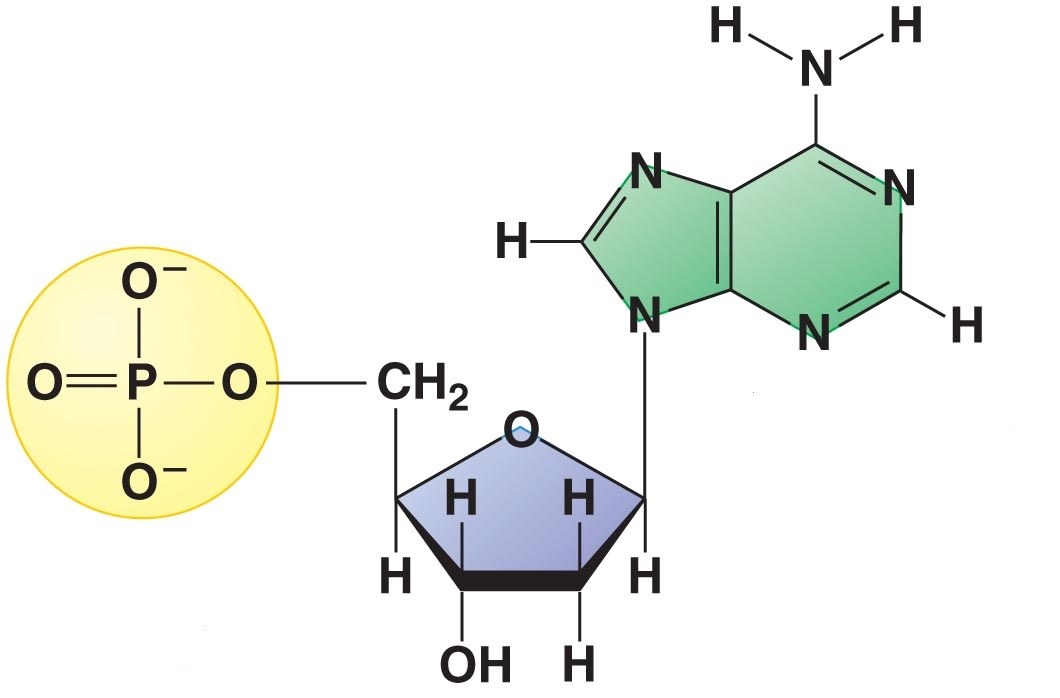
Name this structure
a)
double helix
b)
nucelotide
c)
twisted ladder
d)
hydrogen bond
25.
DNA polymerase is a(n)
a)
lipid
b)
enzyme
c)
sugar
d)
starch
26.
In a molecule of double-stranded DNA, the amount of Adenine present is always equal to the amount of
a)
cytosine
b)
guanine
c)
thymine
d)
uracil
27.
What determines the code, or information, of a DNA molecule?
a)
the shape (structure) of the nitrogen bases
b)
the order (sequence) of the nitrogen bases
c)
the color of the nitrogen bases
d)
the frequency (number) of nitrogen bases
28.
What is the complement to the DNA strand below:
5'-ATGCCAT-3'
a)
5'-TACGGTA-3'
b)
3'-TACGGTA-5'
c)
3'-ATGGCAT-5'
d)
5'-ATGGCAT-3'
29.
The term used to describe DNA Replication is:
a)
Semi-Conservative
b)
Conservative
c)
AntiParallel
d)
Dispersive
30.
DNA is a 3-D molecule made of linked nucleotides therefore we refer to DNA's direction as:
a)
left or right
b)
up or down
c)
5' and 3' prime
31.
Which of the following best describes purines?
a)
Double ring structures that consist of adenine and guanine
b)
single ring structure that consist of adenine and guanine
c)
single ring structures that consist of thymine and cytosine
32.
Which of the following best describes the first step in DNA replication?
a)
DNA helicase breaks the hydrogen bonds
b)
DNA Polymerase reads the DNA & determines new nucleotide
c)
strand of mRNA is read to create a protein structure
33.
According to Erwin Chargaff, if a sample of DNA has 20% Cytosine, what % A, T, and G would there be in the sample.
a)
20% A, 20% T, 20% G
b)
20% G, 30% A, 30% T
34.
Which sequence of DNA bases would pair with this partial strand
ATG TGA CAG
a)
ATG TGA CAG
b)
TAC ACT GTC
c)
GTA AGT GAC
d)
CAT TCA CTG
35.
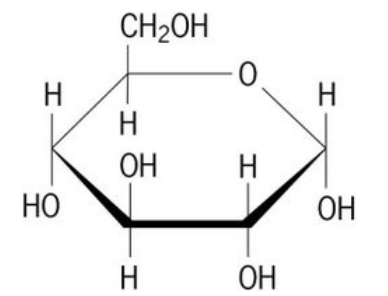
Which biomolecule is this a picture of?
a)
Protein
b)
Nucleic Acid
c)
Lipid
d)
Carbohydrate
36.
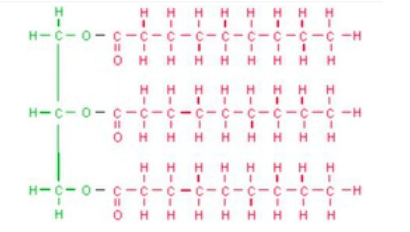
Which biomolecule is this a picture of?
a)
Protein
b)
Nucleic Acid
c)
Lipid
d)
Carbohydrate
37.
The name of the initial chain of monomers in a protein is called.....
a)
polypeptide
b)
polysaccharide
c)
polyester
d)
polynucleotide
38.
What is a peptide bond?
a)
Bond that holds two amino acids together.
b)
A bond that holds hydrogen and oxygen molecules together.
c)
A bond that holds the phosphate group of one nucleotide and a sugar of a neighboring nucleotide.
d)
A bond that is formed by the sharing of electrons.
39.
Which macromolecule is this?
a)
carbohydrate
b)
lipid
c)
protein
d)
nucleic acid
40.
Which process is used to copy DNA in the nucleus?
a)
replication
b)
transcription
c)
translation
41.
A triplet of mRNA is called a
a)
codon
b)
anticodon
c)
amino acid
d)
peptide bond
42.
_______ is made during transcription and ________ is made during translation.
a)
mRNA / a protein
b)
a protein / mRNA
c)
Ribosome / Nucleus
d)
mRNA / tRNA
43.
How many amino acids are coded for by this sequence of nucleotides:
ATG GGA ACT CCA
a)
4
b)
2
c)
6
d)
12
44.
Which of the following best represents the “Central Dogma of Molecular Biology
a)
DNA → RNA → Proteins
b)
DNA → Proteins → RNA
c)
Proteins → RNA → DNA
45.
Translation occurs:
a)
Outside of the Nucleus
b)
Inside of the Nucleus
46.
Frameshift mutations are caused by:
a)
Insertions & Deletions
b)
Substitutions 
47.
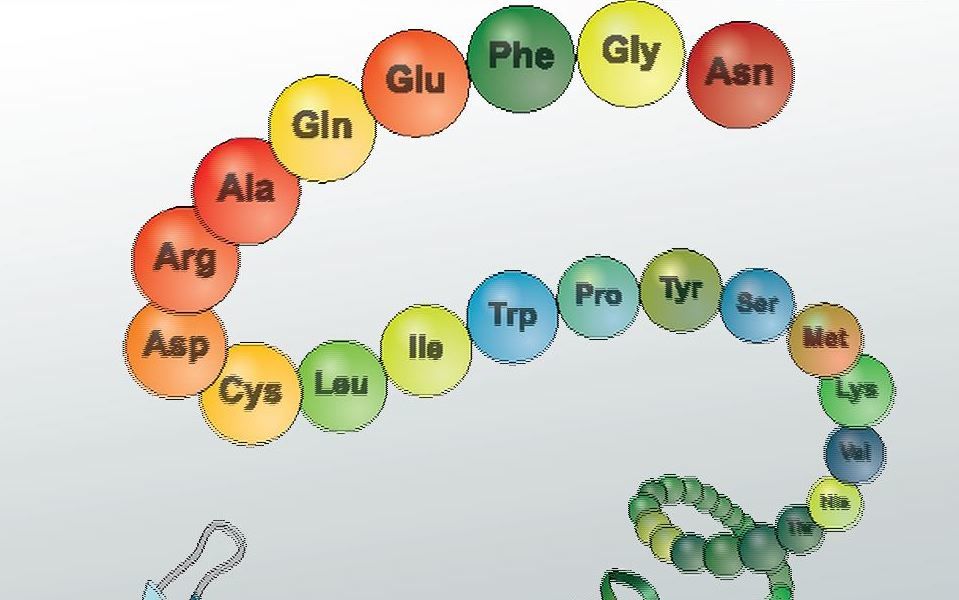
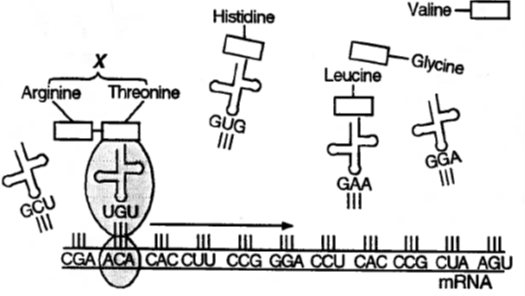
Which amino acid pairs with the codon GUA
a)
Val
b)
Ile
c)
Asp
d)
Gly
48.
Which amino acid pairs with the codon AGA
a)
Thr
b)
Arg
c)
Ala
d)
Glu
49.
Which amino acid pairs with the codon CAU
a)
Ala
b)
His
c)
Ser
d)
Thr
50.
If I give you the DNA Sequence: GAT, which amino acid pairs would pair with its RNA?
a)
Leu
b)
Phe
c)
Cys
d)
Gly
51.
If I give you the DNA Sequence: TCG, which amino acid pairs would pair with its RNA?
a)
Tyr
b)
Thr
c)
Ser
d)
Arg
52.
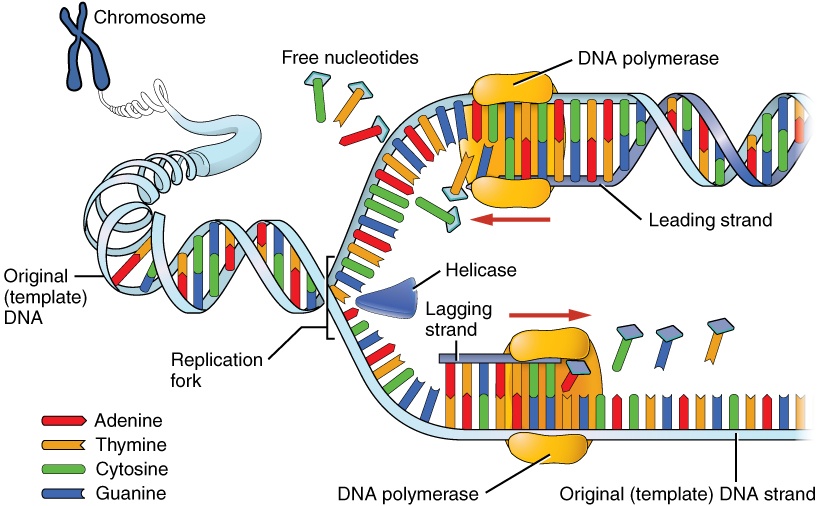
What is occurring in this picture?
a)
Translation
b)
DNA Replication
c)
Polymerase is unzipping the DNA
d)
Transcription
53.
What process is going on in this photo? 
a)
Transcription 
b)
Translation 
c)
Replication 
d)
All the above 
54.

What mutation has occurred here?

T-G-A-C-C-A

T-G-A-G-C-A

a)

Point

b)

Deletion

c)

Insertion

d)

Frameshift

55.
A type mutation in which the sequence of   amino acids does not change is called 
a)
Missense
b)
Nonsense
c)
Silent
d)
Deletion
56.

Why are insertion and deletion mutations so harmful?

a)

They cause a frameshift mutation that affects the sequence (and folding) of a protein.

b)

They insert things that an organism doesn't need.

c)

They often delete things that organisms need.

d)

Insertion and deletions cause point mutations that affect the sequence of amino acids in a protein.

57.
Would a mutation in the DNA of a skin cell be passed on to an organism's offspring?
a)
Yes, because any change to the DNA is passed on to the offspring
b)
Maybe. Sex cells only use half of the body's genetic code. It might get the copy of a gene that wasn't mutated.
c)
No. Only mutations that occur in the gametes (sex cells) are passed on to the offspring
d)
Without knowing the animal, it would be hard to tell whether or not the mutation would be passed on.
58.
If a mutation occurs in an expressed gene, it will most directly affect the structure of a cell's
a)
ATP
b)
proteins
c)
energy source
d)
membrane
59.
What type of chromosomal mutation is this?
a)
Translocation
b)
Inversion
c)
Deletion
d)
Duplication
60.
Identify the chromosomal mutation
a)
Deletion
b)
Duplication
c)
Inversion
d)
Translocation
61.
Identify the chromosomal mutation
a)
Deletion
b)
Duplication
c)
Inversion
d)
Translocation
62.
Identify the chromosomal mutation
a)
Deletion
b)
Duplication
c)
Inversion
d)
Translocation
63.
illustration shows. 
a)
sickle cell
b)
hemophilia
c)
turner's
d)
tay-sachs. 
64.
Marfan
a)
Trisomy of chromosome # 13
b)
Mutation in the gene that controls how the body makes collagen and affects how the body makes skin cells
c)
Mutation in the gene that controls how the body makes Fibrilin, that affects the production of connective tissue
d)
Partial deletion of chromosome # 21
65.
Fragile X
a)
Mutation in the FGFR3 gene
b)
Trisomy of chromosome # 21
c)
Monosomy of Chromosome X 
d)
Mutation in the FMR1 gene
66.
Cri-du-chat
a)
Caused by Translocation on chromosome # 13
b)
Autosomal Dominant disorder
c)
Caused by a partial deletion of Chromosome #5
d)
Sex linked Disorder
67.
Patau
a)
Autosomal Recessive disorder
b)
Monosomy of the X chromosome
c)
Mutation in the FGFR3 gene
d)
Trisomy 13
68.
Hemophilia
a)
Autosomal recessive disorder
b)
Mutation in the FGFR3 gene
c)
Sex linked disorder
d)
partial deletion of chromosome # g
69.
Duchenne Muscular dystrophy
a)
Mutation in the FGFR3 gene
b)
 A defective gene that codes for a muscular protein called dystrophin. 
c)
trisomy 21
70.
Colorblindness is more common in males than in females because the colorblind allele is...
a)
dominant and located on the X
b)
recessive and located on the Y
c)
recessive and located on the X
d)
dominant and located on the Y
71.
A male with the notation 47, XYY has which chromosomal condition?
a)
Turner's Syndrome
b)
Klinefelter's Syndrome
c)
Down Syndrome
d)
Jacob's Syndrome
72.
Which of the following conditions results in mucus lining the lungs, liver, and digestive tract?
a)
cystic fibrosis
b)
sickle cell anemia
c)
Tay-Saachs
d)
Hunington's
73.
a)
Kleinfelter
b)
Edwards
c)
Patau
d)
Turner
74.
a)
Kleinfelter
b)
Edwards
c)
Patau
d)
Turner
75.
Which of the following is a true statement about gametes?
a)
In humans, there are 22 autosomes and one sex chromosome. 
b)
Gametes have a diploid number of chromosomes.
c)
Gametes are body cells
d)
n humans, there are 22 Pairs of autosomes and one pair of sex chromsomes.
76.
A zygote has 8 chromosomes, how many chromosomes were in the gametes?
a)
2
b)
4
c)
8
d)
1
77.
The two parts of a duplicated chromosome are held together by a... 
a)
Nucleolus
b)
spindle fiber
c)
centromere
d)
centriole
78.
What is a picture used to examine chromosomes called?
a)
Sonogram
b)
Electrocardiogram
c)
X-Ray
d)
Karyotype
79.
The cause of chromosomal disorders such as trisomy & monosomy is...
a)
Non-disjunction during Meiosis
b)
Overfertilization
c)
Non-disjunction during Mitosis
d)
Translocation during meiosis
80.
Which would be considered a somatic cell?
a)
Sperm cell
b)
Egg Cell
c)
Skin Cell
d)
All of these
81.
What is the haploid number for this Karyotype?
a)
54
b)
27
c)
13
82.
What is the diploid number for this Karyotype?
a)
54
b)
27
c)
13
83.
When an area of a chromatid is exchanged with the matching area on a chromatid of its homologous chromosome, _________________ occurs
a)
crossing over
b)
mutagenesis
c)
hybridization
d)
fertilization
84.
There are 18 chromosomes in the root cell of a carrot, How many chromosomes are found in the pollen cells of the carrot?
a)
18
b)
9
c)
27
d)
36
85.

If an egg cell in a butterfly contains 12 chromosomes, a butterfly wing cell will have?

a)

3

b)

6

c)

12

d)

24

86.
Which is the correct sequence? 
a)
mitosis - gametes - zygote - meiosis - fertilization - embryo
b)
Fertilization-mitosis-zygote-gametes-meiosis-embryo
c)
meiosis-zygote-gametes-mitosis-fertilization-embryo
d)
meiosis-gametes-fertilization-zygote-mitosis-embryo
87.
What is the chromosomal condition of the individual whose karyotype is seen in the image?
a)
Down Syndrome
b)
Jacob's
c)
Edward's
d)
Klinefelter's Syndrome
88.
A cat has a total of 38 chromosomes in its body cells.  How many in its gametes?
a)
38
b)
19
c)
76
d)
10
89.
If a wing cell of a beetle has 10 chromosomes, how many chromosomes will be in one stomach cell from this beetle?
a)
2
b)
5
c)
10
d)
20
90.
A female with patau's syndrome will have the notation
a)
46 XX +18
b)
47 XY+13
c)
47 XX+13
d)
46 XY +18
91.
A male with Down's syndrome will have a notation of 
a)
47 XX +13
b)
47 XY +21
c)
47 XY +18
d)
45 X0
92.
What type of inheritance do two alleles have if their traits blend together? 
a)
Incomplete Dominance
b)
Co-Dominance
c)
Dominant / Recessive Inheritance
d)
Homozygous Inheritance
93.
A calico cat shows both the traits for orange fur and black fur. What kind of allele expression is this?
a)
Incomplete Dominance
b)
Co-dominance
c)
Sex-linked inheritance
d)
Recessive inheritance
94.
A pattern of inheritance in which a trait is carried on one of the sex-determining chromosomes.
a)
Dominant Inheritance
b)
Co-dominance
c)
Incomplete dominance
d)
Sex-linked inheritance
95.
How many generations are shown in this pedigree?
a)
3
b)
6
c)
5
d)
4
96.
Snap dragon color is a incomplete dominant trait.  A red flower (RR) is crossed with white flower (WW). What color are flowers that are heterozygous?
a)
Red
b)
Red and White
c)
White
d)
Pink
97.
When many genes influence a trait we referred to this as
a)
incomplete dominance
b)
polygenic
c)
co-dominant
d)
multiple alleles
98.
An organism with the genotype Gg will have the same phenotype as an organism with which genotype?
a)
GG
b)
gg
c)
Tt
d)
none of these are correct
99.
What goes in box 1
a)
AABb
b)
AABB
c)
aabb
d)
AaBb
100.
What goes in box 2
a)
AABb
b)
AaBb
c)
aabb
d)
AaBB
101.
What goes in box 3
a)
Aabb
b)
AABB
c)
AAbb
d)
aaBb
102.
What goes in box 4
a)
AABb
b)
AABB
c)
AAbb
d)
AaBB
103.
What goes in box 6
a)
AaBB
b)
AABB
c)
aaBB
d)
AAbb
104.
What are the possible genotypes for this cross?
a)
TT = 25% Tt= 50% tt=25%
b)
all tall
c)
TT= 75% tt = 25%
d)
Tt = 100%
105.

What is the genotype of a yellow lab pup whose father was a black lab and a mother was a chocolate lab?

a)

BBEE

b)

bbEe

c)

Bbee

d)

BBee

106.
If green is dominant over purple, then what is the genotype for this individual?
a)
Purple
b)
Green
c)
GG
d)
gg
107.
What is the genotype for this organism?
(E= 3 eyes, e= 1 eye)
a)
EE
b)
Ee
c)
ee
d)
EE or Ee
108.
Hemophilia is a recessive x-linked disorder.
Which genotype represents a male with hemophilia?
a)
XHXh
b)
XhXh
c)
XHY
d)
XhY
109.
Hemophilia is a recessive x-linked disorder.
Which genotype represents a female who is a carrier for hemophilia?
a)
XHXh
b)
XhXh
c)
XHXH
d)
XhY
110.
Duchenne muscular dystrophy is a recessive x-linked disorder.
According to the Punnett square, what percentage of male offspring will have the disorder?
a)
0%
b)
25%
c)
50%
d)
100%
111.
What is the term for an inheritance pattern in which one gene can silence the expression of another, such as with albinism?
a)
Codominant
b)
Incomplete dominance
c)
Epistatic
d)
Polygenic
112.
What does this image represent?
a)
Species Biodiversity
b)
Ecological Biodiversity
c)
Individual Biodiversity
d)
Genetic Biodiversity
113.
What does the following image represent?
a)
Genetic Biodiversity
b)
Ecological Biodiversity
c)
Species Biodiversity
d)
Individual Biodiversity
114.
What does this picture represent?
a)
species diversity
b)
ecosystem diversity 
c)
genetic diversity
d)
biodiversity
115.
Tigers living in warm climates have thinner coats of fur than tigers living in cool climates. This is a result of
a)
general diversity 
b)
species diversity
c)
ecosystem diversity
d)
genetic diversity
116.
A Chinook Salmon fish in Alaska can produce between 2000-17,000 eggs in a single spawning. Which step of natural selection does this observation demonstrate?
a)
Overproduction
b)
Inherited variations
c)
Struggle to survive
d)
Differential Reproduction
117.

Due to the ability to camouflage itself from predators the White Peppered Moth of England was once more abundant that the Black Peppered Moth. As the Industrial Revolution hit, factories began to release black soot which coated everything, including tree bark. Because the moths'

habitat was now darker. the white moth became much more susceptible to predators. At the same time. the Black Peppered moth was now more protected and began to increase in number. This story is an example of

a)

Mutation

b)

Natural selection

c)

Endangered species

d)

Extinction

118.
What is the advantage of having different shaped beaks?
a)
To look different from other species.
b)
To be able to eat the food readily available in the environment.
c)
To protect itself against predators.
d)
To protect itself against prey.
119.

The ability of an organism to survive and reproduce

a)

common descent

b)

genetic drift

c)

speciation

d)

fitness

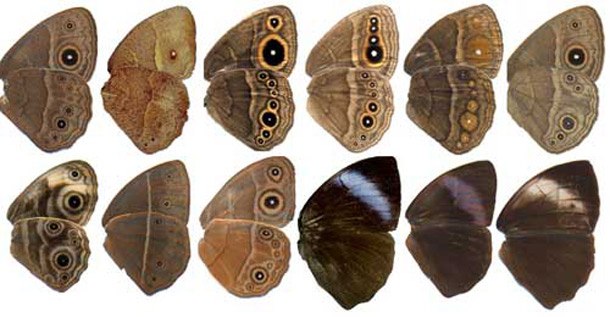
120.
These moths are all the same species. The differences between their wings is an example of ________________
a)
Natural Selection
b)
Variation
c)
Homeostasis
d)
Extinction
121.

Why are advantageous traits more likely to be passed onto offspring?

a)

Because they are more likely to survive and reproduce.

b)

Because they come from dominant alleles.

c)

Because they come from recessive alleles.

d)

Because the trait is an acquired phenotype.

122.
a bird that can easily outcompete other birds for food and that can produce many eggs has a high
a)
life expectancy
b)
mutation rate
c)
fitness
d)
adaptability
123.
Mutations are important because they bring about
a)
death of the organism in which they develop
b)
genetic variation needed for a population to evolve
c)
benefits for the individual, not for the population
d)
Hardey-Weinberg equilibrium within a population
124.
An organism's appearance or other observable characteristics:
a)
phenotype
b)
recessive
c)
genotype
d)
dominant
125.
An organism's genetic make-up:
a)
phenotype
b)
recessive
c)
genotype
d)
dominant
126.

When dark-colored fur gives mice a 1% competitive advantage and 1% of the population begins with dark fur, in about 1,000 years, 95% of the population will have dark fur. Which of the following statements is true? **You must select ALL correct options to get the question CORRECT***

a)

If dark-colored rock pocket mice had a competitive advantage of 0.1%, it would take more than 1,000 years for 95% of the population to have dark fur.

b)

Dark-colored rock pocket mice, in this population, have

fewer offspring than light-colored rock pocket mice.

c)

If dark-colored mice had a competitive advantage of 5%,

it would take less than 1,000 years for 95% of the population to have

d)

If dark-colored mice had a competitive advantage of

10%, it would take more than 1,000 years for 95% of the population to have black fur.

127.

Why did dark-colored rock pocket mice first appear in a population of light-colored rock pocket mice?

a)

They have a genetic mutation

that affects their fur color

b)

There is dark lava rock in the area where they live.

c)

Individuals change color to blend in with the

environment.

d)

Predators eat light-colored rock pocket mice.

128.
Since the 1800s humans have stopped burning coal, and the trees have returned to their original color. Which moth will be more successful in this environment?
a)
Dark moth
b)
Light moth
c)
Both will be equally successful
d)
Neither will be successful
129.
Which of these statements best describes what Darwin observed on the Galapagos Islands?
a)
The finch population on each island was unique
b)
The finches on the islands ate seeds and nuts, but no insects
c)
The finches on the islands were the same as the finches in Ecuador
d)
The finches could produce offspring only with finches from other islands
130.
Where do adaptations come from?
a)
The individual organism decides to adapt
b)
Mutations that give an organism an advantage in its environment
131.
Which best describes the role of mutations in natural selection?
a)
Mutations help an organism to better survive in their environment
b)
An organism may acquire a helpful mutation by interacting with the environment
c)
A mutation may result in an adaptive trait that makes an organism more likely to survive and reproduce
d)
Organisms with certain traits are more likely to win competitions for mutations
132.

Which habitat exhibits the least biodiversity?

a)

A habitat with 15 different species with about 300 individuals each

b)

A habitat with 10 different species with about 75 individuals each

c)

A habitat with 4 different species with about 150 individuals each

133.

Which trait would be environmentally influenced?

a)

Fur color depends on how many brothers and sisters you have.

b)

You can stretch to grow taller.

c)

Fur color changes as you get older.

d)

Height is affected by how well you eat

134.

What does fitness mean in biology?

a)

being the biggest in your population

b)

being the fastest in your population

c)

eating the most food

d)

having the more offspring survive to reproductive age

135.

A more complete definition of fitness is the ability to survive and produce offspring who can also survive and reproduce. Below are descriptions of four male lions. According to this definition of fitness, which lion would biologists consider the “fittest”? Explain why.

a)

Gerald because he is the largest in size.

b)

Darren because he lived the longest and fathered the most cubs.

c)

Thomas because he had the highest number offspring to survive to adulthood.

d)

Stripe because he 14 of his 20 cubs survived to adulthood.

136.

Two students are discussing natural selection in bacteria and how it can relate to antibiotic resistance in bacteria. Which opinion do you agree with more .

a)

Bernadette states that when antibiotics are used, bacteria can respond by developing traits to help them defeat the antibiotic, which then may increase their fitness.

b)

Dominque states that there is already a variety of traits among the bacteria. Bacteria that have traits that allow them to survive the antibiotic and reproduce may have higher fitness.

137.

Natural selection is an example of a mechanism of evolution. Does this mechanism produce a change in individuals or populations?

a)

Population, The fittest individuals are more likely to survive and pass their genes to their offspring, producing a population that is better adapted to the environment.

b)

Individual, alleles can change within a lifetime to fit the needs of the organism and pass the change from generation to generation.

138.
Humans have been a very successful species on earth.  They have very large, very diverse populations spread all around the world. As a result,
a)
Human have very limited ability to adapt to changes in the environment.
b)
Young humans have lower survival rates as compared to other species.
c)
Humans have a potential to adapt to various environmental changes.
d)
All humans are more disease resistant.
139.

Geneticists studying the gene for lactase did not find any differences in the coding region DNA (the section of DNA with instructions to make a protein) between people who could digest lactose and people who could not digest lactose. After they investigated further, they discovered that the difference between lactose-tolerant and -intolerant individuals was due to a mutation located in

a)

the genetic switch for the lactase gene

b)

an intron of the lactase gene

c)

the gene for glucose production

d)

different genes for different individuals

140.

Why would measuring blood glucose levels in an individual 20 to 30 minutes after they drink a liter of milk indicate whether they are able to digest lactose?

a)

When lactose is digested by lactase in the small intestine, different cells in the body start releasing glucose into the bloodstream.

b)

When lactose is digested by lactase, the glucose that is produced enters the bloodstream from the small intestine.

c)

When lactose enters the large intestine, glucose is digested by bacteria and then enters the bloodstream.

d)

The fats and proteins in milk are digested by the body, causing glucose levels in the blood to increase.

141.

Lactose is a(n)

a)

sugar

b)

enzyme

c)

protein

d)

monosaccharide

142.

Lactase is a(n)

a)

enzyme

b)

monosaccharide

c)

sugar

d)

disaccharide

143.

Study the figure above. Each pie chart represents a unique population. The degree to which the pie chart is filled in illustrates the percentage of individuals in that population who are lactase persistent. What trend do you see in the data?

a)

The greatest proportions of individuals with lactase persistence occur in populations in northern Europe, far western Africa, a small part of India, and a small part of east-northeastern Africa.

b)

The greatest proportions of individuals with lactase persistence occur in populations in southern Africa and Australia.

c)

The greatest proportions of individuals with lactase persistence occur in populations in South American

d)

The greatest proportions of individuals with lactase persistence occur in populations in northern Asia and China

144.

Which of the following best describes pyrimidines?

a)

Double ring structures that consist of adenine and guanine

b)

single ring structure that consist of adenine and guanine

c)

single ring structures that consist of thymine and cytosine

145.

Transcription occurs:

a)

Outside of the Nucleus

b)

Inside of the Nucleus