wayground logo

Free Printable Worksheets

Font size

S
M
L
XL
Worksheets

Biology 2nd semester review

Total questions: 148

Worksheet time: 3hrs 1mins

Name
Class
Date
1.
What is the cell cycle?
a)
The gradual development of something, especially from a simple to a more complex form.
b)
The study of heredity and the variation of inherited characteristics.
c)
The branch of biology that deals with the relations of organisms to one another and to their physical surroundings.
d)
The series of events that take place in a cell leading to its division and duplication of its DNA to produce two daughter cells.
2.
Which part of the Cell Cycle takes the longest?
a)
Interphase
b)
Mitosis
c)
Prophase
d)
Cytokinesis
3.
What happens in the first part of Interphase?
a)
Mitosis
b)
Cell Growth
c)
DNA Replication
d)
Anaphase
4.
What part of the cell cycle results in the splitting of the new cells?
a)
Interphase
b)
Mitosis
c)
Metaphase
d)
Cytokinesis
5.
What does DNA Replication mean?
a)
DNA is made.
b)
DNA makes new cells. 
c)
DNA copies itself.
d)
DNA starts the cell cycle.
6.
True or False. 
After a cell goes through cytokinesis, it starts mitosis all over again.
a)
True
b)
False
7.
True or False.
Mitosis is a continuous process.
a)
True
b)
False
8.
What phase is this cell in?
a)
Cytokinesis
b)
Mitosis
c)
Prophase
d)
Metaphase
9.
What phase is this cell in?
a)
Mitosis
b)
Interphase
c)
Anaphase
d)
Telophase
10.
What phase is this cell in?
a)
Mitosis
b)
Cytokinesis
c)
Prophase
d)
Telophase
11.
What phase is this cell in?
a)
Mitosis
b)
Interphase
c)
Prophase
d)
Telophase
12.
What part of the cell cycle is this cell in?
a)
Mitosis
b)
Interphase
c)
Telophase
d)
Cytokinesis
13.
True or False.
Mitosis is made up of 5 phases.
a)
True
b)
False
14.
What is the longest phase in MITOSIS?
a)
Prophase
b)
Metaphase
c)
Interphase
d)
Anaphase
15.
In what phase do the chromosomes line up in the middle of the cell?
a)
Cytokinesis
b)
Metaphase
c)
Prophase
d)
Telophase
16.
In what phase does chromatin condense to form chromosomes?
a)
Mitosis
b)
Interphase
c)
Prophase
d)
Anaphase
17.
In what phase do the chromosomes get pulled apart into sister chromatid to opposite sides of the cell?
a)
Prophase
b)
Interphase
c)
Metaphase
d)
Anaphase
18.
In what phase do the organelles disperse out into the daughter cells, and the cell prepares for cytokinesis?
a)
Prophase
b)
Interphase
c)
Mitosis
d)
Telophase
19.
What can the cell cycle also be called?
a)
Cell growth
b)
DNA Replication
c)
Preparation for Mitosis
d)
Cell Divison
20.

In which part of Interphase are the chromosomes replicated?

a)

G0

b)

G1

c)

S

d)

G2

21.

Spinal cord injuries are difficult to treat because damaged nerce cells do not regenerate. Which of the following most accurately explains why damaged nerve cells no longer regenerate?

a)

Mature nerve cells are in a resting state; the no longer divide during mitosis

b)

Nerve damage disrupts the cell cycle at the G1 phase

c)

Nerve damage disrupts the cell cycle at the S phase

d)

Nerve damage prevents centrioles from being synthesized

22.

During which stage of the cell cycle does the nucleus divide?

a)

interphase

b)

mitosis

c)

endocytosis

d)

cytokinesis

23.

If you look at a cell under a microscope, which phase is it MOST likely to be in?

a)

Cytokinesis

b)

M phase

c)

Interphase

d)

G1 Phase

24.
Put the following actions in order: DNA replicates, cell grows, cell divides, cell prepares for mitosis. 
a)
DNA replicates, cell grows, cell prepares for mitosis, cell divides
b)
cell grows, cell prepares for mitosis, DNA replicates, cell divides
c)
cell grows, DNA replicates, cell prepares for mitosis, cell divides
d)
DNA replicates, cell prepares for mitosis, cell grows, cell divides
25.

Apoptosis is

a)

programmed cell death

b)

mysterious cell death

c)

programmed cellular mutation

d)

mysterious cellular mutation

26.

_____ is the uncontrolled growth of cells, often resulting in a tumor or mass of abnormal cells

a)

Cancer

b)

Apoptosis

c)

Radiation

27.

Select all stages of interphase?

a)

G1

b)

S

c)

G2

d)

Mitosis

28.

Which is not a phase of the cell cycle?

a)

Interphase

b)

Mitosis

c)

Cytokinesis

d)

Duplication

29.
Cells spend 90% of their time in this stage of the cell cycle. This is the reason you would see most cells in this stage if viewed under a microscope.
a)
Prophase
b)
Metaphase
c)
Anaphase
d)
Interphase
30.
Cell division occurs to allow for 
a)
Growth
b)
Reproduction
c)
Repair
d)
All of the above
31.
The sister chromatids of each chromosome are separated (come apart) and move to opposite ends of the cell. Name that Stage!
a)
Prophase
b)
Metaphase
c)
Anaphase
d)
Telophase
32.
The cytoplasm is divided between the cells splitting the cell into two. Name that Stage!
a)
Cytokinesis
b)
Interphase
c)
Prophase
d)
Metaphase
33.
DNA is copied in the S part of this stage. Name that Stage!
a)
Interphase
b)
Prophase
c)
Metaphase
d)
Anapahse
34.
Nucleolus and nuclear membrane start to disappear, chromatin condenses into chromosomes, and spindle fibers start to form. Name that Stage!
a)
Interphase
b)
Prophase
c)
Metaphase
d)
Anaphase
35.
The chromosomes start to line up in the middle of the cell.
a)
Prophase
b)
Metaphase
c)
Anaphase
d)
Telophase
36.
How many chromosomes do human body cells have?
a)
23
b)
46
c)
92
d)
None of these
37.
What type(s) of cells undergo mitosis?
a)
sex cells
b)
gametes
c)
body cells
d)
sperm and egg cells
38.
What do the cells look like at the end of mitosis?
a)
different from original cell
b)
similar to the original cell
c)
identical to the original cell
d)
none of these
39.
Would a prokaryotic or eukaryotic cell be more likely to use mitosis as a means of reproduction?
a)
prokaryotic
b)
eukaryotic
40.
Identify the stage of the cell cycle while looking at the picture.
a)
Prophase
b)
Metaphase
c)
Anaphase
d)
Telophase
41.
Identify the stage of the cell cycle while looking at the picture.
a)
Interphase
b)
Telophase
c)
Metaphase
d)
Cytokinesis
42.
Identify the stage of the cell cycle while looking at the picture.
a)
Early Prophase
b)
Late Propahse
43.
Identify the stage of the cell cycle while looking at the picture.
a)
Prophase
b)
Metaphase
c)
Anaphase
d)
Telophase
44.
*Identify the stage of the cell cycle while looking at the picture.
a)
Prophaese
b)
Metaphase
c)
Anaphase
d)
Telophase
45.
Identify the stage of the cell cycle while looking at the picture.
a)
Interphase
b)
Prophase
c)
Metaphase
d)
Anaphase
46.
Which of the following cells is a gamete?
a)
egg
b)
bone
c)
heart
d)
muscle
47.
The fertilized egg is termed a/an _____.
a)
gamete
b)
allele
c)
homolog
d)
zygote
48.
In mitosis cells are genetically _______, but in meiosis cells are genetically ______.
a)
diverse, identical
b)
identical, diverse/different
49.

Is this a normal human karyotype?

a)

YES

b)

NO

50.

Is this karyotype for a male or female?

a)

MALE

b)

FEMALE

51.

CROSSING OVER INCREASES

a)

LIFE SPAN

b)

GENETIC VARIATION

c)

THE NUMBER OF OFF-SPRING

d)

ALL ARE TRUE

52.
A Skin has 2 of every chromosome.  Which term means 1 of each chromosome? 
a)
Meiosis
b)
Mitosis
c)
Haploid
d)
Diploid
53.
What kind of cells are made in MEIOSIS?
a)
Haploid cells
b)
Diploid Cells
c)
Skin Cells
d)
Liver Cells
54.
What causes genetic variation in meiosis?
a)
chromosomes lining up
b)
crossing over of chromosomes
c)
separation of chromosomes
d)
chromosomes pulling apart
55.
Diploid Cells are represented by
a)
2n
b)
n
c)
4n
d)
1/2 n
56.
If the Diploid number of Carrots is 18, the haploid number is
a)
18
b)
9
c)
27
d)
36
57.
The process of crossing over occurs in what phase of meiosis?
a)
anaphase 1
b)
prophase 1
c)
prophase 2
d)
telophase 1
58.
Crossing over creates
a)
male genotype
b)
genetic variation (differences)
c)
DNA replication
d)
mitosis
59.
Which cellular process is shown?
a)
meiosis
b)
endocytosis
c)
mitosis
d)
phagocytosis
60.
Which of the following best describes meiosis?
a)
It is carried out in all tissues theat require cell replacement
b)
It occurs only in cells in the reproductive structures of an organism
c)
It happens in all of the tissues except the brain and spinal cord
d)
It is the first stage of mitosis
61.
A human zygote should have _____ chromosomes inside.
a)
46
b)
23
c)
92
d)
64
62.
Which of the following represents chromosome # during fertilization?
a)
n+n=2n
b)
n=n
c)
2n=n+n
d)
2n=2n
63.
Meiosis makes sperm and egg cells. In humans, sperm and egg cells each have _____ chromosomes. Therefore a fertilized human egg cell (sperm and egg cell combined) would create a cell with _____ chromosomes.
a)
23, 46
b)
46, 23
c)
2, 4
d)
50, 100
64.
How many daughter cells does Meiosis create?
a)
2
b)
4
c)
8
d)
1
65.
What are the nucleotides made of?
a)
Sugar, Phosphate, nitrogen base
b)
Phosphate, Adenine, nitrogen base
c)
Thymine, Adenine, Cytomine
d)
Phosphate, Nitrogen, Adenine
66.
Adenine bonds with ______________.
a)
Guanine
b)
Thymine
c)
Cytosine
d)
Adenine
67.
Guanine bonds with ______________.
a)
Adenine
b)
Guanine
c)
Cytosine
d)
Thymine
68.
Why is DNA important?
a)
it is very small and very complicated
b)
it's in everything
c)
it serves as the blueprint for traits of all living things
d)
because we eat it every day for energy
69.
What are the 4 nitrogen bases?
a)
adenine, thymine, cytoplasm, and guanine
b)
adenine, thymine cytosine, and guanine
c)
adenine, thymine, cytosine, and gylcerol
d)
adenine, thymine, cytosine, and glucose
70.
Which sequence of DNA bases would pair with this partial strand
ATG TGA CAG
a)
ATG TGA CAG
b)
TAC ACT GTC
c)
GTA AGT GAC
d)
CAT TCA CTG
71.

In eukaryotes, which organelle is DNA usually found in?

a)

cell membrane

b)

vacuole

c)

chloroplast

d)

nucleus

72.
Which shows the correct complementary base pairing for DNA?
a)
C-A, T-G
b)
A-G, C-T
c)
C-G, U-A
d)
T-A, G-C
73.
What does DNA stand for?
a)
Deoxyribonucleic acid
b)
Denitrogenous acid
c)
Deribonucleic acid
d)
Diribonucleic acid
74.
The building block of nucleic acids are nucleotides.  Nucleotides are composed of a sugar, a phosphate group, and a _________________ base.
a)
oxygen
b)
hydrogen
c)
nitrogen
d)
carbon
75.
The sugar in DNA is ?
a)
sucrose
b)
glucose
c)
deoxyribose
d)
fructose
76.
Which of the following monomers are repeatedly joined together to form a strand of DNA?
a)
amino acids
b)
nucleotides
c)
fatty acids
d)
polysaccharides
77.
What determines the code, or information, of a DNA molecule?
a)
the shape (structure) of the nitrogen bases
b)
the order (sequence) of the nitrogen bases
c)
the color of the nitrogen bases
d)
the frequency (number) of nitrogen bases
78.
Which 2 molecules form the sides (backbone) of the DNA ladder?
a)
deoxyribose sugar and adenine
b)
deoxyribose sugar and a hydrogen bond
c)
deoxyribose sugar and the nucleus
d)
deoxyribose sugar and phosphate
79.
The two strands of nitrogenous bases in DNA are joined by which type of bond?
a)
polar bonds
b)
ionic bonds
c)
covalent bonds
d)
hydrogen bonds
80.
The drawing shows the structure of what molecule?
a)
A DNA molecule
b)
A lipid molecule
c)
A carbohydrate molecule
d)
A protein molecule
81.
X outlines a(n) ___________.
a)
amino acid
b)
nitrogen base 
c)
nucleotide
d)
nitrogen base pair
82.
Identify #2.
a)
nitrogen base
b)
phosphate group
c)
deoxyribose sugar
d)
nucleotide
83.
A long chain of amino acids is a/an
a)
protein
b)
nucleic acid
c)
tRNA
d)
mRNA
84.
If a DNA molecule consists of 29% Guanine, how much cytosine will it contain?
a)
29%
b)
58%
c)
21%
d)
I have no idea.
85.

The monomers units of DNA and RNA are

a)

amino acids

b)

monosaccharides

c)

nucleotides

d)

fatty acids

86.

In what process is mRNA synthesized?

a)

Transcription

b)

Translation

c)

DNA Replication

d)

Mitosis

87.

Where does TRANSCRIPTION occur?

a)

Nucleus

b)

Ribosome

c)

Cytoplasm

d)

Mitochondria

88.

Why must transcription occur where DNA can be found?

a)

because DNA can't leave

b)

because ribosomes are in the nucleus

c)

because DNA polymerase is found there

d)

because helicase unzips the DNA

89.

Which of the following is a codon?

a)
b)

ATG

c)

AUG

d)

AUT

90.

Which of the following is a codon?

a)
b)

ATG

c)

AUG

d)

AUT

91.

How many codons equals 1 amino acid?

a)

1

b)

2

c)

3

d)

4

92.

How many nucleotides equal 1 amino acid?

a)

1

b)

2

c)

3

d)

4

93.

On which molecule can an anticodon be found?

a)

mRNA

b)

DNA

c)

tRNA

d)

rRNA

94.

Where is the anticodon located?

a)

at the top of the molecule it's found on

b)

at the bottom of the molecule it's found on

c)

on the right of the molecule it's found on

d)

on the left of the molecule it's found on

95.

What is the purpose for anti-codons?

a)

to ensure the correct amino acid is dropped off

b)

to match the strand of DNA

c)

to decode a sequence of 4 nucleotides into an amino acid

d)

to make me hate biology

96.

A polypeptide is a sequence of ____________________ held together by a ______________ bond.

a)

amino acids; peptide

b)

fatty acids; ionic

c)

proteins; hydrogen

d)

fatty acids; covalent

97.

TRANSCRIBE this DNA sequence: TACGTTACT

a)

AUGCAAUGA

b)

ATGCAATGA

c)

AUGGATUGA

d)

TACGTTACT

98.

TRANSLATE this RNA sequence: AUGCAAUGA

a)

Met-Glu-Stop

b)

Met-His-Stop

c)

Thr-Glu-Stop

d)

Thr-Pro-Stop

99.
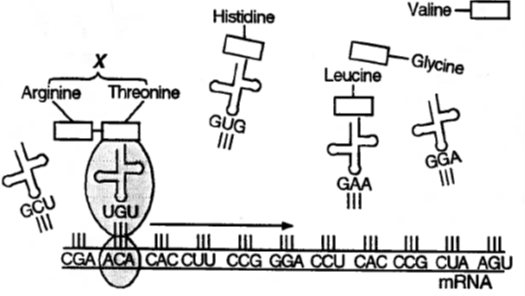
What process is going on in this photo? 
a)
Transcription 
b)
Translation 
c)
Replication 
d)
All the above 
100.
Does the order of amino acids in a protein matter?
a)
YES!
b)
NO!
101.
The process of going from DNA to mRNA is called
a)
Transcription
b)
Translation
c)
Transportation
d)
Transient
102.
Are recessive traits shown with capital or lowercase letters? 
a)
Capital
b)
Lowercase
103.
The physical appearance or the way a gene looks is known as it's....
a)
genotype
b)
allele
c)
gene
d)
phenotype
104.
The different forms of genes are known as
a)
environment
b)
probability
c)
traits
d)
alleles
105.
An allele or gene that always shows is
a)
recessive
b)
dominant
c)
hidden
d)
present
106.
Two of the same genes for a trait (sometimes called purebred). BB or bb
a)
homozygous
b)
hetrozygous
c)
protein
d)
chromosome
107.
Two different genes for a trait (sometimes called hybrid). Bb
a)
protein
b)
homozygous
c)
heterozygous
d)
genotype
108.
What would the ratio for genotypes be for this Punnett Square?
a)
2Bb:2bb
b)
2BB:2Bb
c)
1BB:2Bb:1bb
d)
4Bb
109.
G = dominant green and y = recessive yellow
A fish has a Gy genotype, what will its phenotype be?
a)
yellow
b)
green
c)
greenish-yellow
d)
red
110.
T - tall and t = short
In the punnett square below, what belongs in the missing square
a)
tt
b)
Tt
c)
Bb
d)
TT
111.
A ________________________ is used to predict the possible genotype from certain parents
a)
Mendel Grid
b)
Genetic Tic Tac Toe
c)
Punnett Square
d)
Pedigree Plot
112.
Heredity is the passing of traits from _____________________ to _____________________
a)
predators to prey
b)
water to rain
c)
parents to offspring
d)
fungi to protists
113.
What are the possible phenotypes in this punnett square?
a)
Bb, bb, BB
b)
purple, white
c)
Bb, bb
d)
light purple
114.
Which is a true statements about this picture?
a)
Brown is recessive
b)
Brown is dominant
c)
Blue is dominant
d)
Blue is codominant
115.
Which is a true statements about this picture?
a)
Brown is recessive
b)
Brown is dominant
c)
Blue is dominant
d)
Blue is codominant
116.
What is a gene?
a)
An entire chromosome that  codes for a trait
b)
a piece of clothing
c)
a piece of a DNA on chromosome that codes for a trait
d)
Chemical messengers in your brain that code for a trait
117.
Which of the following alleles is homozygous (purebred) recessive?
a)
Tt
b)
tt
c)
TT
d)
t
118.
Which of the following is a phenotype?
a)
Aa
b)
red hair
c)
heterozygous genes
d)
mutated DNA
119.
Aa is
a)
homozygous (purebred)
b)
heterozygous (hybrid)
120.

When one allele is not dominant over another, resulting in a blended phenotype for heterozygous offspring is considered....

a)

Incomplete Dominance

b)

Codominance

121.

When one allele is not dominant over the other, resulting in both traits expressed in a heterozygous individual.....

a)

Incomplete Dominance

b)

Codominance

122.

Some flowers are controlled by codominance. Red flowers (RR), blue flowers (BB) and Speckled flowers (RB).


Cross a red flower with a speckled flower. What is the phenotypic ratio?

a)

2 red, 2 speckled

b)

2 red, 2 blue

c)

2 blue, 2 speckled

123.

Some flowers are controlled by codominance. Red flowers (RR), blue flowers (BB) and Speckled flowers (RB).


Cross two speckled flowers.

a)

1 red, 2 speckled, 1 blue

b)

2 red, 2 blue

c)

2 blue, 2 speckled

d)

1 red, 1 speckled, 2 blue

124.

Some flowers are controlled by codominance. Red flowers (RR), blue flowers (BB) and Speckled flowers (RB).


Cross a red flower with a blue flower.

a)

1 red, 2 speckled, 1 blue

b)

2 red, 2 blue

c)

4 speckled

d)

1 red, 1 speckled, 2 blue

125.

Radish color is completely dominant, red and white are pure breeding colors. While heterozygous are purple.


Cros a red radish with a white.

a)

4 purple

b)

1 red, 2 purple, 1 white

c)

2 red, 2 white

d)

1 red, 1 purple, 2 white

126.

Radish color is completely dominant, red and white are pure breeding colors. While heterozygous are purple.


Cros a red radish with a purple.

a)

4 purple

b)

1 red, 2 purple, 1 white

c)

2 red, 2 purple

d)

1 red, 1 purple, 2 white

127.

Radish color is completely dominant, red and white are pure breeding colors. While heterozygous are purple.


Cros a white radish with a purple.

a)

4 purple

b)

1 red, 2 purple, 1 white

c)

2 purple, 2 white

d)

1 red, 1 purple, 2 white

128.

____ is an inheritance pattern that results in offspring that are a MIXTURE of the two traits of its parents, like yellow and blue flowers making green offspring.

a)

incomplete dominance.

b)

codominance

129.

What type of inheritance pattern is shown here?

a)

Codominance

b)

Incomplete dominance

130.

A calico cat shows both the traits for orange fur and black fur. What kind of allele expression is this?

a)

Incomplete dominance

b)

Codominance

131.

If you cross a black chicken with a white chicken and only black AND white feathered chickens are produced, then feather color follows the inheritance pattern of ---

a)

Incomplete dominance

b)

Codominance

132.

A red flowered plant (RR) is crossed with a white flowered plant (WW). The gene for petal color in these plants expresses incomplete dominance. What percentage of the offspring will have pink (RW) flowers?

a)

0%

b)

25%

c)

50%

d)

100%

133.

Incomplete dominance occurs in cats, which allows them to be Black, White, or gray as shown on this Punnett square. What percentage of the offspring will be gray?

a)

25

b)

50

c)

75

d)

100

134.

Incomplete dominance occurs in cats, which allows them to be Black, White, or gray as shown on this Punnett square. What percentage of the offspring will be white?

a)

25

b)

50

c)

0

d)

100

135.

Jim has type AB blood. His dad could be type O.

a)

True

b)

False

136.

A person with type AB blood can donate to what type(s)?

a)

A

b)

O

c)

B

d)

AB

137.

A person with type B blood can donate to what type(s)?

a)

All

b)

A, O

c)

B, AB

d)

AB, O

138.

A person with type O blood can donate to what type(s)?

a)

All Types

b)

O

c)

A

d)

AB

139.

A person with type O blood can receive to what blood type(s)?

a)

All Types

b)

O

c)

A

d)

AB

140.

If Andy has Type A blood who can he receive blood from?

(Mark all correct answers)

a)

B

b)

O

c)

A

d)

AB

141.

If Marcus has Type B blood. Who can he donate blood to? (Mark all correct answers)

a)

Tanya -- Type B

b)

Ralph -- Type O

c)

Janice -- Type A

d)

Luis -- Type AB

142.
What is NOT a possible genotype for someone with type B blood?
a)
IBIB
b)
IAIB
c)
IB i
143.

Mrs. Canal is type A and Mr. Canal is type O. They have three children named Greg, Rosalind and Biff. Greg is type 0, Rosalind is type A and Biff is type AB...

What is Mrs. Canal's genotype? How do you know?

a)

IᴬIᴬ , because Rosalind is A

b)

Iᴮi because Biff is AB

c)

Iᴬi because Greg is type O

d)

ii because it is a universal donor

144.

Two parents think their baby was switched at the hospital. The mother has blood type O, the father has blood type AB and the baby has blood type B.

Complete a punnett square and then answer the question. What possible Genotypes COULD the baby have inherited from the parents? (what genotypes could the parents produce)

a)

Iᴬi

b)

IᴮIᴮ

c)

Iᴮi

d)

ii

145.

Two parents think their baby was switched at the hospital. The mother has blood type O, the father has blood type AB and the baby has blood type B.

Complete a punnett square and then answer the question. Was the baby switched at birth? (Do they have a baby that is not theirs? )

a)

No, the baby is type B which is possible when Dad is AB

b)

No, the baby is theirs - it has type B just like the mom

c)

Yes - neither parent is type B so it must have been switched

146.

Two parents think THEIR baby was switched at the hospital. Lulu (mom) has blood type A, and Caesar (dad) has blood type B. The baby has blood type AB. What is the mom's possible genotype? check all that apply

a)

Iᴬi

b)

IᴬIᴬ

c)

Iᴮi

d)

IᴮIᴮ

147.

Punnett Square Practice: Based on the information, which men COULD NOT be the father of the baby. Mom is type A and Baby is type B. Check ALL that APPLY. (create a punnett square if you need help figuring it out.)

a)

Sam - Type O

b)

Sebastian Type AB

c)

Sean - Type A

d)

Steve Type B

148.

Based on the information, which men COULD NOT be the father of the baby. Check ALL that apply

Mom is Type B, Baby is type AB

a)

Robert Type O blood

b)

Roman Type AB blood

c)

Ryan Type A blood

d)

Reid Type B blood