

wayground logo

Free Printable Worksheets

Font size

S
M
L
XL
Worksheets

EOC Review

Total questions: 151

Worksheet time: 4hrs 28mins

Name
Class
Date
1.

Name the photosynthesizing organelle of the plant cell. (a)  

Choose from the below words
G
B
J
C
2.

Name the process in the picture. (a)  

Choose from the below words
transcription
mitosis
translation
replication
3.

What process is occurring in the picture? (a)  

Choose from the below words
DNA replication
mitosis
protein synthesis
meiosis
4.

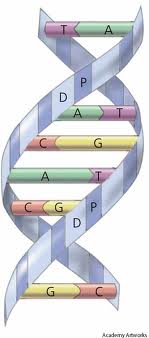
Name B. (a)  

Choose from the below words
phosophate
glucose
deoxyribose
nitrogen base
5.

What type of punnett square? (a)  

Choose from the below words
codominance
incomplete dominance
complete dominance
sex linked recessive
6.

Widow's peak is dominant to straight hair line. Cross a heterozygous widow's peak female with a heterozygous widow's peak male. What is the genotype ratio? (a)  

Choose from the below words
1:2:1
3:1
1:1
1:0
7.

According to the diagram, when did the common ancestor of giant pandas and spectacled bears exist?  (a)  

Choose from the below words
5-10 mya
10-15 mya
15-20 mya
20-25 mya
8.
Prokaryotes used to be classified as a single kingdom. New technology allowed them to be split into...
(a)  
Choose from the below words
Eubacteria and Archaea
species
phylum
genus
9.
Which list includes only structures that would be found in a prokaryotic cell? 
a)
Cell wall, plasma membrane, mitochondria
b)
Central vacuole, cell wall, lysosome
c)
Cell wall, plasma membrane, cytoplasm
d)
Plasma membrane, nucleus, mitochondria
10.
Which of the following statements vest describes the cell cycle? 
a)
Interphase is the reproductive phase, mitosis is the growth phase
b)
Interphase is the growth phase, mitosis is the reproductive phase
c)
Cytokinesis is the growth phase, S-phase is the reproductive phase
d)
Cytokinesis is the reproductive phase, S-phase is the growth phase
11.

What is the function of this molecule in organisms?  (a)  

Choose from the below words
Storage of genetic information
Structure and support
Short term energy storage
Long term energy storage
12.
Which best describes the function of enzymes?
a)
to speed up chemical reactions in a cell
b)
to produce cellular energy
c)
to produce proteins
d)
to speed up cell division
13.
Which factor determines the shape and function of a protein?
a)
The density of ribosomes in the cell
b)
The peptide bonds between amino acids
c)
The order of the amino acids in the peptide chian
d)
The sequence of the phosphate molecules in the DNA chain. 
14.

What are the products of photosynthesis?  (a)  

Choose from the below words
glucose and oxygen
glucose and carbon dioxide
glucose and water
water, carbon dioxide, and energy
15.

Which process uses ATP to move materials across the plasma membrane against the concentration gradient? (a)  

Choose from the below words
passive transport
active transport 
facilitated diffusion
osmosis
16.

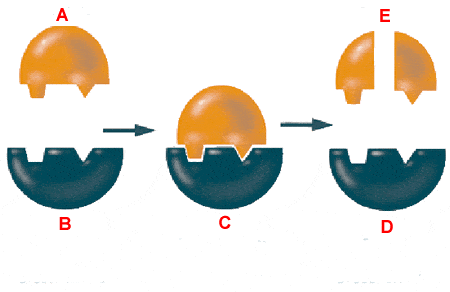
Which process of the carbon cycle removes carbon dioxide from the atmosphere?  (a)  
Choose from the below words
photosynthesis
cellular respiration
combustion of fossil fuels 
death and decomposing organisms 
17.

Enzymes catalyze reactions by (a)   Activation Energy.

Choose from the below words
Increasing
Decreasing
18.

An experiment is performed on plants to see how different liquids affect plant growth. Each plant in the experiment is given a different liquid; water, apple juice, or milk. Each plant has the same amount of soil, sunlight, and listens to the same music. In this investigation, the independent variable is ...

a)

type of liquid

b)

growth

c)

soil

d)

light

19.
The amount of energy that usually transfers from one trophic level to the next...
a)

10%

b)

90%

c)

50%

d)

25%

20.

Which of the following converts food into energy for the cell? (a)  

Choose from the below words
vacuole
mitochondria
cytoplasm
cell membrane
21.
What is something that prokaryotic and eukaryotic cells have in common?
a)
They have a nucleus. 
b)
They are multi-cellular. 
c)
They have DNA. 
d)
They have organelles that are membrane-bound.
22.

Active transport does not require energy. (a)  
Choose from the below words
True 
False 
23.

Which 2 molecules forms the sides (backbone) of the DNA ladder? (a)  

Choose from the below words
deoxyribose and adenine
deoxyribose and a hydrogen bond
sugar and the nucleus
deoxyribose (sugar) and phosphate
24.

These molecules represent which organic molecule? (a)  

Choose from the below words
proteins
lipids
nucleic acids
carbohydrates
25.

In this image, the cell is using which type of molecular transport? (a)  

Choose from the below words
Osmosis
Diffusion 
Endocytosis
Exocytosis 
26.

What are the two reactants of cellular respiration? (a)  

Choose from the below words
C6H12O6 & 6CO2
6 CO2 & 6H2O
C6H12O6 & 6O2
6CO2 & 6O2
27.

Name structure #5. (a)  

Choose from the below words
rough ER
nucleus
vesicle
cytoplasm
28.
What is one advantage of sexual reproduction?
a)
offspring are identical to parents
b)
offspring are resistant to viruses
c)
offspring are born live, rather thna from eggs
d)
offspring inherit a wider variety of genetic information
29.

Replicate the following strand of DNA: AATCATGGA (a)  

Choose from the below words
AATCATGGA
TTAGTACCT
UUAGUACCU
GGATAUCUA
30.

Colorblindness is a recessive, X chromosome sex-link disorder. Cross the parents to figure out which percentage of their offspring will be colorblind. (a)  

Choose from the below words
25%
0%
75%
50%
31.

What fraction of offspring from the cross AaBB x Aabb will be heterozygous for both traits? (a)  

Choose from the below words
1/16
4/16
8/16
3/16
32.

What is the purpose of Strand A?

a)

to act as a template for the synthesis of messenger RNA

b)

to carry the code from the DNA molecule in the nucleus to the ribosome

c)

picks up and transfers specific amino acids to the ribosome

d)

picks up and transfers nucleic acids to the nucleus

33.

What mRNA sequence will best match the section of DNA shown? (a)  

Choose from the below words
C-T-A-G-G-C
C-U-A-G-G-A
A-G-C-U-U-C
T-C-G-A-A-G
34.

What is the main purpose of the structure labeled D in the diagram above?

a)

Bring the amino acid to the ribosome

b)

Assemble the amino acids into a protein

c)

Copy the DNA strand

d)

Edit the mRNA strand

35.

The diagram above represents a biochemical process that occurs in a cell. The purpose of this process is to synthesize - (a)  

Choose from the below words
deoxyribonucleic acid
protein
messenger RNA
carbohydrate
36.

Use the mRNA codon chart to identify Amino Acid 1 in the given picture. (a)  

Choose from the below words
Isoleucine
Tyrosine
Methionine
Serine
37.

A mutation has occurred in a mRNA fragment that was originally CUU. Using the codon chart given above, which of the following mutated mRNA fragments would result in an amino acid sequence different from that produced by the CUU fragment? (a)  

Choose from the below words
CUC
CUA
CUG
CAU
38.
An insertion of a DNA base into a gene can affect an organism by—
a)
causing future gametes to have additional chromosomes.
b)
changing the sequence of amino acids in a protein.
c)
causing chromosome fragments to form long chains.
d)
changing the structure of ribose sugar in nucleic acids.
39.
Nitrogenous bases are located on both strands of the DNA double helix. What is the significance of the nitrogenous bases?
a)
The number of adenines and cytosines determines the type of RNA that will be produced.
b)
The order of nitrogenous bases determines the order of amino acids in the proteins synthesized.
c)
The amount of thymine and guanine in the DNA molecules determines the length of the genes.
d)
The type of hydrogen bonding between the nitrogenous bases determines which amino acid will be added to the peptide chain.
40.
A model of a biological process is shown. What is the purpose of this process?
a)
To replicate the DNA of an organism before cell division
b)
To assemble nucleotides in an mRNA chain along a DNA template
c)
To synthesize amino acids used to unzip strands of DNA and copy the genetic code
d)
To translate the genetic code into a specific sequence of amino acids
41.

What molecule is this (a)  

Choose from the below words
sucrose
protein
glucose
cellulose
42.
Which of these is NOT true?
a)
Enzymes can denature (change shape) when the temperature gets too high.
b)
Enzymes can only be used once in a chemical reaction. 
c)
Extreme pH can denature enzymes.
d)
Enzymes speed up chemical reactions. 
43.
How do enzymes increase the speed of chemical reactions?
a)
reducing the number of products   
b)
reducing the activation energy
c)
increasing the temperature of the cell
d)
increasing the concentration of reactants 
44.
The cell below is in a (a)   solution.
Choose from the below words
Hypertonic
hypotonic
isotonic
45.

What is the role of the pioneer species in Primary Succession?

a)

To kill any remaining organisms from before the disturbance

b)

To break down rock and rebuild soil

c)

To provide food for large animals

d)

To put fresh oxygen into the air

46.

What are some abiotic factors that could be limiting factors in the Iowa River ecosystem?

a)

Temperature, fertilizer runoff from fields, drought or flood

b)

Invasive species, floods

c)

Temperature, predators, droughts, floods, over fishing

47.

An offspring will receive how many alleles from each parent to determine a specific trait? (a)  

Choose from the below words
one
two
three
five
48.

In the graph to the right, what is the population of deer at the carrying capacity of the environment?

49.

What does the graph represent? (a)  

Choose from the below words
Emigration
Exponential growth
Immigration
Logistic Growth
50.

Provides support and protection for the cell, while also controlling the movement of materials in and out of the cell. (a)  

Choose from the below words
Cellular Membrane
Nucleus
Ribosomes
Vacuole
51.

What type of transport is illustrated? (a)  

Choose from the below words
facilitated diffusion
active transport
diffusion
osmosis
52.
What will most likely be the result if all of the mitochondria are removed from a plant cell? 
a)
It will be unable to carry out respiration. 
b)
It will lose water through osmosis. 
c)
It will break down the ribosomes in the cell. 
d)
It will be unable to photosynthesize
53.

Fruit fly body cells have 8 chromosomes. After mitosis, you would expect a resulting fruit fly daughter cell to have (a)  

Choose from the below words
16 chromosomes.
46 chromosomes.
8 chromosomes.
4 chromosomes.
54.

Structure B is pointing to the (a)  

Choose from the below words
chromosome
centromere
DNA
chromatid
55.

Is the following cell diploid or haploid? (a)  

Choose from the below words
Diploid
Haploid
56.

Which species’ DNA is most similar to the DNA of the toothed whale?  (a)  

Choose from the below words
Hippopotamus 
Baleen Whale
Grazing Mammals
Camels
57.

The white feathers of a snowy owl allow it to blend in with its environment during the winter months (snow). This is an example of (a)  

Choose from the below words
Species
Environmental Change
Adaptation
Variation
58.
What is the advantage of having different shaped beaks?
a)
To look different from other species.
b)
To be able to eat the food readily available in the environment.
c)
To protect itself against predators.
d)
To protect itself against prey.
59.

Which type of cell has no nucleus? (a)  

Choose from the below words
Eukaryote
Prokaryote
Animal
Plant
60.

Which type of cell? (a)  

Choose from the below words
Prokaryote
Eukaryote
61.

What is another name for natural selection? (a)  

Choose from the below words
survival of the smartest
survival of the fastest
survival of the biggest
survival of the fittest
62.

What is a change in an organism that allows for it to survive in its environment? (a)  
Choose from the below words
homologous
vestigial
variation
adaptation
63.

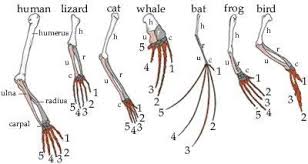
What is this an example of? (a)  

Choose from the below words
vestigial structures
embryology
homologous structures
fossil record
64.
Which layer is the oldest?
65.

This is a structure that was inherited but has lost most of its original function (a)  

Choose from the below words
homologous
analogous
vestigial
homozygous
66.

These structures share a common function but not structure ex) the wing of a bird and the wing of an insect (a)  

Choose from the below words
homologous
analogous
vestigial
homozygous
67.

This is a result of the organism's genetic variability, ability to reproduce and natural selection. (a)  

Choose from the below words
natural selection
evolution
fertility
genetics
68.
What property of water makes it the 'universal solvent'?
a)
it is a polar molecule
b)
it is an ionic compound
c)
it contains hydrogen bonds
d)
it steals electrons from other atoms
69.
Carbohydrates are made of... 
(a)  
Choose from the below words
C H O
CHON
CHONP
70.
Glucose is a (a)   .
Choose from the below words
carbohydrate
PROTEIN
LIPID
AMINO ACID
71.

Proteins are composed of what smaller building blocks? (a)  

Choose from the below words
amino acids
nucleic acids
fatty acids
nucleotides
72.

Which group of organic molecules serve as long-term energy storage and make the cell membrane is? (a)  

Choose from the below words
proteins
carbohydrates
lipids
nucleic acids
73.

The primary purpose the body uses monosaccharides for is? (a)  

Choose from the below words
Building muscles
Helping the Immune System
Immediate Energy
Generating Heat
74.

Attractions between water molecules are called (a)  

Choose from the below words
Covalent bonds
Ionic bonds
Polar bonds
Hydrogen bonds
75.

Phospholipids have a _________ head and a __________ tail.

(a)  

76.

Enzymes are (a)   that (b)   chemical reactions.
Choose from the below words
proteins, slow down
proteins, speed up
lipids, slow down
lipids, speed up
77.

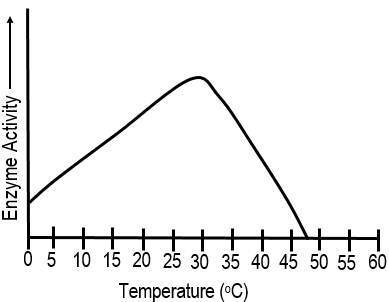
Based on the graph, what temperature does this enzyme work best?  (a)  

Choose from the below words
15 C
40 C
30 C
78.

Which of the following binds to the active site of an enzyme?  (a)  

Choose from the below words
substrate
product
codon
none of the above
79.

Enzymes _ activation energy (a)  

Choose from the below words
raise
lower
80.
What happens when enzymes are heated to a high temperature?
a)
The enzymes die.
b)
The shapes of the enzyme are altered or denatured
c)
The enzymes' amino acid sequence changes.
d)
The enzymes remain the same
81.
A scientist performs an experiment to see if acids have an effect on the health of a particular type of plant. Three sets of plants were treated with acidic solutions of known pH while the control set was treated with a solution of neutral pH 
Which is the best conclusion for this experiment? 
a)
Acid has no effect on the health of this type of plant
b)
 High acidity is helpful to this type of plant.
c)
Low acidity is harmful to this type of plant.
d)
High acidity is harmful to this type of plant.
82.
How do human diseases caused by bacteria and diseases caused by viruses react to antibiotics? 
a)
Neither responds to antibiotics.
b)
Both respond to antibiotics.
c)
Viral diseases respond to antibiotics; bacterial diseases do not.
d)
Bacterial diseases respond to antibiotics; viral diseases do not.
83.
Which of the following best compares the structures of lipids and carbohydrates?
a)
both are made of monosaccharide monomers but lipids are hydrophobic and carbohydrates are hydrophilic
b)
both consist of carbon hydrogen and oxygen, but carbohydrates have repeating structural units and lipids do not
c)
both contain carbon and hydrogen, but carbohydrates also contain oxygen while lipids contain nitrogen
d)
both have a carbon backbone, but lipids have an amino group and carbohydrates have a carboxylic acid group
84.
Which of the following best describes the differences in function between enzymes and nucleic acids?
a)
nucleic acids are the building blocks of proteins while enzymes are used as the building blocks of phospholipids
b)
nucleic acids contain the genetic code for protein synthesis, while enzymes catalyze chemical reactions
c)
nucleic acids inhibit chemical reactions, while enzymes provide structural support in cells
d)
nucleic acids transmit signals that begin biochemical reactions, while enzymes convert carbohydrates to lipids and proteins
85.
During transcription the DNA base sequence is transcribed into a complimentary mRNA sequence. A codon table like the one shown below lists the amino acids coded for by particular triads of mRNA bases. A segment of DNA has undergone a mutation in which one nucleotide has been changed. The original sequence was ACG and the new sequence is ACA. Use the codon table to determine whether or not this mutation will cause a change in the phenotype of the organism
a)
yes, the phenotype of the organism would change because a new amino acid will be coded for.
b)
yes, the phenotype of the organism would change because any change in the DNA sequence will cause a change in phenotype.
c)
Even though the DNA sequence changed, the sequence still codes for the same amino acid, so no change in phenotype will occur.
d)
It is impossible to determine if a change in phenotype will occur using only the DNA sequence.
86.
While genetic engineering has positive benefits, there are also concerns associated with widespread use of genetic engineering in agriculture. If many farmers begin to plant more genetically modified crops that have an increased tolerance to insects, which of the following may result?
a)
an increase in the use of pesticides
b)
a decrease in the genetic diversity of crops
c)
an increase in the contamination of water supplies
d)
a decrease in crop productivity
87.
Before mitosis begins, which happens before the nucleus starts dividing?
a)
The cytoplasm separates.
b)
The DNA replicates. 
c)
The sister chromatids separate. 
d)
The homologous chromosomes cross over. 
88.
What is the function of autotrophs in the carbon cycle?
a)
to use oxygen to produce glucose 
b)
to take in excess water
c)
to use carbon dioxide to produce glucose
d)
to feed on herbivores 
89.

Two different populations of birds live in the same area and eat the same types of food. Which most likely describes the relationship between these two populations of birds?  (a)  

Choose from the below words
competition
mutualism
parasitism
predator-prey
90.
What will most likely happen if the human population continues to grow at current rates?
a)
There will be fewer natural resources available for future generations.
b)
There will be an increase in nitrogen levels in the atmosphere. 
c)
There will be a decrease in water pollution. 
d)
There will be an increase in the number of strong hurricanes. 
91.

This cell is undergoing mitosis.  What stage of mitosis is shown? (a)  

Choose from the below words
prophase
metaphase
anaphase
telophase
92.

The ability to taste a bitter chemical called PTC is a dominant trait in humans.  The Punnett square below shows a cross between two parents who are heterozygous for the ability to taste this chemical.  What is the probability, expressed as a percentage, that these parents will produce an offspring who is homozygous recessive for the tasting trait? (a)  

Choose from the below words
0%
25%
50%
75%
93.
The diagram summarizes two stages in the production of the specialized cells used for sexual reproduction.
What happens in the stage labeled "process 2"?
a)
The chromosomes cross over.
b)
Th chromosomes number is reduced by half.
c)
The chromosomes move to opposite end of the cell.
d)
Four identical gametes form.
94.
The diagram shows a container divided into two compartments by a membrane permeable to water but not to starch. Two solutions containing different concentrations of dissolved starch were placed on each side of the membrane. Which of the following describes what will happen to the water level during the process of osmosis?  
a)
The water level of both sides of the membrane will decrease 
b)
The water level on the right side of the membrane will increase 
c)
The water level on the left side of the membrane will increase
d)
The water level on both sides of the membrane will stay the same 
95.
An animal cell placed in a sugar solution is shown in the diagram. Which statement best describes how osmosis will affect this animal cell?  
a)
Water will move out of the cell and the cell will shrink
b)
Water will move into the cell and the cell will expand 
c)
Sugar will move out of the cell and the cell will expand 
d)
Sugar will move into the cell and the cell will expand
96.

The stages of the cell cycle are shown in random order below.  Starting with prophase, sequence the diagrams to show the stages of mitosis.                           (a)  

Choose from the below words
5-3-1-2-4
3-1-4-2-5
4-1-2-5-3
2-3-1-5-4
97.
What is the diploid number of chromosomes in the above diagrams?   
a)
2
b)
4
c)
6
d)
8
98.

The diagrams show the stages of mitosis in random order.  What sequence correctly shows the stages of mitosis?              (a)  

Choose from the below words
3-1-2-4
1-3-4-2
4-2-3-1
2-1-4-3
99.
A daughter cell that resulted from a mitotic division has 24 chromosomes.  How many chromosomes did the parent cell have?   
a)
6
b)
12
c)
24
d)
48
100.
A bone cell of a goat contains 60 chromosomes.  How many chromosomes will be in each daughter cell after mitosis? 
a)
15
b)
30
c)
60
d)
120
101.

The 1918 influenza epidemic killed between 50 million and 100 million people worldwide. THis epidemic happened near the end of World War I. More people died from the influenza epidemic than were killed in the war. Which of the following explains why this virus was so deadly worldwide?

a)

Infected soldiers returning from the war spread the virus when they coughed.

b)

Food was scarce because of the war, so people were undernourished, and their immune systems were weakened.

c)

Medical personnel often became ill as a result of exposure to airborne virus particles.

d)

All of the above

102.

The diagram represents one way an enzyme can be inhibited. Which statement explains the effect of an inhibitor on an enzyme?

a)

A substrate will be able to bond with the enzyme.

b)

The enzyme will likely be attacked by immune cells

c)

The enzyme will be unable to produce more enzymes.

d)

A substrate will be unable to attach to the enzyme.

103.

In the early 1900s a scientist hypothesized a link between DNA and the production of protein in the cytoplasm. However, the fact that DNA could not be found outside the nucleus led scientists to believe that another substance was also involved in the synthesis of protein in the cytoplasm. In the 1940s scientists performed an experiment that ultimately identified the site of protein synthesis. They also identified the molecule responsible for transporting information from the nucleus to the site of protein synthesis. What was the newly identified molecule? (a)  

Choose from the below words
a gene
mRNA
ATP
thymine
104.

Which statement best describes the relationship between the products of photosynthesis and the reactants in cellular respiration?

a)

The products of photosynthesis serve as the reactants in cellular respiration to provide chemical energy.

b)

The products of photosynthesis combine with the reactants in cellular respiration to remove ATP from cells.

c)

The products of photosynthesis inhibit the reactants in cellular respiration in the presence of light.

d)

The products of photosynthesis change the structure of the reactants in cellular respiration in the presence of light.

105.

Several structures work together to allow flowering plants to reproduce. The diagram shows a typical flower. Which table correctly identifies the function of each structure or group of structures in the reproduction of the plant?

a)
b)
c)
d)
106.

Kidneys are part of the excretory system in a human body. They purify the impure blood and send it back to the rest of the body. Which system is mainly responsible for the transport of plasma to the kidneys? (a)  

Choose from the below words
Respiratory system
Circulatory system
Muscular system
Nervous system
107.

The function of a (a)   is to absorb water, store food, and anchor plants. 

Choose from the below words
phloem
tissue
xylem
root
108.

Transports water and nutrients UP from the soil through all parts in the plant. Involved in transpiration. (a)  
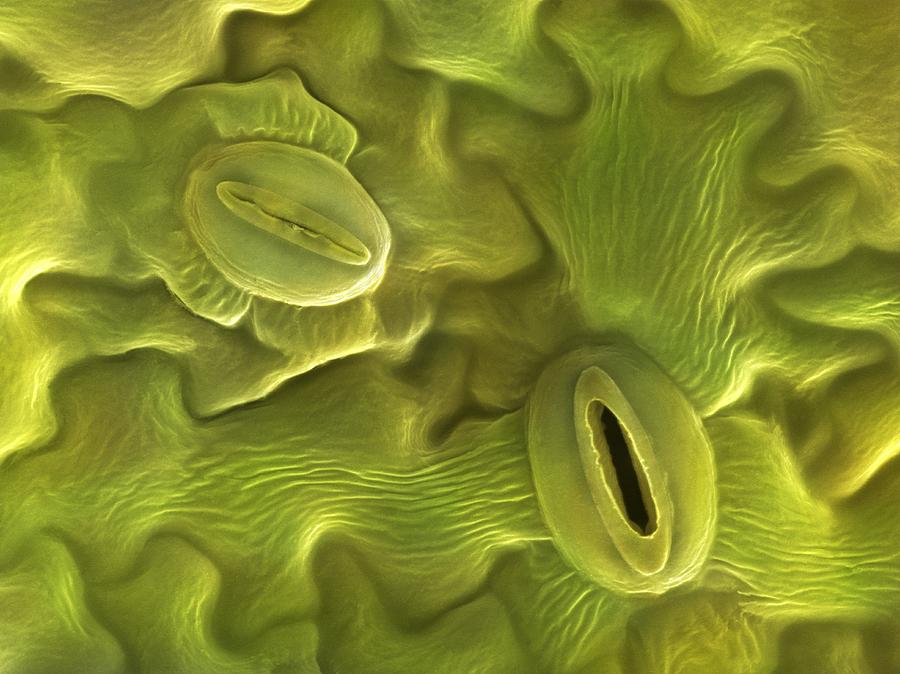
Choose from the below words
xylem
phloem
stomata
roothair 
109.

What is the structure in the picture? (a)  

Choose from the below words
Stomata
Leaves
Roots
Vascular tissue
110.
A pond ecosystem is shown in the diagram below. Which statement describes an interaction that helps maintain the dynamic equilibrium of this ecosystem?
Which statement describes an interaction that helps maintain the dynamic equilibrium of this ecosystem?
a)
The frogs make energy available to this ecosystem through the process of photosynthesis.
b)
The algae directly provide food for both the rotifers and the catfish.
c)
The green-backed heron provides energy for the mosquito larvae.
d)
The catfish population helps control the populations of water boatman and waterfleas.
111.

According to the food web, which of these supply energy for all the other organisms?      (a)  

Choose from the below words
snakes
insects
grasses
cougars
112.

The number of species within a specific habitat. (a)  
Choose from the below words
Conservation
Sustainable development
Biodiversity
Preservation
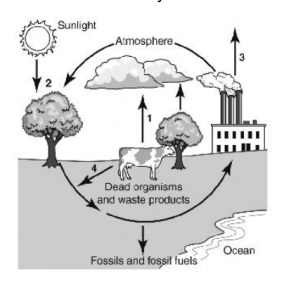
113.
What is happening at 1?
a)
respiration: releasing CO2
b)
decomposing CO2 in the soil
c)
photosynthesis: absorbing CO2
d)
turning CO2 from the atmosphere into organic molecules
114.
Why does secondary succession have more species diversity than primary succession?
a)
There is no species diversity.
b)
Secondary succession has more species diversity due to the lack of soil.
c)
Secondary succession has more species diversity due to the microorganisms that survived in the soil.
d)
Primary succession ALWAYS has more species diversity.
115.

Which of the following are missing from the food web shown above? (a)  

Choose from the below words
producers
decomposers
omnivores
carnivores
116.

Which is the most important criteria for a hypothesis to be useful in science? (a)  

Choose from the below words
It is correct.
It is testable.
It can be observed.
It can be measured.
117.

Look the the cross below.Yy x YyIn this cross, two yellow seed plants are crossed. What are the genotypes for the offspring in this cross? (a)  

Choose from the below words
Yy, Yy, Yy, Yy
YY, Yy, Yy, yy
YY, YY, Yy, Yy
YY, YY, YY, YY
118.

Which process produces the most variation within a species?  (a)  

Choose from the below words
Asexual reproduction
Sexual reproduction
mitosis
cloning
119.

Which technique would most likely be used by forensic scientists? (a)  

Choose from the below words
gene cloning
gene therapy
DNA fingerprinting
karyotyping
120.
The use of pesticides on crops has been a common farming practice for decades. What has been the greatest effect of natural selection through the use of pesticides on certain insect populations? 
a)
Natural selection has been altered because the insects and their predators are killed. 
b)
The rate of selection is increased because the pesticides do not kill the insects that are naturally resistant to it. 
c)
The rate of selection has decreased because the pesticides kill only young insects. 
d)
The pesticides have altered natural selection by causing the insect DNA to spontaneously mutate.
121.
A freshwater plant is placed in a container of saltwater. What will most likely happen to the cells of the plant?
a)
They will swell because water will move into them.
b)
They will swell because salt will move into them
c)
They will shrink because water will move out of them.
d)
They will shrink because salt will move out of them.
122.

During which phase of the cell cycle is the cell growing and preparing for cellular division?  (a)  

Choose from the below words
cytokinesis
anaphase
prophase
interphase
123.

This organelle would NOT be found in animal cells. (a)  

Choose from the below words
cell membrane
nucleus
lysosome
chloroplast
124.

During which phase of the cell cycle is DNA replicated? (a)  

Choose from the below words
G1 phase
S phase
G2 phase
M phase
125.

What phase of mitosis is shown in the picture? (a)  

Choose from the below words
Prophase
Metaphase
Anaphase
Telophase
126.

This diagram shows the cell cycle.Which of the following activities occur in the G1 phase? (a)  

Choose from the below words
Replication of the DNA
Growth of the cell
Formation of the mitotic spindle
Breakdown of the nuclear membrane
127.
a)
Prophase
b)
Anaphase
c)
Telophase
d)
Interphase
128.

What concept do these diagrams illustrate?

a)

the abiotic factors of an environment

b)

the biological adaptations of animals

c)

the flow of energy through an ecosystem

d)

the population of organisms within a habitat

129.

Which of the following best describes the bluebird in the food chain? (a)  

Choose from the below words
decomposer
primary consumer
producer
secondary consumer
130.

When an area of a chromatid is exchanged with the matching area on a chromatid of its homologous chromosome, (a)   occurs

Choose from the below words
Crossing over
Mutagenesis
Hybridization
Fertilization
131.
What does the peak of the dotted line represent?
a)
energy of the products
b)
reaction progress
c)
activation energy without a catalyst
d)
activation energy with a catalyst
132.

The graph represents a reaction before and after the addition of an enzyme.

According to the graph, the addition of the enzyme

a)

lowered the overall energy change in the reaction

b)

decreased the amount of product produced

c)

increased the potential energy of the products.

d)

lowered the activation energy needed to speed up the reaction.

133.

Having freckles is dominant over not having freckles. If two individuals heterozygous for freckles have a child, what is the probability the child will have freckles? (a)  

Choose from the below words
0%
25%
50%
75%
134.

Some marine worms and mollusks go through similar larval stages during development. Which can be inferred about their relationship? (a)  

Choose from the below words
They share a common ancestor
The mate with each other
They compete for a habitat
The share the same food source
135.

Which statement best describes natural selection?

a)

As the weather changes, organisms that are able to find shelter need less energy to live.

b)

Organisms that eat only plants need less food than organisms that eat animals.

c)

Organisms better adapted to their environment are more likely to reproduce and pass on their traits to their offspring.

d)

Small organisms are more likely to survive than larger organisms.

136.

Some scientists claim recent evidence suggests birds should be reclassified to share more taxonomic groups with dinosaurs. What type of evidence would provide the best support for this claim?

a)

evidence showing birds shared similar habitats with dinosaurs

b)

evidence showing birds shared similar nutritional requirements as dinosaurs

c)

evidence showing birds shared similar behaviors with dinosaurs

d)

evidence showing birds shared a common genetic history with dinosaurs

137.

Which statement best explains how sweating during exercise maintains homeostasis?

a)

It regulates mineral concentrations in cells

b)

It regulates body temperature

c)

It maintains water balance

d)

It maintains sugar balance in cells

138.

Which statement best explains why animals are considered heterotrophic?

a)

They are able to produce food through the process of photosynthesis.

b)

They are able to produce food through the process of respiration.

c)

They are able to obtain nutrients by decomposing plant and animal tissue.

d)

They are able to obtain nutrients by consuming other organisms or their products

139.

What will most likely be the result as humans move into new areas, forests are clear cut and housing developments are built?

a)

Global temperatures will decrease because trees are removed.

b)

Many organisms will lose their homes because their habitats have been destroyed.

c)

Better sanitation in the area will reduce the amount of pollution.

d)

The rainfall in the area will increase because there will be increased runoff.

140.

Which process can occur in both mitosis and meiosis? (a)  

Choose from the below words
fertilization
independent assortment
gene mutation
crossing over
141.

What is the difference between the DNA of a dog and the DNA of a fly? (a)  

Choose from the below words
the type of sugar building blocks
the sequence of nucleotides
the strength of hydrogen bonds
the strength of covalent bonds
142.

Which graph best illustrates the growth of a population introduced into an environment with limited resources?

a)
b)
c)
d)
143.

Which will most likely result in a negative growth rate in the human population of a country?

a)

The death rate is higher than the birth rate

b)

The birth rate is higher than the death rate

c)

The country has improved economic conditions

d)

The country has made improvements in sanitation

144.
An analysis of DNA and RNA sequences can be used to classify organisms. A dendrogram/evolutionary tree, such as the one shown below, is based on molecular data. It can be used to represent evolutionary relationships within a group of organisms that are hypothesized to have descended from a common ancestor.
Which statement is best supported by the information in this dendrogram/evolutionary tree? 
a)
Lesser pandas are more genetically similar to giant pandas than they are to raccoons.
b)
Brown bears are more genetically similar to giant pandas than they are to sun bears.
c)
Lesser pandas are more genetically similar to raccoons than they are to giant pandas.
d)
The bear species are all more genetically similar to dogs than they are to giant pandas.
145.
Below is the illustration of the bones of the forelimbs (wing or arm) of three animals. While only birds and bats have wings, the underlying skeletal structure is more similar in bats and humans.
What is the most reasonable conclusion one can draw from a comparison of these structures?
a)
Birds and bats are closely related to each other, while humans are unrelated to both.
b)
The common ancestor of birds and bats must have had wings and flown.
c)
Humans live in habitats very different from the habitats of both birds and bats.
d)
Humans and bats share a closer evolutionary history with each other than with birds.
146.

Which process results in greater genetic diversity in offspring?

a)

genetic linkage

b)

recombination of DNA during meiosis

c)

crossing-over during mitosis

d)

rearrangement of chromosomes in germ cells

147.
Genetic drift is change in the allele frequency of a population due to...
(a)  
Choose from the below words
random chance
natural selection
non-random mating (sexual selection)
artificial selection
148.

This mechanism of evolution occurs when populations migrate. (a)  

Choose from the below words
Extinction
Gene flow
Genetic drift
Natural Selection
149.
Which of the following cannot introduce new alleles into a population's gene pool?
a)
Mutataion
b)
Natural selection
c)
Gene Flow
d)
All of the above introduce new alleles into the population
150.

Inherited trait that helps an organism survive is a(n) (a)   .

Choose from the below words
Fossil
Adaptation
Ancestor
Natural selection
151.
Which of the following is an example of the founder effect?
a)
Bald Eagles are hunted until near extinction, population recovers.
b)
Small group of iguanas floats to an island, starts a new population.
c)
Red fox pups are more likely to survive in a snowy environment if they are born white.
d)
Farmer chooses seeds from largest apples to plant next year.  This results in larger apples from year to year.