
 Worksheets
AP Biology Review
Total questions: 113
Worksheet time: 1hrs 8mins
Name
Class
Date
1.
1. If the water potential of a cell is higher than the surrounding solution. The water will ____.
a)
Move into the cell.
b)
Move equally in and out of the cell.
c)
Move out of the cell.
2.
Pure water has a water potential of ___.
a)
1
b)
0
c)
-1
d)
100
3.

Carrot and potato cores were placed in various sucrose solutions for 24 hours and the % change in mass was recorded and graphed. The temperature in the room was 24 degrees celcius. Sucrose is too large of a molecule to cross the membrane of potato and carrot cells. Which molecule caused the change in mass?
a)
water
b)
sucrose
c)
salt
d)
glucose
4.
Carrot and potato cores were placed in various sucrose solutions for 24 hours and the % change in mass was recorded and graphed. The temperature in the room was 24 degrees celcius. Sucrose is too large of a molecule to cross the membrane of potato and carrot cells. Which molecule caused the change in mass?
a)
water
b)
sucrose
c)
salt
d)
glucose
5.
Carrot and potato cores were placed in various sucrose solutions for 24 hours and the % change in mass was recorded and graphed. The temperature in the room was 24 degrees celcius. Identify the approximate concentration of sucrose in the potato cells.
a)
0.13 M
b)
0.0 M
c)
0.4 M
d)
0.33 M
6.
A sucrose solution in a beaker has a solute potential of -4 bars. A cell with a solute potential of -2 bars is placed in the beaker. What will be the direction for the net movement of water?
a)
into the cell
b)
out of the cell
c)
there will be no net movement
7.

What is the approximate sucrose concentration in the potato core?
a)
.43 M
b)
.30 M
c)
0.0 M
d)
1.0 M
8.

The cell below is in a _________ solution.
a)
Hypotonic
b)
Hypertonic
c)
Isotonic
9.

The cell below is in a _____________ solution.
a)
Hypertonic
b)
Hypotonic
c)
Isotonic
10.

Hydrophobic region of the cell membrane?
a)
E
b)
B
c)
C
d)
A
11.
Hydrophilic means...
a)
water-loving
b)
water-fearing
c)
nonpolar
d)
lipid soluble
12.

When cells are placed in a __________ solution they begin to swell.
a)
Hypertonic
b)
Isotonic
c)
Hypotonic
d)
Equalized
13.
The movement of molecules against a concentration gradient
a)
simple diffusion
b)
facilitated diffusion
c)
active transport
d)
osmosis
14.
A saltwater snail is placed in freshwater. What happens to its cells?
a)
They shrink
b)
They swell
c)
Nothing happens
15.

The sodium-potassium pumps requires energy to move ions across the cell membrane against their concentration gradient so it is a type of
a)
active transport
b)
osmosis
c)
diffusion
d)
facilitated diffusion
16.
The tails of a phospholipid are...
a)
Nonpolar
b)
Polar
17.
The tails of a phospholipid are...
a)
Hydrophobic
b)
Hydrophilic
18.
How many layers make up the phospholipid bilayer?
a)
1
b)
2
c)
3
d)
4
19.
When looking at the cell membrane, where are the lipid tails located?
a)
Inner part of the bilayer
b)
Outer part of the bilayer
c)
At the end of the bilayer
d)
Goes through each end of the bilayer
20.
What forms the channels and pumps in the phospholipid bilayer?
a)
carbohydrates
b)
proteins
c)
hydrophilic heads
d)
lipids
21.
Phospholipid heads are...
a)
Hydrophobic
b)
Hydrophilic
22.
_____ contain both a hydrophobic and a hydrophilic region.
a)
Phospholipids
b)
Molecules
c)
Lipids
d)
Cell wall
23.

How many degrees of freedom will be present?
a)
4
b)
5
c)
6
d)
7
24.

Observed in the wild are 10 circles, 20 squares and 30 triangles. The ratio for this particular population is 2:3:5
observed: 10 circles expected: 12
observed 20 squares expected : 18
observed 30 triangles expected: 30
Chi square + 5.96
Would you accept or reject?
observed: 10 circles expected: 12
observed 20 squares expected : 18
observed 30 triangles expected: 30
Chi square + 5.96
Would you accept or reject?
a)
accept
b)
reject
25.

What are the degrees of freedom?
a)
3
b)
2
c)
1
d)
9.488
26.
What body system is the slow-acting control system using hormones?
a)
Endocrine
b)
Exocrine
c)
Nervous
d)
Integumentary
27.
What hormone reduces blood sugar?
a)
Insulin
b)
Glucagon
c)
PTH
d)
Calcitonin
28.
What hormone increases blood sugar?
a)
Insulin
b)
Glucagon
c)
PTH
d)
Calcitonin
29.
_______ stimulates follicle development (ovaries) or stimulates sperm production (testes).
a)
FSH
b)
LH
c)
TSH
d)
ADH
30.
Which gland produces insulin and glucagon?
a)
Anterior pituitary
b)
Posterior pituitary
c)
Pancreas
d)
Adrenal
31.
What is the principle that defines evolution in terms of allele frequency
a)
Natural Selection
b)
Convergent Evolutions
c)
Directional Selection
d)
Hardy -Weinberg
32.
Which condition is not part of Hardy -Weinberg principle
a)
random mating
b)
no genetic drift
c)
no gene flow
d)
mutations
33.
In the Hardy Weinberg equation, q2
a)
heterozygous
b)
homozygous dominant
c)
homozygous recessive
34.

A measure of how commonly a particular allele occurs in a population is known as the
a)
gene pool
b)
allele frequency
c)
mutation rate
d)
phenotype
35.

Genetic variation can arise from a random change in the DNA of a gene. The change is called a(n)
a)
mutation
b)
gene flow
c)
gene pool
d)
allele
36.
Combined alleles of all individuals in a population is called
a)
phenothype
b)
gene pool
c)
mutation rate
d)
allele frequency
37.
Group of organisms all of the same species, living in the same place at the same time.
a)
gene pool
b)
population
c)
species
d)
evolution
38.
A horse and a donkey can successfully mate to produce offspring known as a mule. Mules are sterile . Would mules be classified as a species?
a)
Yes, mules have enough of their own traits to be considered a species.
b)
Yes, the fact that have different number of chromosomes makes them a different species
c)
No, mules are too similar to the parent species
d)
No, due to their inability to reproduce successfully.
39.
What type of genetic drift occurs when the population size is greatly decreased?
a)
Founder's Effect
b)
Bottleneck Effect
c)
Intrasexual Selection
d)
Intersexual Selection
40.
Which of the following is an example of the founder effect?
a)
Bald Eagles are hunted until near extinction, pop recovers
b)
Small group of iguanas floats to an island, starts a new pop
c)
Environ of red fox pop now snowy, gen later pop is all white
d)
farmer chooses seeds from largest apples to plant next gen.
41.

What type of selection?
a)
Directional
b)
Stabilizing
c)
Disruptive
42.

What type of selection?
a)
Directional
b)
Stabilizing
c)
Disruptive
43.

What type of selection?
a)
Directional
b)
Stabilizing
c)
Disruptive
44.
Robins typically lay fours eggs. If more then four eggs are produced then the baby chicks are malnourished while smaller egg numbers result in no viable (able to live) baby chicks. This is an example of
a)
stabalizing
b)
disruptive
c)
direction
d)
none of the above
45.
If finches with large beaks and finches with small beaks increase in a population while finches with average sized beaks decreases, which pattern of natural selection has occurred?
a)
Directional selection
b)
Disruptive selection
c)
Stabilizing selection
46.
T4. The lava released by a volcanic eruption separates two populations of a species of monkey. What does this represent?
a)
biological isolation
b)
geographical isolation
c)
temporal isolation
d)
anatomical isolation
47.

T5. What does the image represent?
a)
Founder effect
b)
Bottleneck effect
c)
Mutation
d)
Natural Selection
48.
The work of scientists including Griffin, Avery, Hershey & Chase and Franklin helped us to determine the __ are responsible for carrying genetic material.
a)
Amino Acids
b)
Proteins
c)
Nucleic Acids
d)
Carbohydrates
49.
What did Erwin Chargaff conclude from his experiments?
a)
Nitrogen bases are held together by peptide bonds
b)
A and T, C and G always occur in equal amounts
c)
Proteins are the carriers of genetic information
d)
C and G rarely occur in eukaryotic organisms
50.
What was Watson and Crick's main scientific accomplishment?
a)
Building the first accurate model of DNA
b)
Isolating strains of pneumonia causing bacteria
c)
Determining base pairing rules
d)
Discovering the process of genetic transformation
51.
If Chargaff found that a sample of DNA has 20% ADENINE, how much GUANINE would he have determined to be there?
a)
30%
b)
20%
c)
80%
d)
60%
52.
If Chargaff found that a sample of DNA has 30% THYMINE, how much GUANINE would he have calculated to be there?
a)
30%
b)
20%
c)
80%
d)
60%
53.
By using radioactive isotopes, Hershey and Chase were able to conclude that __ is/are the carrier(s) of genetic information.
a)
nucleic acid
b)
Proteins
c)
Carbohydrates
d)
Lipids
54.
Griffith discovered that
a)
DNA is different than RNA.
b)
adenine = thymine.
c)
bacteria can transfer DNA.
d)
DNA is the genetic molecule.
55.
How did Hershey and Chase's use of radiolabeled bacteriophages to study the genetic material validate Avery's research?
a)
It demonstrated conclusively that the genetic material is not protein.
b)
It showed that bacteriophages are not digested by bacterial enzymes.
c)
It proved that bacteria will take up phosphorus, but not sulfur.
d)
It confirmed that bacteriophages cannot inject radiolabeled DNA.
56.
Scientist Griffith mixed dead, virulent, pneumonia-causing bacteria with living, harm-less bacteria. The harmless bacteria than infected mice with pneumonia. This experiment showed the process of....
a)
replication
b)
transcription
c)
transformation
d)
virulination
57.
By using a kitchen blender and isotopes, Hershey and Chase
a)
determined that nuclein was what transformed rough to smooth bacteria, and thus developed the transforming principle.
b)
was able to isolate nuclein and determined that nuclein was made up of hydrogen, oxygen, nitrogen and phosphorus.
c)
traced radioactive phosphorus and radioactive sulfur and determined that DNA was incorporated into the nucleus of cells.
d)
determined by isolation of nucleic acid from various species, the ratio of adenine to thymine and guanine to cytosine.
58.

Who was responsible for the experiment depicted by the image?
a)
Friedrich (Fritz) Miescher
b)
Watson and Crick
c)
Frederick Griffith
d)
Rosalind Franklin
59.

Who was responsible for the experiment depicted by the image/data table?
a)
Oswald Avery, et. al.
b)
Watson and Crick
c)
Erwin Chargaff
d)
Frederick Griffith
60.
what is an operon?
a)
a part of a ribsome
b)
a part of a Rna
c)
a unit made up of linked genes that code for proteins needed to do a specific task
d)
needed for dna replication
61.
A protein that binds to the operator and blocks the RNA polymerase
a)
regulator
b)
repressor
c)
activator
d)
corepressor
62.
The "on/off" switch for an operon is called the
a)
promoter
b)
repressor
c)
operator
d)
gene
63.
What is the name of the stretch of DNA where RNA polymerase binds?
a)
operator
b)
promoter
c)
enhancer
d)
origin
64.
What is the role of operons in prokaryote gene expression?
a)
It makes the genes prokaryotes be turned on
b)
It accounts for the regulation of gene activity in response to the needs of the cells
c)
To make DNA for the gene
d)
To make the gene turn of and off
65.
The lac operon genes only become expressed if:
a)
lactose binds to the repressor
b)
glucose binds to the repressor
c)
lactose binds to the operator
d)
the repressor binds to the operator
66.
In the lac operon model the genes within the operon will be expressed if:
a)
lactose is absent in the cell
b)
glucose is present in the cell
c)
lactose is present in the cell
67.

What type of operon is the trp (tryptophan) operon?
a)
inducible
b)
repressible
c)
positive control
d)
promoible
68.

What percentage of the offspring will have this recessive disease?
a)
0%
b)
25%
c)
50%
d)
75%
69.

What percentage of the female offspring will be a carrier for this recessive disease?
a)
0%
b)
50%
c)
100%
d)
25%
70.
In fruit flies, eye color is a sex linked trait. Red is dominant to white. What would be the percentages of offspring of a cross of a white eyed female with a red-eyed male?
a)
1 female white eyes, 1 female red-eyes, 1 male white eyes, 1 male red-eyes
b)
2 female red eyes, 2 males white eyes
c)
2 female white eyes, 2 males red eyes
d)
2 female red eyes, 1 male red eyes, 1 male white eyes
71.

Jim has type AB blood. His dad could be type O.
a)
True
b)
False
c)
Maybe
72.

How many affected females are present?
a)
1
b)
2
c)
3
d)
4
73.
What does the variable q represent?
a)
Percentage of homozygous dominant individuals in a population.
b)
Percentage of the homozygous recessive individuals in a population.
c)
The percentage of the recessive allele in the population.
d)
The percentage of the dominant allele in the population.
74.
Which Hardy-Weinberg factor represents the frequency of heterozygous individuals in a population?
a)
p2
b)
2pq
c)
q2
d)
p2 + 2pq
75.
In a population of bears, the frequency of q is 0.44. What is the frequency of p?
a)
0.1936
b)
0.44
c)
0.56
d)
0.22
76.
In a population of humans, the frequency of no dimples is 0.36. If having no dimples is the recessive phenotype, what is the frequency of the recessive allele?
a)
0.6
b)
0.36
c)
0.64
d)
0.18
77.
In a population of cats, short hair is dominant to long hair. If 16% of a breeder’s cats have long hair, what is the frequency of the recessive allele?
a)
0.16
b)
0.84
c)
0.4
d)
0.8
78.
Negative Feedback Loops:
a)
amplify processes
b)
prevent small changes from getting larger
c)
are initiated during childbirth
d)
are found only in plants
79.
When glucose levels in the blood rise, your brain sends a signal to your pancreas. The pancreas releases insulin, which opens channels in cell membranes to allow glucose to enter the cell, lowering blood sugar levels.
a)
Positive Feedback Response
b)
Negative Feedback Loop
80.
When you get cut, your skin cells release hormones that signal platelets to come and stop the bleeding. Platelets then release more hormones that signal even more platelets to help stop bleeding. The hormone signals continue until the cut is closed.
a)
Positive Feedback Response
b)
Negative Feedback Loop
81.
Rapid growth during puberty causes your body to release more and more growth hormones. As you grow, more and more growth hormones are released until puberty is reached, and then the hormones stop.
a)
Positive Feedback Response
b)
Negative Feedback Loop
82.
If the calcium in your blood decreases below homeostasis levels, a gland in the brain will sense the decrease and send a chemical message to your bones. Your bones will release calcium into the blood, bringing blood calcium levels back up.
a)
Positive Feedback Response
b)
Negative Feedback Loop
83.
When a neuron is resting, the inside of the axon has a ____________ charge.
a)
positive
b)
negative
84.
When a neuron is not engaged in an impulse.
a)
Resting potential
b)
Action potential
c)
Neural potential
d)
Synaptic potential
85.
Neurotransmitters are released from the
a)
Dendrites
b)
Post-synaptic neuron
c)
Presynaptic neuron
d)
Axon
86.

X
a)
Axon Terminal Button
b)
Neurotransmitters
c)
Dendrite
d)
Synapse
87.
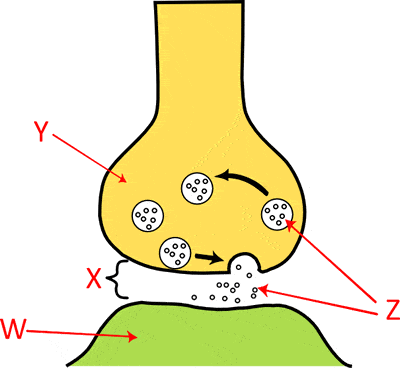
W
a)
Axon Terminal Button
b)
Neurotransmitters
c)
Dendrite
d)
Synapse
88.

Z
a)
Dendrite
b)
Axon Terminal
c)
Neurotransmitters
d)
Synapse
89.
If black and white true-breeding mice are mated and the result is all gray offspring, what inheritance pattern would this be indicative of?
a)
dominance
b)
codominance
c)
multiple alleles
d)
incomplete dominance
90.
Imagine you are performing a cross involving seed color in garden pea plants. What F1 offspring would you expect if you cross true-breeding parents with green seeds and yellow seeds? Yellow seed color is dominant over green.
a)
100 percent yellow-green seeds
b)
100 percent yellow seeds
c)
50 percent yellow, 50 percent green seeds
d)
25 percent green, 75 percent yellow seeds
91.
A recessive trait will be observed in individuals that are ________ for that trait.
a)
heterozygous
b)
homozygous or heterozygous
c)
homozygous
d)
diploid
92.
Meiosis results in ______.
a)
4 genetically distinct haploid gametes
b)
2 genetically distinct cells
c)
2 genetically identical cells
d)
4 genetically identical cells
93.
The chromosomes that pair up during meiosis, are called __________ chromosomes.
a)
homozygous
b)
asexual
c)
homologous
d)
genes
94.

When an area of a chromatid is exchanged with the matching area on a chromatid of its homologous chromosome, _________________ occurs
a)
crossing over
b)
mutagenesis
c)
hybridization
d)
fertilization
95.
One of the main reasons genes assort independent of one another is that
a)
they produce unrelated traits
b)
they produce related traits
c)
they are on the same chromosome
d)
they are on different chromosomes.
96.
Chromosomes that do NOT play a role in determining the sex of an individual are called
a)
sex chromosoems
b)
X and Y
c)
autosomes
d)
A and B are correct
97.
Gametes are _________.
a)
Diploid
b)
Haploid
c)
Aneuploid
d)
variably ploidy
98.
Snap dragon color is a incomplete dominant trait. A red flower (RR) is crossed with white flower (WW). What color are flowers that are heterozygous?
a)
Red
b)
Red and White
c)
White
d)
Pink
99.

If this image were real, it would represent what type of inheritance?
a)
incomplete dominance
b)
codominance
c)
polygenic inheritance
d)
compete dominance
100.
Tendency for alleles of genes on the same chromosome to be inherited together
a)
genetic linkage
b)
genetics
c)
Punnett square
d)
gene locus
101.
Enzymes need certain environmental conditions in order to function properly. What happens when enzymes are heated to a high temperature?
a)
they die
b)
they denature
c)
they change their amino acid sequence
d)
they work better
102.
What type of macromolecule are enzymes?
a)
Protein
b)
Carbohydrate
c)
Lipid
d)
Nucleic Acid
103.
Which of the following correctly describes how enzymes work?
a)
they lower the energy of the reactants to increase the rxn rate
b)
they supply energy to the reaction to increase the rxn rate
c)
they lower the energy of the products to increase the rxn rate
d)
they lower the activation energy of the reaction to increase the rxn rate
104.
The part of the enzyme that the substrate bonds to is called the _____.
a)
active site
b)
activation energy
c)
bond site
d)
peptide bond
105.
Enzymes are made up of these repeating monomers.
a)
monosaccharides
b)
amino acids
c)
nucleotides
d)
phospholipids
106.

Which of the following conclusions can be drawn from this graph?
a)
The optimum pH of the enzyme is 6.6.
b)
The optimum pH of the enzyme is 5.8
c)
The enzyme’s activity increases as pH increases 5.0 to 9.0
d)
The enzyme’s activity is greater around pH of 8.0 .
107.
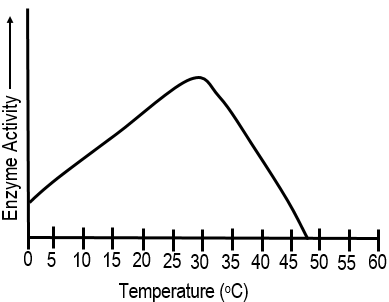
Based on the graph, what is the optimal temperature for this enzyme?
a)
15oC
b)
40oC
c)
30oC
d)
35oC
108.
Which of these is most likely an enzyme?
a)
Sucrose
b)
Galactose
c)
Fructose
d)
Amylase
109.
The condition in which there are barriers to successful interbreeding between individuals of different species in the same community is referred to as
a)
sexual dependency
b)
reproductive isolation
c)
geographic isolation
d)
adaptive radiation
110.
The differences in sparrow songs among sympatric species of sparrows are examples of
a)
geographic isolation
b)
convergent evolution
c)
behavioral isolation
d)
mechanical isolation
111.
Which of the following types of reproductive barriers separate a pair of species that could interbreed except that one mates at dusk and the other at dawn?
a)
behavioral isolation
b)
mechanical isolation
c)
habitat isolation
d)
temporal isolation
112.
Which of the following is not in Hardy-Weinberg equation?
a)
a population with non-random mating
b)
a population in which the allele frequencies do not change over time
c)
p2+2pq+q2=1
d)
a population undergoing natural selection
113.
How do you spell Ms. S's name?
a)
Schpanski
b)
Sczepanski
c)
Szczpanski
d)
Szczepanski
100 %

