wayground logo

Free Printable Worksheets

Font size

S
M
L
XL
Worksheets

Population, Pollution, Waste, Forestry, Agriculture, and Energy

Total questions: 156

Worksheet time: 3hrs 52mins

Name
Class
Date
1.
 What does the term carrying capacity describe?
a)
The maximum number of birth rates for a population.
b)
The ability of a population to accept new immigrants.
c)
The ratio of birth rates to death rates in a population.
d)
The population size that the environment can sustain.
2.
How does an increase in population density impact the spread of infectious disease?
a)
as population density increases, spread of infectious disease decreases
b)
as population density decreases, spread of infectious disease decreases
c)
as population density decreases, spread of infectious disease increases
d)
as population density increases, spread of infectious disease increases
3.
Any abiotic or biotic factor in an ecosystem that causes a population’s size to slow or decrease is a ____________ factor.
a)
growth
b)
limiting
c)
carrying
d)
density dependent
4.
As a population reaches its carrying capacity, there may be an increase in competition for
a)
food
b)
shelter
c)
mates
d)
all the above
5.
What is population density?
a)
The number of people living across Europe.
b)
The number of plants occupying an area.
c)
The number of people living in an area.
d)
The number of insects in an ecosystem.
6.
When populations increase because animals are moving into a population?
a)
Emigration
b)
Limiting Factors
c)
Immigration
d)
Exponential Growth
7.
When populations decrease because animals are moving out of a population?
a)
Emigration
b)
Limiting Factors
c)
Immigration
d)
Exponential Growth
8.
largest number of individuals of a population that the environment can support  
a)
carrying capacity
b)
primary succession 
c)
denitrification
d)
mutualism
9.
symbiotic relationship in which one organism benefits and the other organism is harmed 
a)
secondary succession 
b)
predation
c)
pioneer species 
d)
parasitism
10.
a relationship between two in which the predator feeds on the prey
a)
chemosynthesis
b)
predation
c)
cellular respiration 
d)
commensalism
11.
symbiotic relationship in which one organisms benefits and the other organism is not affected
a)
invasive (non-native) species
b)
mutualism 
c)
nitrogen fixation
d)
commensalism
12.
symbiotic relationship in which both organisms benefit
a)
competition
b)
Mutualism
c)
nitrogen fixation
d)
energy pyramid
13.
Where an organism lives
a)
habitat
b)
niche 
c)
heterotrogh
d)
biosphere
14.
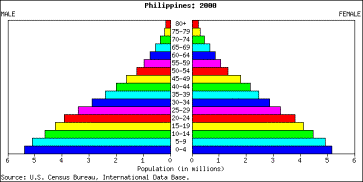
This population pyramid shows a country with a population that  is 
a)
growing
b)
staying the same
c)
decreasing
15.
This population pyramid shows a country that's population is 
a)
Growing
b)
Stable
c)
Shrinking
16.
This population pyramid shows a country with a population that is 
a)
Growing
b)
Stable (Staying the Same)
c)
Shrinking
17.
Which country has the most young people?
a)
2
b)
3
c)
4
18.
Which country has the most elderly people?
a)
1
b)
2
c)
3
19.
In which stage does a country has a more equal amount of young, middle-aged, and older people?
a)
1
b)
2
c)
3
d)
4
20.
Which country do you think has the best health care?
a)
1
b)
2
c)
3
21.
Which country has the highest death rates?
a)
1
b)
2
c)
3
d)
4
22.
Which country has the lowest birth rates?
a)
1
b)
2
c)
3
d)
4
23.
Which country has the lowest life expectancy?
a)
1
b)
2
c)
3
24.
Which country would you expect to have the worst health care?
a)
2
b)
3
c)
4
25.
Which is NOT shown on a population pyramid?
a)
Age
b)
Sex (male/female)
c)
Ethnicity 
d)
Race
26.
The number of people that are too young or too old to work on a population pyramid.
a)
Sex Ratio
b)
Dependency Ratio
c)
Demographic Ratio
d)
Population Ratio
27.
The number of males per hundred females.
a)
Sex Ratio
b)
Dependency Ratio
c)
Demographic Ratio
d)
Population Ratio
28.
Those 0-14 and 65+ are usually classified as?
a)
Dependents
b)
Independents
c)
Working Age
d)
Baby Boomers
29.
the periodic count of a nation's population by its government
a)
census
b)
count day
c)
rate of natural increase
d)
migration
30.
diagram that shows the age and male/female distribution of a population, where the youngest are at the base and the oldest at the top
a)
dependent population
b)
population pyramid
c)
food pyramid
d)
population density distribution
31.
According the population pyramid Canada's population is _______________ 
a)
growing
b)
getting smaller
c)
staying the same 
32.
According to the population pyramid of this country, its population is most likely...
a)
growing slowly.
b)
growing rapidly.
c)
decreasing.
d)
not changing.
33.
The number of people that are too young or too old to work on a population pyramid.
a)
Sex Ratio
b)
Dependency Ratio
c)
Demographic Ratio
d)
Population Ratio
34.
What type of city does this population pyramid represent?
a)
College town
b)
Retirement Community
c)
Business Center
d)
Military Base
35.
Name the type of pyramid in the picture.
a)
slow growth
b)
fast growth
c)
zero growth
d)
decline
36.
Name the type of pyramid in the picture.
a)
slow growth
b)
fast growth
c)
zero growth
d)
decline
37.
a)
Expanding 
b)
Stationary
c)
Declining
38.
a)
Expanding
b)
Stationary
c)
Declining
39.
What is the first step in reading population pyramids?
a)
Title
b)
Left and Right - Men and Women
c)
Horizontal Axis
d)
Vertical Axis
40.
What is the second step in reading population pyramids?
a)
Title
b)
Left and Right - Men and Women
c)
Horizontal Axis
d)
Vertical Axis
41.
What is the third step in reading population pyramids?
a)
Title
b)
Left and Right - Men and Women
c)
Horizontal Axis
d)
Vertical Axis
42.
a)
Expanding
b)
Stationary
c)
Declining
43.
a)
Expanding Population 
b)
Stationary Population
c)
Declining Population
44.
Heat is the movement of ______.
a)
radiation
b)
thermal energy
c)
cold
d)
fire
45.
Thermal energy ALWAYS moves from _____ to _____.
a)
solid to liquid
b)
ice to water
c)
hot to cold
d)
solid to gas
46.
Heat moves by ______ when it travels through waves.
a)
radiation
b)
conduction
c)
insulator
d)
convection
47.
Heat moves by ______ when it travels from one solid to another solid.
a)
radiation
b)
convection
c)
thermal energy
d)
conduction
48.
Concentration of toxins in an organism as a result of ingesting other plants/animals in which the toxins are widely distributed
a)
biomagnification
b)
point-source pollution
c)
artificial eutrofication
d)
consumable pollution
49.
Identify the process shown in this diagram.
a)
Extinction
b)
Toxin Accumulation
c)
Pollution
d)
Biomagnification
50.
What do the small dots in the picture represent?
a)
DDT 
b)
Food
c)
Energy
d)
Biomass
51.
Which organism in this diagram has the highest DDT concentration?
a)
Zooplanktons
b)
small fish
c)
large fish
d)
Fish-eating birds
52.
The process when concentrations of a harmful substance increases in organisms at higher trophic levels in a food chain or food web.
a)
Biomagnification
b)
Predation
c)
Extinction
d)
Accumulation
53.
One of the first widely used pesticides produced and was widely used because it was cheap, remained active for a long time, and killed many insect considered pests.
a)
Baygon
b)
Pyrethroids
c)
Raid
d)
DDT
54.

Which organism in the food web would

contain the highest concentration of chemical pollutants?

a)

producers

b)

primary consumers

c)

secondary consumers

d)

tertiary consumers

55.

Which organism in the food web shown to the right would

contain the lowest concentration of chemical pollutants?

a)

producers

b)

primary consumers

c)

secondary consumers

d)

tertiary consumers

56.

The accumulation of heavy metals or other pollutants causes

a decline in the population of predatory birds because –

a)

heavy metals make it difficult for the birds to hunt

b)

pesticides diminish the amount of available food

c)

the pollutants interfere with bird reproduction

57.

Chemical pesticides tend to be used in terrestrial ecosystems, but they are commonly found in the tissues of aquatic organisms. Because of this, birds and other animals with a diet high in fish commonly suffer the effects of biological magnification. How do these pesticides end up in these aquatic ecosystems?

a)

Pesticides evaporate and are delivered to water sources by rainfall

b)

Land animals containing pollutants die and decompose in waterways

c)

Pesticides are carried to water sources by freshwater runoff.

58.

Algae grow rapidly when certain nutrients are added to the water supply causing an algal bloom. Eutrophication describes the process of adding nutrients to the water supply. What human activity is most responsible for the eutrophication that leads to algal blooms?

a)

Burning fossil fuels

b)

Disposing of pesticides

c)

Fertilizer for food crops

59.

The rapid growth of algae, called an algal bloom, can lead to the formation of dead zones that cannot sustain aquatic life. This is mainly because the algal bloom lowers the amount of –

a)

chemical pollutants

b)

dissolved oxygen

c)

freshwater runoff

60.

Pollution resulting from the use of fertilizers and the disposal of sewage from humans and livestock can lead to an algal bloom. The effects of these pollutants on algae growth can be intensified as a result of which of the following?

a)

The decreased use of solar power

b)

An increase in freshwater runoff

c)

An increase in organic farming practices

61.

The eutrophication of a water supply can lead to a phytoplankton bloom. The excess nutrients allow these microscopic organisms to reproduce at a faster rate than normal. What is one ecological problem that can occur as a result of these blooms?

a)

The reduction of fish populations as oxygen levels in the water decline

b)

Fertilizers become less effective causing an increase in their use by farmers

c)

The increase in photosynthesis reduces the solar energy available to terrestrial plants

62.
Most of this trash is dumped in
a)
lakes.
b)
landfills.
c)
ocean.
d)
forests.
63.
Many things that are thrown away can be
a)
burned.
b)
melted.
c)
recycled.
64.
The three Rs of solving the garbage problem are
a)
Rebekah, Rachel, and Ronda.
b)
red, redo, and remember.
c)
remove, rewind, and recover.
d)
reduce, reuse, and recycle.
65.
_____________ is the process of reclaiming raw materials and reusing them to create new products.
a)
Reducing
b)
Repurposing
c)
Recycling
d)
Composting
66.
When you throw something "away", where does it end up?
a)
Outer space
b)
Landfills
c)
My trashcan is a magical trash-disappearing portal
d)
Who cares?
67.
What can you recycle at school?
a)
Paper
b)
Plastic
c)
Aluminum
d)
All of these
68.
Which of these is NOT hazardous waste
a)
Motor oil
b)
Paint
c)
Cell phones
d)
Glass bottles
69.
In order to make recycling an economically sustainable practice, people need to
a)
buy recycled materials
b)
recycle more
c)
ban landfills in their area
d)
compost their scraps
70.
What is the leading country in recycling?
a)
Japan
b)
Germany
c)
U.S.A.
d)
Vatican City
71.
When trash is burned in an incinerator, it is completely destroyed and no waste is still present.
a)
True
b)
False
72.
Solid waste
a)
threatens human health or the environment because it is toxic, chemically active, corrosive or flammable.
b)
any unwanted or discarded material we produce that is not a liquid or gas.
c)
produce directly from homes.
73.
Hazardous (toxic) waste
a)
threatens human health or the environment because it is toxic, chemically active, corrosive or flammable.
b)
any unwanted or discarded material we produce that is not a liquid or gas.
c)
produce directly from homes.
74.
In the U.S. how much of our waste is industrial solid waste?
a)
98.5
b)
97.5
c)
95.8
d)
95.7
75.
What is Electronic Waste?
a)
produced indirectly by industries that supply people with goods and services.
b)
any unwanted or discarded material we produce that is not a liquid or gas.
c)
E-waste consists of toxic and hazardous waste such as PVC, lead, mercury, and cadmium.
76.
Secondary recycling
a)
materials are turned into new products of the same type.
b)
materials are converted into different products.
77.
how can you tell the age of a tree?
a)
The ammount of leaves
b)
Number of branches
divided by 3
c)
The Rings
d)
Sap sample
78.
what is the leading cause of deforestation?
a)
Diseases 
b)
Housing market
c)
Agriculture and Farming
d)
Paper mill
79.
What does deforestation effect?
a)
Plants and animals
b)
Our biosphere
c)
Humans
d)
All of the above
80.
What are the effects of deforestation ?
a)
loss of habitat
b)
increased green house gasses 
c)
soil erosion and flooding
d)
all of the above
81.
What are the effects of deforestation ?
a)
loss of habitat
b)
increased green house gasses 
c)
soil erosion and flooding
d)
all of the above
82.
Resources of a fixed amount, or a resource that is used up faster than it can be replaced
a)
Renewable resource
b)
Nonrenewable resource
83.
Resource that can be replaced at a rate close to its rate of use or in an unlimited supply.
a)
Renewable resource
b)
Nonrenewable resource
84.
The cutting down of selected trees in a forest so the growth of other trees is not affected.
a)
Selective Cutting
b)
Controlled Burn 
c)
Thinning
d)
Clear Cutting
85.
Widespread deforestation is a major factor in causing which ecological process?
a)
famine
b)
erosion
c)
monsoons
d)
tornadoes
86.
play a major role in building up and breaking down the shoreline
a)
waves
b)
people
c)
wind
d)
sand
87.
The dropping or depositing of sediments by water, wind, and ice
a)
deposition
b)
erosion
c)
weathering 
d)
valley
88.
Huge waves that occur because of underwater earthquakes
a)
tsunami
b)
erosion
c)
flood
d)
Naomi
89.
The repeated movement of water
a)
waves
b)
tides
c)
breaker
d)
crest
90.
True or false, bubbling is a sign of a chemical reaction?
a)
True
b)
False
91.
Another term for burning is
a)
Fire triangle
b)
Magnesium oxide
c)
Combustion
d)
Bustion
92.
What is carbon monoxide?
a)
A toxic gas
b)
A large solid
93.
Which statement is true about action thresholds?
a)
In an urban landscape, action thresholds are usually more related to economics than aesthetics.
b)
Action thresholds are usually easy to establish.
c)
The IPM technician needs to implement control measures below the action threshold level.
d)
The action threshold for a pest may be set at a zero pest population density
94.
Which would increase the likelihood of pesticide resistance?
a)
An insect has only one generation per year.
b)
Continual use of the same pesticides or pesticides from the same chemical class.
c)
Applying a pesticide that has little or no residual effect.
d)
Limiting the number of pesticide applications.
95.
Lowering the humidity of stored grains and other food products to reduce damage from mold is an example of which type of pest management method?
a)
Mechanical
b)
Physical/environmental modification
c)
Biological
d)
Regulatory pest control.
96.
Which statement is true about cultural control practices?
a)
Cultural practices alter the environment, the condition of the host, or the behavior of the pest to prevent or suppress an infestation.
b)
Cultural controls involve the release of parasites and predators found in foreign countries.
c)
Sanitation is not considered a cultural practice.
d)
Trapping is an important cultural control practice.
97.
The surface layer of soil
a)
Topsoil
b)
Arable land
c)
Erosion
d)
Compost
98.
Wearing away of rock or soil by wind and water.
a)
Compost
b)
Yield
c)
Desertification
d)
Erosion
99.
When land becomes more desertlike because of human activity or climate change.
a)
Erosion
b)
Desertification
c)
Salinization
d)
Compost
100.
Chemicals used to kill insects, weeds, and other pests
a)
Salinization
b)
Pesticide
c)
Biological pest control
d)
Genetic engineering
101.
Use of living organisms to control pests
a)
Pesticide
b)
Biological pest control
c)
Salinization
d)
Genetic engineering
102.
Modifying a cell for medical or industrial use
a)
Pesticide
b)
Genetic engineering
c)
Domesticated
d)
Livestock
103.
Animals bred and managed for human use
a)
Domesticated
b)
Livestock
c)
Ruminant
d)
Aquaculture
104.
When too much of a food source is removed from a population
a)
Overharvesting
b)
Aquaculture
c)
Domesticated
d)
Livestock
105.
Raising organisms in water for human use or consumption
a)
Aquaculture
b)
Livestock
c)
Genetic engineering
d)
Domesticated
106.
Animals raised on a farm to be sold for profit
a)
Domesticated
b)
Livestock
c)
Aquaculture
d)
Ruminant
107.
Compost is a type of fertilizer, mainly composed of __________.
a)
cow or sheep manure
b)
decaying plant matter
c)
rotting meat
d)
industrial chemicals
108.
Which of the following is a method to prevent desertification. 
a)
overgrazing
b)
high powered sprinklers
c)
frequent plowing
d)
allowing land to lie fallow
109.
These factors affect the formation of soil
a)
Wind, climate, water
b)
Living organisms, parent material, climate
c)
Time, water, wind
d)
Parent material, water, climate
110.
Soil texture affects _______________
a)
The storage and movement of air and water through the soil
b)
The way the soil is assembled
c)
The amount of organic matter that is present in the soil
d)
None
111.
The movement of nutrients and other materials through the soil profile is referred to as
a)
Field capacity
b)
Permeability
c)
Leaching
d)
Weathering
112.
Sand and has smaller particles than ______________
a)
Clay
b)
Silt
c)
None 
d)
All
113.
Cation exchange capacity is____________
a)
The capacity of the soil to hold its structure
b)
The total amount of exchangeable ions held by the clay
c)
The ability of the soil to move ions from one particle to another
d)
The capacity to exchange between the organic fraction and inorganic fraction
114.
What soil is course and drains quickly?
a)
Sand
b)
Silt 
c)
Clay
d)
Loam
115.
Humus is found in _____________?
a)
Top Soil
b)
Minerals
c)
Houses
d)
Rock
116.
What is a a soil horizon?
a)
A layer of soil
b)
A factor influencing how soil is formed
c)
A technique used to map soils
d)
An organism found within the soil
117.
"Xenobiotics" are _____________.
a)
products used for the biological control of pests
b)
synthetic organic compounds not found in nature
c)
special soil amendments favored in organic farming
d)
chemicals that contain carbon
118.
Organic compounds may be destroyed by which of the following processes?
a)
biological degradation
b)
leaching to groundwater
c)
Runoff
d)
adsorption to clay or organic matter
119.
Which of the following would be considered one of the benefits or advantages of ex situ soil washing ?
a)
quickness with which cleanup standards can be met
b)
relatively low cost of washing the soil with an appropriate solvent compared to other methods
c)
relatively little disturbance of the site and the soil involved
d)
All
120.
Which of the following would be the benefits or advantages of "natural attenuation"?
a)
quickness with which cleanup standards can be met
b)
relatively low cost compared to other remediation methods
c)
relatively high degree of certainty or confidence that the pollutant will be destroyed 
d)
All
121.
When the pollutant applied to soil would be ___________________.
a)
degradation 
b)
retention
c)
runoff / leaching
d)
All of the above
122.
Phytoremediation can clean up polluted soils by using ______.
a)
plant cover to prevent surface soil heating
b)
anaerobic bacteria to degrade toxic compounds
c)
plants to take up and accumulate the pollutant so that it can be removed when the plant is harvested
d)
All
123.
Bioremediation can clean up polluted soils by ______.
a)
adding nutrients to stimulate the activity of certain soil bacteria
b)
inoculating the soil with certain bacteria that can degrade toxic organic compounds
c)
using plants to stimulate soil microbial activity by exuding energy compounds into the rhizosphere
d)
All
124.
What are the two factors that affect the rate at which weathering occurs?
a)
climate and mass of rock
b)
climate and size of rock
c)
type of rock and size of rock
d)
type of rock and climate
125.
2/3 of freshwater on Earth is "locked away" in what water source location?
a)
atmosphere
b)
rivers and lakes
c)
underground
d)
ice and glaciers
126.
The land area that supplies water to a river system is called a
a)
water table
b)
trailer
c)
house
d)
watershed
127.
Karst topography is found primarily in which of Virginia's provinces?
a)
Piedmont
b)
Blue Ridge
c)
Valley & Ridge
d)
Coastal Plain
128.
Which of the following types of chemical weathering causes a karst landscape, such as a cavern?
a)
lichens
b)
acid precipitation
c)
acids in groundwater
d)
water
129.
Stream that flows into the main stream of a river system
a)
tributary
b)
runoff
c)
kettle lake
d)
kettle stream
130.
The process by which water, ice, wind or gravity moves weathered rock and soil from one place to another.
a)
weathering
b)
erosion
c)
deposition
d)
dumptruck
131.
How might a weathered mountain appear different than an unweathered mountain?
a)
Weathered mountain would be taller.
b)
Weathered mountain would be rounder and less jagged.
c)
Weathered mountain would be more jagged and less rounded.
d)
Weathered mountain would have no trees.
132.
Deltas are built up by -
a)
deposition
b)
leaching
c)
abrasion
d)
erosion
133.
A river flowing across a wide flood plain begins to form loop-like bends called - 
a)
rills
b)
meanders
c)
outside curves
d)
deltas
134.
Rainwater that flows into streams and rivers from surface areas
a)
spit
b)
erosion
c)
runoff
d)
sand bar
135.
The use of pesticides and fertilizers must be carefully monitored 
because of the effect they can have on the environment. 
Which of the following is a possible negative effect of the use 
of these chemicals on the environment?
a)
Runoff carries these chemicals into lakes and streams.
b)
Theses chemicals cannot be purchased in large bulk.
c)

These chemicals are expensive to produce.
d)
Storage space for these chemicals is limited.
136.
What is a watershed?
a)
Land that collects and channels water froma small body of water to a larger body of water
b)
the shape of the land determined by elevation
c)
A natural stream of water of considerable  volume
d)
a river and all its tributaries
137.
Why is gravity a factor in watersheds? 
a)
it causes the water to flow away from a watershed
b)
it causes the water to flow down towards a watershed
138.
The build up of nutrients in a lake is a process called ________________.
a)
eutrophication
b)
volcanic eruption
c)
algae buildup
d)
pond death
139.
A lake that stores water for human use is called a ____________.
a)
dam
b)
oxbow lake
c)
reservoir
d)
crater lake
140.
what is a non renewable resource?
a)
water
b)
wind
c)
coal
d)
biomass
141.
what is a fossil fuel
a)
oil
b)
biomass
c)
wind 
d)
hydro
142.
what is a renewable resource used for?
a)
food
b)
diging
c)
energy
d)
smelting
143.
What is a renewable resource?
a)
An object you can reuse
b)
An object you cannot reuse
c)
Fossil fuels
d)
Oil
144.
What is a non-renewable resource?
a)
Paper
b)
You can`t reuse them 
c)
A plastic bottle
d)
You can reuse 
145.
Where does most of earth`s energy come from?
a)
The sun
b)
Mars
c)
Wind
d)
Water
146.
What is an example of a renewable resource?
a)
hydroelectric
b)
oil
c)
coal
d)
fossil fuel
147.
Fossil fuels are Renewable resources. True or False?
a)
True
b)
False
148.
Do Renewable energy sources run out?
a)
Yes 
b)
No
149.
Hydroelectricity and Wind Power are both indirect forms of what? 
a)
Hydrogen
b)
Geothermal Energy
c)
Solar Energy
d)
Nuclear
150.
Which renewable resource gets its direct energy from the sun? 
a)
Geothermal
b)
Solar
c)
Wind
d)
Hydrogen
151.
What is the most plentiful fossil fuel? 
a)
Oil
b)
Natural Gas
c)
Petroleum 
d)
Coal
152.
Why do we use non-renewable resources instead of renewable resources? 
a)
Less Expensive 
b)
More Energy
c)
All of the above
153.
Energy we get from burning living things
a)
Hydroelectricity 
b)
Wind Energy
c)
Biomass Fuel
d)
Hydrogen Power
154.
Energy we get from earth's interior heat
a)
Geothermal
b)
Solar Energy 
c)
Wind Energy 
d)
Hydroelectricity 
155.
Oil and Natural gas are both known as types of what? 
a)
Coal
b)
Geothermal Energy 
c)
Renewable Resources
d)
Petroleum 
156.
What is the best pro about renewable resources? 
a)
The are inexpensive 
b)
They are always available
c)
They are expensive
d)
They create pollution