wayground logo

Free Printable Worksheets

Font size

S
M
L
XL
Worksheets

2022-2023 Semester 2 Final Exam Practice Questions

Total questions: 161

Worksheet time: 2hrs 2mins

Name
Class
Date
1.
If we think of DNA as a ladder, which parts are the sides of the ladder?
a)
the nitrogenous base pairs
b)
the phosphate-sugar backbone
c)
the genes
d)
the phospholipid bilayer
2.
If we think of DNA as a ladder, which parts are the steps of the ladder?
a)
the nitrogenous base pairs
b)
the phosphate-sugar backbone
c)
the genes
d)
the phospholipid bilayer
3.
What is the shape of DNA?
a)
double helix
b)
double heelies
c)
double trouble
d)
double staircase
4.

The word helix means spiral. What does this tell you about the structure of DNA, which is a double helix molecule?

a)

The nucleotides of the two strands bond together with spiral bonds.

b)

A double-stranded DNA molecule is composed of two linear strands that run opposite to each other, or anti-parallel, and twist together to resemble a twisted ladder.

c)

DNA is a double helix because it has two strands held together like a spiral staircase.

d)

Nucleotides are spiral-shaped molecules that bond together to form DNA.

5.
the process of making a copy of DNA
a)
transcription
b)
double helix
c)
DNA replication
d)
replication fork
6.
The basic subunit (monomer) of DNA is a
a)
codon
b)
nucleotide
c)
phosphate group
d)
nitrogenous base
7.
Nitrogen base that pairs with adenine
a)
cytosine
b)
DNA polymerase
c)
deoxyribose
d)
thymine
8.
nitrogen base that pairs with guanine
a)
adenine
b)
cytosine
c)
nucloetide
d)
deoxyribose
9.
the base that pairs with Thymine in DNA
a)
adenine
b)
guanine
c)
helicase
d)
nucleotide
10.
A nitrogen base that bonds with cytosine; a purine
a)
thymine
b)
guanine
c)
helicase
d)
double helix
11.
In order for a cell to go through cell division, the DNA within the cell must undergo
a)
translation
b)
replication
c)
transcription
d)
protein synthesis
12.
DNA has the code to instruct cells to make
a)
lipids
b)
sugars
c)
proteins
d)
carbohydrates
13.
Hereditary information is contained within your cell's _.
a)
ATP
b)
DNA
c)
Ribosomes
d)
Smooth ER
14.

How are DNA and RNA different? (CHECK ALL THAT APPLY)

a)

Only DNA can leave the nucleus

b)

RNA contains Thymine; DNA contains Uracil

c)

DNA is double stranded, RNA is a single stranded

d)

DNA contains Thymine, RNA contains Uracil

15.
The process to go from mRNA to a protein is called ____
a)
transcription
b)
rRNA
c)
replication
d)
translation
16.

Why must transcription occur in the nucleus?

a)

because DNA can't leave the nucleus

b)

because ribosomes are in the nucleus

c)

because DNA polymerase is found there

d)

because helicase unzips the DNA

17.

Which organelle contains rRNA and reads the mRNA to synthesize a protein?

a)

Ribosome

b)

Nucleus

c)

Cytoplasm

d)

Nucleotide

18.

What brings the amino acids to the ribosome to assemble a protein?

a)
mRNA
b)
tRNA
c)
rRNA
d)

DNA

19.

Which anticodon would be placed in spot #2

a)

GGC

b)

CCA

c)

GGA

d)

GGT

20.

True or False: mRNA contains anticodons and tRNA contains codons.

a)

True

b)

False

21.

When these bond together, they form a protein

a)

Amino Acids

b)

Peptide Bonds

c)

Ribose

d)

Nucleotides

22.

What determines the shape and function of a protein?

a)

The sequence of amino acids

b)

The type of ribosome that assembles the protein

c)

The cell that manufactures the protein

23.
The mRNA leaves the ________ to find the ribosome to make proteins.
a)
cell
b)
nucleotide
c)
nucleus
24.

Which process does this diagram illustrate?

a)

transcription

b)

DNA replication

c)

translation

25.

In what process is mRNA synthesized?

a)

Transcription

b)

Translation

c)

DNA Replication

d)

Mitosis

26.

How many nucleotides code for 1 amino acid?

a)

1

b)

2

c)

3

d)

4

27.
In the sequence of nucleotides on one strand of a DNA molecule is GCCATTG, the sequence of the complementary strand is:
a)
CCCTAAC
b)
CGGTAAC
c)
GCCATTC
d)
GGGTAAG
28.
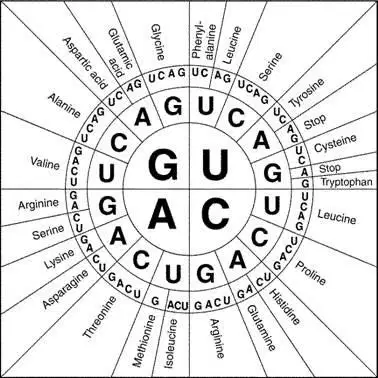
Using the following DNA code, transcribe AND then translate the corresponding amino acid sequence. AAATTTCCCGGG
a)
serine- tyrosine-leucine-alanine
b)
lysine-phenylalanine-proline-glycine
c)
phenylalanine-lysine-glycine-proline
d)
phenylalanine-asparagine-glycine-proline
29.

Choose the sequence of the mRNA strand that would match up with to the following DNA strand:

GTACAT

a)

CATGTA

b)

GAUCUA

c)

CAUGUA

d)

CUTGTU

30.
The molecule read by the ribosomes to build proteins is
a)
DNA
b)
rRNA
c)
tRNA
d)
mRNA
31.
Which shows the correct complementary base pairing for DNA?
a)
C-A, T-G
b)
A-G, C-T
c)
C-G, U-A
d)
T-A, G-C
32.
Which of the following describes what occurs during translation?
a)
The mRNA message travels to the ribosome, the tRNA brings the amino acids the mRNA call for, and the amino acids are linked by peptide bonds to form a protein.
b)
The tRNA message travels to the ribosome, the mRNA brings the amino acids that the tRNA calls for, and the amino acids are linked by peptide bonds to form protein.
c)
The rRNA message travels to the ribosome, the tRNA brings the amino acids that the rRNA calls for, and the amino acids are linked by peptide bonds to form a protein.
d)
The mRNA message travels to the ribosome, the rRNA brings the amino acids that the mRNA calls for, and the amino acids are linked by peptide bonds to form a protein.
33.

During interphase, ________is replicated.

a)

ATP

b)

DNA

c)

RNA

d)

FBI

34.

The process of where one cell becomes two cells, is called ________ _______________

a)

photosynthesis

b)

cellular respiration

c)

anaphase

d)

the cell cycle

35.

The structure in the nucleus that is formed from DNA is called a __________________.

a)

chromosome

b)

organelle

c)

membraneds

d)

ribosome

36.

At the end of the cell cycle, there are two genetically different cells. True or False

a)

True

b)

False

37.

The last part of the cell cycle, where the cell finishes dividing into two cells, is called _________________________ ?

a)

prophase

b)

cytokinesis

c)

interphase

d)

duplication

38.

The cell cycle consists of interphase, mitosis, and cytokinesis? True or false?

a)

True

b)

False

39.

Cell division illustrates the part of the cell theory that says all cells come from pre-existing cells. True or False

a)

True

b)

False

40.

Our DNA is located in the ______________________ of our cells.

a)

mitochondria

b)

cytoplasm

c)

nucleus

d)

chloroplasts

41.
There are a TOTAL of ___ chromosomes in human body cells.
a)
23
b)
46
c)
92
d)
scientists don't know
42.

How can a mutation in the DNA sequence result in NO change to the protein that is made?

a)

There are multiple codons that can code for the same amino acid and result in the same protein

b)

There is always a change in the protein when a mutation occurs

c)

Only the mRNA is used in protein synthesis so a mutation in the DNA would have no effect on the protein

43.
Mutations that occur in the non-coding section of DNA will result in a phenotype/physical change.
a)
True
b)
False
44.
Down Syndrome, which is caused by an extra chromosome, can be detected by performing a karyotype of
a)
any of the father's cells
b)
any of the sibling's cells
c)
any of the mother's cells
d)
any of the individual's cells
45.
An individual's karyotype can be done using any of his/her cells except
a)
skin
b)
brain
c)
kidney
d)
gametes (sex cells)
46.
Two siblings with the same parents will NOT have identical gene combinations because of
a)
codominance
b)
polygenic traits
c)
incomplete dominance
d)
independent assortment
47.

What mutation has occurred here?

T-G-A-C-C-A

T-G-A-G-C-A

a)

Substitution

b)

Deletion

c)

Insertion

d)

Frameshift

48.

Which of the following would result in a frameshift mutation?

a)

Insertions only

b)

Substitution only

c)

Deletion only

d)

Insertions and Deletions

49.

DNA molecule segment is : TTACGCAAG

The mutated DNA segment is TTCGCAAG. This is an example of ___ mutation.

a)

Substitution

b)

Deletion

c)

Insertion

d)

Inversion

50.

A mutation is defined as:

a)

A change in the cell's structure

b)

Anything that changes in an embryo

c)

Any change in the physical features of a human

d)

A change in the DNA sequence

51.

ATTTGAGCC- Original

ATTGAGCC - Mutated

The example above is an example of a

a)

Insertion- Frameshift

b)

Deletion- Substitution

c)

Deletion -Frameshift

d)

All of the above

52.

What mutation has occurred here?

T-G-A-C-C-A

T-G-A-G-C-A

a)

Substitution

b)

Deletion

c)

Insertion

d)

Frameshift

53.

Why are insertion and deletion (frameshift) mutations so harmful?

a)

They change all of the codons from the mutation on down the line, which changes the amino acid sequence

b)

They insert things that an organism doesn't need.

c)

They often delete things that organisms need.

d)

Insertion and deletions are not any more harmful than substitution mutations.

54.

Identify the DELETION mutation form the following:

ATG CCA AAT

a)

ATG TCA AAT

b)

ATG CCT AAA T

c)

ATC CA AT

d)

ATG CCA AAT

55.

Which mutation will cause translation to stop?

a)

Mutations 1 and 3 only

b)

Mutation 1 only

c)

Mutation 2 only

d)

Muations 1, 2, 3

56.

Which type of mutation does the model demonstrate?

a)

Deletion

b)

Substitution

c)

Insertion

d)

Translocation

57.
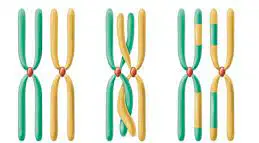
The diagram shows what process that increases genetic variation?
a)
deletion
b)
replication
c)
duplication
d)
crossing over
58.
The loss of control of cellular division is called
a)
cancer
b)
meiosis
c)
deletion
d)
progeny
59.
Which of the following is NOT a possible cause of cancer?
a)
genetics
b)
radiation
c)
lack of sleep
d)
exposure to chemicals
60.
Some genetic mutations, such as sickle cell anemia can be passed to offspring.
a)
true
b)
false
61.
The mutation for PKU must occur in this type of cell to be passed on to one's offspring.
a)
skin
b)
liver
c)
muscle
d)
gametes
62.
In most cases a living thing grows because it produces
a)
more cells
b)
larger cells
c)
smaller cells
d)
useless cells
63.
Reproduction in bacteria produce offspring that are genetic clones of the parent. This is an example of
a)
sexual reproduction
b)
asexual reproduction
64.
Which of the following is an advantage of sexual reproduction?
a)
produces a genetically varied population
b)
produces a large population in a short period of time
c)
uses a large amount of energy during the development of their offspring
65.
If a parent cell has 14 chromosomes prior to mitosis, how many chromosomes will each of the daughter cells have?
a)
7
b)
14
c)
21
d)
28
66.
If a female gamete is produces by meiosis
a)
the cell will be diploid
b)
the cell will be haploid
c)
it will be identical to the parent cell
d)
the cell will have twice the number of chromosomes
67.
Proofreading of DNA nitrogen bases by specific enzymes prevents errors in DNA replication. Possible errors in the proofreading process are called:
a)
changes
b)
variations
c)
mutations
d)
DNA modifications
68.
If a parent that is homozygous dominant is crossed with a parent that is homozygous recessive, the offspring are
a)
homozygous and show the dominant trait
b)
homozygous and show the recessive trait
c)
heterozygous and show the recessive trait
d)
heterozygous and show the dominant trait
69.
When a heterozygous tall plant is crossed with a short plant (tallness is dominant) the expected phenotypic ratio is:
a)
3 tall: 1 short
b)
2 tall: 2 short
c)
1 tall: 3 short
d)
4 tall: 0 short
70.
The principle of genetics involved when one gene in a pair masks or prevents the other from taking effect is called ______________.
a)
dominance
b)
segregation
c)
unit character
d)
independent assortment
71.
Alleles for the same trait are found at the same location on a pair of homologous chromosomes.
a)
True
b)
False
72.
The two unknown genotypes in the top row would be.....
a)
TT and Tt
b)
TT and tt
c)
Tt and Tt
d)
Tt and tt
73.
The use of genetic engineering to transfer human genes into bacteria
a)
is impossible with current technology
b)
allows the bacteria to produce human proteins
c)
results in the formation of a new species of organism
d)
causes the human genes to manufacture bacterial proteins
74.
Mendel's law of ________ states that homologous pairs separate independently of each other during the formation of gametes.
a)
genetics
b)
inheritance
c)
segregation
d)
independent assortment
75.

During daytime, the rate of photosynthesis is faster than the rate of cellular respiration. A plant is placed in a clear, airtight container with a mechanism to allow its roots to get water. Will it be able to sustain itself?

a)

No, because the plant would need ATP to complete cellular respiration.

b)

No, because the plant would need oxygen to complete cellular respiration.


c)

Yes, because the amount of oxygen produced during the daytime would be enough to allow for

d)

Yes, because the amount of carbon dioxide produced during the daytime

76.
Biotechnology can improve a plant population by improving all of the following except
a)
making it disease resistant
b)
stopping all mutations from happening
c)
making it drought resistant
d)
making it insect resistant
77.
Which process creates the most ATP molecules?
a)
fermentation
b)
aerobic respiration
c)
anabolic respiration
d)
anaerobic respiration
78.
What process is found in both aerobic and anaerobic metabolism?
a)
the Kreb's cycle
b)
oxidative phosphorylation
c)
the citric acid cycle
d)
glycolysis
79.
During cellular respiration:
a)
energy is stored in an oxygen molecule
b)
energy is released to make ATP
c)
energy is converted to glucose
d)
energy is transferred to another organism
80.
Which of the following molecules is not needed for the Calvin Cycle?
a)
CO2
b)
ATP
c)
NADPH
d)
H2O
81.
Which is correct about the photosynthesis and respiration equations?
a)
Water and carbon dioxide are the reactants in one equation and the products in the other
b)
Light is a requirement ONLY in photosynthesis
c)
Glucose and oxygen are the reactants in one equation and the products in the other
d)
All of the above is correct
82.
site of the krebs cycle
a)
1
b)
2
c)
3
d)
4
83.
The light reactions occur in the ________ and the dark reactions take place in the ________.
a)
Chloroplast / thylakoid membrane
b)
stroma / thylakoid
c)
mesophyl / stomata
d)
thylakoid membrane / stroma
84.
The final electron acceptor of aerobic respiration is
a)
oxygen
b)
water
c)
carbon dioxide
d)
NAD+
85.
What is the primary function of the light reactions of photosynthesis?
a)
To produce glucose
b)
To produce NADPH and ATP
c)
To use ATP
d)
To produce RuBP
86.
The main purpose of anaerobic respiration is to
a)
produce oxygen
b)
replenish NAD+ for glycolysis
c)
replenish oxaloacetic acid for the Krebs cycle
d)
produce ATP
87.
What enzyme in the ETC is responsible for generating the ATP molecules?
a)
ATPase
b)
ATP synthase
c)
Hexokinase
d)
none of the above
88.
Which of the following are products of the light reactions of photosynthesis that are utilized in the Calvin cycle?
a)
CO2 and glucose
b)
H2O and O2
c)
electrons and H+
d)
ATP and NADPH
89.
Where does glycolysis occur?
a)
Inner mitochondrial membrane
b)
Mitochondrial Matrix
c)
Cytosol
d)
At a ribosome
90.
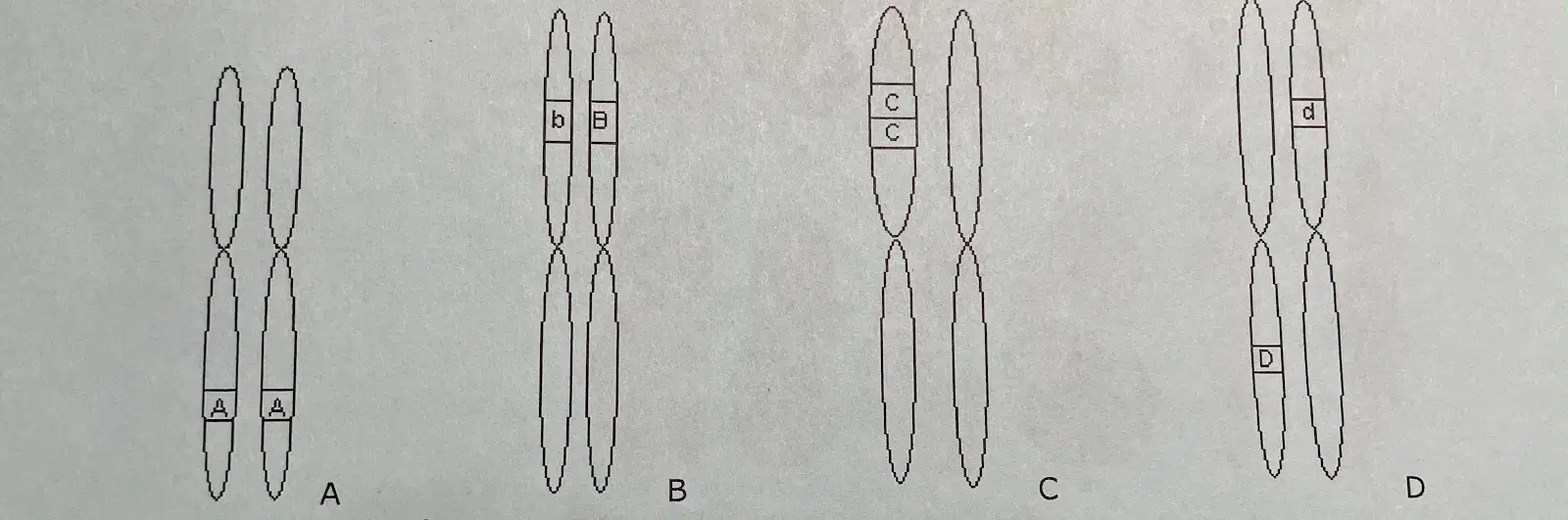
Which of the following drawings shows a homologous chromosome pair with heterozygous alleles highlighting a particular gene location?
a)
A
b)
B
c)
C
d)
D
91.
What is the primary function of the Calvin cycle?
a)
regenerate ATP for use in the light reactions of photosynthesis
b)
produce carbon dioxide for use in the light reactions of photosynthesis
c)
produce oxygen by oxidizing water
d)
produce simple sugars from carbon dioxide
92.
Where does the carbon come from that is used to form glucose?
a)
The soil
b)
CO2 in the air
c)
From other carbohydrates
d)
Calvin Cycle
93.
What is the correct equation for cellular respiration?
a)
6O2 + C6H12O6 -> 6CO2 + 6H2O + Energy
b)
6O2 + C6H12O6 + Energy -> 6CO2 + 6H2O
c)
6CO2 + 6H2O -> 6O2 + C6H12O6 + Energy
d)
6CO2 + 6H2O + Energy -> 6O2 + C6H12O6
94.
During photosynthesis, light energy is converted to __ energy.
a)
heat
b)
sound
c)
chemical
d)
mechanical
95.
Name the 3 carbon molecule produced when glucose is broken in half during glycolysis.
a)
lactic acid
b)
pyruvic acid
c)
acetly-coA
d)
citric acid
96.
Which molecule enters Kreb's Cycle?
a)
Pyruvate
b)
Glucose
c)
Acetyl CoA
d)
reducing powers
97.
During respiration, glucose is broken down to release __.
a)

oxygen

b)

water

c)

ATP

d)

carbon dioxide

98.
Which of the following statements are false?
a)
Glycolysis can occur with or without oxygen
b)
Glycolysis is the first step in both anaerobic and aerobic respiration
c)
Glycolysis occurs in the mitochondria
d)
Glycolysis produces 2 ATP, 2 Pyruvates, and 2 NADH
99.
Where does ETC occur?
a)
Mitochondrial matrix
b)
Outer mitochondrial membrane
c)
Inner mitochondrial membrane
d)
Cytosol
100.
How is cellular respiration related to photosynthesis?
a)
Both require oxygen to start
b)
respiration is the opposite of photosynthesis
c)
Both start with glycolysis
d)
Both end with 38 ATP for cells
101.
Which of these are the products of cellular respiration?
a)
oxygen and water
b)
glucose, oxygen and water
c)
carbon dioxide, water and ATP
d)
water, glucose, and carbon dioxide
102.
The purpose of photosynthesis is to make:
a)
water
b)
oxygen
c)
glucose
d)
carbon dioxide
103.
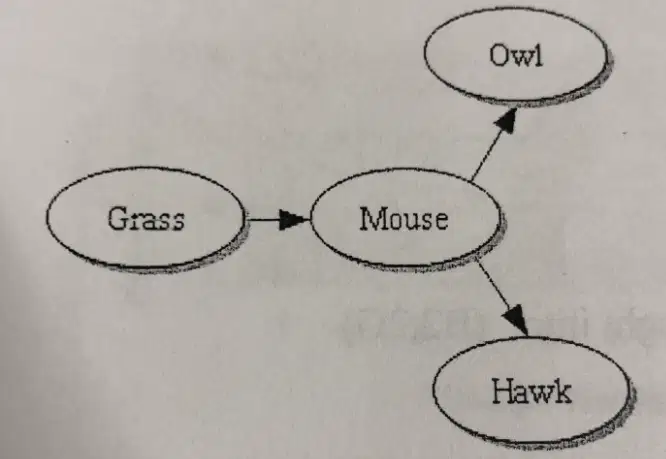
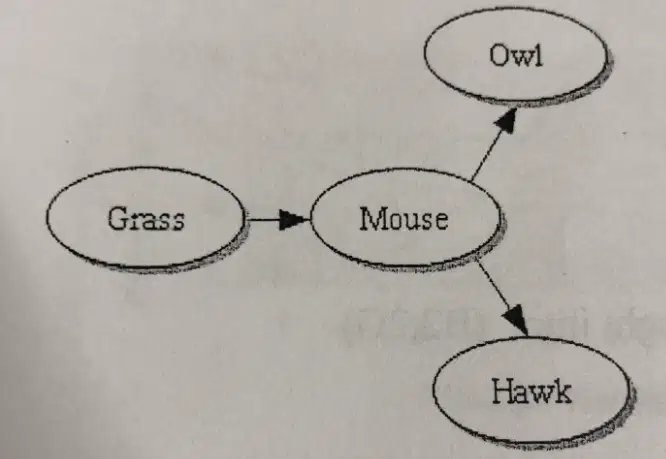
Using the food chain, if there were fewer mice the...
a)
population of owls would increase
b)
population of grass would increase
c)
population of hawks would increase
d)
None of the above would occur
104.
Using the food chain, which organism has the most available energy?
a)
Owl
b)
Hawk
c)
Grass
d)
Mouse
105.
Which of the following organisms are producers?
a)
algae, some bacteria, and plants
b)
hawks and owls
c)
mice and rabbits
d)
grasses and mushrooms
106.
Which of the following organisms are decomposers?
a)
bacteria
b)
hawks and owls
c)
mice and rabbits
d)
grasses and trees
107.
Decomposers...
a)
do not play a role in energy transfer
b)
get their energy only from producers
c)
get their energy only from consumers
d)
return nutrients to the soil for producers
108.
Which of the following explains why the decrease of sunlight in an ecosystem could lead to a decrease in the population growth rate of a top carnivore?
a)
The top carnivore would not be able to produce enough energy from the sun.
b)
The top carnivore would hibernate resulting in a decreased reproduction rate.
c)
Prey of the top carnivore would become less active, making hunting more difficult.
d)
Energy production by plants would decrease, meaning less food available for all consumers.
109.
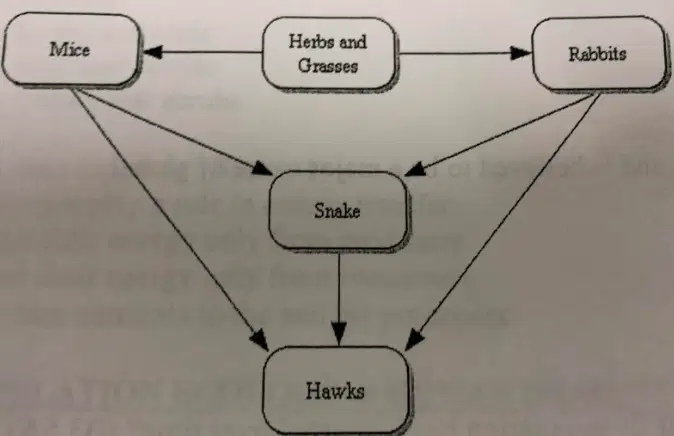
Red Fox population is forced to move into this nearby field. Red Foxes eat mice, rabbit. The Red Fox remains in this ecosystem as a non-native resident (invasive species). Which of the following would be an expected consequence?
a)
Decreased hawk population
b)
Increased rabbit population
c)
Increased snake population
d)
Decreased herb and grass population
110.
For a population to be in exponential growth, what must the organisms have?
a)
carrying capacity
b)
diseases
c)
no predators
d)
unlimited resources
111.
What is the term used to describe the maximum number of organisms a ecosystem can support?
a)
density limit
b)
population limit
c)
carrying capacity
d)
population capacity
112.
An organism that needs to eat other organisms to obtain energy is known as a:
a)
Autotroph
b)
Producer
c)
Consumer
d)
Mutualist
113.
What does every food chain start with?
a)
producers
b)
sun
c)
consumer
d)
decomposers
114.
What is another name for producer?
a)
consumer
b)
herbivore
c)
autotroph
d)
lichen
115.
The rabbit in this food web would be considered a:
a)
Decomposer
b)
Producer
c)
Secondary Consumer
d)
Primary Consumer
116.
In this Food Web Pyramid Which type of consumer gets only 10% of the energy stored in plants?
a)
Herbivore
b)
Carnivore
c)
Omnivore
d)
Secondary Consumer
117.
What does a Secondary Consumer eat?
a)
Tertiary Consumers
b)
Primary Consumers
c)
Producers
d)
Secondary Consumers
118.

Which of the following is a tertiary consumer?

a)

Rabbit

b)

Tree

c)

Deer

d)

Mountain lion

119.

Which of the following is both a secondary consumer and a tertiary consumer?

a)

Rabbit

b)

Mountain Lion

c)

Shrew

d)

Hawk

120.

Which of the following contains the most energy in this food web?

a)

Rabbit

b)

Mountain Lion

c)

Shrew

d)

Hawk

121.

Which organisms break down dead organic matter into soil so that plants can use it to grow?

a)

Producers

b)

Carnivores

c)

Scavengers

d)

Decomposers

122.

Secondary consumers receive what percentage of the ecosystem's total energy?

a)

100%

b)

10%

c)

1%

d)

0.1%

123.

An animal that needs food from its habitat is called a

a)

producer

b)

consumer

124.

Which of the following describes how ALL consumers get their energy?

a)

directly from the sun

b)

from eating primary producer

c)

from inorganic chemicals like hydrogen sulfide

d)

from eating organisms that are living or were once living

125.

The food web diagram shows feeding relationships between organisms on the African Savannah. Which of the following organisms is part of the trophic level with the greatest amount of stored energy?

a)

Vulture

b)

Wildebeast

c)

Termite

d)

Red Oat Grass

126.

The diagram here is called a trophic pyramid. It shows trophic levels of a grassland habitat. The size of each trophic level represents biomass, with producers representing the largest amount of biomass.

Which of the following best explains the unique shape of the trophic pyramid?

a)

The higher levels of the pyramid are smaller due to human interference with those organisms.

b)

Decomposers work more rapidly breaking down animal tissue than plant tissue.

c)

The organisms on the lower level of the pyramid tend to be smaller in size.

d)

The higher levels of the pyramid are smaller due to the inefficiency of energy transfer.
127.

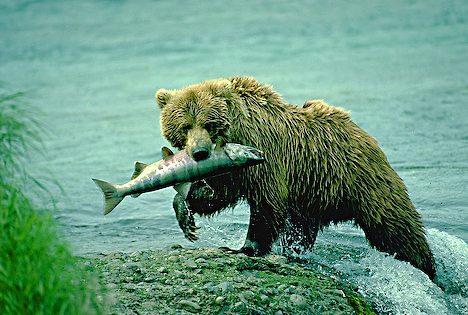
A grizzly bear survives because he is well-adapted to his environment. When he reproduces he passes on those traits to his offspring. This process is called

a)

Natural Selection

b)

Selective Breeding

c)

Random mutations

d)

Variations in a species

128.
Behavioral changes of individuals of a species that allow for better survival. (Acquired traits)
a)
Variation
b)
Adaptation
c)
Behavior
d)
Environment
129.

Where do adaptations come from?

a)

The individual organism decides to adapt

b)

Mutations that give an organism an advantage in its environment

c)

Genetic recombination during meiosis

d)

Both mutations and genetic recombination are sources of adaptation

130.
Sexual reproduction is an advantage in a changing environment because __________ .
a)
it decreases variation within the population
b)
it increases variation within the population
c)
the environment will change to meet the needs of the new individuals
d)
it will not allow adaptation within the population
131.

Mutations are important because they bring about

a)

death of the organism in which they develop

b)

genetic variation needed for a population to evolve

c)

benefits for the individual, not for the population

d)

changes in genotype, but not phenotype
132.
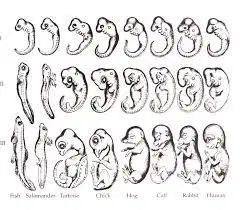
Which of the following statements best reflects the evolutionary importance of figures below?
a)
all adult vertebrates retain pharyngeal pouches
b)
the evolutionary history of organisms is evident in the way embryos develop
c)
new genetic instructions have been disregarded in the evolution of vertebrates
d)
early in development, vertebrate embryos show no evidence of common ancestry
133.
10,000 years ago, a group of squirrels were separated by the Colorado River. The two groups of squirrels evolved into two different species. This is an example of
a)
genetic drift
b)
behavioral isolation
c)
geographic isolation
d)
reproductive isolation
134.
Which of the following types of populations would be most likely to survive a disaster in the environment?
a)
large and diverse
b)
small and diverse
c)
large and identical
d)
small and identical
135.
An analysis of the DNA from these organisms would indicate that
a)
their DNA is identical
b)
they all have gill pouches
c)
their DNA sequences show many similarities
d)
they all have the same number of chromosomes
136.

Do organisms "decide" to evolve and change? (they have the ability to change whenever they want)

a)
Yes, they know they need to change to survive 
b)
No, they change because of natural selection
137.
Kettlewell's study that found a relationship between the amount of soot on trees and the survival of the peppered moth is an example of ________ .
a)
overproduction
b)
natural selection
c)
genetic interaction
d)
artificial selection
138.
These bones are known as
a)
fossil structures
b)
vestigial structures
c)
sequential structures
d)
homologous structures
139.

This is an example of which type of adaptation?

a)

Physiological

b)

Structural

c)

Behavioral

140.

What is the definition of fitness?

a)
ability to survive and reproduce in a specific environment
b)
organisms with traits well suited to their environment survive and reproduce at a greater rate
c)
a growing population causes a scarcity of resources
d)
differences in the DNA sequence
141.


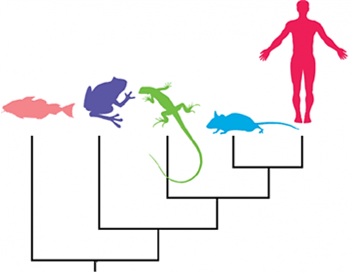
The image below shows a phylogenetic tree that compares many known organisms. Based on the information in this phylogenetic tree, which of the following statements correctly makes a claim about fungi?

a)

Fungi are closer to bacteria than plants.


b)

Fungi are closer to bacteria than animals.

c)

Fungi are closer to animals than plants.

d)

Fungi are closer to animals than bacteria.
142.
According to Darwin's theory of natural selection, the individuals that tend to survive are those that have
a)
the greatest number of offspring
b)
variations best suited to the environment
c)
characteristics that are admired by plant and animal breeders
d)
characteristics their parents acquired by use and disuse
143.
The differences among a species, like different bird beaks, are called
a)
genes.
b)
variations.
c)
traits.
d)
theories.
144.
The similarities of these structures suggest that these organisms
a)
evolve slowly
b)
live for a long time
c)
have a common ancestor
d)
all grow at different rates
145.
The fossil record provides evidence that:
a)
fossils cannot be dated accurately
b)
older species gave rise to more recent species
c)
the fossilized species have no connection to today's species
d)
all species were formed during Earth's formation and have changed little since then
146.
Which of the following adaptations allowed the finches (birds) to still get food as the seasons on the Galapagos Islands changed?
a)
feather color
b)
beak size and shape
c)
length of legs
d)
size of wings
147.
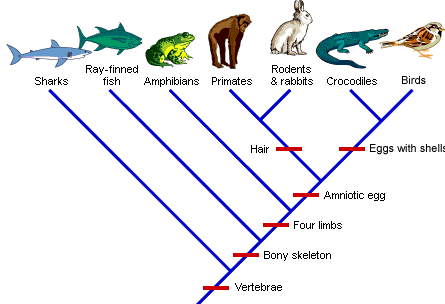
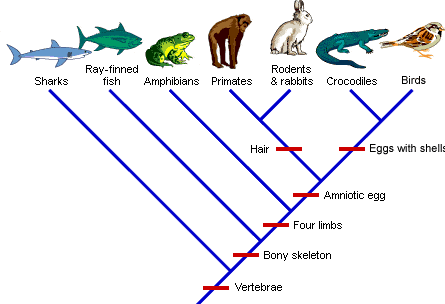
According to this cladogram, sharks are MOST closely related to which organism? 
a)
Amphibians
b)
Ray finned fish
c)
Crocodiles
d)
Birds
148.
Which two orgainsms have hair? 
a)
Sharks & Ray Finned Fish
b)
Primates & Rodents
c)
Birds & Crocodiles
d)
Rabbits & Birds
149.

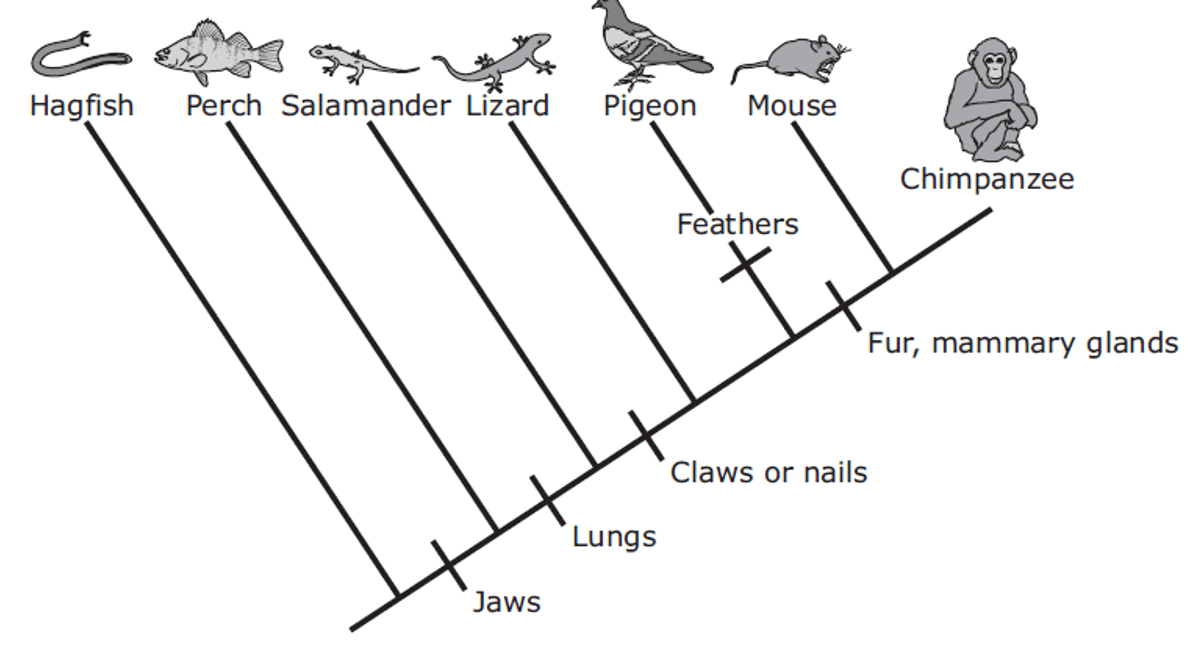
All the animals to the right of the salamander would have the common characteristic of...

a)

Fur

b)

Claws or nails

c)

Lungs

d)

Jaws

150.

What is the human most closely related to?

a)

Fish

b)

mouse

c)

Salamander

d)

Human

151.
Living things can be classified based on __________, embryological, and molecular evidence.
a)
familial
b)
habitual
c)
structural
d)
developmental
152.
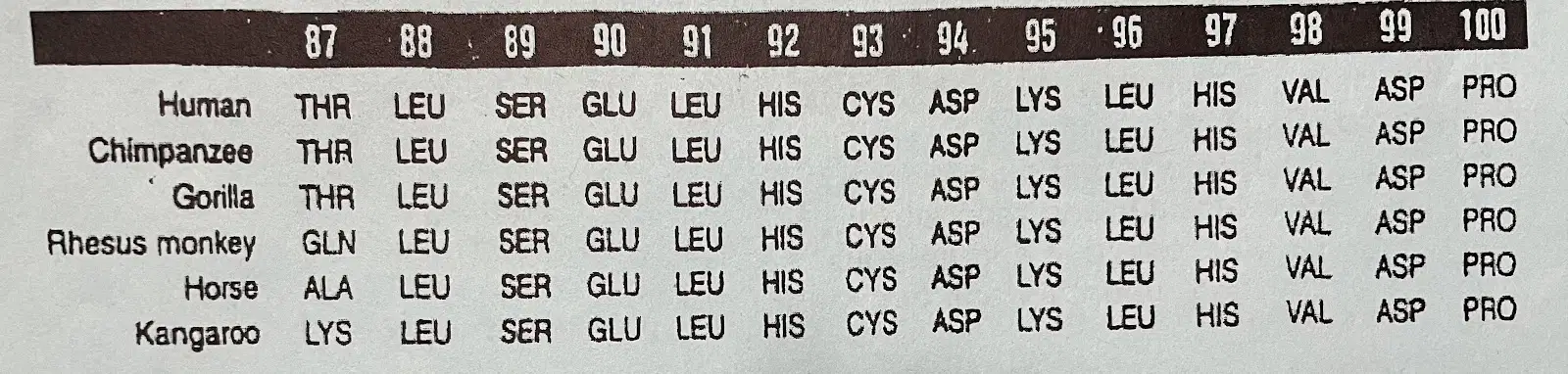
Look at the chart below which shows the similarities among some vertebrates. Which organisms are the most closely related to humans?
a)
horse, kangaroo
b)
chimpanzee, gorilla
c)
rhesus monkey, horse, kangaroo
d)
chimpanzee, gorilla, rhesus monkey
153.

The arm of a human, the flipper of a whale, and the wing of a bat all have similar bone structures. Therefore, these parts of the body would all be considered...

a)

homologous structures

b)

vestigial structures

c)

transitional fossils

d)

common ancestors

154.

The tail bone, wisdom teeth, and appendix are all parts of the human anatomy that would be considered...

a)

homologous structures

b)

vestigial structures

c)

fossils

d)

extinct

155.

A bird's wing and a butterfly's wing have the same function, but they have very different structures. These structures are classified as follows:

a)

homologous structures

b)

analogous structures

c)

vestigial structures

d)

embryological homologues

156.
When the individuals of two populations can no longer interbreed due to geographic isolation, the two populations will become
a)
different classes
b)
different species
c)
the same species
d)
different families
157.

Two organisms that are closely related would have

a)

very similar DNA sequence

b)

exactly the same DNA sequences

c)

no proteins in common

d)

completely different DNA sequence

158.

Based on the number of differences in amino acid sequence, which pair of organisms is least related to each other?

a)

Fruit fly-wheat

b)

Human - wheat

c)

Fruit fly- pigeon

d)

Human-horse

159.

The study of embryological development provides anatomical evidence for evolution because...

a)

all vertebrate embryos pass through the same stages of development in the same sequence.

b)

all vertebrates are born with gills and a tail.

c)

all vertebrate embryos have completely different stages of development that look nothing alike.

d)

all plants and animals have wings, even if you can't see them when they are born.

160.

The fossil record helps to build a timeline of life on Earth because...

a)

the older a fossil is, the deeper it will be found within layers of sedimentary rock.

b)

the older a fossil is, the closer it will be to the surface layers of sedimentary rock.

c)

gaps in the fossil record tell us all of the detailed changes to life on Earth during that gap.

d)

fossilized clocks from millions of years ago tell us exactly what time it was when specific events happened.

161.

In this example of natural selection, what environmental factor is acting as a selection force - or environmental pressure - on the giraffe?

a)

Food is found on tree tops

b)

Having a long neck

c)

Being cursed with beauty

d)

Having spots that act as camouflage