wayground logo

Free Printable Worksheets

Font size

S
M
L
XL
Worksheets

Final Exam Review 2019

Total questions: 127

Worksheet time: 3hrs 47mins
Name
Class
Date
1.
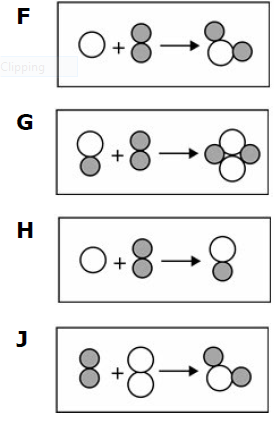
Which of the following models best demonstrates a balanced chemical equation?
a)
F
b)
G
c)
H
d)
J
2.
AB + CD →AD + CB
a)
Double Replacement
b)
Single Replacement
c)
Synthesis
d)
Decomposition
3.
Which chemical reaction breaks down into 2 substances?
a)
Double displacement
b)
Single displacement
c)
Synthesis
d)
Decomposition
4.
Which of the following is an example of synthesis?
a)
Na + Br--> NaBr
b)
KClO--> KCl + O2
c)
HgO + Cl2-->HgCl + O2
d)
Cl2 + NaBr --> NaCl + Br2
5.
A + BC →B + AC
a)
Single Replacement
b)
Decomposition
c)
Double Replacement
d)
Synthesis
6.
Which of the following is true about the atoms involved in a chemical reaction?
a)
The same number of each type of atom will be present before and after a chemical reaction
b)
Some of the atoms present before the reaction will be lost during a chemical reaction
c)
Some of the atoms will be hcanged into a different type of atom by a chemical reaction
d)
During a chemical reaction, atoms will always be combined into much larger molecules
7.
How do you know Baking Soda and Vinegar reaction was endothermic?
a)
The temperature increases (goes up)
b)
The temperature descreases (goes down)
c)
The temperature stays the same
8.

A chemical reaction that gives off heat is called a(n) _________.

a)

subscript

b)

inhibitor

c)

product

d)

exothermic reaction

e)

synthesis reaction

9.
The Law of Conservation of Mass states
a)
that matter exists in all states and reacts the same
b)
that matter can only be changed into new substances by introducing a catalyst
c)
that matter exists in the same state throughout any chemical change
d)
that matter cannot be created or destroyed and that the mass of the products must equal the mass of the reactants
10.
How many Al atoms are in this compound?         4Al2O3
a)
2
b)
8
c)
6
d)
4
11.
How many F atoms are in this compound?
6MgF2 
a)
2
b)
6
c)
8
d)
12
12.
A larger number found in front of a chemical formula is a(n)
a)
Element 
b)
Exponent
c)
Subscript 
d)
Coefficient 
13.
Is this equation balanced?
a)
yes
b)
no
c)
Not enough information
14.
Is this equation balanced?
a)
yes
b)
no
c)
Not enough information
15.
An object is _____ if its position changes relative to another object.
a)
in motion
b)
at reset
c)
a frame of refence
d)
magical
16.
A place or object used for comparison to determine if another object is in motion is called a
a)
comparison point
b)
reference point
c)
point of view
d)
motion detector
17.
A distance vs. time graph shows an object's
a)
frame of reference
b)
speed
c)
acceleration
d)
favorite food
18.
Speed =
a)
distance / time
b)
time / distance
c)
distance * time
19.
You walk 10 meters to math class in 20 seconds. Your average speed is
a)
2 m/s
b)
0.5 m/s
c)
200 m/s
d)
5 m/s
20.
On a distance-versus-time graph, a straight line ALWAYS indicates that an object’s speed is _____.
a)
constant
b)
zero
c)
increasing
d)
decreasing
21.
Change in speed over a given period of time is
a)
velocity
b)
motion
c)
speed
d)
acceleration
22.
On a distance vs. time graph, the steeper the slope _____
a)
the slower the speed
b)
the faster the speed
c)
less acceleration
d)
greater acceleration
23.
What is the SI unit for acceleration?
a)
m/s
b)
m
c)
m/s2
d)
s
24.
When something has speed in a certain direction it is called ___________.
a)
motion
b)
position
c)
velocity
d)
speed
25.
Acceleration of an object happens when things ________
a)
slow down
b)
go faster
c)
change direction (turn)
d)
All of the above
26.

The distance an object travels per unit of time (how far, how fast) is called:

a)

direction

b)

speed

c)

acceleration

d)

deceleration

27.
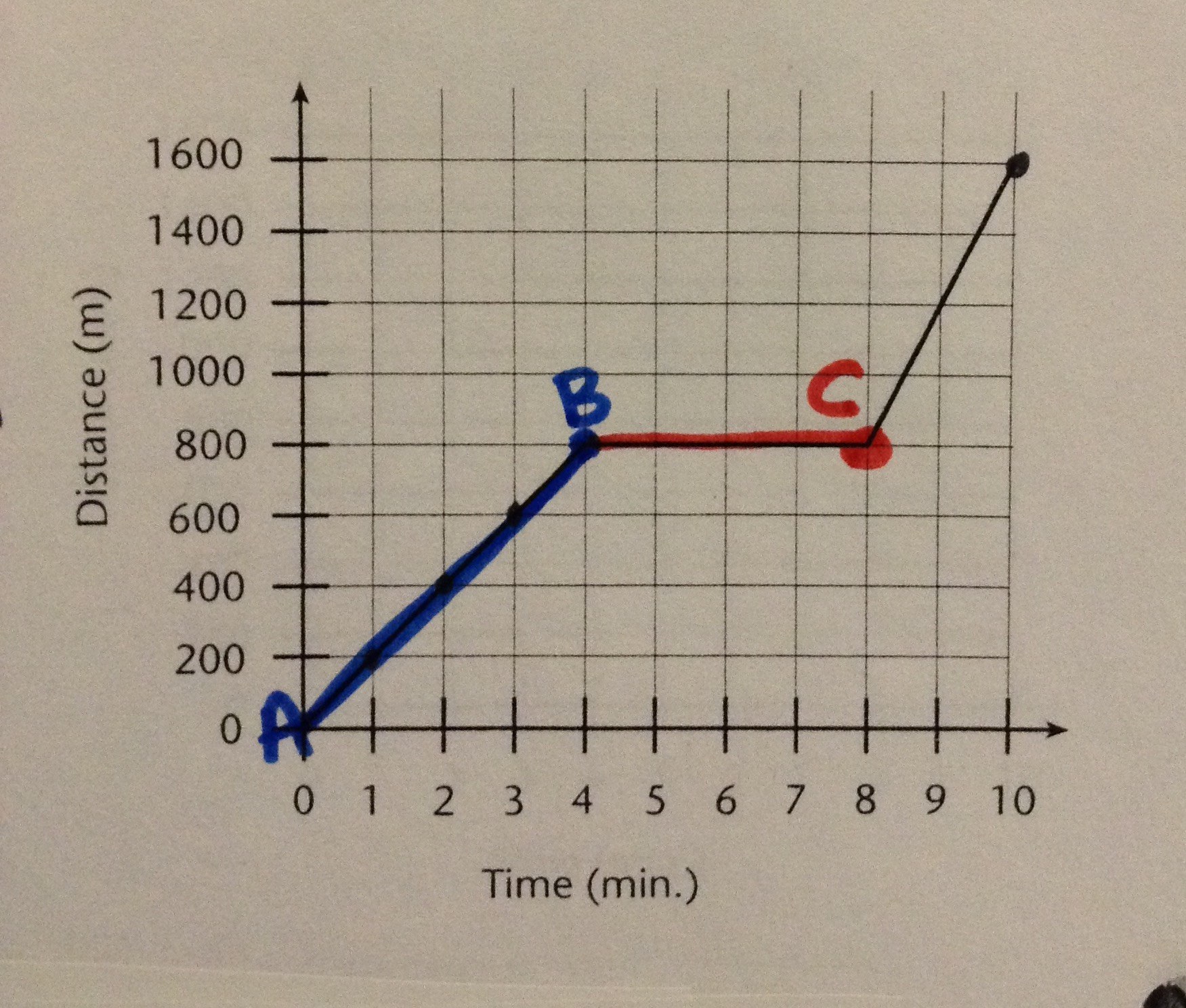
LT4: The graph shows Ashley riding her bike to Maria's house. 
What was occurring from point B to point C?
a)
She was increasing her speed.
b)
She stopped for 4 minutes
c)
She was decreasing in speed
28.
The graph represents
a)
no motion
b)
Constant velocity
c)
Acceleration
d)
negative acceleration
29.
The graph represents
a)
no motion
b)
constant velocity
c)
acceleration
d)
negative acceleration
30.
The graph respresents
a)
No motion
b)
Constant Velocity
c)
Acceleration
d)
Deceleration
31.
What is a PUSH or PULL of an object?
a)
Motion
b)
Force
c)
Friction
d)
Gravity
32.
What is the net force?
a)
40 N left
b)
0 N Balalnced
c)
400 N right
d)
40 N right
33.
How will this object move? 
a)
It won't move. 
b)
It will move to the right. 
c)
It will move to the left. 
d)
It will move in both directions. 
34.
Forces that have a net force of zero ( the object is still).
a)
Balanced force
b)
Unbalanced force
35.
The sum of all forces acting on an object and direction
a)
Contact Force
b)
Balanced Force
c)
Unbalanced Force
d)
Net Force
36.
What are balanced forces?
a)
Forces in the same direction
b)
Forces of the same size
c)
forces of the same size in opposite directions
37.
The force that opposes the motion of two surfaces sliding past each other is called ___________.
a)
acceleration
b)
inertia
c)
friction
d)
unbalanced
38.
What is the unit of force?
a)
Kilogram
b)
Meter
c)
Pascal
d)
Newton
39.
What force brings the pencil down?
a)
Applied
b)
Magnetic
c)
Normal
d)
Gravitational
40.
"For every action, there is an equal and opposite reaction."
a)
Newton's 1st Law
b)
Newton's 2nd Law
c)
Newton's 3rd Law
d)
Newton's 4th Law
41.
Force = Mass x Acceleration
a)
Newton's 1st Law
b)
Newton's 2nd Law
c)
Newton's 3rd Law
d)
Newton's 4th Law
42.
"An object in motion (or at rest) will to stay in motion (or at rest) until an outside force acts upon it."
a)
Newton's 1st Law
b)
Newton's 2nd Law
c)
Newton's 3rd Law
d)
Newton's 4th Law
43.
The tendency of an object to resist changes in its motion is...
a)
inertia
b)
force
c)
acceleration
d)
velocity
44.
Which of the following is the same as a Newton?
a)
kg*m/sec/sec
b)
kg*m/sec
c)
m/sec/sec
d)
m/sec
45.
Which of the following is the units for momentum?
a)
kg*m/sec/sec
b)
kg*m/sec
c)
m/sec/sec
d)
m/sec
46.
Which of the following is the units for acceleration?
a)
kg*m/sec/sec
b)
kg*m/sec
c)
m/sec/sec
d)
m/sec
47.
An archer pulls the bowstring back, then releases the string and the arrow flies forward. Pulling the string back is the...
a)
action force
b)
reaction force
c)
net force
d)
inertia
48.
A cannonball with a mass of 0.5 kg is flying at an acceleration of 10 m/sec/sec. What is it's force?
a)
50 Newtons
b)
5 Newtons
c)
20 Newtons
d)
9.5 Newtons
49.
Gravity is increased with...
a)
greater mass & shorter distance
b)
greater mass & farther distance
c)
lower mass & shorter distance
d)
lower mass & farther distance
50.
A magician pulls a tablecloth out from under dishes and glasses on a table without disturbing them.
a)
Newton's 1st Law
b)
Newton's 2nd Law
c)
Newton's 3rd Law
51.
A person not paying attention while skateboarding hits a rock. The skateboard stops...they don't.
a)
The Law of Inertia
b)
The Law of Acceleration
c)
The Law of Conservation of Momentum
52.
A 20 kg bike accelerates at 10 m/s2.  what was the force
a)
25
b)
200 N
c)
20 N
d)
10 N
53.
Energy causes ___________ to occur.
a)
change
b)
motion
c)
age
54.
What type of energy is in this picture?
a)
Kinetic
b)
Potential
c)
Electromagnetic
55.
When plants convert the sun's energy into food, which type of energy does the sun energy become?
a)
kinetic
b)
chemical
c)
thermal
56.
What kind of energy does this device use?
a)
Chemical
b)
Electrical
c)
Thermal
d)
Chemical
57.
A battery converts what type of energy to another?
a)
sound to kinetic
b)
light to heat
c)
mechanical to electrical
d)
chemical to electrical
58.

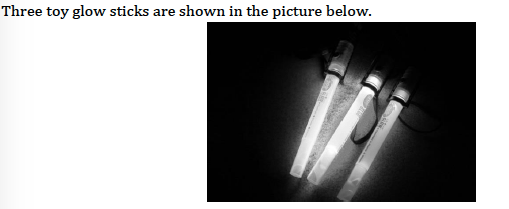
The glow sticks produce light for a short amount of time. The light from the glow stick is a conversion from what to what?

a)

thermal to light

b)

gravitational to potential

c)

radiant to electrical

d)

chemical to radiant

59.

What form of energy is often a byproduct during energy transformations? (created even though it wasn't the intention of the transformation)

a)

Radiant Energy

b)

Chemical Energy

c)

Thermal Energy

d)

Electrical Energy

60.
On a roller coaster, where is maximum potential energy?
a)
At the bottom of a big hill
b)
When going around a corner
c)
When going upside down
d)
At the top of a big hill
61.
The formula for work is:
a)
d = r x t
b)
p = m x v
c)
f = m x a
d)
w = d x f
62.
Energy that is stored in bonds between atoms is:
a)
Mechanical energy
b)
Chemical energy
c)
Kinetic energy
d)
Nuclear energy
63.
Energy caused by the movement in the particles of matter. It is a form of kinetic energy.
a)
Nuclear energy
b)
Sound energy
c)
Light energy
d)
Thermal energy
64.

According to which law of energy, energy can't be created or destroyed?

a)

First Law of Motion

b)

The Law of Tacos

c)

Laws of Energy

d)

Law of Conservation of Energy

65.
What kind of energy is associated with vibrations?
a)
mechanical energy
b)
electrical energy
c)
light energy
d)
sound energy
66.

Which of the following would sound travel through the fastest?

a)

water

b)

oxygen

c)

steel

d)

koolaid

67.
The picture is a good example of which of the following?
a)
refraction
b)
a broken pencil
c)
opaque
d)
the glass is broken
68.
According to the Law of Conservation of Energy, energy cannot be _________ or ____________. 
a)
destroyed, destroyed
b)
created, saved
c)
created, destroyed
d)
lost, found
69.
Energy transformations occur when...
a)
energy is created through conduction
b)
energy changes from one form to another
c)
two forces slide together that are touching
d)
a chemical reaction takes place
70.
Gravitational potential energy depends on the ________ and ________ of the object. 
a)
Height and mass
b)
Friction and movement
c)
Mass and Movement
d)
Height and Friction 
71.

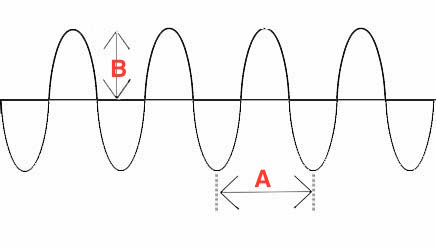
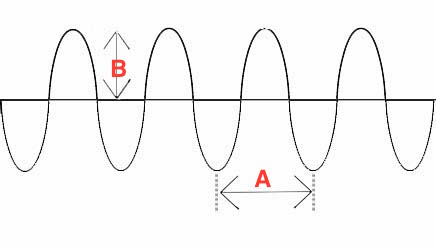
What property of this wave is represented by the letter "A"

a)

amplitude

b)

crest

c)

trough

d)

wavelength

72.
What property of the wave is represented by the letter "B"?
a)
amplitude
b)
crest
c)
trough
d)
wavelength
73.
The highest point on a wave is:
a)
the crest
b)
the trough
c)
the top
d)
the coast 
74.
The number of wavelengths that pass a point each per second is:
a)
frequency
b)
period
c)
longitudinal 
d)
transverse wave 
75.

The type of waves that require medium to pass:

a)

Mechanical Waves

b)

Electromagnetic Waves

c)

Transverse Waves

d)

Gamma Radiation

76.
When the frequency of a wave increases, what happens to the wavelength?
a)
The wavelength is not directly affected by the frequency of a wave.
b)
The wavelength increases.
c)
The wavelength decreases.
d)
More specific information is needed to form a conclusion about the wavelength.
77.
A mechanical wave cannot travel through...
a)
a vacuum(empty space).
b)
water.
c)
air. 
d)
glass.
78.
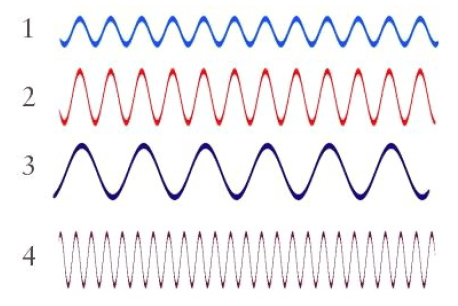
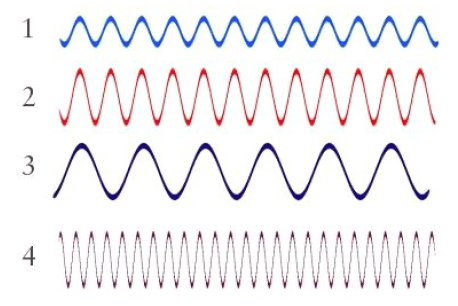
Which wave in the diagram has the greatest frequency?
a)
1
b)
2
c)
3
d)
4
79.
Which wave in the diagram has the greatest wavelength?
a)
1
b)
2
c)
3
d)
4
80.
When a wave strikes and object and bounces off. (example echo)
a)
medium
b)
refraction
c)
reflection
d)
interference
81.
When a wave bends as it passes through at an angle from one medium to another.(example: pencil in a glass of water-)
a)
medium
b)
refraction
c)
reflection
d)
interference
82.
What kind of wave moves at right angles to the direction of the wave?
a)
compressional waves
b)
mechanical waves
c)
transverse waves
d)
ultraviolet rays
83.

What do we call the part of a compressional wave that is when the waves are squeezed together?

a)

compression

b)

rarefaction

c)

crest

d)

trough

84.

What do we call the part of a compressional wave that is spread a part?

a)

compression

b)

rarefaction

c)

crest

d)

trough

85.
Waves are a transfer of what?
a)
Heat
b)
Light
c)
Energy
d)
Food
86.

What is a mechanical wave?

a)

a disturbance in a medium

b)

vibrations

c)

mediums

d)

a disturbance in a vacuum

87.
Which wave has a greater frequency?
a)
A
b)
B
88.
Which answer best explains how a wave is created?
a)
A wave is created when energy stays still
b)
A wave is created when a force causes a vibration
c)
A wave is created when molecules become a medium
d)
A wave is created when a liquid becomes a solid
89.
Which conversion factor should be used for the following question " How many molecules are there in 4.00 moles of glucose, C6H12O6
a)
1 mole = 78.12 g
b)
1 mole = 22.4 L 
c)
1 mol = 6.02x 10²³ particles 
d)
more than one
90.
Which conversion factor should be used to solve the following, "How many moles in 28 grams of CO2?"
a)
1 mol = 22.4 L 
b)
1 mol = 44.01 g
c)
1 mol = 6.02x10²³ atoms
d)
more than one
91.
What are the units for molar mass?
a)
grams
b)
amu
c)
grams/mole
d)
liters
92.
The number 6.02 x 10²³, which is the number of particles found in a mole. 
a)
molar mass
b)
mole
c)
Avogadro's number
d)
hydrate
93.
How many molecules are in 2.5 mol of NaCl?
a)
1.51x10²³
b)
146
c)
4.15
d)
1.51x1024
94.
How many atoms of carbon are in 6.00g of carbon?
a)
1.20x1024atoms C
b)
6.02x10²³atoms C
c)
3.01x10²³atoms C
d)
1.50x10²³atoms C
95.
What is a coefficient?
a)
The small number on the right of the chemical symbol.
b)
The large number in front of a chemical formula.
c)
The number in between the chemical symbols.
d)
The number behind a chemical formula.
96.
Is the equation balanced?: 2H2O + O2 --> 4MgO + 3Fe
a)
Yes
b)
No
97.
Gravity attracts all objects towards one another.
a)
False
b)
True
c)
It depends
d)
I don't care
98.
The force of gravity is also known as
a)
Mass
b)
Weight
c)
Distance
d)
Acceleration
99.
An object is falling but is not accelerating. What do you know?
a)
Gravity is stronger than air resistance
b)
Air resistance is stronger than gravity
c)
Air resistance is equal to gravity
d)
Forces are unbalanced
100.
Where would you have to travel to reduce your weight but not lose any mass?
a)
The moon
b)
The Sun
c)
Jupiter
d)
Saturn
101.
When does a falling object experienced balanced forces?
a)
Terminal velocity
b)
During free fall
c)
When it first starts to fall
d)
Just before it hits the ground
102.
A cyclist traveling at 25 km/hr turns sharply to the left while continuing to move 25 km/hr. This means the forces involved are_____________________.
a)
Balanced, because the cyclist's speed did not change.
b)
Balanced, because he was still moving forward.
c)
Unbalanced, because it's the same bicycle.
d)
Unbalanced, because his direction changed.
103.
Which of the following is a form of the inclined plane?
a)
pulley
b)
screw
c)
wheel and axle
d)
lever
104.
A log splitting machine was invented to split logs quickly. A motor powers a metal piece that is pushed through the middle of a log. The metal piece used to split a log is an example of what simple machine? 
a)
wedge
b)
pulley
c)
screw
d)
lever
105.
Which of the following does a simple machine do?
a)
allows the users to apply less force over a longer distance
b)
reduce the amount of force needed to do work
c)
change the direction of the applied force
d)
all of the above
106.
A seesaw is an example of a  
a)
wedge
b)
lever 
c)
inclined plane 
d)
pulley 
107.
What is effort (input) force?
a)
the force required by a machine in order to accomplish work (the force you put on the machine)
b)
the force which an effort force must overcome in order to do work on an object via a simple machine.
c)
the force the machine exerts on a object
d)
the output work times the input distance
108.
What is resistance (output) force?
a)
the force required by a machine in order to accomplish work (the force you put on the machine)
b)
the force which an effort force must overcome in order to do work on an object via a simple machine.
c)
the force the machine exerts on a object
d)
the output work times the input distance
109.
Using a lever, Joe is able to lift a 10,000 N car off of the ground with a force of 1000 N. What is the mechanical advantage of the lever?
a)
1
b)
10
c)
100
d)
1000
110.
The mechanical advantage of this inclined plane is.....
a)
2.4
b)
3.4
c)
4.4
111.

How would I find an objects acceleration?

a)

a=f/m

b)

a=f x m

c)

a=fm

112.

If you have an equation that says:

F= 10 N

M= 2 Kg

A= ?


What does the question mark represent?

a)

5 m/s

b)

20 m/s

c)

12 m/s

113.
Which of the following statements regarding force, mass and acceleration is true? 
a)
If objects with the same mass are pushed, larger forces will cause greater acceleration.
b)
If objects with the same mass are pushed, larger forces will cause less acceleration. 
c)
 Objects with large masses accelerate at a greater rate than objects with less mass.
d)
Objects with large masses need less force to accelerate than objects with less mass.
114.
If the same force were applied to each vehicle, which would have the greatest change in speed?
a)
Vehicle X
b)
Vehicle Y
c)
Vehicle Z
115.
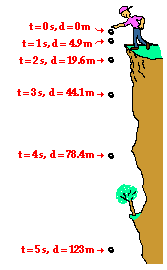
What happens to the velocity of a ball as it is dropped off a cliff? 
a)
It decreases at a uniform rate 
b)
It increases at a uniform rate 
c)
It is constant 
d)
It increases at a non-uniform rate
116.
Which would hit the ground first if dropped from the same height in a vacuum—a feather or a metal bolt?
a)
the feather
b)
the metal bolt
c)
They would hit the ground at the same time.
d)
They would be suspended in a vacuum.
117.
Which would fall with greater acceleration in a vacuum—a leaf or a stone?
a)
the leaf
b)
the stone
c)
They would accelerate at the same rate.
d)
It is difficult to determine without more information.
118.
When an ambulance move TOWARD you it sounds ________ pitched. 
a)
high
b)
low
c)
medium
119.
Which objects on the table are "Translucent"?
a)
Fish Bowl; Supply Box; Goggles
b)
Pencil; Fish Bowl; Cup
c)
Fish Bowl; Supply Box; Pitcher
120.

When a crest and a trough interfere, what occurs?

a)

They combine to create a higher amplitude wave.

b)

They counteract and the wave stops.

c)

The wave changes into a longitudinal wave.

d)

They combine to create a low amplitude wave.

121.

Light can behave as both a ______ and a _______.

a)

Ray; beam

b)

Wave; particle

c)

Natural source; unnatural source

d)

Refraction; reflection

122.

Our eyes perceive colors because of differences in which of the following properties of light?

a)

Intensity

b)

Wavelength

c)

Angle

d)

Source

123.
Objects that reflect ALL colors will appear _____?
a)
Black
b)
White
c)
Gray
d)
Multi-colored
124.

The unit for measuring frequency is the ---

a)

Joule

b)

Hertz

c)

Gram

d)

Newton

125.

Sound can be measured in ________. It is recommended that humans not be exposed to volumes over 90 _______ for long periods of time.

a)

decimals

b)

frequency

c)

hertz

d)

decibels

126.
Which part of the ear acts as a funnel for sound waves?
a)
inner ear
b)
outer ear
c)
middle ear
d)
ear canal
127.
A wave has a frequency of 8 Hz.  What is the period of the wave?
a)
16 sec
b)
2 m
c)
0.5 sec
d)
0.125 sec