wayground logo

Free Printable Worksheets

Font size

S
M
L
XL
Worksheets

Biology, Second Semester Review

Total questions: 100

Worksheet time: 1hrs 22mins

Name
Class
Date
1.
Which of the following is a term for a group of similar organisms that can reproduce fertile offspring?
a)
individual
b)
population
c)
species
d)
fossil
2.
Which of the following is a fossil?
a)
a plant that has recently died
b)
a group of organisms that can reproduce
c)
a structure or organ that no longer functions
d)
a trace of an organisms that existed in the past
3.
The difference in the physical traits of an individual from those of other individuals in a group is called a(n)
a)
change
b)
adaption
c)
species
d)
variation
4.
Over time, adaptions can lead populations to experience 
a)
environmental changes
b)
genetic changes
c)
geological changes
d)
extinction
5.
what did Charles Darwin observe in finch populations of the Galapagos Islands off the coast of South America?
a)
different species on different islands
b)
all species on one of the islands
c)
identical species on all the islands
d)
the same species as North America
6.
In natural selection, the selective agent is the
a)
humans
b)
mutations
c)
breeders
d)
environment
7.
All rabbits living in a particular area would be an example of a(n)
a)
population
b)
species
c)
fossil
d)
individual organism
8.
a bird that can easily outcompete other birds for food and that can produce many eggs has a high
a)
life expectancy
b)
mutation rate
c)
fitness
d)
adaptability
9.

Which of the following describes natural selection?

a)

it acts on genetic material directly

b)

it acts on existing physical traits

c)

it forms new traits

d)

it forms new genetic material

10.
which of the folllowing is an exammple of a vestigial structure?
a)
the wings of a red-tailed hawk
b)
the hind limbs of a house cat
c)
the fins of sharks
d)
the wings of an ostrich
11.

What is suggested by the anatomical similarity of different species of vertebrates?

a)

no evolutionary relationships between the groups

b)

recent common ancestry

c)

similar environments in the past

d)

evolution from a distant common ancestor

12.
Some organisms that share a common ancestor have features that have different functions, but similar structures.  These are known as
a)
vestigial structures
b)
analogous structures
c)
homologous structures
d)
fossil structures
13.
If an organism has a vestigial structure, that structure likely once had a function in a(n)
a)
close relative
b)
early ancestor
c)
unrelated organism
d)
embryological stage
14.
Two organisms that are closely related would have
a)
very similar DNA sequence
b)
exactly the same DNA sequences
c)
no proteins in common
d)
completely different DNA sequence
15.
protein sequences in one organism that resemble those of another suggest a 
a)
coincidence
b)
lack of evolutionary relationship
c)
great number of mutations
d)
shared ancestry
16.
a measure of how commonly a particular allele occurs in a population is known as the 
a)
gene pool
b)
allele frequency
c)
mutation rate
d)
phenotype
17.

The more genetic variation a population has,

the more likely it is for some individuals to

a)

evolve

b)

migrate

c)

survive

d)

mutate

18.
Genetic variation can arise from a random change in the DNA of a gene.  The change is called a(n)
a)
mutation
b)
gene flow
c)
gene pool
d)
allele
19.
What increases genetic variation when animals move  from one population to another
a)
genetic drift
b)
sexual selection
c)
bottleneck effect
d)
gene flow
20.

The five-factors for evolution are gene flow, genetic drift, mutation, natural selection and ....

a)

non-random mating

b)

controlled mating

c)

emigration

d)

immigration

21.
Mutations are important because they bring about
a)
death of the organism in which they develop
b)
genetic variation needed for a population to evolve
c)
benefits for the individual, not for the population
d)
Hardey-Weinberg equilibrium within a population
22.
What is speciation?
a)
combining of tow species to form one with different traits
b)
isolation that affects mating behaviors
c)
timing of mating that prevents normal sexual selection
d)
divergence of two or more species from an existing one
23.
An earthquake causes an ocean channel top open and separate an island into two.  the species on each section are now in
a)
geographic isoliation
b)
behavioral isolation
c)
disruptive selection
d)
temporal isolation
24.
What kid of isolation occurs when two populations of birds have different courtship dances?
a)
geographic
b)
sexual
c)
temporal
d)
behavioral
25.
two species are in different environments and look very similar.  However, that are not closely related (analogous).  Their resemblance is most likely an example of.
a)
sexual selection
b)
temporal isolation
c)
convergent evolution
d)
divergent evolution
26.

Other insects cannot, but, a bumble bee has just enough weight to open up the snapdragon flower and pollinate. This adaption is ....

a)

convergent evolution

b)

co-evolution

c)

divergent evolution

d)

speciation

27.

What is the term for a feature that allows an organism to survive better in its environemtn?

a)

variation

b)

adaptation

c)

homologous structure

d)

vestigial structure

28.
What is the process in which humans breed organisms for certain traits?
a)
natural selection
b)
inheritance
c)
artificial selection
d)
descent withOUT modification
29.
Natural selection results in change over time by acting on traits that are
a)
heritable
b)
new
c)
mutated 
d)
better than the best
30.

The combined alleles of all individuals in a population is called the population's

a)

phenothype

b)

gene pool

c)

mutation rate

d)

allele frequency

31.
Age structure data include all of the following except
a)
the number of members of a population who are between 5 and 11 years old.
b)
the ratio of males to females in a population
32.
Which of the following leads to a decrease in birthrates among women?
a)
Higher Education
b)
High Infant Mortality Rate
c)
No Prenatal Care
d)
No contraceptives
33.
VOCAB: The study of human population statistics
a)
demography
b)
biology
c)
microbiology
d)
ecology
34.
VOCAB: The average number of children a female member of a population has during her lifetime
a)
total fertility rate
b)
replacement fertility rate
c)
growth rate
d)
death rate
35.
VOCAB: describes the relative numbers of organisms of each age within a population and is often represented by a graph
a)
age structure diagram
b)
population growth rate
c)
demographic transition
d)
fertility rate
36.
VOCAB: number of males compared to females in a population
a)
sex ratio
b)
age structure
c)
growth rate
d)
population shift
37.
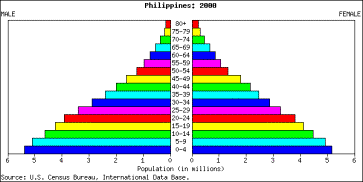
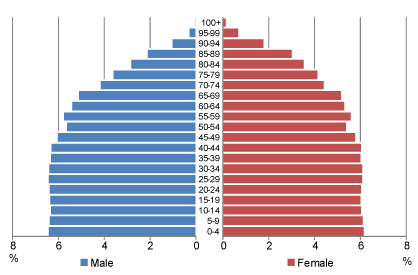
According to the population pyramid of this country, its population is most likely...
a)
growing slowly.
b)
growing rapidly.
c)
decreasing.
d)
not changing.
38.
What kind of growth is this country experiencing?
a)
Exponential Growth
b)
Stable Growth
c)
Declining Growth
39.
VOCAB: Introduction of machinery powered by fossil fuels, marked by the shift from a rural, agricultural-based society to an urban, industry-based society
a)
Industrial Revolution
b)
Greenhouse Effect
c)
Endangered Species Act
d)
Climate Change
40.
VOCAB: The average number of years an individual is expected to live.
a)
life expectancy
b)
infant mortality
c)
death rate
d)
growth rate
41.
VOCAB: how a population changes in size during a specific period of time.
a)
growth rate
b)
infant mortality
c)
life expectancy
d)
death rate
42.
The world's population in 2011 was approximately 7 billion and a steady rate of growth was expected to reach 14 billion in approximately 90 years. The period of 90 years is known as: 
a)
doubling time.
b)
life expectancy.
c)
overpopulation.
d)
demographic transition.
43.
Life expectancy is lowest in:
a)
East Asia.
b)
North America.
c)
Africa.
d)
Western Europe.
44.
The number of individuals an environment can support is known as the
a)
Total Fertility Rate
b)
Exponential Growth
c)
Limiting Factor
d)
Carrying Capacity
45.
In recent years, the human population has 
a)
increased exponentially
b)
decreased exponentially
c)
decreased slowly
d)
increased slowy
46.
High levels of GDP per capita indicate...
a)
Higher levels of happiness 
b)
Higher standard of living
c)
Equal levels of wealth 
d)
Self-sufficient communities
47.
What is one way improved agriculture contributed to population growth?
a)
it led to better sanitation
b)
it created a surplus of food
c)
it meant that horses could be used for transportation
d)
it led to the production of more wool for warm clothing
48.
What is the carrying capacity of the following graph?
a)
1000
b)
8000
c)
800
d)
600
49.
What type of population change does this graph represent
a)
Exponential Growth
b)
Massive Die-off
c)
Linear Growth
d)
Decrease in Birth-Rate
50.
A person that moves from one country to another country.
a)
Emigrant
b)
Immigrant
c)
Religious Persecution Escapee
d)
Citizen
51.
Mutations are a source of _______________. 
a)
Variation 
b)
Disease
c)
Polypeptide 
52.
Any change in the sequence of DNA is...
a)
transgenic shift
b)
Single Genotype
c)
Monohybrid Trait
d)
Mutation
53.
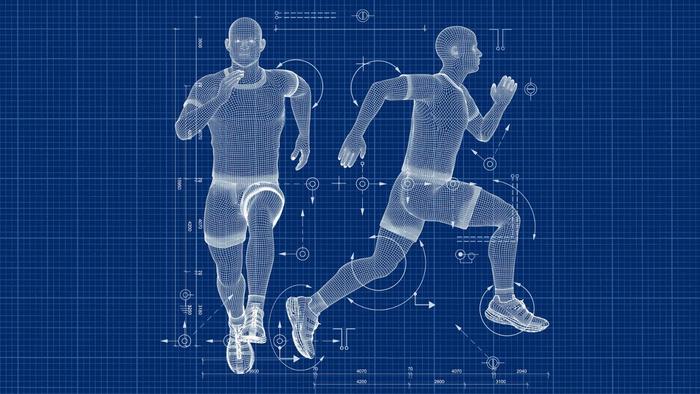
DNA is often considered the "______________" of life.
a)
Blueprint
b)
Mistake
c)
Swimming Pool
d)
Smelly Cheese
54.
Are all mutations bad?
a)
Yes
b)
No
55.
Mutations:
a)
are permanent changes in the DNA sequence or structure
b)
produce allelic variation
c)
are more likely to be harmful than beneficial
d)
all of the above
56.
Chromosomes are
a)
Tightly wound strands of DNA
b)
Tightly wound proteins
c)
Found in the mitochondria
d)
Not important for cell division
57.
Would a mutation in the DNA of a skin cell be passed on to an organism's offspring?
a)
Yes, because any change to the DNA is passed on to the offspring
b)
Maybe. Sex cells only use half of the body's genetic code. It might get the copy of a gene that wasn't mutated.
c)
No. Only mutations that occur in the gametes (sex cells) are passed on to the offspring
d)
Without knowing the animal, it would be hard to tell whether or not the mutation would be passed on.
58.
Which of the following statements about homologous chromosomes is correct?
a)
Each gene is at the same locus on both chromosomes.
b)
They are two identical copies of a parent chromosome which are attached to one another at the centromere.
c)
They come from the same parent.
d)
They are chromosomes that have identical genes and alleles.
59.
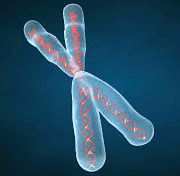
The structure labeled A is a(n)
a)
chromatid
b)
centriole
c)
centromere
d)
chromophere
60.
The structures labeled B are
a)
centrioles
b)
chromatids
c)
centromeres
d)
chromopheres
61.
A pair of chromosomes that consists of  XX is  a __________________.
a)
Male
b)
Female
62.
A cat has a total of 38 chromosomes in its body cells.  How many in its gametes?
a)
38
b)
19
c)
76
d)
10
63.
chromosomes that have the same sequence of genes and the same structure
a)
homologous chromosomes
b)
alleles
c)
phenotypes
d)
genotypes
64.
The diploid number of human chromosomes is
a)
23
b)
46
c)
92
65.
The haploid number of human chromosomes is
a)
11
b)
12
c)
23
d)
46
66.
Each identical side of a chromosome is the 
a)
centromere
b)
chromatin
c)
centriole
d)
chromatid
67.
Which of the following is heterozygous
a)
FF
b)
tt
c)
Gg
d)
RR
68.
Which of the following is homozygous recessive?
a)
rr
b)
AA
c)
TT
d)
Ff
69.
What does the prefix homo- in homozygous mean?
a)
same
b)
different
c)
dating
d)
humans
70.
What does the prefix hetero- in heterozygous mean?
a)
same
b)
different
c)
dating
d)
human
71.
Which of the following is homozygous dominant?
a)
Jj
b)
Rr
c)
MM
d)
ee
72.
The physical appearance of a trait is known as the-
a)
genotype
b)
phenotype
c)
characteristics
d)
intelligence
73.
How many letters does a genotype contain?
a)
1
b)
2
c)
3
d)
4
74.
Mark is heterozygous. If B is for brown hair, and b is for blonde hair, what is Mark's phenotype?
a)
Brown Hair
b)
Blonde Hair
c)
Brown and Blonde Hair
d)
Black Hair
75.
Mark is heterozygous. If B is for brown hair, and b is for blonde hair, what is Mark's genotype?
a)
BB
b)
bb
c)
Bb
d)
bB
76.

Which of these is not a major group of invertebrates?

a)

Fish

b)

Worms

c)

Mollusks

d)

Sponges

77.
A __________ is a simple invertebrate  with holes through which water flows.
a)
Echinoderms
b)
Mollusks
c)
Sponges
d)
Arthropods
78.
Which one of the following is a characteristic of arthropods?
a)
They can only live underwater
b)
Some use air tubes to breathe
c)
Crocodilians are a major group
79.
Which of these invertebrates have special stinging cells that allow them to catch their prey?
a)
Mollusks
b)
Cnidarians
c)
Arthropods
d)
Worms
80.
What are the three major groups of Mollusks?
a)
Cephalopods, Nitropods, and Gastropods
b)
Nitropods, Bivalves, and Gastropods
c)
Nitropods, Bivalves, and Cephalopods
d)
Cephalopods, Bivalves, and Gastropods
81.
All invertebrates _________
a)
Have a backbone
b)
Do not have a backbone
c)
Are really just Vertebrates
d)
Have a nerve cord
82.
Some invertebrates have exoskeletons which are ___________
a)
Internal skeletons
b)
External skeletons
c)
Soft tissue
d)
Mushy tissue
83.
Which is NOT a major group of Arthropods?
a)
Crustaceans 
b)
Gastropods
c)
Insects
d)
Arachnids 
84.
Which of the following is not a characteristic of Mollusks?
a)
Soft Bodies
b)
Hard Bodies
c)
Take in oxygen through gills or lungs
d)
Muscular foot for movement
85.
A __________ is the simplest animal with a brain, nervous system, and blood in blood vessel.
a)
Sponge
b)
Worm
c)
Mollusk
d)
Cnidarian 
86.
One characteristic that invertebrates and vertebrates share is they both ___________.
a)
Are multicellular
b)
Are autotrophs
c)
Have a nerve cord
87.
A butterfly is an example of what type of invertebrate?
a)
Arthropod
b)
Sponge 
c)
Cnidarian
d)
Echinoderm 
88.
One key difference between worms and sponges is worms are ________________.
a)
More complex organisms
b)
More simple organisms 
c)
Have special stinging cells
89.
T/F Worms have bilateral symmetry.
a)
True 
b)
False
90.
What do worms have that run through their entire body?
a)
A brain
b)
Digestive tube
c)
A foot
d)
Fangs
91.
A Tree Frog is a...
a)
Fish
b)
Amphibian
c)
Reptile
d)
Both Fish & Amphibians
92.
A snake is a....
a)
Fish
b)
Amphibian
c)
Reptile
d)
Both Fish & Reptiles
93.
A Turtle is a...
a)
Fish
b)
Amphibian
c)
Reptile
d)
Both Reptiles & Amphibians
94.
I breathe with lungs, lay eggs, am ectothermic (cold-blooded), and often have scaly skin which holds in the water.  What am I?  
a)
fish
b)
mammals 
c)
birds
d)
reptile 
95.
I live part of my life in water and part on land.  I am born with gills but grow lungs.  I am ectothermic (cold-blooded).  I have moist smooth skin.  What am I? 
a)
fish
b)
bird
c)
amphibian 
d)
mammal
96.
Metamorphosis occurs in
a)
fishes and amphibians
b)
amphibians
c)
fishes, amphibians, and reptiles
d)
amphibians and reptiles
97.
Frogs, toads, and salamanders are all examples of which class?
a)
Amphibians
b)
Reptiles
c)
Birds
d)
Mammals
98.
Turtles, lizards, snakes and crocodiles are all examples of what class?
a)
Amphibians
b)
Reptiles
c)
Birds
d)
Mammals
99.
Which class has organisms with dry, scaly skin?
a)
Amphibians
b)
Reptiles
c)
Birds
d)
Mammals
100.
Which class has organisms with moist skin?
a)
Amphibians
b)
Reptiles
c)
Birds
d)
Mammals