wayground logo

Free Printable Worksheets

Font size

S
M
L
XL
Worksheets

PS Final Exam Review

Total questions: 114

Worksheet time: 2hrs 18mins

Name
Class
Date
1.
The correct equation to calculate speed is
a)
distance/time
b)
time/distance
c)
distance x time
d)
distance/time2
2.
How far will a person go if they jog for 2 hours at a speed of 12 km/hr?
a)
6 km
b)
0.5 km
c)
10 km
d)
24 km
3.
If a cheetah runs 180 miles in 3 hours, what is its average speed?
a)
60 hours
b)
60 miles
c)
60 miles/hour
d)
60 miles/second/second
4.
How long does it take to go 340 meters if you are travelling at 23 m/s?
a)
363 s
b)
.068 s
c)
7820 s
d)
14.78 s
5.
A ball of clay is thrown at a wall at a velocity of 28.0 m/s.  After it hits the wall, it takes 0.020 s to stop.  What is the acceleration of the clay when it hits the wall?
a)
1400 m/s2
b)
-1400 m/s2
c)
0.56 m/s2
d)
-0.56 m/s2
6.
A roller coasters accelerates from an initial velocity of of 6.0 m/s to a final velocity of 70 m/s over 4 seconds.  What's the acceleration?
a)
24 m/s2
b)
18 m/s2
c)
16 m/s2
d)
16 m/s
7.
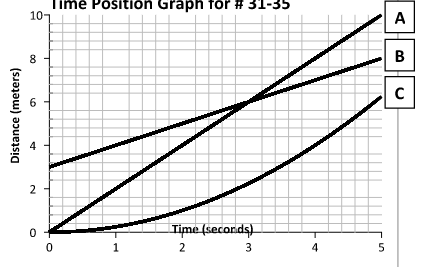
Which runner had a head start?
a)
A
b)
B
c)
C
8.
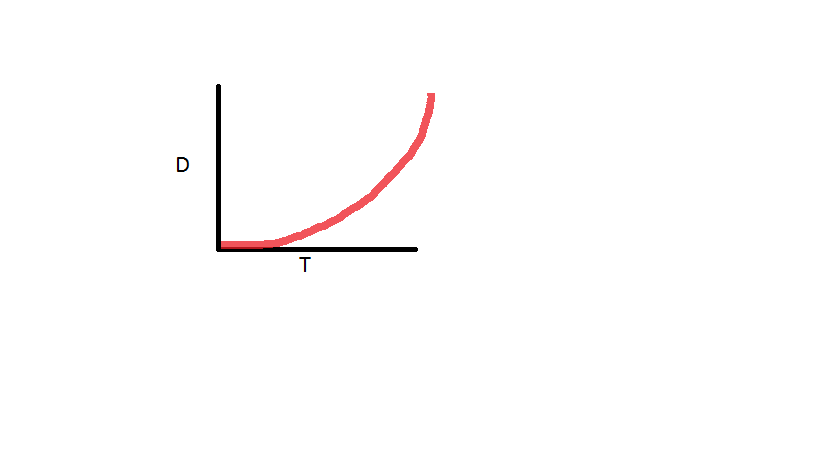
What is this graph showing?
a)
Constant Speed
b)
Acceleration (speeding up)
c)
Deceleration (slowing down)
d)
No motion
9.
What is this object doing?
a)
speeding up
b)
slowing down
c)
not moving
d)
moving at a constant velocity
10.
What does this graph represent?
a)
Constant speed
b)
Acceleration
c)
Not moving
11.
What does this graph represent?
a)
Constant speed
b)
Acceleration
c)
Not moving
12.
Describe the speed of the object from 4-6 seconds using the distance vs. time graph.
a)
Increasing speed
b)
Decreasing speed
c)
Not moving
d)
Constant speed
13.
Which graph is would represent a decrease in speed?
a)
Graph A
b)
Graph B
c)
Graph C
d)
The object is not decreasing in speed in any of these graphs
14.
On a distance vs. time graph, the steeper the slope _____
a)
the slower the speed
b)
the faster the speed
c)
less acceleration
d)
greater acceleration
15.
In the distance vs. time graph, what type of motion does the line represent? 
a)
Speed
b)
Velocity
c)
Acceleration
d)
Deceleration
16.
The slope of a position vs. time graph is equal to:
a)
distance.
b)
speed.
c)
time.
d)
position.
17.
Which time section is the object moving the fastest?
a)
0-10 seconds
b)
10-20 seconds
c)
20-30 seconds
d)
30-40 seconds
18.
What is happening between 4 and 5 seconds?
a)
The object is slowing down in a negative direction.
b)
The object is slowing down in a positive direction.
c)
The object is slowing down in a negative direction.
d)
The object is speeding up in a negative direction.
19.
During which interval is the object slowing down?
a)
A to B
b)
D to E
c)
E to F
d)
G to H
20.
Velocity is 
a)
speed
b)
direction
c)
speed with a direction
21.
Acceleration of an object happens when things ________
a)
slow down
b)
go faster
c)
change direction (turn)
d)
All of the above
22.
On a graph, which axis shows the independent variable?
a)
x-axis
b)
y-axis
c)
neither
d)
it changes
23.
The slope of a speed vs. time graph tells you
a)
acceleration
b)
distance traveled
c)
velocity
d)
All of these
24.
The Law of Inertia
a)
Newton's
1st
Law of Motion
b)
Newton's
2nd
Law of Motion
c)
Newton's
3rd
Law of Motion
25.
F=ma
a)
Newton's
1st
Law of Motion
b)
Newton's
2nd
Law of Motion
c)
Newton's
3rd
Law of Motion
26.
For every action, there is an equal and opposite reaction.
a)
Newton's
1st
Law of Motion
b)
Newton's
2nd
Law of Motion
c)
Newton's
3rd
Law of Motion
27.
A ____________ is a push or a pull on an object.
a)
friction
b)
force
c)
magnet
d)
gravity
28.
the tendency of an object to resist a change in its motion
a)
acceleration
b)
inertia
c)
mass
d)
frame of reference
29.
Gravity attracts all objects towards one another.
a)
False
b)
True
c)
It depends
30.
The force of gravity acting on an object is the object's ______.
a)
mass
b)
matter
c)
weight 
d)
friction 
31.
a force that opposes motion between any surfaces that are touching
a)
velocity
b)
friction
c)
inertia
d)
position
32.
What is the SI unit used to measure force? 
a)
pounds 
b)
grams 
c)
newtons 
d)
friction
33.
F = mass x ____
a)
force
b)
velocity
c)
acceleration
34.
given 20 N,  2 Kg, you can know a (acceleration) is 
a)
20N/2 kg=10N/kg
b)
20Nx2kg=40N/kg
c)
2kg/20N=0.1kg/N
d)
none of the above
35.
given 10 m/s2, 5 kg, and 50N, what is the mass
a)
50 N
b)
5 kg
c)
2 kg
d)
5 N/kg
36.

The acceleration of objects falling on Earth due to gravity is

a)

9.8 m/s

b)

9.8 m/s2

c)

9.8 g/mL

d)

9.8 g/m/m

37.
What is the net force
a)
10 N
b)
0 N
c)
25 N
d)
1 N
38.
What is the net force?
a)
40 N left
b)
0 N Balalnced
c)
400 N right
d)
40 N right
39.
What is the net force?
a)
400 N Up
b)
400 N Down
c)
- 400 N Down
d)
800 N Down
40.
Which way is the force  moving?
a)
it's not , it is balanced or moving at a constant
b)
to the right
c)
to the bottom
d)
up
41.
True or false
You do work only when you exert a force on an object and move it
a)
true
b)
false
42.
Two factors that determine work are
a)
size of the force, and distance
b)
size of the force, and type of force
c)
mass, and distance
43.
The amount of work done in a certain amount of time is known as 
a)
work
b)
effort force
c)
resistance force 
d)
power
44.

What would 419W be a unit for?

a)

Force

b)

Power

c)

Work

d)

Time

45.
The unit used to measure work is the 
a)
Watt
b)
Newton
c)
Joule
d)
meter
46.
The unit used to measure power is the 
a)
Watt
b)
Newton
c)
Joule
d)
Newton*meter
47.
Energy due to motion is ____________ energy. 
a)
Potential 
b)
Energy
c)
Kinetic
d)
Friction
48.
The faster an object moves, the ________ kinetic energy it has. 
a)
more
b)
less
c)
none of the above
d)
all of the above 
49.
__________ is stored energy. 
a)
Potential
b)
Kinetic
c)
None of the above 
d)
All of the above 
50.
Gravitational potential energy depends on the ________ and ________ of the object. 
a)
Height and mass
b)
Friction and movement
c)
Mass and Movement
d)
Height and Friction 
51.
The Law of Conservation of Energy states:
a)
Energy can created or destroyed but not transformed 
b)
Energy cannot be created or destroyed, it can only transformed
c)
Energy can't be created, destroyed or transformed
52.
The world record for pole vaulting is 6.15 m. If the pole vaulter's gravitational potential is 4942 J, what is his mass? 
a)
82 kg
b)
7875 kg
c)
803 kg
d)
.0012 kg
53.
With an elevation of 5334m above sea level, the village of Aucanquilca, Chile is the highest inhabited town in the world.  What would be the gravitational potential energy associated with a 64kg person in Aucanquilca?
a)
3345484 J
b)
5407.8 J
c)
816.76 J
d)
72.31 J
54.
A cheetah can run briefly with a speed of 31m/s.  Suppose a cheetah with a mass of 47 kg runs at this speed.  What is the cheetah’s kinetic energy?
a)
22583.5 J
b)
728.5 J
c)
1457 J
d)
0.75 J
55.
At which point is potential energy greatest?
a)
W
b)
X
c)
Y
d)
Z
56.
which point has the most potential energy
a)
G
b)
f
c)
b
d)
a
57.
Which 2 letters have the most kinetic energy
a)
W & Y
b)
X & Z
58.
What are the two types of Mechanical Energy? (ME)
a)
Kinetic and Potential Energy
b)
Kinetic and Nuclear Energy
c)
Potential and Chemical Energy
d)
Thermal and Kinetic Energy
59.

Energy that is transmitted by electromagnetic waves

a)

electrical energy

b)

radiant energy

c)

sound energy

d)

refraction

60.

What is chemical energy?

a)

Energy of motion

b)

Energy of gravity

c)

Energy that is released and transformed into other types of energy when a chemical reaction occurs.

d)

Energy of particles moving fast when heated or slower when cooled.

61.
Thermal energy is referring to:
a)
Temperature
b)
Heat
c)
Movement
d)
Matter
62.
What are the two major forces involved with nuclear energy? 
a)
Fission and Fusion
b)
Alpha and Beta particles
c)
Gamma and Fission
d)
Radioactivity and Alpha Decay
63.
What are the three (3) types of radiation that exist in nuclear chemistry?
a)
Alpha, Beta, and Gamma
b)
Fission, Fusion, and Friction
c)
Protons, Neutrons, and Electrons
d)
Atomic Mass, Isotopes, and Ions
64.
Which form of energy is being used by the toaster?
a)
chemical
b)
electrical
c)
solar
d)
nuclear
65.
W = 500 Joules 
t = 25 seconds
P = ???
a)
0.05 W
b)
20 W
c)
12500 W
d)
2000 W
66.
How far does a car that weighs 5,000 N go if 18,000 J of work is done on it?
a)
3.8 m
b)
3.7 m
c)
3.2 m
d)
3.6 m
67.
An Xbox consumes 15.7 watts while in standby mode. If you leave it in standby mode for 86,400 seconds (one day), how much work was done?
a)
1,356,490 J
b)
1,356,480 J
c)
1,356,470 J
d)
1,356,460 J
68.
Calculate the amount of work done when a force of 10 N displaces a body by 4 m in the direction of force.
a)
0.4 joule
b)
40 joule
c)
40 kilo joule
d)
400 joule
69.
Rahul does a work of 600 joule to displaces a body by 12 m. how much force did he apply?
a)
50 N
b)
500 N
c)
0.5 N
d)
0.005 N
70.
Energy and work are measured in ________.
a)
Newtons
b)
Joules
c)
Kilograms
d)
Meters/second
71.

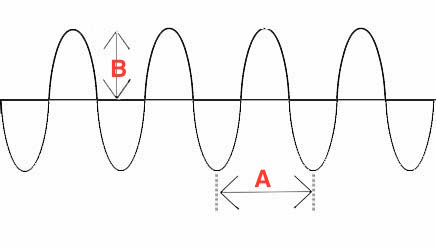
What property of this wave is represented by the letter "A"

a)

amplitude

b)

crest

c)

trough

d)

wavelength

72.
The highest point on a wave is:
a)
the crest
b)
the trough
c)
the top
d)
the coast 
73.
The lowest point on a wave is the:
a)
Amplitude
b)
Crest
c)
Trough
d)
Wavelength
74.
What is the measure of how many waves pass a point in a certain amount of time?
a)
frequency
b)
wavelength
c)
midpoint
d)
crest and trough
75.
The SI unit for frequency is ________.
a)
m
b)
m/s
c)
hertz
d)
s
76.
An object is _____ if its position changes relative to another object.
a)
in motion
b)
at reset
c)
a frame of refence
d)
magical
77.

Which of the following relationships is a correct representation of force?

a)

1 N = 1 kg · m

b)

1 N = 1 kg · m/ s2

c)

1 N = 1 kg

d)

1 N = 1 kg · m/s

78.

Displacement is distance combined with:

a)

velocity

b)

direction

c)

magnitude

d)

speed

79.

When a balanced force acts on an object, the net force that results is______.

a)

Greater than both forced combined

b)

Greater in size than the smaller of the forces

c)

Equal to zero

d)

Equal in size to one of the forces

80.

When you sit on a train and look out a window, a treetop may help you see how fast you are moving relative to the ground. The purpose of looking at the tree to describe this motion accurately and completely, is called using a_________ .

a)

distance

b)

vector

c)

frame of reference

d)

speedometer

81.

Marisa and David walked from school East, 6 blocks to the snowball stand. Doug walked Marisa home, which is only one block East, from the snowball stand. Then Doug left Marisa’s house to head home, which is halfway between the snowball stand and the school. How far did Doug walk? What was his displacement?

a)

Doug walked a total of 10 blocks; his displacement was 3 blocks

b)

Doug walked a total of 11 blocks; his displacement was 3 blocks

c)

Doug walked a total of 3 blocks; his displacement was 11 blocks

d)

Doug walked a total of 4 blocks; his displacement was 10 blocks

82.

Forces are represented by __________.

a)

Arrows

b)

Asterisks

c)

Subscripts

d)

Triangles

83.

The SI unit, which represents force, is the ___________.

a)

Joule (J)

b)

Kilogram (kg)

c)

Meter (m)

d)

Newton (N)

84.

When an unbalanced force acts on an object, ___________.

a)

The objects motion does not change

b)

The object free falls

c)

The object accelerates

d)

The object explodes

85.

The overall force acting on an object when all forces are combined is called its _______.

a)

net force

b)

net weight

c)

net gravity

d)

net motion

86.

What kind of friction occurs as a fish swims through water?

a)

fluid

b)

rolling

c)

sliding

d)

static

87.

When you put on the brakes of your bike, the wheels stop turning. Friction between the wheels and the road slows your bike to a stop. Which type of friction is this?

a)

fluid

b)

rolling

c)

sliding

d)

static

88.

A force is a _______ or _______ that acts on an object.

a)

Acceleration or deceleration

b)

Up or down

c)

Push or pull

d)

Acid or Base

89.

If an object is at rest, which of the following statements must be true?

a)

There are no forces acting on the object

b)

There is no friction acting on the object

c)

The forces acting on the object are unbalanced

d)

The net force acting on the object is zero.

90.

According to Newton’s Second Law of Motion, the acceleration of an object, equals the net force acting on the object divided by the object’s ______.

a)

mass

b)

velocity

c)

momentum

d)

weight

91.

Newton’s Third Law of Motion describes

a)

centripetal forces

b)

action and reaction forces

c)

net force

d)

balanced forces

92.

Determine the net force acting on the object and the direction the object will move in.

a)

18 N, Right

b)

10 N, Right

c)

2 N, Right

d)

2 N, Left

93.

A 10 kg bowling ball would require what force to accelerate down an alleyway at a rate of 3m/s2?

a)

0.3 N

b)

30 N

c)

3.3 N

d)

0 N

94.

What is the mass of a truck if it produces a force of 14,000 N while accelerating at a rate of 5 m/s2?

a)

28 kg

b)

2800 kg

c)

2.8 kg

d)

280 kg

95.

If the arrows represent action and reaction forces between the hammer and the nail, which law of motion does the following picture represent?

a)

Newtons 1st Law

b)

Newtons 2nd Law

c)

Newtons 3rd Law

96.

The person in the picture below will continue moving forward if the outside force of the seatbelt didn’t stop him. Which law of motion does the following picture represent?

a)

Newtons 1st Law

b)

Newtons 2nd Law

c)

Newtons 3rd Law

97.

Use the diagram below to answer the following question. The arrows below show forces acting on an object. What is the net force on the object and in what direction would the object move?

a)

100 N to the right

b)

100 N to the left

c)

100 N upward

d)

150 N upward

98.
What is the formula for kinetic energy? 
a)
KE = mgh
b)
KE = 2mv2
c)
KE = 1/2mv2
d)
KE = mv2
99.
What is the formula for gravitational potential energy? 
a)
GPE = mgh
b)
GPE = 2mv2
c)
GPE = 1/2mv2
d)
GPE = mv2
100.
An 8kg dog chases a cat. if the dog has 400J of kinetic energy. What is the speed of the dog?
a)
10 m/s
b)
5 m/s
c)
1 m/s
d)
100 m/s
101.
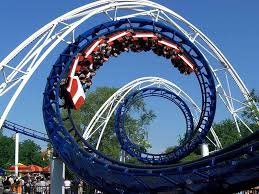
Which way is the object moving?
a)
left
b)
right
c)
down
d)
up
102.
What size resistor would produce a 3 Amp current flow with a 12 Volt battery
a)
1 Ohm
b)
3 Ohms
c)
4 Ohms
d)
12 Ohms
103.
What it the formula to find voltage. 
a)
I= V/R
b)
R=V/I
c)
V= I x R 
104.
If you ride your bicycle down a straight road for 500 m then turn around and ride back, your distance is ____ your displacement.
a)
greater than
b)
equal to 
c)
less than
d)
can't determine
105.
3 m/s north is an example of a(n) ____.
a)
speed
b)
velocity 
c)
position 
d)
acceleration
106.
If you ride your bike up a hill, then ride down the other side, your acceleration is ____.
a)
all positive 
b)
all negative 
c)
first positive, then negative
d)
first negative, then positive
107.

The equation used to find acceleration is a = ____.

a)

vf - vi/t

b)

v/t

c)

vi - vf/t

d)

vi + vf/t

108.
The upward force on an object falling through the air is ____.
a)
air resistance
b)
inertia
c)
momentum 
d)
terminal velocity 
109.

A 300-N force acts on a 25-kg object. The acceleration of the object is ____.

a)

7,500 m/s2

b)

300 m/s2

c)

25 m/s2

d)

12 m/s2

110.

A 3,000-N force acts on a 200-kg object. The acceleration of the object is ____.

a)

50 m/s2

b)

26 m/s2

c)

15 m/s2

d)

150 m/s2

111.
Increasing the speed of an object ____ its potential energy.
a)
does not affect 
b)
increases
c)
decreases
d)
changes
112.

You can calculate kinetic energy by using the equation ____.

a)

KE = m x 9.8 m/s2 x h

b)

KE = w x h

c)

KE = 1/2 m x v2

d)

KE = 9.8 m/s2 x 1/2 m

113.

You can calculate gravitational potential energy by using the equation ____.

a)

GPE = 1/2m x 1/2h

b)

GPE = m x 9.8 m/s2 x h

c)

GPE = h x 9.8 m/s2

d)

GPE = 1/2h x w

114.

A material that reduces the flow of heat by conduction, convection, and radiation is ____.

a)

a conductor

b)

condensation

c)

an insulator

d)

a solar collector