
 Worksheets
Earth Science NCFE Review
Total questions: 100
Worksheet time: 49mins
Name
Class
Date
1.
In North Carolina, most of the mature Piedmont forests are dominated by deciduous trees, while most mature coastal upland forests are dominated by evergreen conifers. What factor contributes to this difference?
a)
Rainfall in coastal areas is twice as high as in the Piedmont.
b)
Rainfall in coastal areas is of much lower pH than rainfall in the Piedmont.
c)
Most soils in coastal areas are clay-rich and of low permeability, favoring the deep root systems typical of coniferous trees.
d)
Most soils in coastal areas are sand-rich and of high permeability, favoring the deep root systems typical of coniferous trees.
2.
Which best defines biodiversity?
a)
Biodiversity is the total amount of biomass on Earth.
b)
Biodiversity is the total number of living organisms on Earth.
c)
Biodiversity is the total variability of living organisms on Earth.
d)
Biodiversity is the total number of animals and plant species on Earth.
3.

The photo shows an area with a heavy growth of kudzu, an introduced vine species commonly found in North Carolina.
Based on the evidence shown in the photo, what is the effect of kudzu on the habitat shown?
Based on the evidence shown in the photo, what is the effect of kudzu on the habitat shown?
a)
The kudzu is overcrowding the native plant species.
b)
The kudzu is providing habitat for many other species of plants.
c)
The kudzu is a slow-growing vine that has beneficial effects for native plants.
d)
The kudzu was introduced with a good understanding of North Carolina ecology.
4.
Menhaden is a species of plankton-eating fish that has gone through cycles of overfishing. What is a probable short-term consequence of menhaden overfishing to the local ecosystem?
a)
Plankton populations decrease in size.
b)
Menhaden populations increase in size.
c)
Competitor populations decrease in size.
d)
Menhaden predator populations decrease in size.
5.

he diagram shows one way electricity can be created.
Which renewable energy source is used to create this electricity?
Which renewable energy source is used to create this electricity?
a)
coal energy
b)
solar energy
c)
wind energy
d)
geothermal energy
6.
Which energy source has the lowest long–term environmental impact?
a)
wind
b)
nuclear
c)
clean coal
d)
corn ethanol
7.
Many farm operations are embracing the local-food movement by only purchasing livestock feed and fertilizers that originate within a 100-mile radius and only distributing their products within a 400-mile radius.
What impact could widespread adoption of the local-food movement have on the environment?
What impact could widespread adoption of the local-food movement have on the environment?
a)
loss of genetic diversity due to cross-pollination
b)
less available groundwater as a result of irrigation
c)
cleaner air as a result of decreased transportation needs
d)
nutrient-depleted soils as a result of growing local varieties
8.
According to one source, approximately 70% of the world’s freshwater is currently used by agricultural industries. What problem is at the root of this stress on the world’s freshwater sources?
a)
exponential human population growth
b)
lack of funding for aquaculture programs
c)
development of genetically modified crops
d)
increasing numbers of pathogens in aquatic ecosystems
9.

The graph below shows a population of a group of organisms present in an ecosystem vs. the number of generations
What is the carrying capacity for this hypothetical population of organisms?
What is the carrying capacity for this hypothetical population of organisms?
a)
between 101 and 200 organisms
b)
between 201 and 300 organisms
c)
between 301 and 400 organisms
d)
between 401 and 500 organisms
10.
According to Kepler’s Third Law, which is the shape of every planet’s orbit around the Sun?
a)
circular
b)
elliptical
c)
oval
d)
spherical
11.
Which movement is the reason for the Earth year being 365 days?
a)
Earth’s rotation about its axis
b)
the Moon’s rotation about Earth
c)
the Moon’s rotation about its axis
d)
Earth’s revolution around the Sun
12.
Which will most likely form when movement along a plate boundary forces a landmass to be pulled apart?
a)
volcanic island arc
b)
continental mountains
c)
continental rift
d)
oceanic trench
13.
Subsurface ocean currents continually circulate from the warm waters near the equator to the colder waters in other parts of the world. What is the main cause of these currents?
a)
differences in the topography along the ocean floor
b)
differences in density of ocean water
c)
the rotation of Earth on its axis
d)
movement of the jet stream
14.
Which is associated with an increase of chlorofluorocarbons in the environment?
a)
an increase in health risks associated with UV radiation
b)
an increase in levels of methane gas in the atmosphere
c)
an increase in ozone levels in the upper atmosphere
d)
an increase in acid precipitation
15.
Which change would best aid a farmer in making the transition from conventional farming techniques to more sustainable farming techniques?
a)
reduce the ratio of essential elements in the fertilizer
b)
irrigate crops using well water
c)
rotate the types of crops grown
d)
plant only genetically modified crops
16.
Which is an effect of lower levels of solar radiation striking Earth?
a)
increased incidences of skin cancer
b)
decreased rates of photosynthesis
c)
increased phytoplankton activity
d)
decreased carbon dioxide levels
17.
Which natural phenomenon occurs as a result of Earth rotating on its axis?
a)
movement of tectonic plates
b)
deep ocean currents
c)
seasonal changes
d)
day and night
18.
Which storm most likely develops as air masses interact with the warm water in the northwest Pacific Ocean?
a)
typhoon
b)
tornado
c)
blizzard
d)
monsoon
19.
What is most responsible for the presence of groundwater in an area?
a)
the movement of water from a confined aquifer into surface water
b)
the movement of surface water and precipitation through soil and rock
c)
the movement of water from streams and rivers to watersheds
d)
the movement of surface water through impermeable rock
20.
A community decides to upgrade its water purification and management systems. What lasting impact could this have on available freshwater?
a)
It could cause a decrease in water demand
b)
It could cause a decrease in the water levels
c)
It could cause an increase in waterborne diseases
d)
It could cause an increase in the freshwater supply
21.
Which would most likely cause a reduction in the amount of coal and natural gas on Earth?
a)
a continual increase in the amount of pollution in Earth’s atmosphere
b)
a continual increase in the number of people on Earth
c)
a continual decrease in the amount of water in Earth’s aquifers
d)
a continual decrease in the amount of rain forests on Earth
22.
How could the introduction of a nonnative species of plant affect an ecosystem in North Carolina?
a)
It could pollinate the native plant species, producing a disease-resistant species
b)
It could reduce the competition for space and light with native plant species
c)
It could take over the habitats of the native plant species
d)
It could cause some insect species to destroy native plant species
23.
What long-term impact could the destruction of large areas of forests have on Earth?
a)
decreased rates of erosion
b)
increased atmospheric carbon dioxide levels
c)
decreased amounts of acid rain
d)
increased atmospheric oxygen levels
24.
Why is it important to conserve the biodiversity of Earth?
a)
to decrease the amount of global predator populations
b)
to decrease the stability of major global ocean currents
c)
to increase the stability of ecosystems during environmental changes
d)
to increase the amount of nonrenewable resources located in the lithosphere
25.
Cracks in rocks widen as water in them freezes and thaws. How does this affect the surface of the Earth?
a)
It reduces the rates of soil formation
b)
It changes the chemical composition of the rocks
c)
It exposes rocks to increased rates of erosion and weathering
d)
It limits the exposure of rocks to acid precipitation
26.

In Figure 3-1, what type of rock should occur in the part of the rock cycle labeled B?
a)
sedimentary
b)
lava
c)
igneous
d)
metamorphic
27.
How does the tilt of the Earth’s axis affect the seasons?
a)
by changing the amount of direct solar energy reaching the surface of Earth
b)
by influencing the rate of chemical reactions occurring in the atmosphere
c)
by deflecting the harmful rays of radiation emitted by the sun
d)
by changing the speed of the rotation of Earth
28.

What are the proportions of clay, silt, and sand shown at point A in Figure 5-1?
a)
clay: 70 percent; silt: 20 percent; sand: 10 percent
b)
clay: 60 percent; silt: 20 percent; sand: 20 percent
c)
clay: 40 percent; silt: 40 percent; sand: 20 percent
d)
clay: 80 percent; silt: 10 percent; sand: 10 percent
29.
Wegener’s continental drift hypothesis stated that all the continents once joined together to form ____.
a)
two major supercontinents and three smaller continents
b)
two major supercontinents
c)
one major supercontinent
d)
three major supercontinents
30.
Which of the following is a geographic example of a transform fault boundary?
a)
the East African Rift valley
b)
the Andes Mountains
the Andes Mountains
c)
the San Andreas Fault
d)
the Mid-Atlantic Ridge
31.
Surface water goes from the liquid to the gas state during the process of ____.
a)
infiltration
b)
transpiration
c)
precipitation
d)
evaporation
32.
Permeable rock layers or sediments that transmit groundwater freely are called ____.
a)
aquitards
b)
aquifers
c)
springs
d)
caverns
33.
The single most important erosional agent on Earth is ____.
a)
ocean waves
b)
wind
c)
glaciers
d)
running water
34.
At night, clouds act as a blanket by ____.
a)
absorbing outgoing radiation from the Earth
b)
flecting incoming radiation from the Sun
c)
reflecting outgoing radiation from the Earth
d)
absorbing incoming radiation from the sun
35.

In the Figure, which air masses would be associated with cold, wet conditions?
a)
1 and 3
b)
6 and 4
c)
2 and 5
d)
3 and 4
36.
A continental tropical air mass is ____.
a)
hot and dry
b)
cold and wet
c)
cold and dry
d)
hot and wet
37.
On a weather map, which type of front is shown by a line with triangular points on one side?
a)
warm
b)
stationary
c)
occluded
d)
cold
38.
Maritime air masses form ____.
a)
over water
b)
only in winter
c)
over land
d)
only in summer
39.
Which of the following is an example of human impact on climate changes?
a)
the greenhouse effect
b)
global warming
c)
changes in solar output
d)
changes in the tilt of Earth’s axis
40.

What are the proportions of clay, silt, and sand shown at point C in Figure 5-1?
a)
clay: 20 percent; silt: 60 percent; sand: 20 percent
b)
clay: 10 percent; silt: 80 percent; sand: 10 percent
c)
clay: 10 percent; silt: 20 percent; sand: 70 percent
d)
clay: 30 percent; silt: 40 percent; sand: 30 percent
41.

In Figure 3-1, what process or processes would be occurring in the part of the rock cycle labeled E?
a)
melting
b)
weathering and erosion
c)
cooling
d)
compaction and cementation
42.
During what season would you expect mass movements to be a greater threat?
a)
a dry summer
b)
a wet spring with lots of growing vegetation
c)
a dry autumn after the leaves have turned
d)
a wet spring before vegetation is growing
43.
What is the only type of rock that is NOT produced either by heating or cooling?
a)
igneous
b)
sedimentary
c)
metamorphic
d)
magma
44.
During the first day of which season does North Carolina experience its shortest day?
a)
winter
b)
spring
c)
summer
d)
fall
45.
What causes a solar eclipse?
a)
The Moon passes between the Sun and the Earth
b)
The Earth passes between the Moon and the Sun
c)
The Sun passes between the Moon and the Earth
d)
Another planet passes between the Sun and the Earth
46.
What is responsible for day and night on Earth?
a)
Earth's eliptical path
b)
Earth's rotation
c)
Earth's revolution
d)
Earth's moon
47.
Heat energy moves through Earth's mantle primarily by
a)
conduction
b)
convection
c)
radiation
d)
earthquake waves
48.
Warm air rises above cool air because
a)
warm air is less dense than cool air
b)
warm air is more dense than cool air
c)
warm air has the same density as cool air
d)
warm air has more weight than cool air
49.
Which is a list of abiotic parts of an environment?
a)
soil, leaves, and flowers
b)
soil, rocks, and water
c)
rocks, leaves, and water
d)
water, rocks, and tadpoles
50.
Which best describes how metamorphic rock is formed?
a)
rock melts into magma, then cools
b)
water evaporates, leaving behind small particles of rock
c)
rocks change into new types of rock due to heat and pressure
d)
pieces of rock, plants, and other materials get pressed together, forming layers
51.
The place where two plates come together is known as a
a)
transform boundary
b)
divergent boundary
c)
convergent boundary
d)
rift valley
52.
Which animal listed below would complete the following food chain: grass...
grasshopper...
_________
grasshopper...
_________
a)
fly
b)
lizard
c)
butterfly
d)
hummingbird
53.
How does a straight alignment between Earth, the sun, and moon impact the tides on Earth?
a)
It produces the greatest change in high and low tides.
b)
It produces the least change in high and low tides.
c)
It produces semidiurnal tides.
d)
It produces diurnal tides.
54.
If it is summer in the northern hemisphere, which statement is true?
a)
Earth has changed the tilt of its axis by 20 degrees due to its revolution.
b)
It is winter in the southern hemisphere due to the tilt of Earth's axis.
c)
It is summer in the southern hemisphere due to the tilt of Earth's axis.
d)
Earth has reached its closest point to the sun due to its revolution.
55.
Which describes the difference between nuclear fission and nuclear fusion?
a)
Nuclear fission is the process that produces the radiant energy of stars, and nuclear fusion splits a heavier nucleus into smaller nuclei.
b)
Nuclear fission splits a heavier nucleus into smaller nuclei, and nuclear fusion is the process that produces the radiant energy of stars.
c)
Nuclear fission produces the energy in the core of Earth, and nuclear fusion produces energy in nuclear power plants.
d)
Nuclear fission produces energy in nuclear power plants, and nuclear fusion produces the energy in the core of Earth.
56.
How does heat from the sun get to Earth?
a)
by radiation, using electromagnetic waves to transfer heat
b)
by convection, using liquids and gases to transfer the heat
c)
by conduction, using solids to transfer the heat
d)
by absorption, using primary waves to transfer the heat
57.
Which agent of erosion leads to the formation of sand dunes?
a)
ice
b)
wind
c)
water
d)
gravity
58.
How could the removal of trees and other vegetation impact an environment?
a)
by increasing oxygen production
b)
by increasing soil formation
c)
by increasing transpiration
d)
by increasing erosion
59.
In which atmospheric layer of Earth do thunderstorms occur?
a)
thermosphere
b)
mesosphere
c)
stratosphere
d)
troposphere
60.
Which gas makes up the largest component of the Earth's atmosphere?
a)
argon (Ar)
b)
oxygen (O2)
c)
nitrogen (N2)
d)
carbon dioxide (CO2)
61.
Which most likely occurs when a fast-moving cold air mass moves into a region of warmer, moist air?
a)
It causes light precipitation for a long period of time.
b)
It causes light precipitation for a short period of time.
c)
It causes heavy precipitation for a long period of time.
d)
It causes heavy precipitation for a short period of time.
62.
Which statement describes the general movement of air masses?
a)
They move from areas of high pressure to areas of low pressure.
b)
They move from areas of high altitude to areas of low altitude.
c)
They move from areas of low humidity to areas of high humidity.
d)
They move from areas of low temperature to areas of high temperature.
63.
Which contributes to the formation of hurricanes during the late summer?
a)
the interaction between ocean water salinity and warm air masses
b)
the interaction between ocean water currents and polar air masses
c)
the interaction between water temperatures and warm air masses
d)
the interaction between ocean water salinity and ocean water density
64.
Which can lead to the depletion of the ozone layer of Earth?
a)
coal-fired power plants
b)
vehicle exhaust
c)
burning compost
d)
aerosols
65.
How is climate different from weather?
a)
Climate is constantly changing, whereas weather changes slowly over time.
b)
Climate influences people's daily activities, whereas weather influences people's seasonal activities.
c)
Climate refers to the atmopsheric conditions on a given date, whereas weather refers to the atmospheric conditions during a given season.
d)
Climate is based on observations made for a region over several years, whereas weather is based on day-to-day observations made for a region.
66.
Which example describes an abiotic factor that could impact the diversity of an ecosystem?
a)
An increase in prey can impact the number of predators in an ecosystem.
b)
The introduction of an invasive species can change the amount of available resources in an ecosystem.
c)
An increase in the amount of acid rain can change the pH of the soil in an ecosystem.
d)
The competition for food can impact the survival rate between members of the same species in an ecosystem.
67.

A disease causes the rabbit population to decline drastically. How would this decline in the rabbit population impact the community?
a)
The mouse population would decrease.
b)
The grasshopper population would decrease
c)
The hawk population would decrease.
d)
The snake population would increase.
68.
Kudzu, a vine covering many acres of North Carolina, was introduced to the United States in 1876 to control erosion. Over the years, scientists found that kudzu creates problems by growing rapidly and preventing other plants from getting sunlight. Which best describes kudzu?
a)
a noncompetitive species
b)
an invasive, nonative species
c)
an agent of erosion
d)
an abiotic factor
69.
How could exponential growth of the human population impact regions throughout the world?
a)
It could lead to a decrease in the amount of pollution in the regions.
b)
It could lead to an increase in the biodiversity of the regions.
c)
It could lead to an increase in the demand for food in the regions.
d)
It could lead to a decrease in the demand for land within the regions.
70.
Which best describes the relationship between carrying capacity and Earth's resources?
a)
A population that is below the carrying capacity will have an increase in contagious diseases.
b)
A population that is above the carrying capacity will have a decrease in natural resources.
c)
A population that is below the carrying capacity will experience a decrease in freshwater resources.
d)
A population that is above the carrying capacity will experience an increase in plant production.
71.

What type of storm front is this?
a)
warm front
b)
cold front
c)
stationary front
d)
occluded front
72.
The El Nino is caused by
a)
cold water off the Atlantic coast of South America
b)
warm water in the Pacific off the coast of South America
c)
warm water in the Pacific off the coast of Mexico
d)
cold water in the Pacific off the coast of Mexico
73.
Metamorphic rocks with a layered or banded look are called —
a)
foliated
b)
unfoliated
c)
striated
d)
evaporated
74.
The breakdown of rocks and minerals into smaller particles without a change in composition is
called..
called..
a)
igneous intrusion
b)
chemical precipitation
c)
mechanical weathering
d)
metamorphic foliation
75.

Which layer of the soil profile would be affected the most by weathering and erosion?
a)
1
b)
2
c)
3
d)
4
76.
Which more likely to prevent mass-movement events?
a)
Constructing buildings in stream drainage paths
b)
Clear-cutting trees from the side of a mountain
c)
Paving roads next to sloping hills
d)
Contour plowing of crop areas
77.
Barometric pressure has been dropping all day. What weather conditions will most likely occur?
a)
Sunny Weather
b)
Stormy Weather
c)
Calm Weather
d)
Hot Weather
78.
Folded mountains are created at which boundary?
a)
convergent
b)
divergent
c)
transform
79.
What does erosion do?
a)
Break down rock
b)
changes rock chemically
c)
changes sediment in rock
d)
moves broken pieces of rock, or sediment, from one place to another
80.
Where do deltas form?
a)
in desert areas
b)
on the banks of rivers
c)
at river mouths
d)
in valleys formed by glaciers
81.
what are 3 agents of depostion
a)
water, wind, ice
b)
ice, water, sand
c)
soild, liquid, and gas
d)
wind, ice, glacier
82.
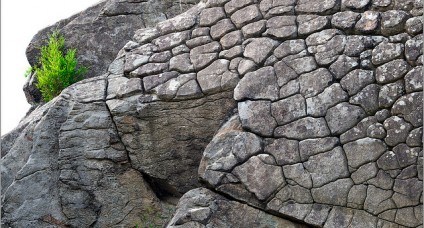
The process that breaks up rock on Earth's surface?
a)
deposition
b)
erosion
c)
compaction
d)
weathering
83.
Which term describes when the Earth spins on its axis.
a)
Rotation
b)
Revolution
c)
Kepler's Laws
d)
Precession
84.
Which term describes the time it takes for Earth to complete one circle around the sun.
a)
Rotation
b)
Revolution
c)
Kepler's 1st Law
d)
Barycenter
85.
Lasts 365 days
a)
Rotation
b)
Revolution
c)
Nutation
d)
Precession
86.
Lasts 24 hours
a)
Rotation
b)
Revolution
c)
Precession
d)
Barycenter
87.
Earth's orbit follows an elliptical path.
a)
Kepler's 1st law
b)
Kepler's 2nd law
c)
Kepler's 3rd law
d)
Nutation
88.
When Earth orbits around the sun, it slows down when it is close to the sun. It speeds up its orbit when it is further from the sun. This is because the sun's gravity is stronger when you are closer to it.
a)
Kepler's 1st law
b)
Kepler's 2nd law
c)
Kepler's 3rd law
d)
Nutation
89.
Why is the light from distant galaxies red-shifted?
a)
They produce more red light than nearby galaxies
b)
They are moving away from us
c)
The longer wavelengths are filtered out more by dust
d)
They are moving toward us
90.
What does the moon orbit around?
a)
Saturn
b)
Neptune
c)
Earth
d)
Sun
91.

What does the Big Bang theory suggest?
a)
The universe was just there
b)
The Milky Way is the only solar system
c)
The universe is continually expanding
d)
The universe started as a point and is moving towards each other
92.
The center point of the orbits of two revolving objects is called the
a)
focus
b)
barycenter
c)
nutation
d)
ellipse
93.
Which is the correct hierarchy of the Earth in the universe from SMALLEST TO LARGEST?
a)
Milky Way Galaxy, Earth, solar system, universe
b)
Earth, solar system, universe, Milky Way Galaxy
c)
Earth, solar system, Milky Way Galaxy, universe
d)
universe, Milky Way Galaxy, solar system, Earth
94.
Fusion is
a)
the splitting of a large atomic nucleus into two or more smaller ones
b)
the joining of two small nuclei to form a larger nucleus
95.

At position A, which hemisphere would have summer?
a)
Northern hemisphere
b)
Southern hemisphere
96.
How long does it take light to get from the sun to earth?
a)
8 hours
b)
2 years
c)
8 minutes
d)
12.5 seconds
97.
Why does Earth have different seasons?
a)
because of the distance between Earth and the sun
b)
because of the speed of Earth as it rotates on its axis
c)
because of the amount of light blocked by the moon on its axis
d)
because of the tilt of Earth on its axis as it moves around the sun
98.

This rock was formed by smaller pieces of rock that settled at the bottom of a lake millions of years ago. What type of rock is this?
a)
Sedimentary
b)
Igneous
c)
Metamorphic
99.

This rock was another type of rock that was heated and compressed over time. What type of rock is this?
a)
Sedimentary
b)
Igneous
c)
Metamorphic
100.
From your knowledge of Earth's crust, where would you most likely find igneous rocks like basalt?
a)
Within mountain ranges
b)
In my backyard
c)
On the ocean floor
d)
Sandy Beaches
100 %

