Wayground logo

Free Printable Worksheets

Font size

S
M
L
XL
Worksheets

Semester Overview Practice

Total questions: 84

Worksheet time: 55mins

Name
Class
Date
1.
Where does an off spring get its traits in asexual reproduction?
a)
From both parents
b)
From only one parent
c)
From neither parent
d)
There are no traits handed down
2.
Sexual reproduction requires _____ parents and asexual reproduction requires ___ parents
a)
1,1
b)
2,2
c)
2,1
d)
1,2 
3.
What is an advantage of sexual reproduction?
a)
Allows genetic variation
b)
Only needs one parent
c)
Happens very quickly
d)
Offspring are exact copies of parent
4.
What is one disadvantage of sexual reproduction?
a)
Only one parent needed
b)
Off spring are exact copies of parents
c)
Happens very quickly
d)
Needs two parents
5.
What are some of the facts about asexual reproduction?
a)
Takes only one mate to reproduce and takes a longer time to reproduce
b)
Takes a shorter amount of time to reproduce and it takes two mates to reproduce
c)
Reproduces diverse offspring and takes a longer time to reproduce
d)
Takes only one mate to reproduce and takes a shorter time to reproduce
6.
What are some of the facts about sexual reproduction?
a)
Takes two mates to reproduce and takes a longer time to reproduce
b)
Takes one mate to reproduce and takes a shorter amount of time to reproduce
c)
Takes two mates to reproduce and takes a shorter amount of time to reproduce
d)
Takes one mate to reproduce and takes a shorter amount of time to reproduce
7.
The _______________ system has been called both a membrane, because it covers the body, and an organ, because it contains several types of tissues. However, most refer to it as a system.
a)
respiratory 
b)
integumentary
c)
cardiovascular
d)
muscular
8.
What is the purpose / function of the skin?
a)
protection
b)
temperature maintenance
c)
excretion and sensory reception
d)
all of the choices
9.

The job of the heart is to . . .

a)

pump blood around the body.

b)

send food to the small intestines.

c)

break down food.

d)

give energy to the body.

10.
The circulatory system works with the ___________ system to provide our body with oxygen.
a)
respiratory
b)
digestive
c)
muscular
d)
skeletal
11.
Which is NOT a function of the circulatory system?
a)
deliver O2 and nutrients to cells
b)
remove CO2 and wastes from cells
c)
break down carbohydrates into glucose
d)
transport other materials through body
12.
The chewing and grinding of food into smaller pieces is an example of...
a)
Mechanical Digestion
b)
Chemical Digestion
13.
As waste moves through the digestive system, the ______ absorbs water before storing waste in the rectum.
a)
Small intestine
b)
Stomach
c)
Esophagus
d)
Large intestine
14.
Which is NOT a function of the Digestive System?
a)
To rid the body of solid waste
b)
Absorb nutrients for energy & growth
c)
Break down nutrients from food
d)
Pump blood around the body
15.
Gastric juices in the stomach digest food into a thick liquid.  This is...
a)
Mechanical digestion
b)
Chemical digestion
16.

What are the three main functions of the muscular system?

a)

movement, protect, blood cell production

b)

movement, posture, blood cell production

c)

movement, posture, body functions

d)

movement, protect, body functions.

17.
A population of small fish and a population of small squids eat the same type of krill (a type of plant) in the same ecosystem. Krill is the main source of food for both the fish and squid. If the squid grows faster than the fish population, what will most likely happen to the fish population? 
a)
The fish population will stay the same size. 
b)
The fish population will start to grow faster. 
c)
The fish population will get smaller or even die out. 
d)
The fish population will start to eat more krill than the squids. 
18.
If the population of grizzly bears gradually increases over time, which of the following will most likely occur? 
a)
The number of prey species will decrease.
b)
The size of the bear population will continue to increase. 
c)
The bear population in that area will eventually die out. 
d)
The number of prey species will increase. 
19.
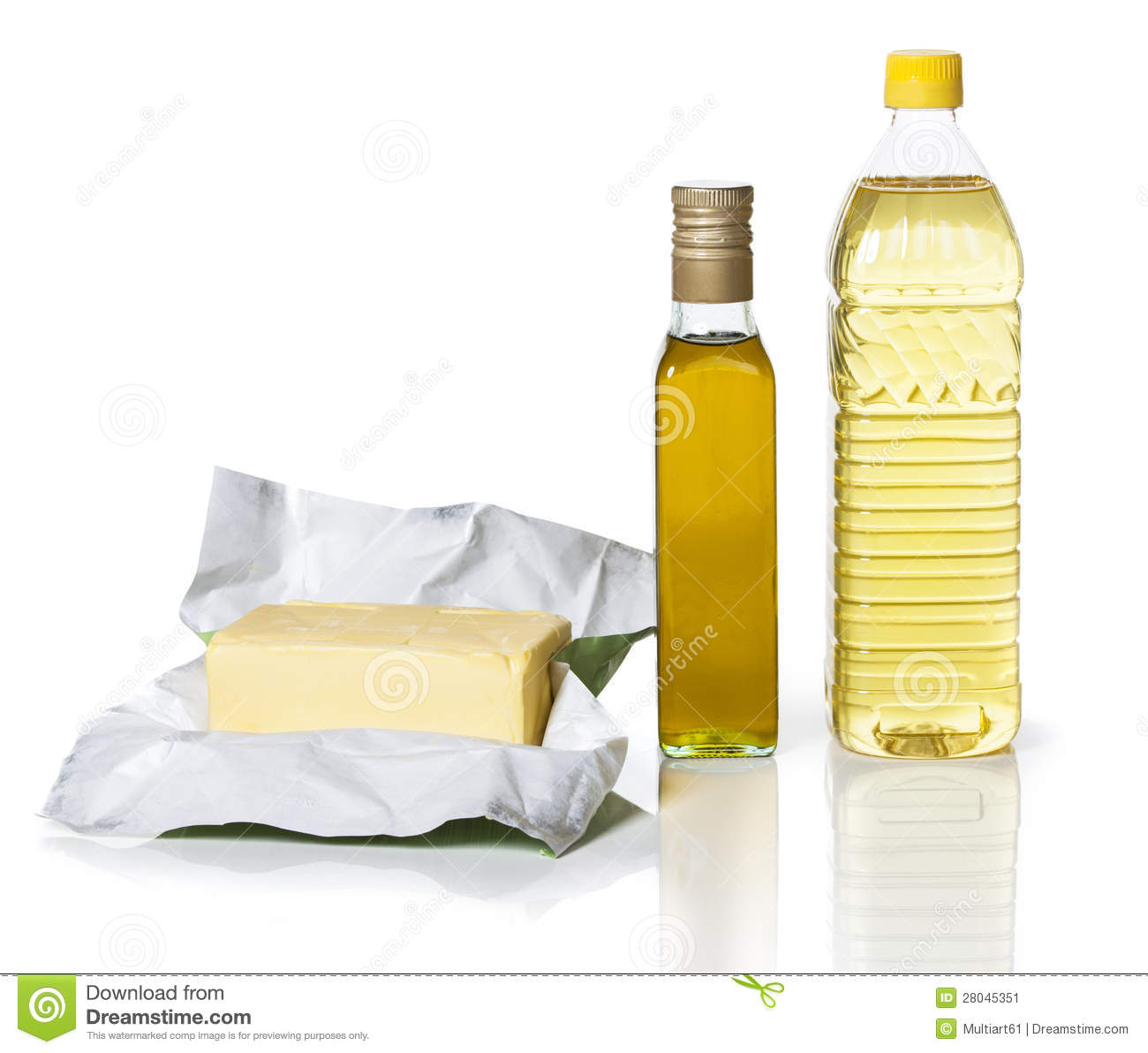
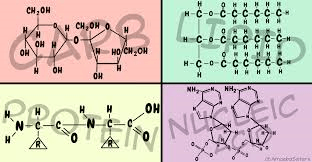
Which biomolecule is found in fats, oils, and waxes and is a source of long-term energy? 
a)
Proteins
b)
Nucleic Acid
c)
Lipids
d)
Carbohydrate
20.
What elements are common to all 4 biomolecules?
a)
Carbon, hydrogen, nitrogen
b)
Carbon, Nitrogen, Phosphorus
c)
Carbon, Hydrogen, Oxygen
d)
Carbon, Hydrogen, Phosphorus
21.
Carbohydrates and lipids both contain which 3 elements?
a)
CHO
b)
CHON
c)
CHONP
d)
CNO
22.
What organelle is called the "powerhouse" of a cell?

a)
Endoplasmic Reticulum
b)
Nucleus
c)
Mitochondria
d)
Nucleolus
23.
What is the function of the mitochondria?
a)
Structure that manufactures ribosomes
b)
Structures that converts nutrients to energy
c)
Stack of membranes that packages chemicals
d)
Structure that contains DNA and directs the cell
24.
What is the function of the vacuole?
a)
Sac that stores water, nutrients, and waste products
b)
Sac filled with digestive chemicals
c)
Jelly-like substance within the plasma membrane
d)
stack of membranes that packages chemicals
25.
I store water in both plant and animal cells. What am I?
a)
cytoplasm
b)
ribosomes
c)
vacuole
d)
lysosomes
26.
The site of photosynthesis
a)
ribosome
b)
mitochondria
c)
chloroplast
d)
nucleus
27.
Which organelle uses energy from sunlight to make sugar?
a)
mitochondria
b)
nucleus
c)
chloroplasts
d)
vacuoles
28.
Controls what enters and leaves the cell
a)
Mitochondria
b)
Cell Membrane
c)
Cell Wall
d)
Nucleus
29.
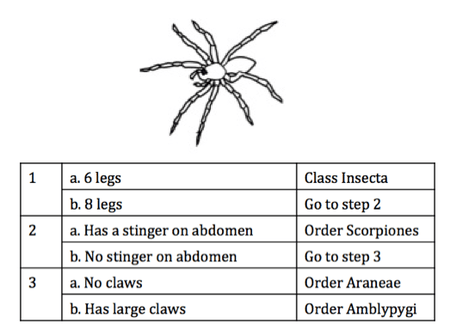
An illustration and a dichotomous key are given. What is the correct classification for this organism?
a)
Class Insecta
b)
Order Amblygygi
c)
Order Araneae
d)
Order Scorpiones
30.
A dichotomous key for trees is provided. Hikers found a tree that has large brown cones and single sharp needles. What species of tree have the hikers found?
a)
Juniper
b)
Pine
c)
Spruce
d)
Fir
31.
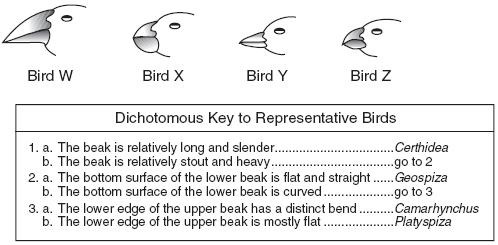
What is the name of bird Z?
a)
Certhidea
b)
Geospiza
c)
Camarhynchus
d)
Platyspiza
32.
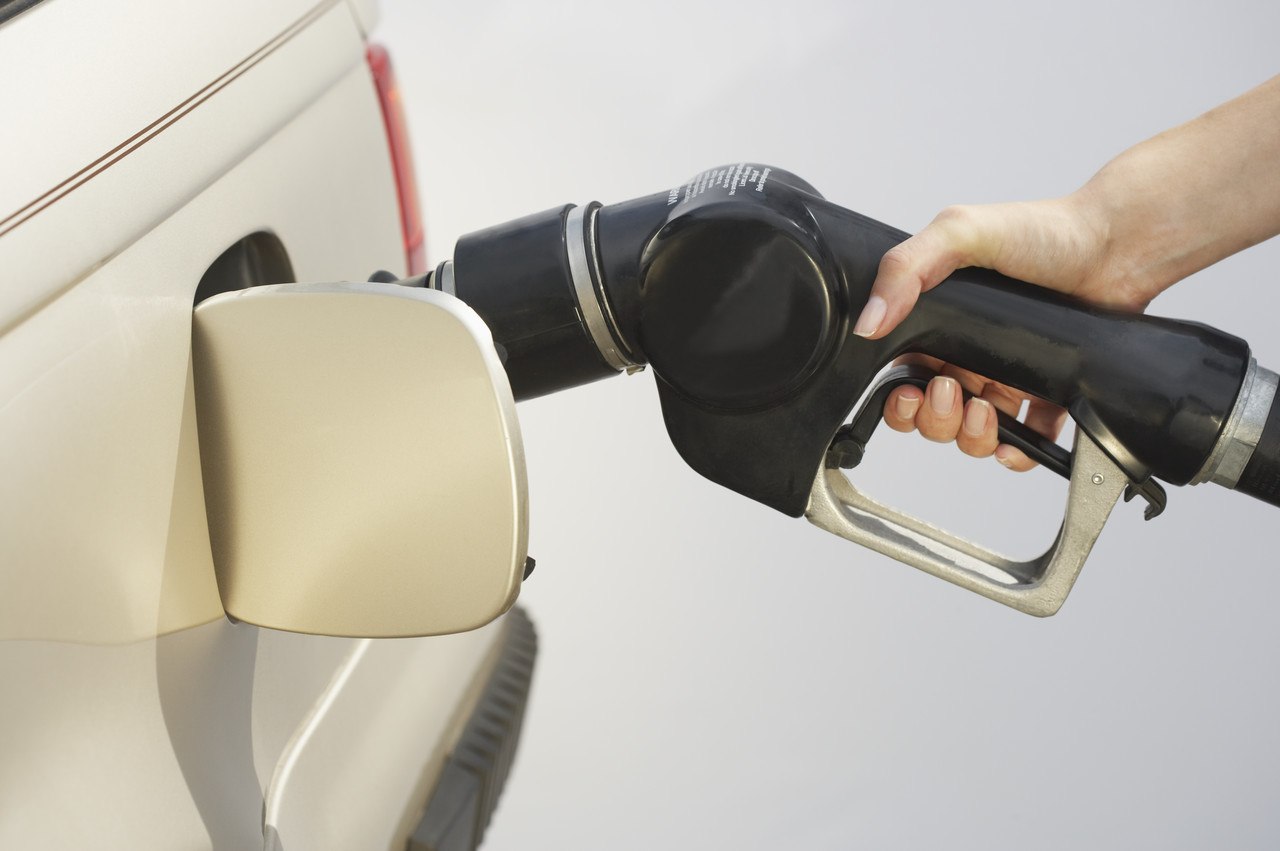
Which energy conversion is taking place when you put gasoline in a car?
a)
thermal -> electrical
b)
mechanical -> electrical
c)
chemical -> mechanical
d)
mechanical -> electromagnetic
33.
Electrical Energy is transferred to _____ Energy.
a)
Thermal
b)
Solar
c)
Electrical
d)
None
34.
According to the Law of Conservation of Energy, energy cannot be _________ or ____________. 
a)
destroyed, destroyed
b)
created, saved
c)
created, destroyed
d)
lost, found
35.
Energy transformations occur when...
a)
energy is created through conduction
b)
energy changes from one form to another
c)
two forces slide together that are touching
d)
a chemical reaction takes place
36.
What type of digestion occurs in the stomach?
a)
Mechanical
b)
Chemical
c)
Mechanical and Chemical
d)
None of the above
37.
Energy stored in foods is __________; digested food releases____________ energy for movement and ___________ energy as heat. 
a)
Chemical, Electric, Hydroelectric
b)
Solar, Chemical, Thermal
c)
Radiant, Chemical, Electric
d)
Chemical, Mechanical, Thermal
38.
Complex carbohydrates break down into which of the following?
a)
enzymes
b)
simple sugars
c)
amino acids
d)
ATP
39.
What are proteins made of ?
a)
long chains of hydrocarbons
b)
lipids
c)
amino acids
d)
salts
40.
An inherited trait that helps those organisms that have it to survive
a)
niche
b)
structure
c)
characteristic
d)
adaptation
41.
Coloring or another physical characteristic that help an organism blend in with its environment
a)
mimicry
b)
camouflage
c)
hibernation
d)
migration
42.
The seasonal movement of an organism from one place to another
a)
camouflage
b)
migration
c)
hibernation
d)
function
43.
Which feature of a rose helps it grow without being eaten by large animals?
a)
flowers with bright colors
b)
sharp thorns
c)
small seeds
d)
deep roots
44.
A giraffe has a long neck in order to better reach leaves to eat.  This is an example of _____. 
a)
an adaptation
b)
environment
c)
response
d)
stimulus
45.
Which adaptation (for the underlined animal) serves the function of defense?
a)
A walking stick looks like the twig on which it rests.
b)
A porcupine’s quills cause a predator to seek another meal.
c)
A whale filters plankton and krill from the water in which it swims.
d)
A penguin is dark on top and white below to blend in with the water.
46.

What does most every living thing need to survive?

a)

Steam

b)

Ice

c)

Plasma

d)

Liquid water

47.

What happens if a planet is too hot?

a)

The water will be nice and warm

b)

The water will boil away

c)

The water will be too cold

d)

The water will freeze and make ice

48.

What happens if a planet is too cold?

a)

The water will be nice and warm

b)

The water will be cold

c)

The water will boils away

d)

It will be like a giant snowball

49.

What determines where the habitable zone is located for each star?

a)

The star's distance from Earth

b)

The size of the star

c)

How many planets the star has

d)

The size of the planet

50.

If a planet is discovered to be in the habitable zone does that mean it has life?

a)

Yes

b)

No

51.
The only planet that can support life is _____________________________.
a)
Mercury
b)
Neptune
c)
Pluto
d)
Earth
52.
A change in an organism's surroundings that cause it to react is a(n) ___________.
a)
response
b)
stimulus
c)
energy
d)
development
53.
Becoming larger and having more complex structures is part of which characteristic of all organisms?
a)
ability to reproduce
b)
growth & development
c)
needs oxygen to live
d)
respond to stimuli
54.
A plant growing toward light is an example of ______.
a)
reproduction
b)
response
c)
stimulus
d)
development
55.
The study of how living things are classified is called _______.
a)
taxonomy
b)
biology
c)
physiology
d)
classology
56.
Put these classificaiton terms in order.  Begin with the MOST broad (largest) to most specific.  
Species     Genus          Kingdom         Phylum
a)
Kingdom, Phylum, Genus, Species
b)
Genus, Species, Phylum, Kingdom
c)
Kingdom, Species, Phylum, Genus
d)
Genus, Kingdom, Phylum, Species
57.
How many Domains are there?
a)
1
b)
5
c)
4
d)
3
58.
How many Kingdoms are there?
a)
3
b)
2
c)
6
d)
7
59.
Which cell contains a nucleus?
a)
prokaryotic cell
b)
Eukaryotic cell
60.
An autotroph is an organism that can 
a)
produce it's own food
b)
consume other organisms
c)
Hunt for food
61.
A Heterotroph is an organism that
a)
makes it's own food
b)
is a consumer or decomposer
c)
uses the sun for food and nourishment
62.
Fungi is a
a)
Domain
b)
Kingdom
c)
neither
d)
Both
63.
In the picture which two are closer related?
a)
plant cell and animal cell
b)
plant cell and bacteria
c)
animal cell and bacteria
64.
In an energy pyramid, how much energy is transferred up through each level?
a)
10%
b)
90%
c)
20%
d)
1%
65.
Homeostasis means to maintain a stable internal environment within an organism.
a)
TRUE
b)
FALSE
66.
The use of pesticides and fertilizers must be carefully monitored 
because of the effect they can have on the environment. 
Which of the following is a possible negative effect of the use 
of these chemicals on the environment?
a)
Runoff carries these chemicals into lakes and streams.
b)
Theses chemicals cannot be purchased in large bulk.
c)

These chemicals are expensive to produce.
d)
Storage space for these chemicals is limited.
67.
What is a watershed?
a)
Land that collects and channels water froma small body of water to a larger body of water
b)
the shape of the land determined by elevation
c)
A natural stream of water of considerable  volume
d)
a river and all its tributaries
68.
Why is gravity a factor in watersheds? 
a)
it causes the water to flow away from a watershed
b)
it causes the water to flow down towards a watershed
69.
Water stored below the Earth's surface is called:
a)
Groundwater
b)
Bogs
c)
Water in the ground
70.
What type of tropism is response to touch? 
a)
Gravitropism
b)
Phototropism
c)
Thigmotropism
d)
Hydrotropism
71.
This picture would represent which type of tropism?
a)
Phototropism
b)
Geotropism
c)
Hydrotropism
d)
Thigmotropism
72.
What type of tropism response to water? 
a)
Hydrotropism
b)
Gravitropism
c)
Thigmotropism
d)
Phototropism
73.

The shoot/stem of a plant growing up.

a)

Positive Gravitropism

b)

Negative Gravitropism

c)

Thigmotropism

d)

Hydrotropism

74.
Which of the following is an example of the effects of geotropism?
a)
Monarch butterflies migrate from Canada to Mexico each year.
b)
A hippopotamus submerges itself in water until the Sun goes down.
c)
A wilted flower returns to an upright position after being watered.
d)
A potted plant falls on its side, but it roots still grow downward.
75.
Which of the following would be the appropriate stimulus and response for geotropism?
a)
Stimulus= Touch; Response= Close leaves
b)
Stimulus= Gravity; Response= roots grow down, stem grows up
c)
Stimulus= gravity; Response= grows toward the light
d)
Stimulus= Light; Response= roots grow toward water
76.
Inorganic compounds may or may not have carbon.
a)
True
b)
False
77.
Organic compounds make up living things.
a)
False
b)
True
78.
Which set of compounds below are organic?
a)
CH4,  C6H12O6, NaClO
b)
C3H8 , CaOH , CO2
c)
C6H8O7 , CH4 , C16H18N2O4S
79.
Which of the following is not a compound?
a)
HCl
b)
Cl
c)
NaCl
d)
CO2
80.
How many total elements are in the compound C2H12O3?
a)
3
b)
17
c)
12
d)
2
81.
Which of the following elements is required in an organic compound?
a)
nitrogen
b)
oxygen
c)
carbon
d)
sodium
82.
The compound PO4 is...
a)
inorganic
b)
organic
83.
The compound CHO is...
a)
inorganic
b)
organic
84.
Is NaCl (table salt) a Organic or Inorganic Compound?
a)
Inorganic
b)
Organic