Wayground logo

Free Printable Worksheets

Font size

S
M
L
XL
Worksheets

Prokaryotes, Eukaryotes & Viruses - AP Biology

Total questions: 127

Worksheet time: 2hrs 44mins

Name
Class
Date
1.

Cells tend to be small, with sizes ranging between 1 and 100 mm. These small sizes help to ensure that cells have a favorable surface-area-to-volume ratio. Choose the statement that explains why a favorable surface-area-to-volume ratio is advantageous.

a)

Higher surface-area-to-volume ratios improve the efficiency of transporting materials in and out of cells.

b)

Lower surface-area-to-volume ratios improve the efficiency of transporting materials in and our of cells.

c)

Higher surface-area-to-volume ratios speed up the flow of cytoplasm within cells.

d)

Higher surface-area-to-volume ratios slow down the flow of cytoplasm within cells.

2.

The Endosymbiotic Theory suggests that eukaryotic cells evolved when an ancient cell engulfed another, forming a permanent symbiotic relationship. Choose the evidence that best justifies this claim.

a)

Both mitochondria and chloroplasts perform energy functions

b)

Eukaryotic cells have many mitochondria

c)

Eukaryotic cells have traits in common with archaea

d)

Mitochondria and chloroplasts contain circular loops of unique DNA

3.

Both prokaryotic and eukaryotic cells contain all of the following EXCEPT

a)

Cell (Plasma) Membrane

b)

Chloroplast

c)

Cytoplasm

d)

Ribosomes

4.

Which of the following is NOT an example of a Eukaryotic cell?

a)

Animal

b)

Fungi

c)

Protist

d)

Archaea

5.

Plant and Animal cells share the following cell parts.

a)

Chloroplast

b)

Mitochondria

c)

Cell/Plasma Membrane

d)

Golgi Apparatus

6.

Eukaryotic cells possess an extensive endomembrane system. The extensive use of internal membranes gives eukaryotic cells certain useful advantages not seen in prokaryotic cells. Choose the example that correctly describes one of these advantages.

a)

Nucleic acids can freely mingle with cytoplasmic enzymes

b)

Lysosomes can maintain a much lower pH than surrounding cytoplasm

c)

Endoplasmic reticulum is prevented from forming vesicles

d)

Surface area available for chemical reactions is greatly decreased

7.
Prokaryotes are classified as belonging to two different domains. What are they?
a)
Bacteria & Protista
b)
Bacteria & Archaea
c)
Bacteria & Eukarya
d)
Archaea & Protista
8.
Which structure is common to plant and animal cells?
a)
central vacuole
b)
chloroplast
c)
wall made of cellulose
d)
mitochondrion
9.
Which of the following is major cause of the size limits for certain types of cells?
a)
evolutionary progression in cell size; more primitive cells have smaller sizes.
b)
the need for sufficient surface area to support the cell's metabolic needs.
c)
limitation on the strength and integrity of the plasma membrane as cell size increases
d)
the difference in plasma membranes between prokaryotes and eukaryotes
10.
A biologist ground up some plant leaf cells and then centrifuged the mixture to fractionate the organelles. Organelles in one of the heavier fractions could produce ATP in the light, whereas organelles in the lighter fraction could produce ATP in the dark. The heavier and lighter fractions are most likely to contain, respectively,
a)
mitochondria and chloroplasts.
b)
peroxisomes and chloroplasts.
c)
chloroplasts and peroxisomes.
d)
chloroplasts and mitochondria.
11.
Large numbers of ribosomes are present in cells that specialize in producing which of the following molecules?
a)
glycogen
b)
cellulose
c)
proteins
d)
lipids
12.
All of the following are part of a prokaryotic cell except
a)
a plasma membrane
b)
DNA
c)
an endoplasmic reticulum
d)
ribosomes
13.
Cell Membrane:
a)
The protective outer layer that controls what enters and leaves the cell.
b)
Stores information on DNA molecules / Directs and controls the activities of the cell.
c)
A folded membrane that moves materials around inside cells / Also acts as the site of manufacturing materials needed by the cell.
d)
The smallest organelle with a huge job / Makes proteins, which are the building blocks of the body.
14.
Nucleus:
a)
Stores information on DNA molecules / Directs and controls the activities of the cell.
b)
 A folded membrane that moves materials around inside cells / Also acts as the site of manufacturing materials needed by the cell.
c)
The smallest organelle with a huge job / Makes proteins, which are the building blocks of the body.
d)
A small sack that stores water and food until the cell needs it /  Stores waste temporarily until the cell  gets rid of it.
15.
Endoplasmic Reticulum:/ER
a)
The smallest organelle with a huge job / Makes proteins, which are the building blocks of the body.
b)
A folded membrane that moves materials around inside cells / Also acts as the site of manufacturing materials needed by the cell.
c)
A small sack that stores water and food until the cell needs it /  Stores waste temporarily until the cell  gets rid of it.
d)
The protective outer layer that controls what enters and leaves the cell.
16.
Vacuole:
a)
A gel-like material that streams through the cell holding all the other organelles / Also stores chemicals needed for cell processes.
b)
The smallest organelle with a huge job / Makes proteins, which are the building blocks of the body.
c)
A small sack that stores water and food until the cell needs it /  Stores waste temporarily until the cell  gets rid of it.
d)
Stacks of pancake-like membranes that package materials to ship out of the cell.
17.
Mitochondrion
a)
Stacks of pancake-like membranes that package materials to ship out of the cell.
b)
Small sacks with pores / Contains digestive enzymes that get rid of waste, worn-out cell parts, and captured invaders.
c)
(plural is Mitochondria): Bean-shaped organelle filled with folded membranes / Breaks down glucose to release energy for cell functions
d)
The protective outer layer that controls what enters and leaves the cell.
18.
Lysosome:
a)
The smallest organelle with a huge job / Makes proteins, which are the building blocks of the body.
b)
Small sacks with pores / Contains digestive enzymes that get rid of waste, worn-out cell parts, and captured invaders.
c)
Bean-shaped organelle filled with folded membranes / Breaks down glucose to release energy for cell functions
d)
Stacks of pancake-like membranes that package materials to ship out of the cell.
19.
Ribosomes
a)
a part of the cell containing DNA and RNA and responsible for growth and reproduction
b)
non membrane bounded organelles responsible for protein synthesis;found in eukaryotes and porkaryotes
c)
System of internal membranes within the cytoplasm. Membranes are rough due to the presence of ribosomes. functions in transport of substances such as proteins within the cytoplasm
d)
An endomembrane system where lipids are synthesized, calcium levels are regulated, and toxic substances are broken down.
20.
Prokaryotic cell
a)
a cell that lacks a nucleus and other membrane bound organelles; includes achaea and bacteria
b)
a cell containing a nucleus and other membrane bound organelles
c)
the idea that the mitochonria and chloroplasts were once free living and were engulfed by other prokaryotic cells.
d)
 part of the cell containing DNA and RNA and responsible for growth and reproduction
21.
Eukaryotic Cell
a)
a cell containing a nucleus and other membrane bound organelles
b)
a cell that lacks a nucleus and other membrane bound organelles; includes achaea and bacteria
c)
the idea that the mitochonria and chloroplasts were once free living and were engulfed by other prokaryotic cells.
d)
a part of the cell containing DNA and RNA and responsible for growth and reproduction
22.
Rough Endoplasmic Reticulum
a)
non membrane bounded organelles responsible for protein synthesis;found in eukaryotes and porkaryotes
b)
a part of the cell containing DNA and RNA and responsible for growth and reproduction
c)
System of internal membranes within the cytoplasm. Membranes are rough due to the presence of ribosomes. functions in transport of substances such as proteins within the cytoplasm
d)
An endomembrane system where lipids are synthesized, calcium levels are regulated, and toxic substances are broken down.
23.
What 4 structures are common between plant, animal, and bacterial cells?
a)
Golgi Apparatus, Chloroplasts, Ribosomes, Nucleus
b)
Cell Wall, Mitochondria, Cell Membrane, Cytoplasm
c)
Rough ER, Smooth ER, Nucleus, Ribosomes
d)
DNA, Cytoplasm, Ribosomes, Cell membrane
24.
What is the function of the Golgi Apparatus?
a)
To produce ribosomes
b)
To transfer materials
c)
To protect the cell
d)
To hold DNA
25.
In a eukaryotic cell, where is the DNA contained?
a)
The cell membrane
b)
The nucleus of a cell
c)
The mitochondria of a cell
d)
The vesicles of a cell
26.
Why do plants need chloroplasts?
a)
To carry out photosynthesis
b)
To carry out DNA transcription
c)
To collect food
d)
To collect water
27.
In a prokaryotic cell, what replaces the nucleus?
a)
Deoxyribonucleic acid
b)
Nucleoid region
c)
Nuclear envelope
d)
Chromatin
28.
Which type of cell has membrane bound organelles?
a)
Prokaryotic
b)
Eukaryotic
c)
Bacteria
d)
Archaeabacteria
29.
What is the boundary of the cell that is made of phosolipid?
a)
Cell Wall
b)
Chlroplast
c)
Nucleus
d)
Cell Membrane
30.
What kind of cells have a cell wall?
a)
Plants and Animals
b)
Animals
c)
Plants
d)
Plants and Bacteria
31.
What is in all cells and provides protein synthesis?
a)
Cell Membrane
b)
Ribosome
c)
Lysosome
d)
Chlroplast
32.
package, modify, and ship proteins
a)
mitochondria
b)
rough ER
c)
Golgi apparatus
d)
smooth ER
33.
Found only in animal cells.  Made of microtubules.  Pull chromosomes apart during mitosis.
a)
vacuole
b)
centriole
c)
lysosome
d)
peroxisome
34.
Which of these is NOT a membrane bound organelle?
a)
lysosome
b)
ribosome
c)
mitochondria 
d)
chloroplast
35.
protein that microfilaments are made out of
a)
actin
b)
tubulin
c)
collagen
d)
integrin
36.
The process of engulfing a bacterium or virus particle by a macrophage is known as
a)
Phagocytosis
b)
Pinocytosis
c)
T cell
d)
Dendritic cell
37.
The protein that sits on pathogenic surfaces and elicits an immune response is known as
a)
antigen
b)
histamine
c)
antibody
d)
anticytosis
38.
When a virus is latent and inserts its DNA into the host cells genome, we call this what phase?
a)
Lysogenic
b)
Lytic
c)
Both lysogenic and lytic
d)
None of the above
39.
Which of the following is characteristic of the lytic cycle?
a)
A large number of phages are released at a time
b)
The virus-host relationship usually lasts for generations
c)
Viral DNA is incorporated into the host genome
d)
The viral genome replicates without destroying the host
40.
Which viruses have single-stranded RNA that acts as a template for DNA synthesis?
a)
viroids
b)
retroviruses
c)
bacteriophages
d)
proviruses
41.
During the lytic infection by a virus, the host cell is-
a)
destroyed
b)
copied
c)
passed on to the lysogenic cycle
d)
not affected
42.
The purpose of the protein coat surrounding a virus, other than to protect the virus, is to-
a)
react with the cell wall of the host cell
b)
release hereditary information into the host cell
c)
produce proteins within the host cell
d)
destroy the nucleus of the host cell
43.
Which statement regarding viruses is true?
a)
a virus can only reproduce inside of a living cell
b)
viruses do not contain DNA
c)
viruses are unicellular
d)
viruses are generally larger than cells
44.
What feature do viruses have in common with animal cells?
a)
ability to form proteins at the ribosomes
b)
existence of lipids in cell membranes
c)
presence of genetic code in nucleic acid
d)
production of energy by a mitochondrion
45.
Which best describes the basic structure of a virus?
a)
nucleic acid strand surrounded by a protein coat
b)
a tail surrounded by a protein coat
c)
a tail surrounded by a carbohydrate coat
d)
nucleic acid strand surrounded by a carbohydrate coat
46.
What part of the phage is the DNA?
a)
A
b)
B
c)
C
d)
D
47.
A(n) _____ is a virus that enters a bacterial cell.
a)
endospore
b)
decomposer
c)
plasmid
d)
bacteriophage
48.
What disease do prions cause?
a)
influenza
b)
HIV
c)
mad cow disease
d)
potato spindle tuber disease
49.
________ is used to prevent viral diseases while _______ are used to kill bacteria. 
a)
vaccine; antibiotics
b)
antibiotics; vaccine
c)
antibiotics; antibiotics
50.
Viruses are made up of
a)
Nucleus, membrane
b)
Capsid, nucleus
c)
Capsid, nucleic acid
d)
Mitochondria, nucleus
51.
What is shown here?
a)
Lysogenic Cycle
b)
Lytic Cycle
c)
Binary Fission
d)
Conjugation
52.
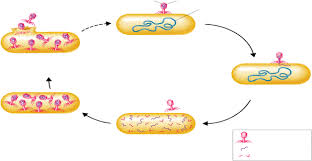
What process is this?
a)
phagocytosis
b)
lytic cycle
c)
lysogenic cycle
d)
formation of antibodies
53.
The lysing of a cell occurs in which phase?
a)
1
b)
2
c)
4
d)
5
54.
Host DNA is compromised and viral DNA takes over in which phase?
a)
1
b)
2
c)
4
d)
5
55.
What happens in the lysogenic cycle? 
a)
Virus goes in and leaves the host cell
b)
Virus quickly kills the host cell
c)
Virus inject the nucleic acid into the host cell, and the nucleic acid integrates into the host cell DNA, and stay dormant for a long time
d)
Bacteria injects DNA into a host cell
56.
What happens in the lytic cyle?
a)
Virus goes in and leaves the host cell
b)
Virus quickly kills the host cell
c)
Virus sleeps inside of the host cell
d)
Virus stay dormant for a long time
57.
Viruses are categorized according to all of the following EXCEPT 
a)
size and shape
b)
type of nucleic acid
c)
presence or absence of an envelope
d)
method of reproduction, whether asexual or sexual
58.
Which of the following is not part of the reproduction cycle of HIV? 
a)
Reverse transcription of the viral RNA
b)
Reverse transcription of the viral DNA
c)
Maturation of the viruses
d)
Biosynthesis of the viral mRNA
59.
Reasons that viruses are considered to be nonliving is because
a)
They are not cellular
b)
They cannot reproduce on their own
c)
They cannot make proteins
d)
all of the above
60.
What does a virus have on the inside?
a)
DNA, but never RNA
b)
RNA but never DNA
c)
DNA or RNA
d)
neither DNA or RNA
61.
When a virus rapidly spreads around the world this is known as ____.
a)
pandemic
b)
evolution
c)
lytic cycle
d)
retrospreading
62.
What is the purpose of reverse transcriptase used by retroviruses?
a)
To copy RNA into DNA
b)
To transcribe mRNA from DNA
c)
To destroy RNA and DNA
d)
To replicate amino acids
63.
The lytic and lysogenic cycle are reproductive cycles for what type of virus?
a)
bacteriophage
b)
tobacco mosaic virus
c)
adenovirus
d)
influenza virus
64.
What is a nonliving thing that can enter a living cell and reproduce inside the cell
a)
virus
b)
parasite
c)
host
d)
people
65.
Which is NOT a part of the endomembrane system?
a)
lysosome
b)
Golgi
c)
ER
d)
ribosome
66.
Contain ribosomes
a)
nucleus
b)
vacuoles
c)
lysosome
d)
chloroplasts
67.
Microtubles make up all of the following structures except ____.
a)
cilia
b)
centrioles
c)
flagella
d)
mitchondria
68.
DNA that is condensed into visible threads
a)
chromosomes
b)
chromatin
c)
microfilaments
d)
genes
69.
All of the following are part of a prokaryotic cell except
a)
a plasma membrane
b)
DNA
c)
nucleolus
d)
ribosomes
70.
Large numbers of ribosomes are present in cells that specialize in producing which of the following molecules?
a)
glycogen
b)
cellulose
c)
proteins
d)
lipids
71.
Which organelle uses hydrolytic enzymes to digest substances?
a)
lysosome
b)
peroxisome
c)
smooth ER
d)
central vacuole
72.
This organelle means 'empty cavity' in Latin.  They are actually fluid-filled sacs that store water, food, wastes, salts or pigments.
a)
vacuoles
b)
vesicles
c)
ribosomes
d)
microtubules
73.
A special set of microtubules used in movement. Long tail whip-like structure that propels the cell forward.
a)
Cilla
b)
Flagella
c)
Tubulin
d)
Centrioles
74.
What path would a newly synthesized protein take to get out of a cell? 
a)
ER to Golgi  to Vesicles
b)
Golgi to ER to Lysosome
c)
Nucleus to ER to Golgi
d)
ER to Lysosome to Vesicles 
75.
What organelle is primarily involved in the production of oils and lipids? 
a)
ribosome
b)
mitochondria
c)
smooth er
d)
lysosome
76.
All cells have these parts.
a)
cell wall, genetic material, cytoplasm
b)
ribosomes, cell membrane, genetic material
c)
cytoplasm, cell membrane, genetic material
d)
cell membrane, genetic material, nucleoid
77.
Prokaryotes have a mesosome.  What does this part of the plasma membrane do that is different?
a)
it regulates the entrance and exit of molecules
b)
stores nutrients for later use
c)
fold into the cytoplasm and increases the surface area
d)
extra covering that supports, shapes and protects the cell
78.
The peroxisome is found in plant and animal cells which has an intermediate by-product of peroxide.  What neutralizes this toxic compound in the cell?
a)
peroxisome attaches to a lysosome to neutralize the H2O2
b)
an enzyme, catalase neutralizes it
c)
the H2O2 is unstable and dissapates before it causes problems
79.
This is the site of protein synthesis that has 2 subunits.  It is composed of RNA and proteins.
a)
peroxisomes
b)
nucleus
c)
ribosomes
d)
lysosomes
80.

Archaea are the oldest organisms. Where do they live?

a)

hydrothermal vents

b)

inside volcanoes

c)

sulfur pools

d)

extreme salt

e)

All of these

81.

What shapes can bacteria be?

a)

square

b)

spiral

c)

spherical

d)

pyramid

e)

rod-like

82.

What are some good functions of bacteria?

a)

Release oxygen

b)

create foods

c)

decompose things

d)

create medicines

e)

None. All bacteria are bad

83.

This type of asexual reproduction involves one cell splitting into two.

a)

Binary fission

b)

nuclear fission

c)

binary mathematics

84.

The protein coat protects the outside of a virus

a)

True

b)

False

85.

A living thing that provides a source of energy for a virus or an organism.

a)

mitochondria

b)

host

c)

power surge

d)

parasite

86.

Viruses act like ______________________ because they destroy the host cells.

a)

bacteria

b)

imposters

c)

parasites

d)

euglena

87.

Protists have a nucleus and can be

a)

plant like

b)

animal like

c)

fungus like

d)

spider like

88.

Surface proteins allow a virus to

a)

Attach to its host

b)

move faster

c)

suck the life out of the host

d)

become airborne

89.

Made of a weakened, or killed virus. It triggers the immune system into action.

a)

antibiotic

b)

vaccine

c)

vitamin

90.

A virus can reproduce on it's own.

a)

No. It needs a host cell.

b)

Yes. Thats true

c)

No. It needs a male and female virus.

91.
Where do archaea live?
a)
Just in the Ocean 
b)
Everywhere, except for harsh environments 
c)
Everywhere, including really harsh environments 
d)
Just down the road, at the corner of 4th and Main 
92.
Which of the following organisms are prokaryotic?
a)
Protists
b)
Archaea 
c)
Fungi 
93.
What do Bacteria and Archaea have in common?
a)
Their ribosomes are very similar 
b)
They have a nucleus 
c)
They are single-celled 
d)
They have a cell wall with peptidogycan 
94.
True of False? Archaea can be phototrophic (make their own food).
a)
True 
b)
False 
c)
A few are chemotrophic 
d)
Nobody knows 
95.
Which kind of archaea live in extremely warm environments?
a)
Halophiles 
b)
Thermophiles 
c)
Methanogens 
d)
Psychophiles 
96.

Bacteria, along with having its main chromosome, has small circular pieces of DNA. What are these small pieces of DNA called?

a)

Plasmids

b)

Nucleoid

c)

Ribosome

d)

Flagellum

97.

The prefix "halo" such as in halophile most likely means...

a)

Salt

b)

High temperatures

c)

Self-serving

d)

Gram

98.

Which of the following groups of organisms are all chemotrophs?

a)

Cyanobacteria

b)

Methanogens

c)

Slime molds

d)

Red algae

99.

The Dead Sea is a large salt lake bording Jordan and Israel. It has a salt concentration of 34.2%, which is too hypertonic for most life. What life might still survive and thrive there?

a)

Halophiles

b)

Thermophiles

c)

Heterotrophs

d)

Cyanobacteria

100.

What would cyanobacteria be characterized as?

a)

Phototrophs

b)

Chemotrophs

c)

Heterotrophs

d)

Tealotroph

101.

What is the difference between Gram positive bacteria and Gram negative bacteria?

a)

How their cell walls are set-up

b)

How long their flagellas are

c)

Whether they have a nucleus or not

d)

The rRNA composition of their ribosomes

102.

Peptidoglycan is the main structural compound found in the cell walls of what kinds of creatures?

a)

Slime molds

b)

Bacteria

c)

Algae

d)

Archaea

103.

How would a scientist describe the cell walls of Archaea?

a)

Weird compositions of lipids

b)

95% peptidoglycan

c)

Mostly composed of chitin

d)

Does not have a cell wall

104.
Archaea are ____ similar to eukaryotes than Bacteria.
a)
more
b)
less
c)
as
105.
Bacteria get new genetic information by exchanging it with other bacteria.  This is called.....
a)
replication
b)
binary fission
c)
conjugation
d)
transfusion
106.
Almost all archaea have cell walls.
a)
true
b)
false
107.
How does a virus use a host to reproduce?
a)
The virus only uses a host cell for shelter; it does not use a host cell to reproduce.
b)
The host cell only provides the virus with the food it needs to reproduce on its own.
c)
The virus can replicate its own genetic material, but it uses the host for the process of conjugation.
d)
The host cell provides the virus with resources and shelter; its proteins replicate the genetic material of the virus.
108.
How does the process of binary fission work in the asexual reproduction of bacteria?
a)
Two cells join to become one larger cell. 
b)
One cell splits into two cells with identical DNA. 
c)
DNA material from the environment is added to the cell.
d)
Bacteria can only reproduce via sexual reproduction, not asexual reproduction.
109.
Bacteria can form ________ to protect itself from harsh conditions.
a)
endospores
b)
armor
c)
spores
d)
mushrooms
110.
A plasmid is
a)
A type of bacteria
b)
a type of archaea
c)
A small ring of DNA
d)
A virus
111.
The cycle of virus reproduction is called
a)
lilac cycle
b)
lytic cycle
c)
lysis
d)
cell cycle
112.
Lysis is _______________________.
a)
when the cell hosting a virus bursts.
b)
when a virus injects a host cell with its DNA.
c)
when the viral DNA is inactive.
113.
Conjugation occurs when ________________.
a)
None of these.
b)
a virus injects DNA into the bacterium.
c)
a plasmid is transferred from one bacteria to another.
d)
bacteria take up DNA from the environment.
114.

Which of the following converts atmospheric nitrogen into nitrogen compounds that living things can use?

a)

nitrogen fixation

b)

decomposition

c)

bioremediation

d)

pasteruization

115.

What are archaea often referred to as?

a)

extremes

b)

extremophiles

c)

exterminators

116.

Archaea that live in areas of little to no oxygen are

a)

anaerobic

b)

non-breathers

c)

aerobic

d)

decomposers

117.
Bacteria that contain chlorophyll and perform photosynthesis like a plant belong in the group
a)
archaebacteria
b)
cyanobacteria
c)
chemoautographs
d)
pathogens
118.
Name this bacteria shape
a)
coccus
b)
spirillum
c)
bacillus
119.
Name this bacteria shape
a)
bacillus
b)
coccus
c)
spirillum
120.
Name this bacteria shape
a)
coccus
b)
bacillus
c)
spirillum
121.
Which disease is not caused by bacteria?
a)
Strep throat
b)
Pneumonia
c)
Food poisoning
d)
Influenza (the Flu)
122.
Bacteria help you digest food.
a)
True
b)
False
123.

Diplo- grouped bacteria are

a)

2 bacteria

b)

a chain of bacteria

c)

a cluster of bacteria

124.

Strepto- grouped bacteria are

a)

2 bacteria

b)

a chain of bacteria

c)

a cluster of bacteria

125.

A _______________________ lives in an anaerobic environment like swamps, sewage treatment plants, and the digestive tracts of animals.

a)

Methanogens

b)

Halophiles

c)

Thermoacidophiles

126.

A _________________________ uses inorganic matter for food.

a)

Saprotroph

b)

Photoautotroph

c)

Chemoautotroph

127.

During conjugation, 2 bacteria are held together by their

a)

Flaglla

b)

Pili