wayground logo

Free Printable Worksheets

Font size

S
M
L
XL
Worksheets

Weather Final Practice

Total questions: 171

Worksheet time: 3hrs 31mins

Name
Class
Date
1.
What are the two main factors that determine the climate of an area?
a)
precipitation and humidity
b)
temperature and air pressure
c)
wind conditions and humidity
d)
temperature and precipitation
2.
What causes winds to form on Earth?
a)
solar energy
b)
ocean currents
c)
elevation differences
d)
uneven heating of the Earth by the sun
3.
What are the 3 major climate zones in order from equator to the poles?
a)
polar, temperate, tropical
b)
tropical, temperate, polar
c)
temperate, polar, tropical
4.
Which BEST describes why latitudes closest to the equator have warmer climates?
a)
they are at lower elevations
b)
they receive more solar energy
c)
they are nearer to ocean currents
d)
they get more winds that carry energy in the form of heat
5.
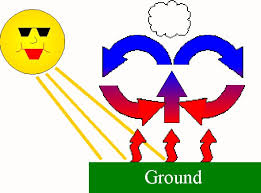
The sun’s rays are least direct
a)
near the poles
b)
near the equator
c)
at high altitudes
d)
far from the ocean
6.
The climate zones lying between 23.5° and 66.5° north and south latitude are called the
a)
temperate zone
b)
polar zone
c)
tropical zone
d)
subtropical zone
7.
Which zones are polar zones?
a)
A and E
b)
B and D
c)
C
d)
B, C and D
8.
Which continent lies almost completely within the tropical zone?
a)
North America
b)
Antarctica
c)
Australia
d)
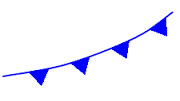
Africa
9.
What is climate?
a)
What's happening in space at a time and place.
b)
What's happening in our atmosphere at a time and place
c)
The average weather over many years
d)
The average temperature over many years.
10.
What is weather?
a)
What's happening in space at a time and place.
b)
What's happening in our atmosphere at a time and place.
c)
The average weather over many years
d)
The average temperature over many years.
11.
What climate does a desert have?
a)
Tropical
b)
Polar
c)
Arid/Dry
d)
Temperate
12.
What affects climate?
a)
The distance from the equator.
b)
The distance from the planets.
c)
The distance from the moon.
13.
Does the following statement refer to climate or weather?
Today's air temperature was the lowest this week.
a)
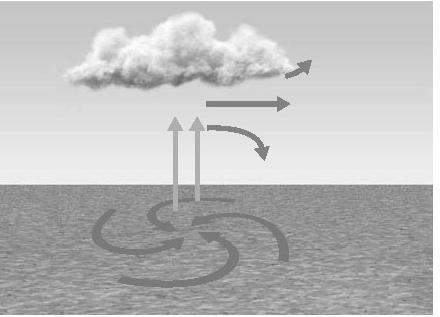
Climate
b)
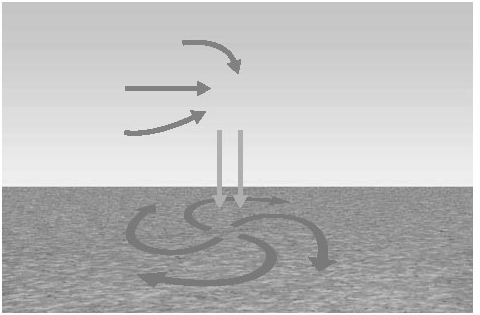
Weather
14.
As latitude ____________ temperature ____________. 
a)
increases, decreases
b)
decreases, increases
c)
increases, increases
d)
decreases, decreases
15.
This climate that is characterized by average temperature that are near or below freezing
a)
middle latitude
b)
polar
c)
tropical
d)
none of them 
16.
Which sentence best describes the relationship between elevation and air temperatures?
a)
 LOWER elevation = COLDER temperatures
b)
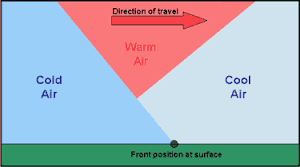
HIGHER elevation = COLDER temperatures
c)
HIGHER elevations = WARMER temperatures
d)
There is no relationship
17.
What causes winds to form on Earth?
a)
solar energy
b)
ocean currents
c)
elevation differences
d)
uneven heating of the Earth by the sun
18.
What is the height of an area above sea level?
a)
elevation
b)
topography
c)
latitude
d)
longitude
19.
Global winds over the United States blow in which direction?
a)
east to west
b)
north to south
c)
south to west
d)
west to east
20.
Warm ocean currents generally come from
a)
The North Pole
b)
The South Pole
c)
The Equator
d)
Both A and B
21.
Cold ocean currents generally come from
a)
The North Pole 
b)
The South Pole
c)
The Equator
d)
Both A and B
22.
When air is heated, it will MOST likely
a)
expand and fall
b)
expand and rise
c)
condense and fall
d)
condense and rise
23.
Which of these MOST likely causes winds to blow on Earth?
a)
Earth spins quickly, causing air to blow around.
b)
The gravity of Earth and the Moon push and pull the air.
c)
Warm air rises and cool air falls toward Earth's surface.
d)
Ocean waves push air onto the shore and across Earth's surface.
24.
Which factor causes the motion of surface ocean currents?
a)
the sun
b)
the wind
c)
the moon
d)
hurricanes
25.
Which of these events have the MOST influence on regional climate?
a)
frequent tornadoes
b)
ocean trade winds
c)
winter snowstorms
d)
temperature inversions
26.
What type of winds blow constantly, predictably, and over long distances?
a)
land breezes
b)
mountain breezes
c)
global winds
d)
land breezes
27.
Where does the initial source of energy come from that creates winds?
a)
the moon
b)
the sun
c)
the Earth's surface
d)
the rotation of the Earth
28.
Why does warm air rise?
a)
Warm air is more dense than cooler air.
b)
Warm air has more pressure than cooler air.
c)
Warm air is less dense than cooler air.
d)
Warm air has a higher dew point than cooler air.
29.
Which statement correctly describes the properties of cold air?
a)
less dense and less pressure than warm air
b)
more dense and more pressure than warm air
c)
more dense and less pressure than warm air
d)
less dense and more pressure than warm air
30.
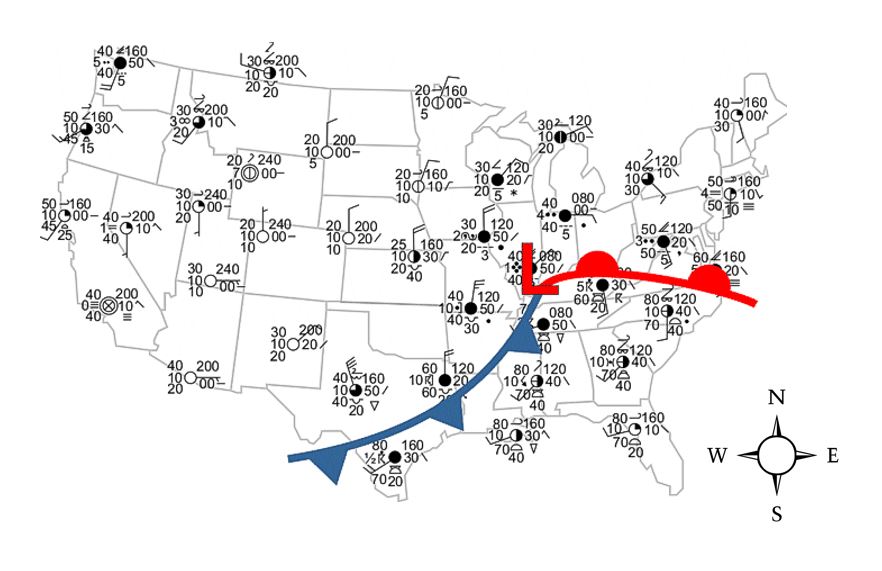
What front is moving through
Alabama and Georgia? 
a)
Warm
b)
Occluded
c)
Stationary
d)
Cold
31.
What front is moving through
Alabama and Georgia? 
a)
Warm
b)
Occluded
c)
Stationary
d)
Cold
32.
What front is moving through the NW part of the US?
a)
Stationary
b)
Warm
c)
Occluded
d)
Cold
33.
When two air masses meet and weather occurs, what is created? 
a)
Fronts
b)
Weather 
c)
Climate
d)
Seasons
34.
Deep Ocean currents are a result of
a)
Global Wind Patterns
b)
Earth's Rotation
c)
Density
d)
All of the above
35.
Two types of water currents are
a)
local and global
b)
sea and land
c)
surface and deep
d)
warm and cold
36.
Where is ocean water the densest.
a)
The surface
b)
The middle
c)
The bottom
d)
Lake Michigan
37.
Do deep currents effect wind
a)
Yes
b)
No
38.
Ocean currents have an affect on which two things
a)
climate and weather
b)
temperature and density
c)
land and sea
d)
equator and poles
39.
What causes wind to blow?
a)
Differences in longitude
b)
Shock waves from clouds
c)
Differences in air temperature and pressure
d)
The rotation of earth
40.
Wind always blow from an area of ____ pressure to an area of ____ pressure
a)
low; high
b)
high; low
41.
Air moves from _______ pressure to _______ pressure.
a)
Low, High
b)
High, Low
c)
Warm, Cold
d)
Cold, Warm
42.
Ocean currents move energy in the form of
a)
Salt
b)
Water
c)
Heat
d)
Oxygen
43.
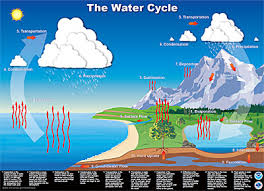
What part of the water cycle does this picture show?
a)
condensation
b)
precipitation
c)
evaporation
44.
Which is the opposite of condensation?
a)
runoff
b)
evaporation
c)
precipitation
d)
transpiration
45.
What is it called when WATER is FORMED from an LIQUID to a WATER VAPOR Oor an [GAS]?
a)
EVAPORATION
b)
PRECIPITATION
c)
TRANSPIRATION
46.
When water _________, dew forms.
a)
Melts
b)
Evaporates
c)
Condenses
d)
Precipitates
47.
During which stage do clouds form?
a)
condensation
b)
evaporation
c)
precipitation
48.
What is the process during which water cools and turns from a gas to a liquid?
a)
Codensation
b)
Runoff
c)
Precipitation
d)
Evaporation
49.
What is water doing when it is changed to water vapor?
a)
evaporating
b)
condensing
c)
transpiring
d)
freezing
50.
On which kind of day would you expect the most evaporation from the surface of a  pond?
a)
sunny and hot
b)
sunny and cold
c)
rainy and hot
d)
rainy and cold
51.
Which is the opposite of condensation?
a)
runoff
b)
evaporation
c)
precipitation
d)
transpiration
52.
Is humidity the amount of water in the air?
a)
Yes
b)
No
53.
What is the definition of CONVECTION
a)
When heat transfers through waves.
b)
When heat transfers from objects that are touching.
c)
a  hot liquid or air that  expands, becomes less dense, and rises or becomes more dense, and sinks.
d)
Heat traveling from the sun
54.
Warm air rises and the cool air sinks demonstrates this type of heat transfer. 
a)
conduction
b)
convection
c)
radiation
d)
Insolation 
55.
In convection, WARM air
a)
Rises
b)
Sinks
56.
In convection, COOL air
a)
Rises
b)
Sinks
57.

Relative Humidity is a measurement of which of the following?

a)

The amount of water vapor in the air relative to how much it can hold

b)

The amount of humiditers in the air relative to how much it can hold

c)

The amount of humiditers in the air relative to maximum

d)

The amount of humiditers in the air relative to the equator

58.

Which method of heat transfer drives storm formation?

a)

Radiation

b)

Convection

c)

Conduction

d)

Insulation

59.

Where does the energy come from that causes all weather?

a)

Radiation from the Sun

b)

Convection from the Sun

c)

Convection from the Mantle

d)

Radiation from the Mantle

60.

Where is it more likely a storm with precipitation form?

a)

Poles

b)

Doldrums

c)

Equator

d)

California

61.

When is it most likely that a thunderstorm form?

a)

In the winter during the afternoon

b)

In the summer during the afternoon

c)

In the winter during the morning

d)

In the summer during the morning

62.

What does temperature measure?

a)

The measure of coldness

b)

The measure of how much particles are "vibrating" on average

c)

The average amount of heat transferred

d)

The total thermal energy

63.
Name the 4 layers of the earth’s atmosphere from bottom to top.
a)
Thermosphere Top Mesosphere Stratosphere Troposphere Bottom
b)
Stratosphere Top Thermosphere Troposphere Mesosphere Bottom
64.
Atmospheric pressure _________________ with ________________altitude.
a)
Decreases with increased
b)
Increases with decreased
c)
Decreases with decreased
d)
Increases with increased
65.
The density of our atmosphere _____________ with an increase in altitude.
a)
Increases
b)
Gets greater
c)
Decreases
d)
Gets heavier
66.
The density of our atmosphere _____________ with an increase in altitude.
a)
Increases
b)
Gets greater
c)
Decreases
d)
Gets heavier
67.
Where you will find the ozone layer.
a)
stratosphere
b)
thermosphere
c)
exosphere
d)
mesosphere
68.
Where weather occurs.
a)
stratosphere
b)
thermosphere
c)
troposphere
d)
mesosphere
69.
Where we live.
a)
stratosphere
b)
thermosphere
c)
troposphere
d)
mesosphere
70.
As you go higher in the troposphere, the temperature _______________.
a)
decreases
b)
increases
c)
stays the same
d)
gets very hot
71.
Where I find clouds.
a)
thermosphere
b)
stratosphere
c)
troposphere
d)
ionosphere
72.
The higher you go, the air becomes _____ _____.
a)
More dense
b)
Less dense 
73.
What happens to the air pressure the higher up in space you go?
a)
the air pressure increases
b)
the air pressure decreases
c)
the air pressure stays the same
d)
there is no air pressure
74.
As you go higher in the troposphere, the temperature _______________.
a)
decreases
b)
increases
c)
stays the same
75.
Density of air is greater ________.
a)
at the top of the mountain
b)
at the bottom of the mountain
c)
at the center of the mountain
76.
How do we characterize an air mass that forms over the ocean?
a)
Dry
b)
Wet
c)
Cold
d)
Warm
77.
How do we name air masses?
a)
Water and temperature
b)
Air pressure
c)
Humidity and temperature
d)
Cold and warm
78.
How do we characterize an air mass that forms over land?
a)
Dry
b)
Wet
c)
Cold
d)
Warm
79.
How do we characterize an air mass that forms over near the equator?
a)
Dry
b)
Wet
c)
Cold
d)
Warm
80.
How do we characterize an air mass that forms near the poles?
a)
Dry
b)
Wet
c)
Warm
d)
Cold
81.
What types of air masses form over oceans?
a)
Maritime
b)
Continental
c)
Polar
d)
Tropical
82.
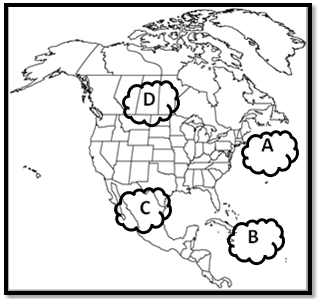
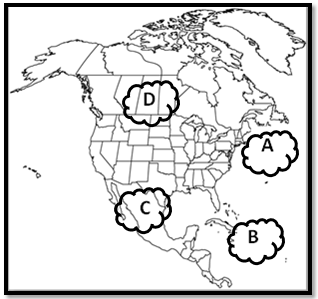
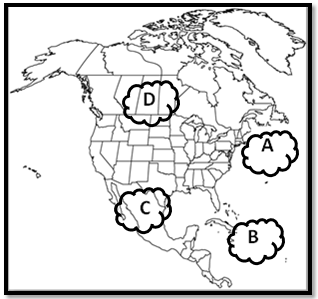
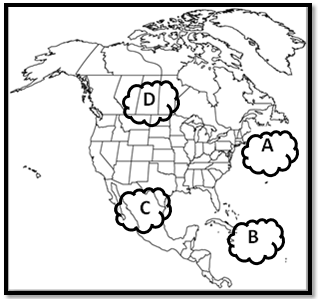
Which type of air would you find at air mass A?
a)
cold, dry
b)
warm, humid
c)
warm, dry
d)
cold, humid
83.
Which type of air would you find at air mass B?
a)
cold, dry
b)
warm, humid
c)
warm, dry
d)
cold, humid
84.
Which type of air would you find at air mass C?
a)
cold, dry
b)
warm, humid
c)
warm, dry
d)
cold, humid
85.
What type of front is this? 
a)
warm front
b)
cold front
c)
stationary front
d)
occluded front
86.
What type of front is this?
a)
warm front
b)
cold front
c)
stationary front
d)
occluded front
87.
What type of air mass is the highlighted arrow?
a)
continental polar
b)
maritime polar
c)
continental tropical
d)
maritime tropical
88.
What type of air mass is the highlighted arrow?
a)
continental polar
b)
martime polar
c)
continental tropical
d)
maritime tropical
89.
What type of air mass is the highlighted arrow?
a)
continental polar
b)
maritime polar
c)
continental tropical
d)
maritime tropical
90.
What type of air mass is the highlighted arrow?
a)
continental polar
b)
maritime polar
c)
continental tropical
d)
maritime tropical
91.
What does this symbol represent?
a)
High Pressure
b)
Warm Front
c)
Cold Front
d)
Mountains
92.
Which front is this?
a)
Warm front
b)
Cold front
c)
Occluded front
d)
Stationary Front
93.
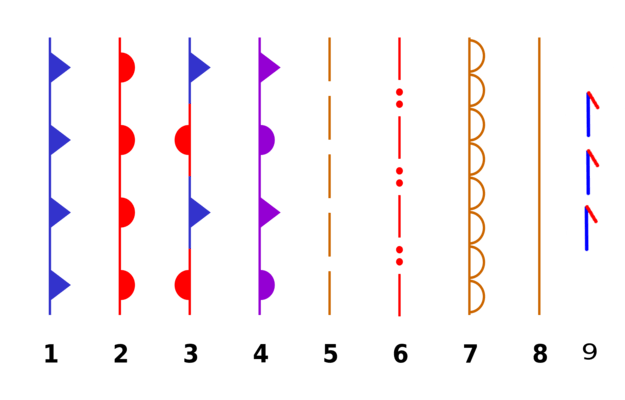
What does symbol # 1 mean?
a)
Occluded Front
b)
Stationary Front
c)
Warm Front
d)
Cold Front
94.
What does symbol # 3 mean?
a)
Cold Front
b)
Warm Front
c)
Stationary Front
d)
Occluded Front
95.
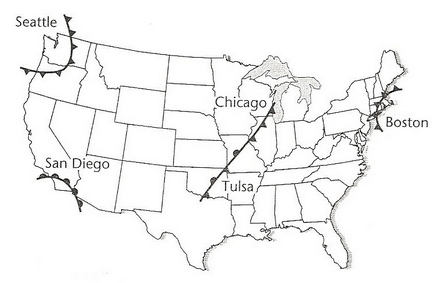
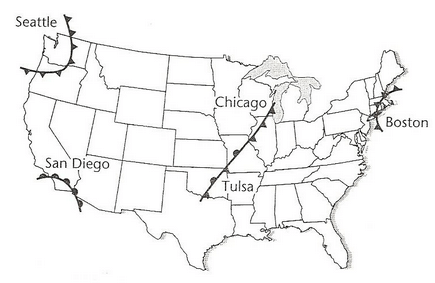
Which type of front is near Seattle?
a)
cold front
b)
warm front
c)
occluded front
d)
stationary front
96.
Which front is located near San Diego?
a)
cold front
b)
warm front
c)
occluded front
d)
stationary front
97.
Which type of front is located near Chicago?
a)
warm front
b)
cold front
c)
occluded front
d)
stationary front
98.
Which type of front is located near Boston?
a)
warm front
b)
cold front
c)
stationary front
d)
occluded front
99.
What direction is the warm front moving on the map? 
a)
North
b)
South
c)
East
d)
West
100.
Which type of pressure system is pictured?
a)
high
b)
low
c)
medium
d)
none
101.
Based on the weather map, which city will most likely experience increasing temperatures during the next 24 hours? 
a)
Denver, because it is raining there
b)
Minneapolis, because a cold front is approaching
c)
Atlanta, because a warm front is approaching
d)
Houston, because it is in a high pressure area
102.
Which location is most likely experiencing the greatest wind speeds? 
a)
Location A
b)
Location B
c)
Location C
d)
Location D
103.
Which of the following best describes the weather conditions of location B? 
a)
cloudy
b)
windy
c)
clear skies
d)
hurricane
104.
A front is moving across Oklahoma and Texas bringing warm humid air behind it. Which of the following labels should be used to mark this front on a map? 
a)
IV only
b)
II and III
c)
II only
d)
I and III
105.
A front is moving across Oklahoma and Texas bringing cold air behind it. Which of the following labels could be used to label the air behind the front? 
a)
III only
b)
I and II
c)
II and IV
d)
I and III
106.
Where is the center of the high pressure system?
a)
Idaho
b)
Wyoming
c)
Texas
d)
Illinois
107.
Where is the center of the low pressure system located?
a)
Wisconsin
b)
Idaho
c)
Wyoming
d)
Texas
108.
6. Wind develops because the Earth is heated unevenly.
a)
True
b)
False
109.
Hurricanes form in what area of the world?
a)
Over dry land
b)
Near the poles in cold water
c)
Near the equator in warm water
d)
During rain storms anywhere
110.
Which term best describes how the earth's atmosphere is heated, which generates wind?
a)
spirally
b)
unevenly
c)
circularly
d)
kinetically
111.
What creates the temperature differences between the equator and the poles?
a)
The length of the seasons
b)
the shape of the earth
c)
the duration of the solar year
d)
the amount of direct radiation (sunlight) 
112.
Which term describes a circulation of air or water that is caused by density?
a)
convection current
b)
conduction current
c)
radiation current
d)
emission current
113.
In convection currents, COOL air
a)
Rises
b)
Sinks
114.
Energy driving convection currents on Earth comes from...
a)
The sun
b)
The moon
c)
The wind
d)
The ocean
115.
Is hot air LESS dense or MORE dense than cold air?
a)
LESS dense
b)
MORE dense
c)
EQUAL density
116.
What is the greatest source of thermal energy on Earth?
a)
Moon
b)
Sun
c)
Heat
d)
Convection
117.
Is hot air LESS dense or MORE dense than cold air?
a)
LESS dense
b)
MORE dense
c)
EQUAL density
118.
Temperature changes can cause density changes in water or air.
a)
False
b)
True
119.
How does temperature affect density?
a)
Hot air/water sinks
b)
Cold air/water rises
c)
Hot air/water rises
d)
Cold and hot air rise
120.
Does density create convection currents?
a)
Yes
b)
No
121.
What is the main source for convection currents in the atmosphere?
a)
wind
b)
sun
c)
moon
d)
clouds
122.
All energy on earth begins
a)
with the heat produced by pressure inside the earth
b)
photosynthesis by producers
c)
with the sun
d)
with the magma inside the earth
123.
The temperature changes we experience close to earth are due to:
a)
elevation
b)
conduction
c)
radiation
d)
convection currents
124.
Convection currents are caused by differences in 
a)
density
b)
humidity
c)
gravity
d)
temperature
125.
What causes our air to flow in a circular pattern of warm air rising, cool air sinking?
a)
High pressure
b)
the jet stream
c)
the coriolis effect
d)
convection currents
126.
If we didn't receive energy from the sun, convection currents in the air and oceans would stop.
a)
true
b)
false
127.
what are source regions?
a)
areas where air masses originate
b)
place that have fires 
c)
places that has droughts
128.
What is a front?
a)
the transition between air masses
b)
The face of somthing
c)
the back of somthing
d)
 the speed of the wind velocity 
129.
What causes the differences of density in fronts?
a)
water differences
b)
humidity differences
c)
groundwater differences
d)
Temperature differences
130.
What would you expect from a Continental Polar air mass? 
a)
moist, warm air
b)
dry, cold air
c)
dry, warm air
131.
Air travels
a)
from high pressure to low pressure
b)
from low pressure to high pressue
132.
A severe storm which involves a funnel cloud forming over land is:
a)
hurricane
b)
tornado
c)
thunderstorm
d)
blizzard
133.
Air pressure is greatest:
a)
closer to Earth
b)
farther from Earth
134.
Which type of pressure system is pictured?
a)
high
b)
low
c)
medium
d)
none
135.
What type of weather would you expect with the pressure system pictured?
a)
clear
b)
cloudy
c)
severe storms
d)
hot
136.
Which type of pressure system is pictured?
a)
high
b)
low
c)
medium
d)
none
137.
What type of weather would you expect from the pressure system pictured?
a)
clear
b)
cloudy
c)
hot
d)
stormy
138.

According to the diagram, what is the pressure like on top of Mount Everest

a)

30% of sea level

b)

1% of sea level

c)

10% of sea level

d)

50% of sea level

139.

According to the diagram, which layer contains approximately 75% of the mass of the atmosphere?

a)

Troposphere

b)

Stratosphere

c)

Mesosphere

d)

Thermosphere

140.

According to the diagram, at what elevation does the temperature equal 40C?

a)

30km

b)

130km

c)

90km

d)

50km

141.

According to the diagram, why is it hard to breath at high elevations?

a)

The air density decreases so we get less oxygen.

b)

The temperature decreases so we get less oxygen.

c)

Oxygen percent decreases so we get less oxygen.

142.

According to the diagram, what should you expect when you go into the mountains? (Choose 2)

a)

A lower pressure

b)

A higher pressure

c)

A lower air density (air is thinner)

d)

A higher air density

143.

According to the diagram, which layer has the highest density?

a)

Troposphere

b)

Mesosphere

c)

Stratosphere

d)

Thermosphere

144.

According to the diagram, which layer has the highest pressure?

a)

Troposphere

b)

Mesosphere

c)

Stratosphere

d)

Thermosphere

145.

Which layer of the atmosphere is the most dense?

a)

Troposphere

b)

Thermosphere

c)

Stratosphere

d)

Mesosphere

146.

As you increase in altitude what happens to air density?

a)

It decreases

b)

It increases

c)

It stays the same

147.

According to the diagram, if you were going up in the atmosphere, what would help you determine which layer you are in?

a)

The altitude and the trend in temperature (increasing or decreasing)

b)

The altitude and the air pressure

c)

The altitude, pressure, and water

d)

Altitude and weather

148.

According to the diagram, what layer is the coldest?

a)

mesosphere

b)

thermosphere

c)

troposphere

d)

stratosphere

149.

According to the diagram, what happens to the temperature as we go from layer to layer?

a)

The temperature continues to decrease.

b)

The temperature continues to increase.

c)

The trend reverses in each layer.

d)

The temperature stays the same in each layer, there is no trend.

150.

According to the diagram, what will happen if you go up 1km?

a)

I will enter the stratosphere

b)

The temperature will increase

c)

The temperature will decrease

d)

I will be in the mesosphere.

151.
What happens to the density (thickness)/air pressure of the air as you increase in altitude?
a)
density increases
b)
density decreases
c)
density stays the same
d)
density disappears
152.
The _____ is the layer where the weather occurs.
a)
Exosphere
b)
Thermosphere
c)
Magnetosphere
d)
Troposphere
153.

Which gas makes up MOST of Earth's atmosphere?

a)

Nitrogen

b)

Oxygen

c)

Carbon Dioxiden

d)

Argon

154.
It's been like this for the last 3 days. What kind of front is shown?
a)
warm front
b)
cold front
c)
occluded
d)
stationary
155.
Based on the picture, what type of front is present?
a)
Warm front
b)
Cold front
c)
No front - After a warm front
d)
No front - After a cold front
156.

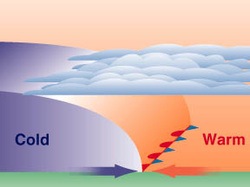
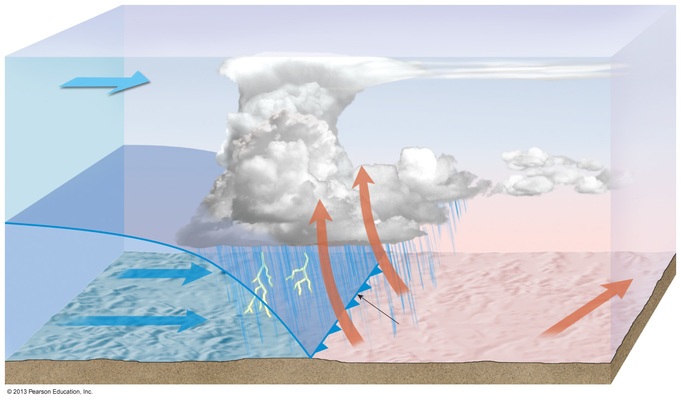
What type of weather does this front bring?

a)

Cloudiness and light precipitation; warm and mild weather follows

b)

Thunderstorms can occur; cool, fair weather follows

c)

Many days of clouds and precipitation

d)

Temperature drops; strong winds and heavy precipitation

157.

What type of weather does this front bring?

a)

Cloudiness and light precipitation; warm and mild weather follows

b)

Thunderstorms can occur; cool, fair weather follows

c)

Many days of clouds and precipitation

d)

Temperature drops; strong winds and heavy precipitation

158.

What type of weather does this front bring?

a)

Cloudiness and light precipitation; warm and mild weather follows

b)

Thunderstorms can occur; cool, fair weather follows

c)

Many days of clouds and precipitation

d)

Temperature drops; strong winds and heavy precipitation

159.

What type of weather does this front bring?

a)

Cloudiness and light precipitation; warm and mild weather follows

b)

Thunderstorms can occur; cool, fair weather follows

c)

Many days of clouds and precipitation

d)

Temperature drops; strong winds and heavy precipitation

160.

How does the air in this type of front move?

a)

Warm air slowly moves over cold air

b)

Warm air rapidly moves up when meeting cold air

c)

Warm air is trapped between two colder air masses

d)

Warm air meets cold air and cannot move

161.

How does the air in this type of front move?

a)

Warm air slowly moves over cold air

b)

Warm air rapidly moves up when meeting cold air

c)

Warm air is trapped between two colder air masses

d)

Warm air meets cold air and cannot move

162.

What type of front is shown?

a)

Warm Front

b)

Cold Front

c)

Occluded Front

d)

Stationary Front

163.

What type of front is shown?

a)

Warm Front

b)

Cold Front

c)

Occluded Front

d)

Stationary Front

164.

What type of front is shown?

a)

Warm Front

b)

Cold Front

c)

Occluded Front

d)

Stationary Front

165.

What type of front is shown?

a)

Warm Front

b)

Cold Front

c)

Occluded Front

d)

Stationary Front

166.
What symbol is this?
a)
warm front
b)
cold front
c)
stationary front
d)
occluded front
167.
Which type of front is pictured?
a)
Cold front
b)
Warm front
c)
Occluded front
d)
Stationary front
168.
What does symbol # 3 mean?
a)
stationary front
b)
occluded front
c)
warm front
d)
cold front
169.
Which type of front is pictured?
a)
Cold front
b)
Warm front
c)
Occluded front
d)
Stationary front
170.
What type of storm front is this? 
a)
warm front
b)
cold front
c)
stationary front
d)
occluded front
171.
Which type of air would you find at air mass D?
a)
cold, dry
b)
warm, humid
c)
warm, dry
d)
cold, humid