wayground logo

Free Printable Worksheets

Font size

S
M
L
XL
Worksheets

Honors Biology Unit 1

Total questions: 110

Worksheet time: 1hrs 26mins

Name
Class
Date
1.
How many variables should you change in an experiment?
a)
none
b)
1
c)
2 or more
d)
depends on the type of experiment
2.
The variable in an experiment deliberately changed by the scientist. The variable being tested.
a)
dependent variable
b)
independent variable
c)
data
d)
control group
3.
If you were testing how well different dish soaps cleaned grease, the independent variable would be the:
a)
dish type
b)
amount of grease
c)
dish soap type
d)
grease type
4.
The variable that depends on changes to the independent variable. 
a)
control group
b)
dependent variable
c)
experimental variable
d)
independent variable
5.
Dory set up an experiment to see how the mass of a ball affects the distance it rolls off a ramp. What is the dependent variable?
a)
distance traveled by the ball
b)
height of the ramp
c)
mass of the ball
d)
ball type
6.

The factor(s) in an experiment that stays the same.

a)

control group

b)

constant(s)

c)

dependent variable(s)

d)

experimental group

7.
Three baseball players investigate to see who can throw a baseball the farthest. They mark off an area on the playground for their investigation. Which should they keep constant?
a)
height of the players
b)
color of the balls thrown
c)
order in which the players throw
d)
spot from which the players throw
8.
When is it appropriate to use a line graph to display your results? 
a)
x & y axis are linear measurements (measured in increments)
b)
only the y axis is linear
c)
only the x axis is linear
d)
x & y axis are not linear (usually types of something)
9.
Students used various temperatures of water to see which one dissolved candy faster. 
What was the Independent Variable?
a)
Amount of Candy
b)
Amount of Water
c)
Temperature of Water
d)
Time for Candy to Dissolve
10.
An experiment is performed on plants to see how different liquids affect plant growth. Each plant in the experiment is given a different liquid; water, apple juice, or milk. Each plant has the same amount of soil, sunlight, and listens to the same music. In this investigation, the independent variable is ...
a)
The type of plant
b)
The amount of sunlight
c)
The type of music
d)
The type of liquid
11.

Smallest living unit of a living organism

a)

Cells

b)

Reproduce

c)

Genetic code

d)

Homeostasis

12.
Which is NOT a characteristic that all living organisms share? 
a)
Ability to reproduce 
b)
Ability to grow 
c)
Ability to respond to their environment 
d)
Ability to dominate an ecosystem 
13.
When you step out into the cold, your body shivers in order to keep its temperature at 98.6F. 
a)
All living things have a metabolism 
b)
All living things have an internal structure of cells
c)
All living things respond to their environment 
d)
All living things grow
14.
During ___________ conditions inside our body are kept stable (the same)
a)
homeopathic
b)
Homo sapian
c)
homeostasis
d)
homologous
15.
Rocks are not living because
a)
they never move
b)
they aren't needed for humans
c)
they are not made of cells
d)
they don't break down
16.
Maintaining a stable internal environment.
a)
Homeostasis
b)
Metabolism
c)
Stimulus
d)
DNA
17.
Which of the following is NOT a characteristic of all living things?
a)
growth and development
b)
ability to move
c)
response to the environment
d)
ability to reproduce
18.
Which of the following characteristics of living things best explains why humans sweat when they get hot?
a)
maintaining a stable internal enviornment
b)
growth and development
c)
using energy
d)
ability to reproduce
19.
A gazelle running away from a hunting lion is an example of ____________.
a)
homeostasis
b)
responding to stimuli
c)
growing and developing
d)
reproducing
20.

The sum of all the chemical reactions in your body?

a)

organization

b)

metabolism

c)

homeostasis

d)

evolution

21.
A camel has eyelashes that work to keep the dust and sand out of its eyes.
a)
All living things have adaptations
b)
All living things grow
c)
All living things have an internal structure
d)
All living things have a metabolism
22.
A caterpillar hibernates in a cocoon and emerges as a butterfly.
a)
All living things have adaptations
b)
All living things have a metabolism
c)
All living things respond to their environment
d)
All living things grow and develop
23.
Creates the greatest diversity, & therefore the ability to survive changing environments is
a)
sexual reproduction
b)
asexual reproduction
c)
cloning
d)
fragmentation
24.
 A general name for a sex cell (egg or sperm) is a: 
a)
zygote
b)
gene
c)
offspring
d)
gamete
25.
Which reproduction requires a mate?
a)
asexual
b)
sexual
c)
neither
26.
Requires only ONE parent creating a clone of themselves-no diversity, large amounts of offspring
a)
natural selection
b)
selective breeding
c)
sexual reproduction
d)
asexual reproduction
27.
Passes genetic information
onto future generations
a)
sexual reproduction
b)
asexual reproduction
c)
both
28.
Prokaryotes reproduce asexually through -
a)
Spore formation
b)
Vegetative propagation
c)
Binary fission
29.
When organisms reproduce asexually, the offsriping are 
a)
identical
b)
unique
30.
What is an advantage of sexual reproduction?
a)
Allows genetic variation
b)
Only needs one parent
c)
Happens very quickly
d)
Offspring are exact copies of parent
31.

Which of the following is an example of sexual reproduction?

a)

Hydra budding

b)

Binary fission in bacteria

c)

Mom bear mates with dad bear

d)

Starfish regenerates its arm

32.
What two elements make up water?
a)
Helium and oxygen
b)
Hydrogen and oxygen
c)
helium and carbon
d)
oxygen and carbon
33.
What word describes when water is attracted to other substances?
a)
cohesion
b)
adhesion
c)
capillary action
d)
surface tension
34.
Why can water have no net charge but have slight charges in different parts of the molecule?
a)
The oxygen end is slightly negative and the hydrogen end is slightly positive
b)
The hydrogen end is slightly negative and the oxygen end is slightly positive
c)
The hydrogen and oxygen ends change in polarity
d)
Because it is hydrophobic
35.
Attractions between water molecules are called
a)
Covalent bonds
b)
Ionic bonds
c)
Polar bonds
d)
Hydrogen bonds
36.

tendency of molecules of the same kind to stick to one another

a)

cohesion

b)

adhesion

c)

solution

d)

polar molecule

37.
molecule in which opposite ends have opposite electric charges
a)
cohesion
b)
polar molecule
c)
hydrogen bond
d)
solution
38.
Why does ice float?
a)
As water freezes, it expands and its density decreases.
b)
As water freezes, it takes up more hydrogen from the atmosphere, causing it to have a greater buoyancy.
c)
As water freezes, air becomes trapped between the hydrogen bonds of water molecules.
d)
As water freezes, it takes up more oxygen from the atmosphere, causing it to have a greater buoyancy.
39.
Which end of the water molecule has a slightly positive charge?
a)
the oxygen end
b)
the hydrogen end
c)
both ends are slightly positive
d)
neither end is positive
40.
Which types of compounds dissolve easily in water?
a)
Polar and Nonpolar
b)
Polar and Ionic
c)
Nonpolar and Ionic
d)
Covalent and Nonpolar
41.
The reason the water balloon did NOT pop while held over a flame is water's _________.
a)
Less dense than air.
b)
Hydrogen bonds between water molecules.
c)
polarity.
d)
high specific heat capacity.
42.
Water molecules are attracted to other kinds of molecules because of the property.
a)
Cohesion
b)
Adhesion
c)
Surface Tension
d)
Universal Solvent
43.
Water is a universal solvent because it...
a)
It can be found anywhere
b)
It freezes when it gets cold
c)
floats when frozen
d)
Dissolves most substances
44.
Water beads up on the surface of a penny because of this property.
a)
Adhesion
b)
High Surface Tension
c)
Universal Solvent
d)
Changes in Density
45.
Most of water's properties occur because it is...
a)
A polar covalent
b)
Made with oxygen
c)
A polar ionic
d)
Makes up 75% of the Earth
46.
What is the reason why oil and water don't mix?
a)
Oil is too heavy to mix with water
b)
Water can only mix with polar molecules 
c)
Water can only mix with non-polar molecules
d)
Oil is too light to mix with water 
47.
The fact that ice floats on liquid water is due to the fact that water's solid is ___________ than it's liquid form
a)
less polar
b)
more polar
c)
less dense
d)
more dense
48.
Water molecules require a lot of energy to separate one from the others.  This gives water a high
a)
density
b)
polarity
c)
solvency
d)
specific heat
49.
Capillary action is the result of adhesion. Which aspect of water is responsible for this?
a)
Nonpolar covalent bonds that enable water to dissolve other substances
b)
Polar covalent bonds that join molecules of water to other substances
c)
Hydrogen bonds between water and another substance
d)
Ionic bonds that enable electrons to flow through water and into another substance
50.
Which term refers to water having partial positive and a partial negative charge?
a)
cohesion
b)
surface tension
c)
polarity
d)
adhesion
51.
Proteins are made of monomers called ___________
a)
Nucleotides
b)
Monosaccharides
c)
Amino Acids
d)
Glycerol and fatty acids
52.
The element _______is found in all of the organic compounds.
a)
Iron
b)
Nitrogen
c)
Carbon
d)
Oxygen
53.
_________ are composed out of carbon (C), hydrogen (H), oxygen (O), nitrogen (N), and phosphorus (P)
a)
Carbohydrates
b)
Lipids
c)
Proteins
d)
Nucleic Acids
54.
DNA and RNA are examples of 
a)
Carbohydrates
b)
Lipids
c)
Proteins
d)
Nucleic Acids
55.
Nucleotides are monomers of
a)
Carbohydrates
b)
Lipids
c)
Proteins
d)
Nucleic Acids
56.
Monosaccharides are monomers of
a)
Carbohydrates
b)
Lipids
c)
Proteins
d)
Nucleic Acids
57.
Waxes, oils and fats are examples of
a)
Carbohydrates
b)
Lipids
c)
Proteins
d)
Nucleic Acids
58.
Glycerol and fatty acids are the monomers of
a)
Carbohydrates
b)
Lipids
c)
Proteins
d)
Nucleic Acids
59.
The organic compounds that have many structural purposes and are used in many processes within the
cell are called ____________________.
a)
Carbohydrates
b)
Lipids
c)
Proteins
d)
Nucleic Acids
60.
Which macromolecule is shown?
 View Figure 1 (if not visible)
a)
lipid
b)
protein
c)
nucleic acid
d)
carbohydrate
61.
What is the function of nucleic acids?
a)
store genetic information
b)
store energy (long-term)
c)
store energy (short-term)
d)
build skin, hair, nails, muscles
62.
Which macromolecule is shown?
 View Figure 3 (if not visible)
a)
lipid
b)
protein
c)
nucleic acid
d)
carbohydrate
63.
Which macromolecule is shown?
 View Figure 4 (if not visible)
a)
lipid
b)
protein
c)
nucleic acid
d)
carbohydrate
64.
What type of macromolecule are enzymes?
a)
Protein
b)
Carbohydrate
c)
Lipid
d)
Nucleic Acid
65.
Which of the following organic compounds is the main source of energy for living things?
a)
carbohydrates
b)
lipids
c)
nucleic acids
d)
proteins
66.
Carbohydrates are made of... 
a)
C H O
b)
C H O N
c)
C H O N P
d)
C H O N S
67.
Lipids are made of... 
a)
C H O
b)
C H O N
c)
C H O N P
d)
C H O N S
68.
Proteins are made of... 
a)
C H O
b)
C H O N
c)
C H O N P
d)
C H O N S
69.
Which macromolecule stores energy, insulates us, and makes up the cell membrane?
a)
lipids
b)
proteins
c)
carbohydrates
d)
nucleic acids
70.
This is one job proteins do NOT have in the body
a)
insulation
b)
structure for tissues and organs
c)
speed up chemical reactions
d)
transport things through cell membrane
71.
Which macromolecule is made of simple and complex sugars?
a)
lipids
b)
proteins
c)
carbohydrates
d)
nucleic acids
72.
What are the four macromolecules?
a)
proteins, nucleic acids, carbohydrates, and lipids
b)
monosaccharides, lipids, polysaccaharides, and proteins
c)
RNA, DNA, proteins, and carbohydrates
d)
proteins, DNA, RNA, and steroids
73.
All of the following are examples of lipids except:
a)
oil
b)
wax
c)
fatty acid
d)
cellulose
74.
What suffix (word ending) is used in the names of most carbohydrates?
a)
-ase
b)
-nic
c)
-ose
d)
-yme
75.
What type of macromolecule is being represented in this image? 
a)
carbohydrate
b)
lipid
c)
protein
d)
nucleic acid
76.
Which macromolecule is this?
a)
carbohydrates
b)
lipids
c)
proteins
d)
nucleic acids
77.
What is the correct name of the macromolecule in the diagram below and what is its correct function?
a)
Nucleic acid/ Storage of energy
b)
Protein/ Formation of enzymes
c)
Nucleic acid/ Contains genetic information
d)
Lipid/ Water soluble membranes
78.
The following is a diagram of the product of protein synthesis. This protein is a chain of a certain molecule. The molecule labeled Z is most likely classified as
a)
Amino acid
b)
Polypeptide
c)
Glycerol
d)
Sugar
79.
Used for short term (quick) energy.
a)
carbohydrates
b)
lipids
c)
proteins
d)
nucleic acids
80.

Provides long term energy and insulation,

a)

lipids

b)

carbohydrates

c)

nucleic acids

d)

proteins

81.
Contains a phosphate, sugar and nitrogen base
a)
nucleic acid
b)
lipid
c)
carbohydrate
d)
protein
82.
Building blocks of the body, hair , muscles etc.
a)
protein
b)
nucleic acid
c)
lipids
d)
carbohydrates
83.
Is found in the cell membrane as a bilayer. 
a)
lipids
b)
protein
c)
nucleic acid
d)
carbohydrate
84.
Identify the macromolecule in the picture
*GLUCOSE
a)
lipid
b)
protein
c)
nucleic acid
d)
carbohydrate
85.

Identify the macromolecule in the picture.

a)

carbohydrates

b)

lipids

c)

proteins

d)

nucleic acids

86.

Identify the macromolecule in the picture

a)

carbohydrate

b)

protein

c)

lipid

d)

nucleic acid

87.
Identify the macromolecule in the picture
a)
carbohydrate
b)
lipid
c)
protein
d)
nucleic acid
88.
This is one job proteins do NOT have in the body
a)
insulation
b)
structure for tissues and organs
c)
speed up chemical reactions
d)
transport things through cell membrane
89.
What is the monomer of nucleic acids?
a)
Glycerol
b)
Monosaccharides
c)
Amino Acids
d)
Nucleotides
90.
What suffix (word ending) is used in the names of most carbohydrates?
a)
-ase
b)
-nic
c)
-ose
d)
-yme
91.
Why is carbon a good atomic backbone for macromolecules?
a)
It has one valence electron.
b)
It has four valence electrons.
c)
It has extra protons.
d)
It has fewer neutrons.
92.
Which of the following elements make up nucleic acids?
a)
C, H, O
b)
C, H, O, N
c)
C, H, O, N, P
d)
C, H, O, Ca, S
93.
Carbohydrates are made of... 
a)
C H O
b)
C H O N
c)
C H O N P
d)
C H O N S
94.
Enzymes are considered to be 
a)
Lipids
b)
Carbohydrate
c)
Protein
d)
Nucleic Acid
95.
What is the purpose  of an enzyme?
a)
give permission for the reaction
b)
raise activation energy
c)
speed up reactions
d)
control how many reactions occur
96.
Where do substrates bind on an enzyme?
a)
voltage-gated channels
b)
surface receptor
c)
calcium channels
d)
active site
97.
Enzymes are capable of increasing the rate of a chemical reaction within a living cell.  Enzymes accomplish this through which of the following means?
a)
reducing the number of products   
b)
reducing the activation energy
c)
increasing the temperature of the cell
d)
increasing the concentration of reactants 
98.
What is structure A?
a)
Substrate
b)
Active site
c)
Enzyme
d)
Products
99.
What is structure D?
a)
Substrate
b)
Active site
c)
Enzyme
d)
Products
100.
What is structure C?
a)
Substrate
b)
Active site
c)
Enzyme
d)
Products
101.
What is structure E, F, G?
a)
Substrate
b)
Active site
c)
Enzyme
d)
Products
102.
How do enzymes speed up chemical reaction?
a)
Increasing activation energy
b)
Decreasing activation energy
c)
Increasing deactivation energy
d)
Decreasing deactivation energy
103.
Each enzyme only has 1 substrate that will fit its active site.  What is this called?
a)
reusable
b)
catalyst
c)
specific
d)
fragile
104.

Changes in pH and temperature can damage an enzymes active site. What is this called?

a)

reusable

b)

catalyst

c)

specific

d)

denaturation

105.
What 3 letters do enzymes typically end in?
a)
-ose
b)
-ase
c)
-ese
d)
-tic
106.
What is the name for the mechanism of enzyme activity?
a)
Lock and key
b)
jigsaw puzzle
c)
hammer and nail
d)
two hands pattern
107.
The "lock and key hypothesis" attempts to explain the mechanism of?
a)
Vacuole formation
b)
Pinocytosis
c)
Sharing of electrons
d)
Enzyme specificity 
108.
After the enzyme and substrate bind together and perform the reaction, what does the substrate become?
a)
a substrate
b)
an enzyme
c)
a product
d)
an active site
109.
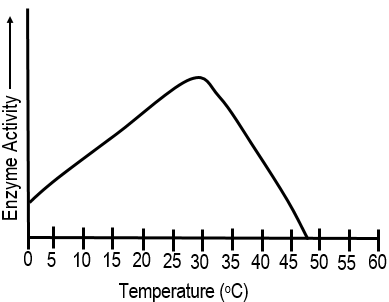
Based on the graph, what is the optimal temperature for this enzyme? 
a)
15oC
b)
40oC
c)
30oC
d)
35oC
110.
An enzyme speeds up a chemical reaction in the cell but can only be used once.  True or False? 
a)
true
b)
false