
 Worksheets
Final Review
Total questions: 140
Worksheet time: 2hrs 55mins
Name
Class
Date
1.
A possible explanation to a problem that has not yet been tested.
a)
data
b)
theory
c)
hypothesis
d)
fact
2.
This variable in an experiment is the one being deliberately changed by the scientist.
a)
dependent variable
b)
independent variable
c)
data
d)
control group
3.
Should experiments be repeated over and over to see if the results are the same each time?
a)
yes
b)
no
4.
The summary at the end of an experiment that explains the results.
a)
conclusion
b)
procedures
c)
materials
d)
responding variable
5.
A series of steps used by scientists to solve a problem or answer a question.
a)
scientific method
b)
recipe
c)
data collection
d)
metric system
6.
In a controlled experiment, how many independent variables can be worked with at a time?
a)
one
b)
none
c)
two or more
d)
how ever many makes sense.
7.
Mr. S. sets up an experiment to see how the mass of a ball affects the distance it rolls off a ramp. Identify the independent variable.
a)
distance traveled by the ball
b)
height of the ramp
c)
mass of the ball
d)
weight of the ball
8.
Mr. S. sets up an experiment to see how the mass of a ball affects the distance it rolls off a ramp. Identify the dependent variable.
a)
height of the ramp
b)
distance traveled by the ball
c)
mass of the ball
d)
weight of the ball
9.
When experimenting with the growth of a plant, a scientist uses three (of the same type of) plants, two different fertilizers, equal light, and equal water. What type of variable is the fertilizer?
a)
Dependent
b)
Independent
c)
Control
d)
Compound
10.
An experiment is performed on plants to see how different liquids affect plant growth. Each plant in the experiment is given a different liquid; water, apple juice, or milk. Each plant has the same amount of soil, sunlight, and listens to the same music. In this investigation, what is the dependent variable?
a)
Type of plant
b)
Water, apple juice, milk
c)
Plant growth
d)
Color of the plant's leaves
11.
What is a hypothesis?
a)
A hypothesis is the right answer to an experiment.
b)
A hypothesis is the wrong answer to an experiment.
c)
A hypothesis is an educated guess.
d)
I don't know.
12.
What step does every scientific experiment begin with?
a)
hypothesis
b)
question/problem
c)
procedures
d)
conclusion
13.
Why do we want to test only one independent variable at a time?
a)
Because it is hard to setup a data table with more than one variable
b)
To better identify what is causing the changes
c)
It is what has always been done
d)
It's easier to perform the experiment
14.
True or False: Your hypothesis can never be wrong.
a)
True
b)
False
15.
Which of these contains steps in the right order?
a)
Ask a question, state your hypothesis, experiment, analyze data, make a conclusion
b)
State your hypothesis, ask a question, experiment, analyze data, make a conclusion
c)
Ask a question, state your hypothesis, experiment, make a conclusion, analyze data
d)
State your hypothesis, ask a question, make a conclusion, experiment, analyze data
16.
If plants are exposed to sunlight, then they will grow taller.
What part of the scientific method is this an example of?
What part of the scientific method is this an example of?
a)
Procedure
b)
Hypothesis
c)
Question
d)
Results
17.
Why do scientists use the scientific method?
a)
To make sure they get credit for their discoveries.
b)
To make sure their results are valid and can be performed by other scientists.
c)
So that other scientist don't get mad at them
18.
The independent variable is the ONE thing you _____.
a)
change on purpose
b)
control or keep constant
c)
measure
19.
The variable that is being measured or observed is called the _______________. Hint: this is the variable that is the result or effect
a)
independent variable
b)
dependent variable
c)
control variable
20.
What is a constant/control in an experiment?
a)
Things that do not change inana experiment. It's the variable that stays the same. You can have many variables stay the same.
b)
It's the variables that the scientist changes in the experiment
c)
It's the variables that are being measured in an experiment
21.
what is the definition of chemical change?
a)
any change that results in the formation of new chemical substances.
b)
changing clothes
c)
matter cannot be created or destroyed, only change form
d)
changes affecting the form of a chemical substance, but not its chemical composition.
22.
what is burning?
a)
physical change
b)
physical property
c)
chemical change
d)
chemical property
23.
what happens when water freezes?
a)
ice is formed; chemical property
b)
cold water is formed; physical change
c)
ice is formed; physical change
d)
cold water is formed; chemical change
24.
Properties that can be observed without trying to change the identity of the substance.
a)
Physical
b)
Chemical
25.
Which of the following properties is a physical property?
a)
magnetism
b)
reaction
c)
flammability
d)
combustion
26.
Color, Odor, Density, and Shape are all what?
a)
Physical Changes
b)
Chemical Changes
c)
Physical Properties
d)
Chemical Properties
27.

Is mold growing on cheese a physical or chemical change?
a)
Physical
b)
Chemical
28.

Is gatorade powder dissolving in water physical or chemical change?
a)
Physical
b)
Chemical
29.

Is copper tarnishing a physical or chemical change?
a)
Physical
b)
Chemical
30.

Is sharpening a pencil a physical or chemical change?
a)
Physical
b)
Chemical
31.
Which is a physical change?
a)
burning match
b)
vinegar in baking soda
c)
melting butter
d)
cooking an egg
32.
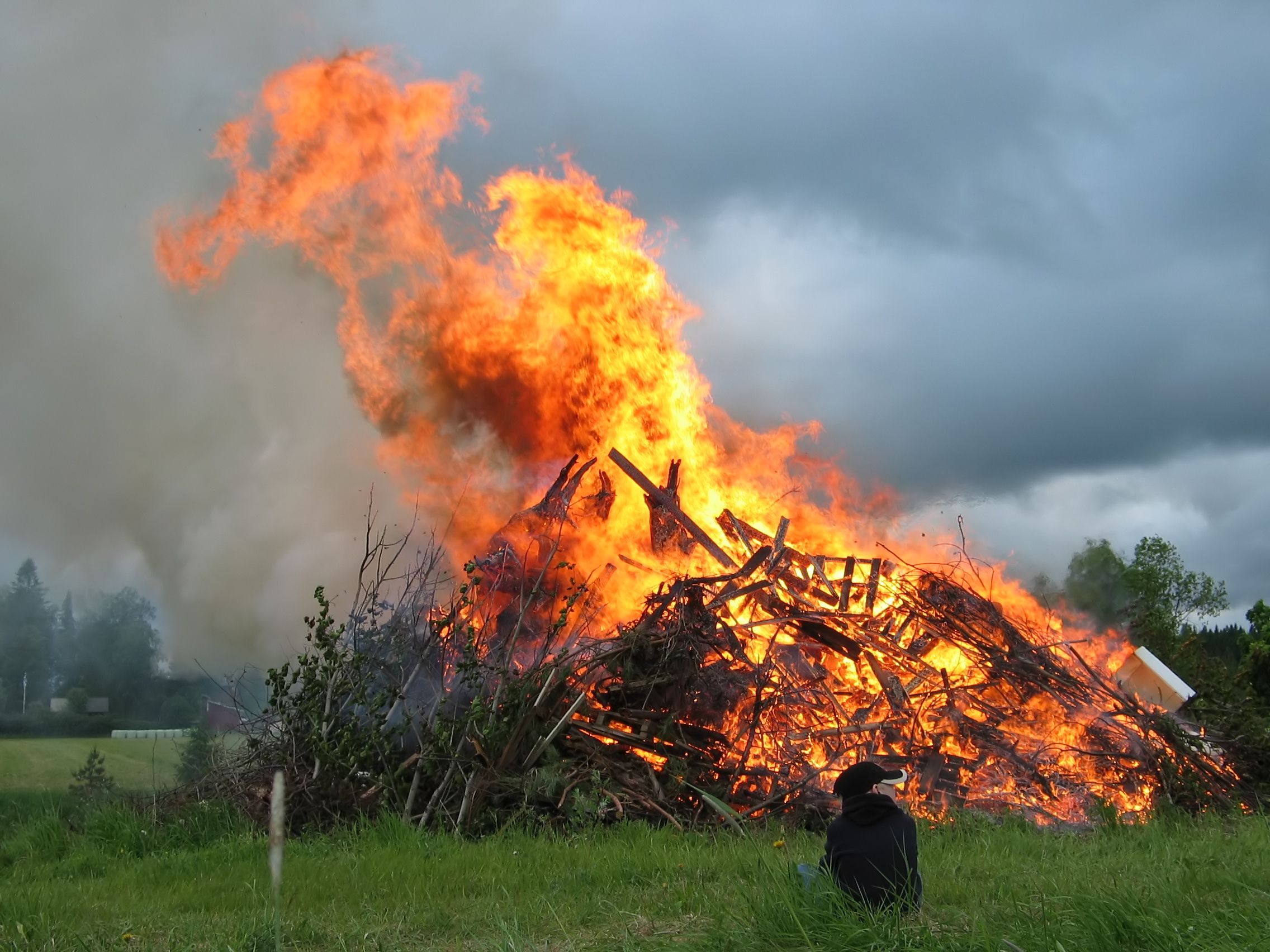
Is wood burning a physical or chemical change?
a)
Physical
b)
Chemical
33.
Which is an example of a physical property?
a)
rusting
b)
boiling point
c)
combustion
d)
reactivity with water
34.
Which is an example of a physical property?
a)
ability to react with acid
b)
color
c)
flammability
d)
ability to react with oxygen
35.
Physical properties are
a)
properties that can be observed without changing the identity of the substance
b)
properties that describe how a substance changes into a completely different substance
c)
properties that we can only observe with our eyes
d)
properties that we need special tools to observe
36.
Which of the following is a chemical property of water?
a)
Reacts with pure sodium
b)
Boils at 100 oC
c)
Is liquid at room temperature
d)
Has a density of 1 gm/mL
37.
Which of the following is a chemical property?
a)
combustion
b)
texture
c)
volume
d)
magnetism
38.
What kind of properties can only be observed when a substance changes into a different substance?
a)
physical properties
b)
chemical properties
c)
liquid properties
d)
real properties
39.
When iron fillings are mixed with sand, the iron can be removed using a magnet. This is evidence that the change that occurred when the two were mixed was....
a)
physical
b)
chemical
c)
irreversible
d)
molecular
40.
What kind of properties can only be observed when a substance changes into a different substance?
a)
physical properties
b)
chemical properties
c)
liquid properties
d)
real properties
41.
Which particle has a positive charge?
a)
electron
b)
orbital
c)
proton
d)
neutron
42.
Choose the particle that has no charge.
a)
nucleus
b)
neutron
c)
proton
d)
electron
43.
This particle determines what element you have - the elements identity.
a)
electron
b)
proton
c)
neutron
d)
valence shell
44.
What is the mass of a proton and a neutron?
a)
1amu
b)
2grams
c)
13amu
d)
10cm
45.
This causes the mass of the nucleus to increase.
a)
adding an electron
b)
adding a neutron
c)
more orbitals
d)
adding negatively charged particles
46.
An electron has a _____ charge.
a)
negative
b)
positive
c)
neutral
47.
What are valence electrons?
a)
electrons on the first orbital always
b)
nucleus
c)
the outermost shell
d)
the number of electrons on the outermost orbital
48.
Which particles make up the nucleus of an atom?
a)
protons and neutrons
b)
electrons and protons
c)
electrons, protons, and neutrons
d)
electrons and neutrons
49.
The particles of the atom you can find by knowing the atomic number.
a)
neutrons
b)
protons and electrons
c)
protons and neutrons
d)
atomic mass
50.
What is the mass number and name of an element with 8 protons and 8 neutrons?
a)
16 - Carbon
b)
16 - Oxygen
c)
24 - Oxygen
d)
8 - Neon
51.
An element with a mass number of 11 and an atomic number of 5 has how many neutrons?
a)
11
b)
5
c)
6
d)
16
52.
An atom has 10 protons, 15 neutrons and 10 electrons what is its mass number.
a)
20
b)
10
c)
5
d)
25
53.

What is the number of protons that the element in this image contain?
a)
14
b)
7
c)
15
d)
18
54.
Protons and Electrons balance the charge of an atom.
a)
True
b)
False
55.

What is the atomic mass of the atom pictured?
a)
9
b)
10
c)
18
d)
19
56.
What is the atomic number of the atom pictured?
a)
9
b)
10
c)
18
d)
19
57.
What is the element name of the atom pictured?
a)
Fluorine
b)
Neon
c)
Argon
d)
Potassium
58.

Identify this atom.
a)
Lithium
b)
Boron
c)
Carbon
d)
Neon
59.

How many valence electrons?
a)
2
b)
3
c)
5
d)
10
60.
How many valence electrons does carbon (C) have?
a)
3
b)
4
c)
5
d)
6
61.
Takes two small nuclei and combines them into a larger nucleus
a)
fission
b)
fusion
62.
The splitting of a nucleus into smaller nuclei is
a)
fusion
b)
fission
c)
half-life
d)
gamma radiation
63.
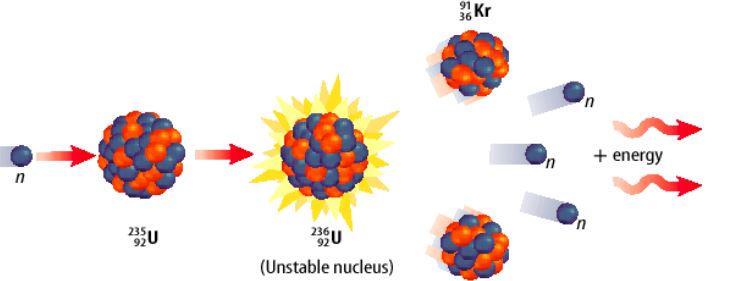
This is an example of...
a)
Fission reaction
b)
Fusion reaction
c)
Decomposition reaction
d)
Decay
64.
Where does fusion occur naturally?
a)
Underwater
b)
All around us
c)
In the radioactive waste
d)
On the sun
65.
Which atoms combine together during fusion reaction on the sun?
a)
Helium and Hydrogen atoms
b)
Hydrogen atoms
c)
Hydrogen and Lithium atoms
d)
Hydrogen and Carbon atoms
66.
Energy is created in the core when two _____________ atoms join together to form a ______________ atom.
a)
helium, hydrogen
b)
carbon, hydrogen
c)
nitrogen, helium
d)
hydrogen, helium
67.
When we look at the sun, what layer are we viewing?
a)
photosphere
b)
chromosphere
c)
corona
d)
convection zone
68.
What layer of the sun's atmosphere gives the sun its "white halo" during a solar eclipse?
a)
chromosphere
b)
photosphere
c)
corona
d)
atmosphere
69.
Areas of gas on the sun's surface that are cooler than gases around them are called:
a)
corona
b)
prominences
c)
sunspots
d)
solarspots
70.
What is the sun mostly made up of
a)
Helium
b)
Core
c)
Carbon
d)
Hydrogen
71.
Where does nuclear fusion occur?
a)
Space
b)
Radiation Zone
c)
Photosphere
d)
The Core
72.

Why are sunspots darker than the surrounding areas?
a)
The hotter gas releases less light
b)
The Cooler gas releases less light
c)
They look that way because the light form the sun
d)
They are created by shadows from the moon.
73.
These can disrupt electronics on Earth.
a)
Sunspots
b)
Solar flares
c)
Comets
d)
Mars
74.

What is an explosion on the sun that gives out huge amounts of energy?
a)
Sun Spot
b)
Solar Flare
c)
Sun Ray
d)
Sun Gases
75.

Which statement is true about the sun?
a)
It is a star.
b)
It is the largest star in our galaxy.
c)
It is a planet close to Earth.
d)
It is a moon.
76.

What is the sun made out of?
a)
fire and lava
b)
gases
c)
magma
d)
flames
77.

How does the sun keep all of the planets in orbit?
a)
The pull of its gravity
b)
the flames give it power
c)
the sun spots
d)
The solar flares guide them
78.

The SUN is an average sized star.
a)
True
b)
False
79.

The most common elements in the SUN are
a)
carbon and oxygen
b)
water and carbon dioxide
c)
calcium and potassium
d)
hydrogen and helium
80.
What is one thing that makes the sun different from the other stars?
a)
It is the largest star
b)
It is the star that gives off the most heat energy
c)
It is the brightest star
d)
It is the closest star to Earth
81.
What determines the color of a star?
a)
It's size
b)
It's temperature
c)
It's composition
d)
They are all the same color
82.
What fuel do stars use?
a)
Oxygen
b)
Hydrogen
c)
Carbon
d)
Iron
83.
The stable period of a star’s life cycle is called...
a)
The birth of a star
b)
Nebula
c)
Neutron star
d)
Main Sequence
84.
A white dwarf is the final stage for _________ mass stars like our Sun.
a)
small/medium
b)
large
c)
super massive
85.
The path a star takes during its life cycle depends solely on its _____.
a)
temperature
b)
luminosity
c)
mass
d)
location
86.
A 'baby' star that is still gathering mass in a Nebula and has not begun fusion is called a ___________.
a)
Prototype
b)
Protostar
c)
Brown Dwarf
d)
White Dwarf
87.
What is the first stage of the life cycle of a star for all stars?
a)
nebula
b)
protostar
c)
main-sequence
d)
red giant
88.
This stage is when a high mass star explodes
a)
Supergiant
b)
Red giant
c)
Supernova
d)
Black hole
89.
When a star's gravitational pull is so strong that not even light can escape, it's called a what?
a)
Black hole
b)
Supernova
c)
White dwarf
d)
Nebula
90.
A star is born when it begins...
a)
nuclear fusion
b)
nuclear abrasion
c)
chemical reaction
d)
nuclear fission
91.
All H-R diagrams show what about stars?
a)
size and mass
b)
brightness and temperature
c)
name and location
d)
fusion of elements
92.
The most common elements stars are made of...
a)
Iron & Carbon
b)
Gold & Zinc
c)
Hydrogen & Helium
d)
Fire and Ice
93.
The core of a Red Giant collapses and becomes a ___________________.
a)
White Dwarf
b)
Blue Supergiant
c)
Red Supergiant
d)
Black Hole
94.
Gravity is responsible for the . . .
a)
sun rotating around the planets
b)
sun revolving around the planets
c)
planets revolving around the sun
d)
planets rotating of a planet around the sun
95.
The ___________ the planet is from the sun, the ____________ it takes to go around the sun.
a)
closer, shorter
b)
farther, shorter
c)
farther, longer
d)
closer, longer
96.
How does the mass of an object effect the gravitational attraction of an object?
a)
The smaller the mass of the object the greater the gravitational force.
b)
The mass of the object has no effect on the gravitational force
c)
The greater the mass of the object the less the gravitational force.
d)
The greater the mass of the object the greater the gravitational force.
97.
What two factors keep Earth in orbit around the sun?
a)
mass and distance
b)
inertia and gravity
c)
eccentricity and velocity
d)
force and speed
98.
What is the biggest difference between the Geocentric Model and the Heliocentric Model?
a)
the shape of the planets' orbits
b)
the movement of the moon
c)
the center of the solar system
99.

This image shows the:
a)
Geocentric Solar System
b)
Heliocentric Solar System
100.
The sun centered view of the universe
a)
Galaxy
b)
Geocentric
c)
Astonomy
d)
Heliocentric
101.
Used to determine whether an object is older or younger than other objects
a)
Superposition
b)
Relative Dating
c)
Fossil
d)
Unconformity
102.
States that younger rocks lie above older rocks if the layers have not been disturbed
a)
Law of crosscutting
b)
Law of superposition
c)
Relative Dating
d)
Unconformity
103.
Traces or remains of organisms that lived long ago
a)
Fossil
b)
Unconformity
c)
Superposition
d)
Column
104.
How does the law of crosscutting explain the age of a fault?
a)
The fault is younger than the rocks above it.
b)
The fault is younger than the rocks it cuts through.
c)
The fault is older than the rocks above it.
d)
The fault is older than the rocks it cuts through.
105.

Analyze the seashell found in the white layer. Which statement is true of the rock layer that contains this fossil?
a)
It could also contain a fossil from the bottom layer.
b)
It is older than the layers below it.
c)
It is younger than the layers above it.
d)
It is older than the layers above it.
106.
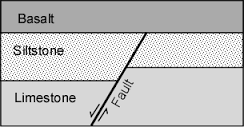
What are the relative ages of the features in order from oldest to youngest?
a)
Limestone, Basalt, Fault, Siltstone
b)
Siltstone, Fault, Basalt, Limestone
c)
Limestone, Fault, Basalt, Siltstone
d)
Limestone, Siltstone, Fault, Basalt
107.
The Geologic Time Scale is a record of what?
a)
old geologists
b)
sweet geology music
c)
the known history of rocks and fossils
d)
a list of every living thing ever
108.
How does sedimentary rock usually form?
a)
Vertically
b)
Diagonally
c)
Folding
d)
Horizontally
109.
What states that a fault or a body of rocks must be younger than any feature or layer of rock that the fault or rock body cuts through?
a)
Unconformity
b)
Intrusion
c)
Law of superposition
d)
Law of crosscutting
110.

When scientists use logic to determine the age of one fossil compared to another, they use this type of dating.
a)
Relative
b)
Carbon
c)
Absolute
111.
The thinnest layer of the Earth is the ___________.
a)
mantle
b)
crust
c)
core
112.
There are how many different types of crust?
a)
1
b)
2
c)
5
d)
3
113.
What is the thickest layer of the Earth?
a)
the crust
b)
the mantle
c)
the outer core
d)
the inner core
114.
What is the core made of?
a)
steel
b)
iron
c)
aluminum
d)
iron and nickel
115.
Which layer of the Earth is the only liquid layer?
a)
Outer Core
b)
Inner Core
c)
Mantle
d)
Lithosphere
116.
What is the correct order (starting from the surface) of Earth's layers?
a)
crust, outer core, inner core, mantle
b)
mantle, outer core, inner core, crust
c)
crust, mantle, outer core, inner core
d)
outer core, inner core, crust, mantle
117.
Less dense materials rise to the top.
a)
True
b)
False
118.
Which layer of Earth is made up of tectonic plates?
a)
outer core
b)
inner core
c)
asthenosphere
d)
lithosphere
119.
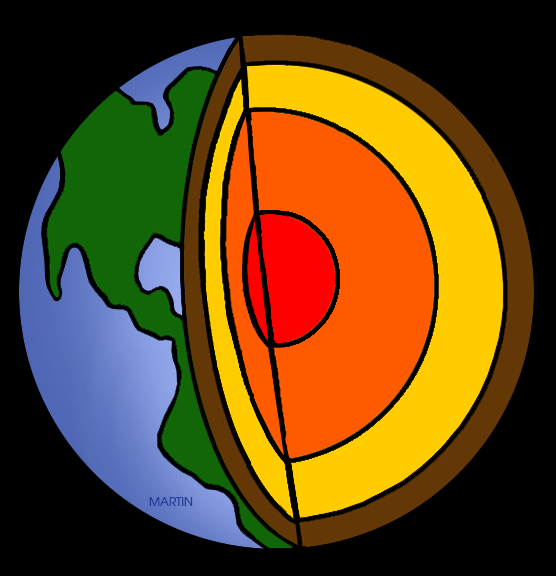
Which layer is shown in red?
a)
crust
b)
mantle
c)
outer core
d)
inner core
120.
Which layer is shown in orange?
a)
crust
b)
mantle
c)
outer core
d)
inner core
121.
What does the theory of continental drift state?
a)
The continents were once joined in a super-continent and have moved over time
b)
Continents are stationary and do not move
c)
The Earth is broken into lithospheric plates that move due to convection currents
d)
none of the above
122.
What evidence did Wegener use in his theory?
a)
Continents and fossils fitting together/matching-up like puzzle pieces
b)
glacier scars and evidence from temperature
c)
mountain ranges and coal deposits line up across continents
d)
all of the above
123.
What two specific continents fit together most noticeably?
a)
Africa and North America
b)
South America and Europe
c)
South America and Africa
d)
Antartica and Africa
124.

Who is the scientist who proposed Continental Drift Theory?
a)
Albert Einstein
b)
Alfred Wegener
c)
Isaac Newton
d)
John Dalton
125.

What do you call the supercontinent landmass formed million years ago?
a)
Pangea
b)
Asia
c)
Pantallasa
d)
Eurasi
126.
Massive pieces of land that are part of the Earth's crust and upper mantle
a)
Tectonic plates
b)
Trenches
c)
Divergent boundary
d)
Continental shelves
127.
What causes the crust to move?
a)
convection
b)
conduction
c)
tension
d)
radiation
128.
When looking at mid ocean ridges the oldest rocks are
a)
In the middle
b)
Found close to the rift zone
c)
Found far from the mid ocean ridges
129.
Sea-floor spreading begins at the
a)
Deep ocean trench
b)
Mid-ocean ridge
Mid-ocean ridge
Mid-ocean ridge
c)
Continent's edge
130.
The type of plate boundary where two plates come together is a .....
a)
Convergent Boundary
b)
Divergent Boundary
c)
Transform Boundary
d)
Plate Boundary
131.

What type of plate boundary is this?
a)
Plate
b)
Divergent
c)
Convergent
d)
Transform
132.
A divergent boundary occurs when plates ....
a)
Pull apart
b)
Come together
c)
Slide past each other
d)
subducting
133.
Which of the following is NOT evidence to support the theory of plate tectonics?
a)
Fossils
b)
Mountains
c)
Glaciers
d)
Sand Erosion
134.
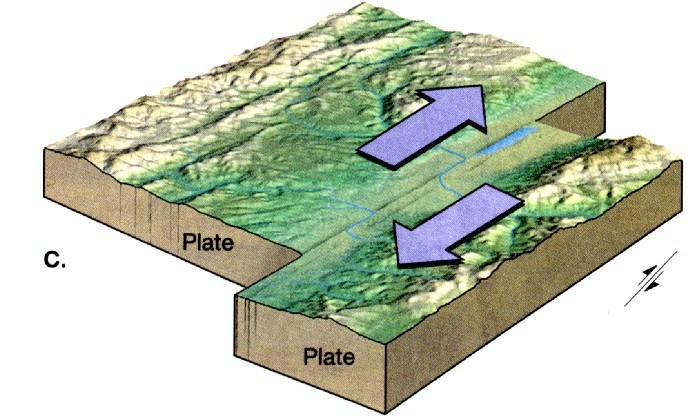
What type of plate boundary is this?
a)
Transform
b)
Convergent
c)
Divergent
d)
Plate
135.
Oceanic Trenches are formed by _______ plate boundaries
a)
Convergent
b)
Transform
c)
Plate
d)
Divergent
136.
A fault is formed by the movement of a __________ plate boundary
a)
Transform
b)
Convergent
c)
Divergent
137.
Islands can from from magma which is pushed up at a __________ plate boundary
a)
Divergent
b)
Convergent
c)
Transform
138.
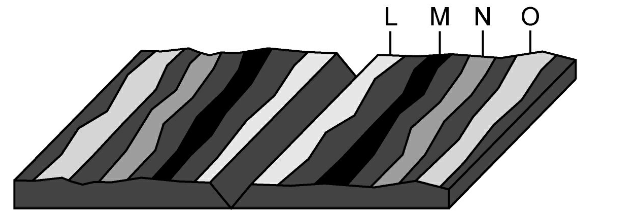
Where would the oldest rock be found?
a)
L
b)
M
c)
N
d)
O
139.
Mountains are created when....
a)
Two continental plates collide
b)
Two oceanic plates pull apart
c)
An Oceanic plate subducts under a Continental Plate
d)
Two continental plates pull apart
140.
How is it possible for new crust to be formed without increasing the surface area of the Earth?
a)
Crust is destroyed at the same time it is created
b)
New crust is underwater where it sinks
c)
New crust breaks more easily than old crust
100 %

