wayground logo

Free Printable Worksheets

NEW

Font size

S
M
L
XL
Worksheets

Test - The Sun

Total questions: 60

Worksheet time: 48mins

Name
Class
Date
1.
The sun is a medium-size star, but it appears much larger than other stars. Why does the sun appear to be so large?
a)
The sun is hotter than other stars
b)
The sun produces more light than other stars
c)
The sun is much closer Earth than other stars are
d)
The sun is affected by  Earth's gravity more than other stars are. 
2.
A stream of particles that extends outward from the sun's corona is called
a)
A sunspot
b)
Chromosphere
c)
Prominence
d)
Solar wind
3.
_____ are loops of gas on the sun that link different parts of sunspot regions together. 
a)
Prominences
b)
Solar flares
c)
Solar winds
d)
Auroras
4.

Where is the energy for the Sun created?

a)

in the radiation zone

b)

in the convection zone

c)

in the core

d)

in the Sun's atmosphere

5.

What heat transfer method is used by the Sun to transfer the heat from its core to its surface?

a)

conduction

b)

convection

c)

radiation

6.

What heat transfer method is used on the surface of the Sun that creates currents where energy moves from more thermal heat to less thermal heat?

a)

conduction

b)

convection

c)

radiation

7.
What heat transfer method is used to get the heat energy from the Sun to the Earth?
a)
conduction
b)
convection
c)
radiation
8.
Which atoms combine together during fusion reaction on the sun?
a)
Helium and Hydrogen atoms
b)
Hydrogen atoms
c)
Hydrogen and Lithium atoms
d)
Hydrogen and Carbon atoms
9.
Why are sunspots darker than the surrounding areas?
a)
The hotter gas releases less light
b)
The Cooler gas releases less light
c)
They look that way because the light form the sun 
d)
They are created by shadows from the moon.
10.

What is the distance that light can travel in one year called?

a)

Light year

b)

Irregular Galaxy

c)

Supernova

d)

Quasar

11.
What is an object that is so massive and dense that even light can not escape its gravity?
a)
Main-sequence
b)
black hole
c)
Apparent Magnitude
d)
Comet
12.
In nuclear fusion, smaller atoms are forced together to create larger atoms. Does this process release, absorb or maintain energy?
a)
Absorb energy
b)
Maintain energy
c)
Release energy
13.

What are the products of a nuclear fusion reaction?

a)

A new element

b)

A new element plus mass

c)

A new larger element plus energy

d)

A new smaller element plus energy

14.

When hydrogen is "fused" together on the Sun, what new element is created?

a)

Helium

b)

Carbon Dioxide

c)

Oxygen

d)

Light

15.

How does energy from the sun travel to Earth?

a)

electromagnetic radiation

b)

kinetic energy

c)

nuclear energy

d)

electrical current

16.

What is the distance from the Sun to Earth?

a)

150,000,000 km or 93,000,000 miles.

b)

1,600,000 km or one million miles.

c)

15,600,000 km or 10 million miles.

d)

1000 miles.

17.
How long does it take the Sun's energy to reach Earth, once it is emitted from the photosphere?
a)
100,000 years
b)
24 hours
c)
28 days
d)
8 minutes
18.

Fusion is:

a)

the splitting of a large atomic nucleus into two or more smaller ones

b)

the joining of two small nuclei to form a larger nucleus

19.

This is the outermost layer of the Sun's interior. Cooler gases sink, forming loops of gas that move energy towards the Sun's surface like a lava lamp.

a)

The Core.

b)

The Radiative Zone.

c)

The Convective Zone.

d)

The Corona.

20.
What is depicted in the image?
a)
Solar Flare
b)
Solar Prominence
21.
What is a dark area of the photosphere of the sun that is cooler than the surrounding areas and that has a strong magnetic field called?
a)
aurora
b)
convective zone
c)
sunspot
d)
photosphere
22.

The zone of the sun's interior in which energy moves by radiation is called the...

a)

photosphere.

b)

convective zone.

c)

radiative zone.

d)

sunspot.

23.
Which number represents a solar flare?
a)
7
b)
8
c)
9
d)
10
24.
What size star is our Sun?
a)
High mass
b)
Low mass
c)
Medium mass
d)
Very high mass
25.
What stage will our Sun enter in the next 5 billion years?
a)
Main Sequence
b)
Protostar
c)
White Dwarf
d)
Red Giant
26.
The sun is a _______.
a)
star
b)
planet
c)
satellite
27.

The temperature of the sun's corona can reach about:

a)

15,000 degrees fahrenheit

b)

15,000,000 degrees fahrenheit

c)

1,000,000-2,000,000 degrees celsius

d)

15,000,000 degrees celsius

28.
Our sun is classified as a
a)
Yellow Dwarf
b)
Red Dwarf
c)
White Dwarf
d)
Blue Dwarf
29.
The Sun and all the planets of our Solar System began as a
a)
Giant cloud dust and gas
b)
Solid rocks
c)
Dense Ice and Gas
d)
Physical liquid
30.

After the Sun consumes all of the hydrogen fuel it will burn...?

a)

Helium

b)

Carbon

c)

Iron

d)

Oxygen

31.
What will start the death of the Sun?
a)
Depleting hydrogen fuel
b)
Fusion ceases
c)
The creation of iron
d)
Depleting helium fuel
32.

When the Sun turns into a Red Giant it will grow large enough to encompass

a)

Mercury, Venus, and maybe Earth.

b)

Mercury only.

c)

The first four planets.

d)

Only Venus.

33.
Will our sun turn into a black hole?
a)
No, not enough mass
b)
Yes, all stars turn into black holes
c)
No, because it will turn in to a white hole
d)
Yes, because our Sun is large enough to burn Carbon
34.
Fusion is a process where _____
a)
Hydrogen atoms collide, giving off energy
b)
Helium atoms break down, giving off energy
c)
Carbon-14 atoms break down into Carbon-12
d)
Hydrogen atoms split apart, giving off energy
35.
In the convection zone, you would expect to find _____
a)
Rotating cycles of hot and cool plasma 
b)
Fusion of Hydrogen atoms
c)
Energy "radiating" out towards the surface
d)
Solar storms, like solar flares
36.

Why can we not see the corona when we look at the sun?

a)

It is invisible

b)

It is in the center of the sun

c)

The photosphere is too bright.

d)

There is nothing to see.

37.
Solar Flares can cause all of the following except
a)
Damage to I.S.S.
b)
Knock out radio signals
c)
Northern Lights
d)
Droughts
38.

How many Earths wide is the Sun?

a)

About 100.

b)

About 200.

c)

About 150.

d)

About 109 million.

39.

The middle layer of the sun's interior that contains very tightly packed gas is called the _____________.

a)

photosphere.

b)

chromosphere.

c)

radiative zone.

d)

convection zone.

40.
What does #1 represent in the diagram?
a)
Core
b)
Radiative Zone
c)
Convective Zone
d)
Photosphere
41.
What does #3 represent in the diagram?
a)
Core
b)
Radiative Zone
c)
Convective Zone
d)
Photosphere
42.
What does #2 represent in the diagram?
a)
Core
b)
Radiative Zone
c)
Convective Zone
d)
Photosphere
43.
The average temperature of the Sun's surface is
a)
15 million K
b)
5780 K
c)
10,000 K
d)
150 million K
44.
The Earth is closest to the sun in
a)
June
b)
March
c)
September
d)
January
45.

Energy from the core radiates ___.

a)

toward the center

b)

around it

c)

outward

d)

inward

46.
What makes the sun more important than the other stars?
a)
Unlike other stars, the sun is very large.
b)
When compared to other stars, the sun is the hottest.
c)
Unlike other stars, the sun is the right color for living things. 
d)
When compared to other stars, the sun is very close to Earth.
47.
During a visit to an observatory, Silvano observed the moon, Venus, the sun, and the star Sirius. Which of these objects is outside of the solar system?
a)
Sirius
b)
Venus
c)
Sun
d)
Moon
48.
The splitting of a nucleus into smaller nuclei is
a)
fusion
b)
fission
c)
half-life
d)
gamma radiation
49.
How do nuclear power-plants work?
a)
Fusion
b)
Half-life
c)
Fission
d)
Fusion or fission
50.
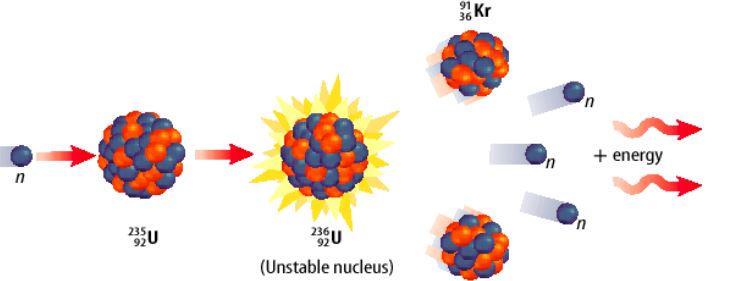
This is an example of...
a)
Fission  reaction
b)
Fusion reaction
c)
Decomposition reaction
d)
Decay
51.
Where does fusion occur naturally?
a)
Underwater
b)
All around us
c)
In the radioactive waste
d)
On the sun
52.
Do all stars make energy through fusion?
a)
Yes
b)
No
c)
Just our sun
d)
Only large stars
53.
_________ happens naturally due to an unstable nucleus.
a)
fission
b)
fusion
c)
radioactive decay
d)
K-capture
54.
Nuclear fusion releases energy when:
a)
heavy ions fuse together
b)
very light nuclei fuse together
c)
uranium splits into two fragments
d)
uranium emits a neutron
55.
Very high temperature and pressure is required for:
a)
Fission
b)
 Fusion
c)
Radioactive Decay
56.
Which of the following is true about nuclear fusion?
a)
It is easy to implement.
b)
It produces less energy than nuclear fission.
c)
It produces more energy than nuclear fission.
d)
It has the ability to occur easily in everyday life.
57.
What is a benefit of nuclear fission?
a)
The ability to absorb energy
b)
The ability to release tremendous amounts of energy
c)
The ability to produce more energy than nuclear fusion
d)
There are no beneficial aspects of nuclear fission
58.
Why do scientists most want to learn more about fusion?
a)
To win the Nobel prize
b)
To make energy for people to use
c)
To destroy the world
d)
To know more about stars
59.

What would be the advantage(s) of using nuclear fusion to produce energy?

a)

no radioactive waste and more energy produced

b)

safer

c)

requires less regulation

d)

more controlled energy produced, less radioactive waste produced

60.

Which process, fusion or fission, is considered a natural process?

a)

Fission

b)

Fusion