wayground logo

Free Printable Worksheets

NEW

Font size

S
M
L
XL
Worksheets

Makeup Quiz #6.5 (Due Sunday, 11/11 @ 11pm)

Total questions: 77

Worksheet time: 2hrs 34mins
Name
Class
Date
1.
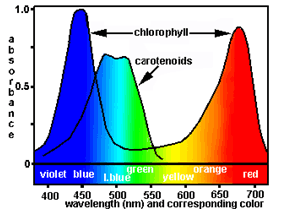
What is one function of the other pigments  besides chlorophyll, in the chloroplast?
a)
to block damaging wavelengths of light
b)
to absorb different wavelengths than the chloroplasts
c)
to provide different colors to the leaves
d)
to transfer energy to a separate photosystem beside the one using chlorophyll a and b.
2.
What is the primary function of the light reactions of photosynthesis?
a)
To produce glucose
b)
To produce NADPH and ATP
c)
To use ATP
d)
To produce RuBP
3.
What is the function of NADP+?
a)
It absorbs light
b)
It is an electron carrier
c)
It is a light-reflecting pigment
d)
It acts as long-term energy storage
4.
Green plants reflect ________ light.
a)
Red
b)
Green
c)
All
d)
Red and Violet
5.
The light reactions occur in the ________ and the dark reactions take place in the ________.
a)
Chloroplast / thylakoid membrane
b)
stroma / thylakoid
c)
mesophyl / stomata
d)
thylakoid membrane / stroma
6.
Where does the carbon come from that is used to form glucose?
a)
The soil
b)
CO2 in the air
c)
From other carbohydrates
d)
Calvin Cycle
7.
When oxygen is released as a result of photosynthesis, it is a direct by-product of
a)
reducing NADP+
b)
splitting water molecules
c)
chemiosmosis
d)
electron transfer in photosystem II and I
8.
What is the primary function of the Calvin cycle?
a)
regenerate ATP for use in the light reactions of photosynthesis
b)
produce carbon dioxide for use in the light reactions of photosynthesis
c)
produce oxygen by oxidizing water
d)
produce simple sugars from carbon dioxide
9.
The H+ concentration gradient is used to 
a)
make NADPH
b)
split a water molecule
c)
generate ATP
d)
form water
10.
The main source of energy for all life comes from ____.
a)
the Earth
b)
the moon
c)
the sun
d)
the food we eat/make
11.
Which of the following is the correct equation for PHOTOSYNTHESIS?
a)
6CO2 + 6H2O --> 6O+ C6H12O6
b)
6CO+ C6H12O6 + 6H2O --> O
c)
6O2 + 6H2O --> 6CO+ C6H12O6
d)
C6H12O6 + 6O2 ---> 6H2O + 6CO2 
12.
How can photosynthesis be related to cellular respiration?
a)
What's produced (made) by one is needed (the reactants) for the other
b)
They both produce the same products
c)
They both have the same reactants (need the same things)
d)
These 2 processes have nothing in common
13.
Where does a plant absorb the water that it uses during photosynthesis?
a)
Leaves
b)
Stem
c)
Roots
d)
Petals
14.

Which of the following statements best represents the relationships between the light reactions and the Calvin cycle?

a)

The light reactions provide ATP and NADPH to the Calvin cycle, and the Calvin cycle returns ADP, ℗i, and NADP+ to the light reactions.

b)

The light reactions provide ATP and NADPH to the carbon fixation step of the Calvin cycle, and the Calvin cycle provides water and electrons to the light reactions.

c)

The light reactions supply the Calvin cycle with CO2 to produce sugars, and the Calvin cycle supplies the light reactions with sugars to produce ATP.

d)

The light reactions provide the Calvin cycle with oxygen for carbon fixation, and the Calvin cycle provides the light reactions with sugars to produce ATP.

15.
Which of the following is NOT a product of the light reactions?
a)
ATP
b)
NADPH
c)
Oxygen
d)
Glucose
16.
What does ATP synthase do?
a)
Create ATP in chemiosmosis.
b)
Break down ATP in chemiosmosis.
c)
Break down NADPH. 
d)
Create NADPH.
17.

Electrons become energized during photosynthesis when

a)

they are absorbed by water

b)

they undergo carbon fixation

c)

they are struck with light energy

d)

they are incorporated into oxygen

18.

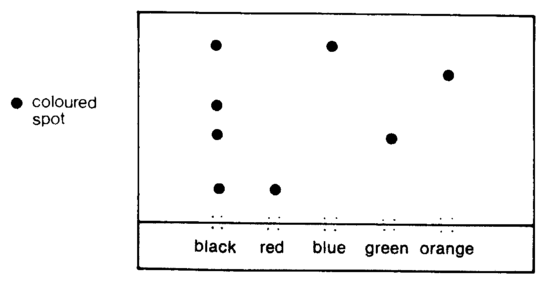
Ink can be separated by a method of -----------------------------------------------

a)

distillation

b)

filtration

c)

chromatography

d)

sedimentation

19.
chromatography separate the mixture of dyes on the basis of their ----------------------------
a)
density
b)
solubility
c)
gravity
d)
boiling point
20.
Which ink is a mixture of different pigments? 
a)
red
b)
orange
c)
green
d)
black
21.
Why must the base line be drawn in pencil and not pen?
a)
a) Pencil is good at keeping substances in place.
b)
b) Pencil is soluble in water
c)
c) Pencil is insoluble in water
d)
d) Pencil is not coloured
22.
In paper chromatography, the MOST soluble solute .......
a)
does not move from the start point
b)
stays closest to the start point
c)
travels furthest away from the start point
d)
can be found in the middle of the chromatogram
23.
In paper chromatography, the LEAST soluble solute .......
a)
does not move from the start point
b)
stays closest to the start point
c)
travels furthest away from the start point
d)
can be found in the middle of the chromatogram
24.
How is a molecule reduced?
a)
electrons are given to the molecule
b)
electrons are taken from the molecule
c)
money is taken from the molecule
d)
protons are given to the molecule
25.
How is a molecule oxidized?
a)
Electrons are added to the molecule
b)
Electrons are taken from the molecule
c)
Electrons are shared with the molecule
d)
Protons are added to the molecule
26.
Where does glycolysis occur?
a)
Inner mitochondrial membrane
b)
Mitochondrial Matrix
c)
Cytosol
d)
At a ribosome
27.
NADH is a ______ form of NAD+.
a)
Reduced
b)
Oxidized
c)
Catabolized
d)
Hydrolized
28.
How many ATP are gained through glycolysis?
a)
0
b)
2
c)
4
d)
30-38
29.
ATP hydrolysis is _________.
a)
Exergonic
b)
Endergonic
c)
Anabolic
d)
A condensation reaction
30.
Cellular respiration involves the net _______ of glucose.
a)
Reduction
b)
Oxidation
c)
ATP
d)
REDOX
31.
Which molecule enters Kreb's Cycle?
a)
Pyruvate
b)
Glucose
c)
Acetyl CoA
d)
reducing powers
32.
Where does ETC occur?
a)
Mitochondrial matrix
b)
Outer mitochondrial membrane
c)
Inner mitochondrial membrane
d)
Cytosol
33.
Each NADH molecule carrying hydrogen to the ETC can produce a maximum of _ molecules of ATP?
a)
1
b)
2
c)
3
d)
4
34.
site of the krebs cycle
a)
1
b)
2
c)
3
d)
4
35.
Which process is the largest contributor to the release of CO
a)
Citric Acid Cycle or Krebs Cycle
b)
Pyruvate Oxidation
c)
Glycolysis
d)
Oxidative Phosphorylation 
36.
If ADP is phosphorylated then what is this indicating in the reaction? 
a)
ADP is forming into ATP
b)
ADP is becoming AMP
c)
ADP is being used to power other reactions
d)
ADP is being created by the reaction
37.
Which process least amount of ATP in cells? 
a)
Glycolysis
b)
Citric Acid cycle
c)
Lactic acid Fermentation
d)
Pyruvate Oxidation
38.
Glucose is broken down into pyruvate in a process known as 
a)
glycolysis
b)
electron transport
c)
the Krebs cycle
d)
phosphorylation
39.
What is the main job of the electron carriers in cellular respiration? 
a)
Transport electrons and hydrogen atoms to the electron transport chain 
b)
Capture energy throughout the process of cellular respiration
c)
Provide the reactants for the process of cellular respiration
d)
Pump positive hydrogen ions and shuttle electrons across the electron transport chain and contribute to chemiosmosis
40.
Enzymes need certain environmental conditions in order to function properly.  What happens when enzymes are heated to a high temperature?
a)
they die
b)
they denature
c)
they change their amino acid sequence
d)
they work better
41.
Which of the following correctly describes how enzymes work?  
a)
they lower the energy of the reactants to increase the rxn rate
b)
they supply energy to the reaction to increase the rxn rate
c)
they lower the energy of the products to increase the rxn rate
d)
they lower the activation energy of the reaction to increase the rxn rate
42.
The part of the enzyme that the substrate bonds to is called the _____.
a)
active site
b)
activation energy
c)
bond site
d)
peptide bond
43.
What is a substance called if it speeds up a chemical reaction?
a)
reusable
b)
catalyst
c)
specific
d)
fragile
44.
Which of the following conclusions can be drawn from this graph?
a)
The optimum pH of the enzyme is 6.6.
b)
The optimum pH of the enzyme is 5.8
c)
The enzyme’s activity increases as pH increases 5.0 to 9.0
d)
The enzyme’s activity is greater around pH of 8.0 .
45.
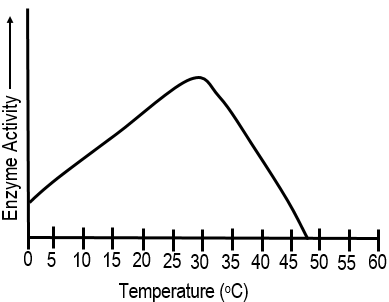
Based on the graph, what is the optimal temperature for this enzyme? 
a)
15oC
b)
40oC
c)
30oC
d)
35oC
46.

Which of the following is directly responsible for the shape of an enzyme/protein?

a)

The amino acid sequence of the protein and the properties of the amino acids that make up the protein.

b)

The temperature of the surrounding environment.

c)

The pH of the surrounding environment.

d)

The amount of substrate present.

47.
Blocking Active site of an enzyme
a)
competitive inhibition
b)
allosteric inhibition
48.

Where is energy stored in ATP?

a)

in the bonds between phosphate

b)

in oxygen

c)

in sugar

d)

in nitrogenous base

49.

A + B --> AB + Energy

This is what type of reaction?

a)

exergonic

b)

endergonic

50.
The monomer, building block, of proteins
a)
Amino Acid
b)
Fatty Acid
c)
Nucleotide
d)
monosaccharide
51.
Combines with 3 fatty acid chains to make up a triglyceride; part of the monomer of lipids
a)
Amino Acid
b)
Fatty Acid
c)
Glycerol
d)
Nucleotide
52.
The monomer, building block, of DNA and RNA; made up of a sugar, phosphate, and nitrogenous base
a)
Amino Acid
b)
Fatty Acid
c)
Nucleotide
d)
Monosaccharide
53.
The process/reaction used to link compounds/monomers together.  Releases water.
a)
Dehydration
b)
Hydrolysis
c)
Enzomatic
d)
Tetratonic
54.
The monomer, building block, of carbohydrates; simple sugar
a)
Amino acid
b)
Fatty Acid
c)
Nucleotide
d)
Monosaccharide
55.
The process used to split polymers; this is done by adding water
a)
Dehydration
b)
Hydrolysis
c)
Enzomatic
d)
Tetratonic
56.
Which of the following is not a job of a protein
a)
Act as hormones and enzymes
b)
Do much of the work in cells and transport materials
c)
Build tissues and muscles 
d)
store and transmit genetic information 
57.
Which is not a use or function of protein?
a)
forms enzymes and hormones
b)
forms transport channel in cell membrane
c)
forms structural proteins in the body
d)
quick energy
58.
These organic molecules are used by the body for long term storage of energy and make up the structure of cell membranes.
a)
Carbohydrates
b)
Lipids
c)
Proteins
d)
Nucleic Acids
59.
What 3 letters do enzymes typically end in?
a)
-ose
b)
-ase
c)
-ese
d)
-tic
60.
Which property makes water molecules stick to other water molecules?
a)
adhesion
b)
cohesion
c)
capillary action
d)
polarity
61.
Which of the following elements make up nucleic acids?
a)
C, H, O
b)
C, H, O, N
c)
C, H, O, N, P
d)
C, H, O, Ca, S
62.
Is this hydrocarbon saturated or unsaturated? 
a)
saturated
b)
unsaturated
63.
The bond that joins amino acids are called:
a)
Peptide Bonds
b)
Ester Bonds
c)
Glycosidic Linkages
d)
Phosphodiester Bonds
64.
Amino acids all have the same general morphology except for the:
a)
Amino Group
b)
Carboxyl Group
c)
'R' Group
d)
Carbonyl Group
65.
Which statement is correct about diffusion?
a)
It's very rapid over long distances.
b)
It's a passive process which molecules move from a region of higher to lower concentration.
c)
It requires an energy expenditure by the cell.
d)
It's an active process where molecules move from a region of lower to higher concentration.
66.
Which describes the events of apoptosis?
a)
The cell's DNA & organelles become fragemented, the cell shrinks & forms blebs, the cell's parts are packaged in vesicles that are digested by cells like macrophages.
b)
The cell dies, it is lysed, its organelles are phagocytized, and its contents are recycled.
c)
The cell's DNA and organelles become fragmented, the cell dies, and it's phagocytized.
d)
The cell shrinks, dies, and the presence of its fragmented contents stimulate nearby cells to divide.
67.
Prokaryotes are classified as belonging to two different domains. What are they?
a)
Bacteria & Protista
b)
Bacteria & Archaea
c)
Bacteria & Eukarya
d)
Archaea & Protista
68.
Which structure is common to plant and animal cells?
a)
central vacuole
b)
chloroplast
c)
wall made of cellulose
d)
mitochondrion
69.
Which of the following is major cause of the size limits for certain types of cells?
a)
evolutionary progression in cell size; more primitive cells have smaller sizes.
b)
the need for sufficient surface area to support the cell's metabolic needs.
c)
limitation on the strength and integrity of the plasma membrane as cell size increases
d)
the difference in plasma membranes between prokaryotes and eukaryotes
70.
Which is true of metabolism in its entirety in all organisms?
a)
Metabolism depends on an organism's adequate hydration.
b)
Metabolism depends on a constant supply of energy from food.
c)
Metabolism consist of all the energy transformation reactions in an organism.
d)
Metabolism uses all of an organism's resources.
71.
A patient has had a serious accident and lost a lot of blood. In an attempt to replenish body fluids, distilled water-equal to the volume of blood lost-is transferred directly into one of his veins. What will be the most probable result of this transfusion?
a)
The patient's red blood cells will shrivel up because the blood fluid has become hypertonic compared to the cells.
b)
The patient's red blood cells will shrivel up because the blood fluid has become hypotonic compared to the cells.
c)
It will have no unfavorable effect as long as the water is free of viruses and bacteria.
d)
The patient's red blood cells will swell because the blood fluid has become hypotonic compared to the cells.
72.
A biologist ground up some plant leaf cells and then centrifuged the mixture to fractionate the organelles. Organelles in one of the heavier fractions could produce ATP in the light, whereas organelles in the lighter fraction could produce ATP in the dark. The heavier and lighter fractions are most likely to contain, respectively,
a)
mitochondria and chloroplasts.
b)
peroxisomes and chloroplasts.
c)
chloroplasts and peroxisomes.
d)
chloroplasts and mitochondria.
73.
A chemical reaction that has a positive ΔG (free energy) is best described as
a)
entropic
b)
spontaneous
c)
endergonic
d)
exergonic
74.
The movement of potassium into an animal cell requires
a)
an energy source such as ATP
b)
low cellular concentrations of sodium
c)
a cotransport protein
d)
 high cellular concentrations of potassium
75.
All of the following are part of a prokaryotic cell except
a)
a plasma membrane
b)
DNA
c)
an endoplasmic reticulum
d)
ribosomes
76.
The difference between pinocytosis and receptor-mediated endocytosis is that
a)
pinocytosis requires cellular energy, but receptor-mediated endocytosis does not.
b)
pinocytosis brings only water molecules into the cell, but receptor-mediated endocytosis brings in other molecules as well.
c)
pinocytosis is nonselective in the molecules it brings into the cell, whereas receptor-mediated emdocytosis offers more selectivity.
d)
pinocytosis increases the surface area of the plasma membrane whereas receptor-mediated endocytosis decreases the plasma membrane surface area.
77.
When a plant cell, such as one from a tulip stem, is submerged in a very hypotonic solution, what is likely to occur?
a)
The cell membrane will lyse.
b)
The cell will burst.
c)
The cell will become turgid.
d)
Plasmolysis will shrink the interior.