Wayground logo

Free Printable Worksheets

Font size

S
M
L
XL
Worksheets

First Semester Chemistry Exam Review Part 1

Total questions: 94

Worksheet time: 3hrs 36mins

Name
Class
Date
1.
How many sig figs are there?
100.00
a)
1
b)
3
c)
4
d)
5
2.
How many sig figs are there?
100000000
a)
1
b)
9
c)
10
3.
What is 0.658 rounded to 1 significant figure?
a)
0
b)
0.66
c)
0.6
d)
0.658
4.
A graduated cylinder measures
a)
length
b)
height
c)
mass
d)
volume
5.
What is the density of an object having a mass of 8.0 g and a volume of 25 cm3?
a)
0.32 g/cm3
b)
3.1 g/cm3
c)
200 g/cm3
d)
2.0 g/cm3
6.
What is the temperature -34oC expressed in kelvins?
a)
139 K
b)
239 K
c)
339 K
d)
207 K
7.

Which group of measurements is the most precise? (Each group of measurements is for a different object.)

a)

2.0 g, 3.0 g, 4.0 g

b)

1 g, 3 g, 5 g

c)

2 g, 2.5 g, 3 g

d)

2 g, 3 g, 4 g

8.
What is the result of adding 2.5 x 10³ and 3.5 x 10²?
a)
2.9 x 10²
b)
6.0 x 10³
c)
2.9 x 10³
d)
6.0 x 10⁵
9.
What is the volume of the rock? The water level is displaced from 20 mL to 23 mL with the rock.
a)
3 mL
b)
23 mL
c)
20 mL
d)
43 mL
10.
Which statement is true?
a)
Oil is the most dense substance.
b)
Corn syrup is less dense than water.
c)
Oil is less dense than water.
d)
Oil and corn syrup have the same density but different masses.
11.
Express the following in scientific notation:
.000457
a)
457 x 106
b)
457 x 10-6
c)
4.57 x10⁴
d)
4.57 x 10⁻⁴
12.
The students measured length during a science experiement, they got 12 cm. But the actual measurement was 14.25 cm. What was the percent error?
a)
15.79%
b)
18.75%
c)
2.25%
d)
18%
13.
Accuracy is defined as
a)
close repeated measurements
b)
awesome measurements
c)
really good guessing
d)
measurement near the true value
14.

Ana is making soup. Her recipe makes 9 liters. She has a pot that holds 8,000 milliliters. Should Ana use this pot to make the soup?

a)

Yes

b)

No

15.

Which student had the most precise results?

a)

Student A

b)

Student B

c)

Student C

d)

Cannot be determined

16.
The scatter plot shows the relationship between the number of chapters and the total number of pages for several books.  Use the trend line to predict how many chapters would be in a book with 180 pages. 
a)
12 chapters
b)
15 chapters
c)
18 chapters
d)
21 chapters
17.
The scatter plot below shows the number of books read by students in Mrs. Hall’s English class and their final grades. Which statement represents the best description about the line of best fit?
a)
The more books students read, the lower their English grade.
b)
The more books students read, the higher their English grade.
c)
The fewer books students read, the higher their English grade. 
d)
No relationship exists between the number of books students read and their English grades. 
18.
Which statement best describes the relationship shown in this scatter plot?
a)
Students with a bigger shoe size earn a higher math score
b)
Students with a smaller show size earn a higher math score
c)
A student's shoe size has no effect on their math score
d)
A student with a shoe size of 8 will always earn a score of 80%
19.

This particle determines what element you have - the element's identity.

a)

electron

b)

proton

c)

neutron

d)

valence shell

20.
Describe an Electron Cloud?
a)
the mist outside of an atom
b)
home of the protons
c)
where electrons are located
d)
nucleus
21.

What are the maximum number of electrons that go in the first 3 energy levels?

a)

2,4,16

b)

2,8,18

c)

4,8,12

d)

3,4,6

22.
What are valence electrons?
a)
electrons on the first orbital always
b)
nucleus
c)
the outermost shell
d)
the number of electrons on the outermost orbital
23.
Which particles make up the nucleus of an atom?
a)
protons and neutrons
b)
electrons and protons
c)
electrons, protons, and neutrons
d)
electrons and neutrons
24.
What charge does the nucleus have and why?
a)
positive - the neutrons do not have a charge
b)
positive - the neutrons and protons are positively charged particles
c)
neutral - the neutral charge dominates the positive charge
d)
neutral - electrons cancel out the positive charge of the atom
25.
An element with a mass number of 10 and an atomic number of 6 has how many protons?
a)
5
b)
8
c)
6
d)
10
26.
An atom has 13 protons, 15 neutrons and ___ electrons what is its mass number?
a)
13
b)
26
c)
28
d)
15
27.
What is the difference between the atomic mass and the mass number?
a)
the atomic mass is always a whole number
b)
the atomic mass equals the atomic #
c)
mass number is the rounded atomic mass - always a whole number
d)
electrons
28.
Which statement best describes the locations of the subatomic particles?
a)
The protons and electrons are found in the nucleus, while neutrons are in the cloud outside the nucleus
b)
The neutrons are in the nucleus, while the protons and electrons are in the cloud outside the nucleus
c)
The protons and neutrons are in the nucleus, while the electrons are in the cloud outside the nucleus
d)
The electrons and neutrons are in the nucleus, while the protons are in the cloud outside the nucleus
29.
An atom of an element contains 20 protons. What is the identity of the element? (NOTE: you will need to use your Periodic Table)
a)
Neon
b)
Calcium
c)
Potassium
d)
Argon
30.
What is the element name of the atom pictured? 
a)
Fluorine
b)
Neon
c)
Argon
d)
Potassium
31.

What do the following properties describe? shiny, ductile, good conductor, high melting point

a)

metal

b)

nonmetal

c)

metalloid

32.
 Which of the following statements are FALSE?
a)
metals are located to the LEFT of the zig-zag line
b)
metals are less reactive than nonmetals
c)
nonmetals are located to the RIGHT of the zig-zag line
d)
metalloids have properties of both metals and nonmetals
33.
Which is an example of a nonmetal?
a)
Platinum
b)
Carbon
c)
Silver
d)
Lead
34.
Which element is located at Period 5, Group 2? 
a)
Niobium
b)
Strontium
c)
Nitrogen
d)
Phosphorus
35.
Periods run VERTICALLY on the periodic table, from top to bottom.
a)
True
b)
False
36.

Which scientist does the planetary model of the atom belong to?

a)

Rutherford

b)

Dalton

c)

Bohr

d)

Democritus

e)

Thomson

37.

Which scientist does the plum pudding or chocolate chip ice cream model of the atom belong to?

a)

Rutherford

b)

Thomson

c)

Dalton

d)

Bohr

e)

Aristotle

38.

Why was JJ Thomson's cathode ray tube experiment so important to modern atomic theory?

a)

He discovered protons, which meant there was something smaller than an atom.

b)

He discovered neutrons, which meant there was something smaller than an atom.

c)

He discovered the nucleus, which meant there was something smaller than an atom.

d)

He discovered electrons, which meant there was something smaller than an atom.

39.

Who was the first person to use the word "atom" to describe a tiny piece of matter than cannot be divided?

a)

Democritus

b)

Bohr

c)

Rutherford

d)

Thomson

40.

During the Rutherford's experiment, why did many of the alpha particles go straight through the gold foil?

a)

They hit the positively charged nucleus and stuck.

b)

They went straight through because the atom was mostly empty space.

c)

They didn't hit any subatomic particles because there are none.

d)

They weren't affected by the negative charges.

41.

Which of the following correctly describes isotopes of the same element?

a)

same neutrons, different electrons

b)

same neutrons, different protons

c)

same protons, different electrons

d)

same protons, different neutrons

42.

Which of the following is the correct way to write the element based off this information:

Protons: 8

Neutrons: 9

Electrons: 8

a)
b)
c)
43.
Which type of radiation has the greatest penetrating power?
a)
Alpha
b)
Beta
c)
Gamma 
d)
Microwaves
44.
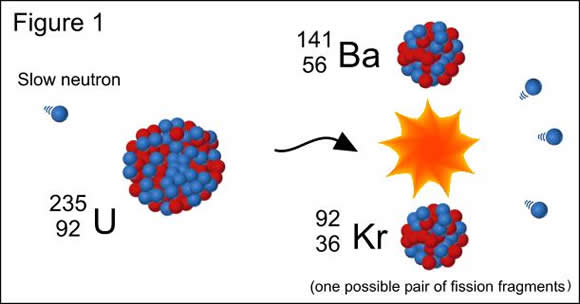
The nuclear process occurring at a nuclear power plant.
a)
Nuclear fusion
b)
Nuclear fission
c)
Combustion
d)
Multiplication
45.
The technetium-99 isotope has a half-life of 6.0 hours. If 100.0 mg were injected into a patient how much remains after 18 hours?
a)
33.0 mg
b)
12.5 mg
c)
.33 mg
d)
15.8 mg
46.
Which nuclear process is shown in the picture?
a)
fission
b)
fusion
c)
alpha decay
d)
beta decay
47.
Arrange in order of increasing ability to penetrate matter.
a)
Beta, gamma, alpha
b)
Alpha, gamma, beta
c)
Gamma, beta, alpha
d)
Alpha, beta, gamma
48.
During fission, some of the nuclear mass is converted into
a)
energy
b)
heavier nuclei
c)
critical mass
d)
protons
49.
Balance the following equation:
146C --> 0-1e + ________
a)
145B
b)
146C
c)
147N
d)
42He
50.
Barium-122 has a half-life of 2 minutes. A fresh sample weighing 80 g was obtained. If it takes 10 minutes to set up an experiment using barium-122, how much barium-122 will be left when the experiment begins?
a)
0.25g
b)
2.5g
c)
25g
d)
80g
51.
Carbon-12 has 98.2% abundance, carbon-13 has 1.7% abundance, and carbon-14 has 0.1% abundance.  Which isotope contributes most to the average atomic mass?
a)
Carbon-12
b)
Carbon-13
c)
Carbon-14
d)
They all contribute equally
52.
What is the missing isotope that will balance the following nuclear equation?
94Be  +  11H →  _____  +  42He
a)
105B
b)
105Ne
c)
63Li
d)
63C
53.
What is Half-life?
a)
The amount of time it takes for some of the nuclei in a sample of the isotope to decay
b)
The amount of time it takes for half the electrons in a sample of the isotope to decay
c)
The amount of time it takes for half the nuclei in a sample of the isotope to decay
d)
the amount of time it takes to double the nuclei in a sample of the isotope to decay
54.
How many neutrons does uranium-235 have?
a)
238
b)
92
c)
146
d)
143
55.
If X is the symbol for an element, which of the following two symbols represent    isotopes of the same element?     I. 7735X  II. 7733X  III. 8137X  IV. 8135 X
a)
I and II
b)
III and IV
c)
I and IV
d)
I and III
56.
The electron configuration of an atom is 1s22s22p6.  The number of electrons in the atom is 
a)
3
b)
6
c)
8
d)
10
57.
What atom matches this electron configuration?
1s22s22p63s23p64s23d10
a)
Zinc
b)
Copper
c)
Nickel
d)
Germanium
58.
What is the noble gas shorthand electron for Sulfur atom?
a)
[Ar] 3p4
b)
[He] 3s23p4
c)
[Ne] 3s23p4
d)
[Na] 3s23p4
59.
Which of the following is the smallest in size?
a)
K
b)
Na
c)
Li
d)
Cs
60.
How many electrons can the first energy level hold?
a)
1
b)
2
c)
8
d)
0
61.
An orbital can at most hold how many electrons?
a)
1 electron
b)
2 electrons
c)
3 electrons
d)
4 electrons
62.
The electron configuration of an atom is 1s22s22p6.  The number of valence electrons in the atom is 
a)
3
b)
6
c)
8
d)
10
63.
Which element is depicted from this atomic orbital diagram?
a)
Carbon
b)
Nitrogen
c)
Oxygen
d)
Phosphorus
64.
When an atom gains a valence electron, it becomes a(n) _____________ ion.
a)
positive
b)
negative
c)
neutral
d)
polyatomic
65.
When an atom loses a valence electron, it becomes a(n) _____________ ion.
a)
positive
b)
negative
c)
neutral
d)
polyatomic
66.
Atoms that gain & lose electrons are called _________
a)
ions
b)
isotopes
c)
radioactive
d)
corrosive
67.
Where are the metalloids / semimetals located on the periodic table?
a)
Blue
b)
Red
c)
Green
68.
What is the charge of an atom that has gained one electron?
a)
-1
b)
-2
c)
+1
d)
+2
69.
Cations are _______ that form ____________ ions and __________ electrons.
a)
nonmetals, positive, lose
b)
nonmetals, negative, gain
c)
metals, positive, gain
d)
metals, positive, lose
70.
Anions are _______ that form ____________ ions and __________ electrons.
a)
nonmetals, positive, lose
b)
nonmetals, negative, gain
c)
metals, positive, gain
d)
metals, positive, lose
71.
How many unpaired electrons would lithium have?
a)
1
b)
2
c)
3
d)
0
72.
What is incorrect about this orbital diagram?
a)
Both arrows in the 2p box should be pointing up
b)
There is nothing incorrect with this diagram
c)
In the there should only be 1 orbital in the first 2p box and one in the 2nd 2p box
d)
All the arrows should be pointing up.
73.
What do you start an electron configuration with?
a)
1s2
b)
1d10
c)
1f14
d)
1p6
74.
There are 4 different types of subshells s,p,d,f
a)
true
b)
false
75.
Electrons occupy orbitals of lowest energy first is part of what electron configuration rule?
a)
Hund’s Rule
b)
Aufbau Principle
c)
Pauli Exclusion Principle
76.

How many electrons can an p sublevel hold?

a)

2

b)

3

c)

5

d)

7

77.

What are the sublevels that make up the third energy level?

a)

s

b)

s, p

c)

s, p, d

d)

s, p, d, f

78.
How many atomic orbitals are there in the d sublevel?
a)
3
b)
4
c)
5
d)
6
79.
Sublevel with single orbital shaped like a sphere.
a)
s
b)
p
c)
d
d)
f
80.
Avogadro's number of representative particles is equal to one_____.
a)
kilogram
b)
gram
c)
kelvin
d)
mole
81.
How many moles are in 3.01 x 10²² atoms of magnesium?
a)
0.050 moles
b)
1.81 x 1046 moles
c)
5.00 x 10²¹ moles
d)
5.00 moles
82.
How many grams are in 1.2 x 1024 atoms of C?
a)
28 grams
b)
24 grams
c)
6.02 grams
d)
1.2 grams
83.
Which conversion factor should be used for the following question " How many molecules are there in 4.00 moles of glucose, C6H12O6? 
a)
1 mole = 78.12 g
b)
1 mole = 22.4 L 
c)
1 mol = 6.02x 10²³ particles 
d)
more than one
84.
Which expression below show the correct method of determining the percent composition of Sodium in Na2CO3?
a)
%Na = (22.99g/106g) x 100
b)
%Na = (22.99g/106) / 100
c)
%Na = (45.98g/106g) x 100
d)
%Na = (106/45.98g) x 100
85.
How many moles are in 16.94g of water?
a)
16.94 mol H2O
b)
0.9401 mol H2O
c)
305.3 mol H2O
d)
1.063 mol H2O
86.
How many molecules are in 9.44 moles of AlCl3?
a)
5.68 molec AlCl3
b)
5.68x1024 molec AlCl3
c)
0.705 molec AlCl3
d)
1.25x10²³ molec AlCl3
87.
Find the percent composition of hydrogen in (NH4)2S.
a)
11.8%
b)
41.1%
c)
47.1%
88.
A formula with the lowest whole # ratio of elements in a compound is called
a)
empirical formula
b)
chemical formula
c)
covalent formula
d)
molecular formula
89.
C2H6
a)
Empirical
b)
Molecular
90.
Which pair has the same empirical formula?
a)
NaCrO4 and Na2Cr2O7
b)
C2H4O2 and C6H12O6
c)
C3H6O3 and C2H6O2
d)
CH4 and C2H6
91.
What is the molecular formula if the empirical formula is C2H5 and the molecular molar mass is 58.14 g/mol?
a)
C2H5
b)
C4H10
c)
C1H2.5
d)
C4H8
92.
What is the empirical formula if you have 81.82% carbon and 18.18% hydrogen?
a)
C3H8
b)
CH4
c)
C2H2
d)
C4H10
93.
What is the empirical formula for the following molecular formula: C6H14
a)
C6H14
b)
C3H7
c)
CH2
d)
CH3
94.
How many moles are in 88 g of propane, C3H8. 
a)
2.0
b)
16.0
c)
0.051
d)
3,872