wayground logo

Free Printable Worksheets

Font size

S
M
L
XL
Worksheets

Test 4 Review

Total questions: 144

Worksheet time: 2hrs 15mins

Name
Class
Date
1.

Which is true about DNA?

a)

It is a nucleic acid.

b)

It is a polymer of nucleotides.

c)

In DNA, nucleotides in the backbone are covalently bonded together via phosphodiester bonds.

d)

All of these are true.

2.

True or False: DNA strands are anti-parallel, meaning they run in opposite directions

a)

True

b)

False

3.

DNA replication happens during which part of the cell cycle?

a)

G1

b)

S phase

c)

G2

d)

mitosis

4.

Transcription is

a)

the process of making new DNA

b)

the process of copying a gene from DNA into RNA

c)

the process of making polypeptides from RNA

d)

None of these

5.

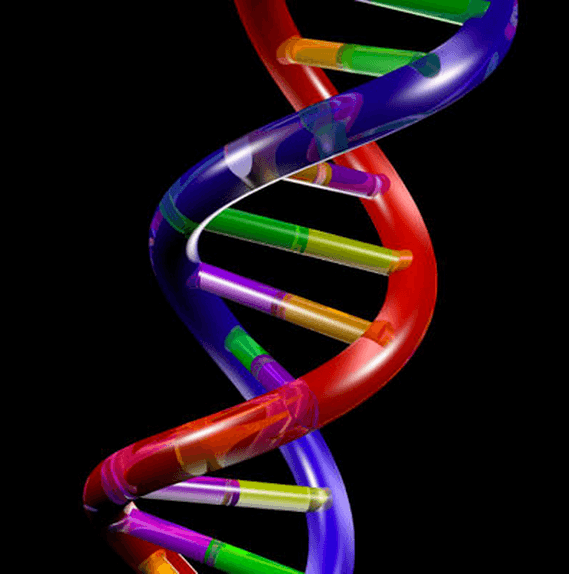
What is the shape of DNA?

a)

Single helix

b)

Double helix

c)

Circle

6.

Select the shape of our DNA.

a)
b)
c)
7.

What is the sugar in DNA?

a)

Ribose

b)

Glucose

c)

Deoxyribose

d)

Lactose

8.

Do all living organisms have DNA?

a)

Yes

b)

No

c)

No clue

9.
Which sequence of DNA bases would pair with this partial strand
ATG TGA CAG
a)
ATG TGA CAG
b)
TAC ACT GTC
c)
GTA AGT GAC
d)
CAT TCA CTG
10.
In a molecule of double-stranded DNA, the amount of Adenine present is always equal to the amount of
a)
cytosine
b)
guanine
c)
thymine
d)
uracil
11.
Which of the following units are repeatedly joined together to form a strand of DNA?
a)
amino acids
b)
nucleotides
c)
fatty acids
d)
polysaccharides
12.
Why is DNA important?
a)
it is very small and very complicated
b)
it determines our hair length
c)
it serves as the blueprint for traits of all living things
d)
because we eat it every day for energy
13.
What determines the code, or information, of a DNA molecule?
a)
the shape (structure) of the nitrogen bases
b)
the order (sequence) of the nitrogen bases
c)
the color of the nitrogen bases
d)
the frequency (number) of nitrogen bases
14.
Which 2 molecules form the sides (backbone) of the DNA ladder?
a)
deoxyribose sugar and adenine
b)
deoxyribose sugar and a hydrogen bond
c)
deoxyribose sugar and the nucleus
d)
deoxyribose sugar and phosphate
15.
Which organelle is DNA usually found in?
a)
cell membrane
b)
vacuole
c)
chloroplast
d)
nucleus
16.
Nitrogenous bases are joined by which type of bond?
a)
polar bonds
b)
ionic bonds
c)
covalent bonds
d)
hydrogen bonds
17.
Replicate the following strand of DNA: 
AATCATGGA
a)
AATCATGGA
b)
TTAGTACCT
c)
UUAGUACCU
d)
GGATAUCUA
18.
What are the three components of a nucleotide?
a)
sugar, hydrogen, nitrogen base
b)
sugar, oxygen, nitrogen base
c)
sugar, phosphate, nitrogen base
d)
sugar, phosphate, protein
19.
Which enzyme proofreads the DNA after replication to catch any mistakes?
a)
primase
b)
proof-read-ase
c)
DNA polymerase
d)
helicase
20.
Nucleotides are made up of a sugar, phosphate, and..?
a)
nitrogenous base
b)
nucleic acid
c)
cholesterol
d)
fatty acid
21.
A gene gives the instructions for protein synthesis. Which type of molecule is responsible for "reading"the instructions and then creating the protein?
a)
ATP
b)
RNA
c)
DDT
d)
DNA
22.
Which shows the correct complementary base pairing for DNA?
a)
C-A, T-G
b)
A-G, C-T
c)
C-G, U-A
d)
T-A, G-C
23.
Any change in the DNA is called a/an
a)
mistake
b)
exon
c)
mutation
d)
intron
24.

DNA is found inside

a)

the cytoplasm of your cells

b)

the nucleus of your cells

c)

the mitochondria of your cells

d)

A+B

e)

B+C

25.

True or False. All DNA codes for proteins.

a)

True

b)

False

26.

RNA

a)

consists of ribose

b)

can be found exclusively in the nucleus

c)

does not contain nucleotides as DNA does

d)

A+B

e)

A+C

27.

If a DNA strand has the sequence of ATG, then the mRNA strand that matches up to transcribe it would be

a)

AUG

b)

UAC

c)

AUC

d)

none of these

28.

A major difference between DNA and RNA is

a)

the fact that DNA is single stranded

b)

the shape of the two molecules, as RNA typically remains in a double helix

c)

uracil is found in place of adenine in RNA

d)

that DNA stays in the nucleus

e)

none of these are differences

29.

The order of the bases in DNA is important so that it can

a)

code for the right amino acids

b)

bind with tRNA

c)

convert its thymines to uracils

d)

none of these

32.

full form of DNA is

a)

Dinucleotide acid

b)

deoxyribonucleic acid

c)

dinucleic acid

d)

dinucleic cell

32.

full form of DNA is

a)

Dinucleotide acid

b)

deoxyribonucleic acid

c)

dinucleic acid

d)

dinucleic cell

32.

full form of DNA is

a)

Dinucleotide acid

b)

deoxyribonucleic acid

c)

dinucleic acid

d)

dinucleic cell

33.

following is not present in DNA

a)

A

b)

G

c)

C

d)

U

34.

Histone is

a)

protein

b)

fat

c)

nucleotide

d)

sugar

35.
What does DNA helicase do?
a)
Break the hydrogen bond between the base pairs
b)
Break the hydrogen bonds between the bases and the back bone
c)
Break the phosphodiester bonds between the base pairs
d)
Break the phosphodiester bonds between the backbone
36.
What is the name given to DNA replication?
a)
Demi-conservative
b)
Semi-conservative
c)
Demi-preservative
d)
Semi-preservative
37.
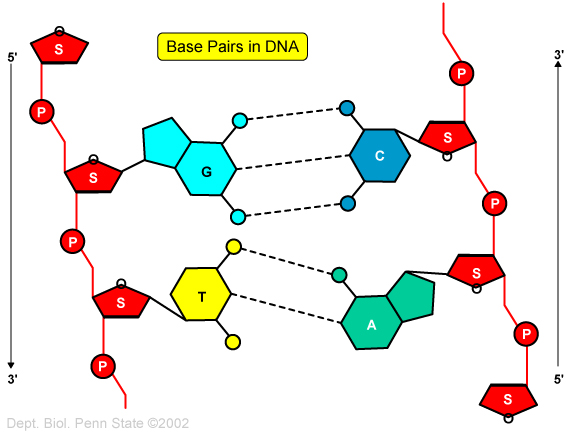
Which part is in blue?
a)
Phosphate
b)
Sugar
c)
Base
38.
Which part is in orange?
a)
Phosphate
b)
Sugar
c)
Base
39.
Which part is in green?
a)
Phosphate
b)
Sugar
c)
Base
40.
Which base is replaced by Uracil in RNA?
a)
Thymine
b)
Cytosine
c)
Guanine
d)
Adenine
41.

What is the building block of DNA?

a)

simple sugars

b)

nucleotides

c)

amino acids

d)

fatty acids

42.

Which of the following is not part of a nucleotide?

a)

nitrogen base

b)

sugar

c)

enzyme

d)

phosphate

43.

Adenine pairs with

a)

Adenine

b)

Thymine

c)

Guanine

d)

Cytosine

44.

DNA is a

a)

amino acid

b)

protein

c)

nucleic acid

d)

carbohydrate

45.
Guanine bonds with ______________.
a)
Adenine
b)
Guanine
c)
Cytosine
d)
Thymine
46.
What are the 4 nitrogen bases?
a)
adenine, thymine, cytoplasm, and guanine
b)
adenine, thymine cytosine, and guanine
c)
adenine, thymine, cytosine, and gylcerol
d)
adenine, thymine, cytosine, and glucose
47.
Codes for a single protein
a)
DNA
b)
Gene
c)
Chromosome
d)
Chromatin
48.
Any change in the sequence of DNA nucleotides or chromosomes is called a 
a)
mutation
b)
single genotype
c)
monohybrid trait
d)
transgenic shift
49.

A five-carbon sugar found in RNA.

a)

ribose

b)

guanine

c)

deoxyribose

d)

RNA helicase

50.
Where are proteins made? 
a)
DNA
b)
nucleus
c)
ribosome
d)
mitochondria 
51.
The DNA of a eukaryotic cell is in the
a)
cytoplasm
b)
ribosome
nucleus
c)
vacuole
d)
nucleus
52.
Segments of DNA on a chromosome that code for a certain trait (protein).
a)
Proteins
b)
Genes
c)
Nucleosomes
d)
Nucleotides
53.
Which series is arranged in order from largest to smallest in size?
a)
chromosome, nucleus, cell, DNA, nucleotide
b)
cell, nucleus, chromosome, DNA, nucleotide
c)
nucleotide, chromosome, cell, DNA, nucleus
d)
cell, nucleotide, nucleus, DNA, chromosome
54.
DNA codes for...
a)
cholesterol
b)
proteins
c)
fatty acids
d)
carbohydrates
55.
Traits that are passed from generation to generation are called ____________________
a)
Excited Traits
b)
Inherited Traits
c)
Inclined Traits
d)
Special Traits
56.

What is the shape of the DNA?

a)

single helix

b)

double helix

c)

triple helix

d)

none of the choices

57.

How many DNA codes are there?

a)

one

b)

two

c)

three

d)

four

58.

Which of the following code combination is INCORRECT?

a)

AT

b)

CG

c)

AC

d)

none

59.

These carry traits.

a)

chromosome

b)

genes

60.

Your traits are a combination of your parents traits.

a)

True

b)

False

61.

Twins do not have the same exact DNA.

a)

True

b)

False

62.
Name this structure
a)
double helix
b)
nucelotide
c)
twisted ladder
d)
hydrogen bond
63.
Which of the following is the blueprint for the production of RNA within a cell?
a)
DNA
b)
protein
c)
ATO
d)
carbohydrate
64.
The DNA sequence ATCAGCGCTGGC is part of a gene. How many amino acids are coded for by this message?
a)
4
b)
8
c)
12
d)
20
65.
What molecules do both DNA and RNA contain?
a)
uracil
b)
nucleotides
c)
thymine
d)
deoxyribose
66.
What is the relationship between a protein, the cell, and DNA?
a)
DNA is produced by protein which is produced in the cell
b)
Protein is composed of DNA which is produced in the cell
c)
DNA controls the production of protein in the cell
d)
A cell is composed of DNA and protein
67.
Genetic info flows in one direction. Which best represents this flow?
a)
DNA-protein-RNA
b)
Protein-RNA-DNA
c)
RNA-protein-DNA
d)
DNA-RNA-protein
68.
The diagram shows the process of
a)
Transcription
b)
Translation
c)
Replication
d)
Mitosis
69.
The building block of nucleic acids are nucleotides.  Nucleotides are composed of a sugar, a phosphate group, and a _________________ base.
a)
oxygen
b)
hydrogen
c)
nitrogen
d)
carbon
70.
The backbone of a DNA molecule is made from a ______________ and a _______________ group.
a)
lipid, carbon
b)
sugar, phosphate
c)
nitrogen, oxygen
d)
nitrogen, sulfur
71.
DNA makes a copy of itself in a process called ________________________________?
a)
translation
b)
replication
c)
translation
d)
division
72.
Which one of the following nucleotide pair bonds would be found in a DNA molecule?
a)
adenine-guanine
b)
guanine-cytosine
c)
adenine-cytosine
d)
cytosine-uracil
73.
An enzyme that unwinds the double helix of DNA and separates the DNA strands in preparation for DNA replication
a)
DNA polymerase
b)
RNA polymerase
c)
nucleotide
d)
helicase
74.

DNA is synthesized,

a)

in a 3' to 5' direction

b)

in a 5' to 3' direction

c)

in either direction

d)

none of the above

75.

Which of the following pyrimidines are not found in DNA synthesis?

a)

uracil

b)

guanine

c)

thyamine

d)

cytosine

76.

Semi-conservative replication means that,

a)

each new DNA molecule is made up of 2 new strands

b)

1 new DNA molecule is made of 2 new strands of DNA

c)

1 new DNA molecule is made up of the 2 old strands of DNA

d)

the DNA molecule made is composed of 1 old strand and 1 new strand of DNA

77.

If a molecule of DNA contains 20% cytosine, what percentage of thymine does it have?

a)

30%

b)

20%

c)

80%

d)

40%

78.
Where does DNA replication take place?
a)
Nucleus
b)
Ribosome
c)
Cytoplasm
d)
Golgi Body
79.
Which one of the following nucleotide pair bonds would be found in a DNA molecule?
a)
adenine-guanine
b)
guanine-cytosine
c)
adenine-cytosine
d)
cytosine-uracil
80.
A scientist observes a base sequence of AGCTAGCTAGCT.  Which of the following would be the complimentary strand?
a)
TGCATGCATGCA
b)
TCGATCGATCGA
c)
TAGCTAGCTAGC
d)
TTAAGGCCTTCC
81.
order of replication
a)
3, 2, 1, 4
b)
2, 1, 4, 3
c)
2, 3, 1, 4
d)
3, 4, 1, 2
82.
A homozygous dominant dog with brown fur is crossed with a heterozygous dog with brown fur. What are the percentages of the possible genotypes?
a)
100% BB
b)
75% BB and 25%Bb
c)
50 % BB and 50% Bb
d)
50% Bb and 50% bb
83.
Genotype refers to the ...
a)
physical expression of the genes
b)
the possible combination of alleles in a gene
c)
whether an allele is dominant or recessive
d)
how an organism will appear
84.
An offspring will receive how many alleles from each parent to determine a specific trait?
a)
one
b)
two
c)
three
d)
five
85.
Which of the following is a phenotype?
a)
BB
b)
Bb
c)
bb
d)
Blue eyes
86.
What is a phenotype
a)
The genetic make up (code)
b)
The physical trait
87.
the passing of genetic traits from parent to offspring.
a)
heredity
b)
trait
c)
gene
d)
allele
88.
Magda is a tall, 11 year old drummer. She has a scar on her right cheek. She is good at swimming. Which of her traits did Magda most likely inherit?
a)
height
b)
the scar
c)
ability to swim
d)
ability to play drums
89.
G = green, g = yellow
The genotype for a yellow plant is...
a)
GG
b)
Gg
c)
gg
d)
all of the choices result in yellow
90.
An allele whose trait only shows up when no dominant allele is present.
a)
hidden allele
b)
dominant allele
c)
recessive allele
d)
present allele
91.
Two heterozygous (Tt) tall pea plants are crossed. Which describes their offspring?
a)
50% tall and 50% short
b)
75%tall and 25% short
c)
100%short
92.
W=white hair
w= non-white hair
If you cross a horse with WW and a horse with ww what fraction of the offspring would be expected to have white hair?
a)
none
b)
3/4
c)
1/2
d)
all
93.
Mary's mom, dad and sister have brown eyes. Mary's eyes are hazel.  Who could Mary have gotten her eye color from?
a)
her grandparents
b)
her aunts
c)
her cousins
d)
her uncles
94.
Which best explains why many animals look like their parents?
a)
Physical traits are learned from their parents.
b)
Physical traits are inherited from their parents.
c)
Physical traits are acquired from their parents.
95.
This chart shows physical traits of a family.  What best explains the data.
a)
Mason inherited traits only from his father.
b)
Maddie inherited traits only from her mother.
c)
Maddie and Mason inherited traits from both their father and their mother.
96.
From whom may an animal inherit characteristics?
a)
the other animals in the ecosystem
b)
their parents
c)
the other animals in it's environment
97.
What is the molecular unit that holds the genetic traits that we inherit from our parents?
a)
gene
b)
cell
c)
blood
98.
A type of grid used to show the genotype of each parent and their possible offspring.
a)
pedigree
b)
carrier
c)
genetics
d)
punnett square
99.
This genotype has the same recessive alleles (ex. hh, aa).
a)
gene
b)
homozygous recessive
c)
dominant
d)
homozygous dominant
100.
A trait that is shown and can hide or mask other traits.
a)
dominant
b)
gene
c)
recessive
d)
genotype
101.
The physical appearance of a pair of alleles.
a)
genotype
b)
gene
c)
phenotype
d)
heterozygous
102.
Family history that shows how a trait is inherited over several generations.
a)
punnett square
b)
phenotype
c)
pedigree
d)
physical
103.
Genes expressed as a pair of alleles.
a)
genotype
b)
carrier
c)
phenotype
d)
recessive
104.
Pedigrees rely on the ______ of the parents and offspring.
a)
genotypes
b)
phenotypes
c)
# of siblings
d)
married offspring
105.
Cross a heterozygous tall (T) giraffe and a homozygous short (t) giraffe. Which of the following is the correct genotypic ratio?
a)
100% TT
b)
100% Tt
c)
100% tt
d)
50% Tt and 50% tt
106.
a)
5 people have the trait
b)
10 people have the trait
c)
All with the trait are females
d)
All with the trait are males
107.
What symbol is used to represent females in pedigrees?
a)
circles
b)
squares
108.
Who was the father of genetics 
a)
Sagan 
b)
Issac Newton 
c)
Gregor Mendel 
d)
C.jenkins 
109.
 which is heterozygous ?  
a)
Tt
b)
TT
110.
Which is homozygous ?
a)
Zz
b)
SS
111.
the genetic makeup of an organism
a)
heterozygous
b)
punnet square
c)
genotype
112.
what predicts the outcome
a)
genetic engineering
b)
punnet square
c)
probability
113.
This is an example of what?
a)
Complete dominance
b)
Incomplete dominance
c)
Codominance
d)
None of the above
114.
If a Homozygous red snapdragon and a Heterozygous pink snapdragon were crossed - what percentage of the offspring would be homozygous white?
a)
0%
b)
25%
c)
50%
d)
75%
115.
Red/green color blindness is a recessive trait.  A woman who is a carrier for this allele marries a normal-vision male.  What is the probability that they will have a child who is color blind?
a)
1/4
b)
1/2
c)
3/4
d)
1
116.
In cats, black fur color is caused by an X-linked allele; the other allele at this locus causes orange 2) color. The heterozygote is tortoiseshell. What is the chance that a black female and an orange male would produce tortoiseshell offspring? 
a)
0%
b)
25%
c)
50%
d)
100%
117.
A woman who is a carrier of an X-linked recessive trait will have a ______ chance of passing that trait to her sons.
a)
0%
b)
50%
c)
25%
d)
100%
118.
In humans, hemophilia is a sex linked recessive trait. Females can be normal, carriers, or have the disease. Males will either have the disease or not (but they won’t ever be carriers). A woman who is a carrier marries a normal man. What is the probability that their children will have hemophilia?
a)
0%
b)
25%
c)
50%
d)
100%
119.
______________________ are three or more forms of a gene that code for a single trait. 
a)
Gametes
b)
Chromosomes
c)
Multiple Alleles
d)
Genes
120.
If T=Tall & t=short, what is the genotypic ratio?
a)
1:3
b)
3:1
c)
1:2:1
d)
2:2
121.
What does heterozygous mean?
a)
An organism that has the same genes for a trait (TT or tt)
b)
An organism that has different genes for a trait (Tt)
c)
When neither gene is fully dominant; offspring is a mixture of both
d)
the different forms of a trait (hair color--> brown, blonde, red
122.
True/False: Different genotypes can code for the same phenotype.
a)
True
b)
False
123.
A heterozygous tall pea plant is crossed with a short plant. The probability that an F1 plant will be tall is
a)
100%
b)
75%
c)
50%
d)
25%
124.
A tall plant (TT) is crossed with a short plant (tt). If the tall F1 pea plants are allowed to self-pollinate
a)
all offspring will be medium height
b)
all offspring will be tall
c)
all offspring will be short
d)
offspring will be tall and short
125.
What principle states that during gamete formation genes for different traits separate without influencing each other’s inheritance?
a)
principle of independent assortment
b)
principle of probabilities
c)
principle of segregation
d)
principle of dominance
126.
Variation in human skin color is an example of
a)
polygenic traits
b)
multiple alleles
c)
incomplete dominance
d)
codominance
127.
Both versions of the trait are expressed in the phenotype of the offspring. Which pattern of inheritance best classifies the observed trait?
a)
dominance
b)
sex-linkage
c)
co-dominance
d)
 incomplete dominance
128.
Which statement best describes the relationship between an allele and a gene?
a)
An allele is a segment of a DNA molecule that controls replication of a gene
b)
An allele is the part of a gene that attaches to messenger RNA molecules
c)
An allele is a variation of a gene that can be expressed as a phenotype
d)
An allele is the primary protein made by a gene found in a developing embryo
129.

ABO blood grouping is a suitable example of -

a)

co--dominance

b)

incomplete dominance

c)

polygenic inheritance

d)

lethal genes

130.

Genotype of an unknown plant can be tested by -

a)

dihybrid cross

b)

test cross

c)

reciprocal cross

d)

monohybrid cross

131.

The genotypic ratio obtained in the F2 generation in a monohybrid cross is-

a)

1:1

b)

1:2:1

c)

3:1

d)

9:3:3;1

132.
R=round seed
r=wrinkled seed.
Cross a homozygous round with a wrinkled. Which statement predicts the results?
a)
offspring will be Rr
b)
offspring will be RR
c)
round seeds will be recessive to wrinkled
d)
Wrinkled will be observed in half of offspring
133.
Pea plants can have green or yellow seeds. In a pea plant that is heterozygous for seed color, the allele for yellow seeds masks the effects of the allele of green seeds. Which of the following terms best describes the allele for yellow seeds?
a)
codominant
b)
recessive
c)
dominant
d)
sex-linked
134.
Which of the following alleles is homozygous recessive?
a)
Tt
b)
tt
c)
TT
d)
T
135.
Colorblindness is a recessive, X chromosome sex-link disorder. Cross the parents to figure out which percentage of their offspring will be colorblind.
a)
25%
b)
0%
c)
75%
d)
50%
136.
This type of inheritance pattern shows BOTH traits in possible offspring
a)
complete dominance
b)
incomplete dominance
c)
co-dominance
d)
dominant pattern
137.
In fruit flies eye color is carried on the X chromosome. RED is dominant to WHITE. What is the sex and color of the following: XrY
a)
female red
b)
female white
c)
male red
d)
male white
138.
In fruit flies eye color is carried on the X chromosome. RED is dominant to WHITE. What is the sex and color of the following: XRXR
a)
female red
b)
female white
c)
male red
d)
male white
139.
In humans, skin tone is caused by 3 genes, each with 2 alleles.  This is an example of
a)
codominance
b)
incomplete dominance
c)
polygenic inheritance
d)
multiple alleles
140.
If a heterozygous pea plant and a heterozygous pea plant cross, what genotype is 50% of the offspring?
a)
BB
b)
Bb
c)
bb
d)
Red
141.
What is the genotype of a blue pea plant? (Blue is recessive)
a)
bb
b)
Bb
c)
BB
d)
Blue
142.
If blue is dominant, and red is recessive, then a organism with bb phenotype is
a)
Redd
b)
Blue
c)
Red
d)
Blu
143.
What genotype is the most common when crossing a plant with FF and a plant with ff?
a)
Ff
b)
FF
c)
ff
d)
Ffc
144.
Who is the "father of genetics"?
a)
Gregor Mendel
b)
Albert Einstein
c)
Newton
d)
Charles Darwin