
 Worksheets
AP Environmental Science - Unit 1,2,3 Review
Total questions: 144
Worksheet time: 2hrs 35mins
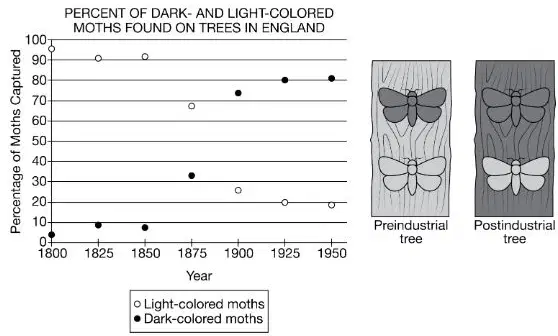
Researchers examined the effect of industrialization and increased pollution (soot) in London on the coloration in a single species of moths. Birds prey on the moths that are easily visible on trees. The researchers observed moths on tree trunks and recorded their body color. The percentage of moths with light colored bodies and the percentage of moths with dark bodies is shown on the graph above. Based on the data in the graph, which of the following best describes the change in the population of moths as a result of industrialization?
The percentage of dark colored moths increased in the population and the percentage of light-colored moths decreased in the population.
The percentage of dark-colored moths decreased in the population and the percentage of light-colored moths increased in the population.
The percentage of dark colored moths decreased in the population after 1850 and the percentage light-colored moths remained constant throughout the time period.
The percentage of both the dark-colored moths and the light-colored moths remained constant throughout the time period.
Based on the theory of island biogeography, which of the following islands would most likely have the highest number of species living on it?
An island 30 hectares in size that is 30 kilometers off the coast of the mainland
An island 30 hectares in size that is 10 kilometers off the coast of the mainland
An island 10 hectares in size that is 30 kilometers off the coast of the mainland
An island 10 hectares in size that is 10 kilometers off the coast of the mainland
Which of the following ecosystem services are categorized as regulating?
Wood fuel, medicine, and potable water
Pollination, decomposition, and water purification
Recreation, education, and aesthetics
Photosynthesis, nutrient cycling, and creation of soils
Which of the following is an example of an ecosystem that provides ecosystem services including protection from hurricane storm surges?
A lock and dam system
An intact coastal wetland
An energy-producing tidal barrage system
An offshore, deep-water fish farm
Which trophic level has the least available energy in kilojoules in this food web?
Phytoplankton
Herbivorous zooplankton
Baleen whale
Killer whale
The majority of the nitrogen on Earth can be found in which of the following reservoirs?
Terrestrial plants
Soil bacteria
The atmosphere
Sedimentary rock
Which of the following describes the most likely change to terrestrial biomes resulting from warmer average global temperatures?
The global distribution of midlatitude biomes, such as grasslands and temperate rain forests, would increase.
Deciduous trees found in temperate seasonal forests would flower later in the year.
The latitude range of tropical rain forests would narrow closer to the equator.
High-latitude biomes, such as the tundra, would experience a decrease in net primary productivity.


Image "B" shows more biodiversity than image "A". Why?
Because "B" shows more different species than image "A"
Because image "B" has less different species than "A"
"A" has a greater number of same species plants so this statement is wrong.
Both images show the same biodiversity


This is an example of
High species diversity
Low species diversity
High genetic diversity
High ecosystem diversity

Whish habitat has the highest biodiversity?
Area A
Area B
Area C
Area D
Which of the following best describes the importance of species diversity?
It ensures that all ecosystems are identical
It contributes to the resilience and productivity of ecosystems
It guarantees that specific species will not become extinct
It reduces the need for conservation efforts
Which of the following is NOT an ecosystem service?
Pollination of crops
Decomposition of waste
Production of greenhouse gases
Purification of water
Choose all the reasons why biodiversity is beneficial to humans and the ecosystem (4).
Limits damage from coastal flooding
Provides resources like lumber and medicine
Decreases survival after an environmental stressor
Decreases pollution
Creates natural pest control and pollinators
What role do bees play in ecosystem services?
They contribute to soil erosion
They act as invasive species in most ecosystems
They pollinate plants, which is essential for the production of fruits and seeds
They primarily consume decomposing organic matter
I am walking through a park and enjoying nature. This is an example of what kind of ecosystem service?
Cultural service
Regulating service
Nature walk
Supporting service
Access to new medicines, agriculture, and ecosystem resiliency are all examples of...
benefits of biodiversity
threats to biodiversity
ecosystem services
conservation biology
What are ecosystem services?
Benefits that people obtain from ecosystems
Harmful effects of ecosystems on people
Artificially created benefits for ecosystems
Products obtained from ecosystems
Maintaining a clean water supply would be an example of:
natural resources
invasive species
interactions between organisms
ecosystems services
Which of the following is an example of an ecosystem service?
Mobile phone repair
Pollination
Car manufacturing
Hairdressing
Which of these is NOT a type of ecosystem service provided by nature?
Provisioning Services
Supporting Services
Technological Services
Regulating Services
Cultural Services
Which of the following is an example of a cultural ecosystem service?
Nutrient cycling
Spiritual enrichment
Soil formation
Water regulation
Which of the following is an example of a provisioning ecosystem service?
Pollination of crops
Production of fresh water
Regulation of climate
Decomposition of waste
Which of the following is a supporting service provided by ecosystems?
Climate regulation
Pollination
Soil formation
Food production
Which is NOT an example of an ecosystem service?
Clean air
Natural pest control
The logging industry
Clean water
What does species diversity refer to in an ecosystem?
The number of different habitats within a particular area
The variety of species within a specific habitat
The genetic variation within a single species
All of the above



How would a reduction in the snail population effect this ecosystem?
It would cause decreased competition between spiders and owls.
It would cause decreased competition between spiders and wood mice.
It would cause increased competition between grasshoppers and beetles.
It would cause increased competition between wood mice and shrews.


Termites are tiny insects that can cause severe damage to homes and other structures that consist of wood. Termites are an example of what type of factor.
Biotic
Abiotic


Which of the following best explains how environmental stressors, such as wildfires, can affect biodiversity in an ecosystem?
After an environmental stress, a genetic bottleneck may occur, which will increase genetic diversity.
Habitat diversity will increase the available niches if the landscape becomes more uniform after a disturbance.
Ecosystems with more species diversity are more likely to recover after a disturbance than ecosystems with low species diversity.
Smaller populations are less likely to go extinct than larger populations, so the species diversity will remain constant.
What is genetic diversity?
Diversity within a species
# of species and abundance in the community
How many different habitats are in a region
What is habitat diversity?
Diversity within a species
# of species and abundance in the community
How many different habitats are in a region
What is species diversity?
Diversity within a species
# of species and abundance in the community
How many different habitats are in a region
Ecosystem services that give humans products and what they need to survive, like food and lumber are called
Provisioning Services
Regulating Services
Cultural Services
Supporting Services
Ecosystem services that indirectly benefit humans , such as plants cleaning air and bees pollinating plants are called
Provisioning Services
Regulating Services
Cultural Services
Supporting Services
Ecosystem services that that support human life and life on Earth such as producing oxygen and water cycling are called
Provisioning Services
Regulating Services
Cultural Services
Supporting Services
The Theory of Island Biogeography states that
There are more species on islands that are smaller and farther from the mainland.
There are more species on islands that are smaller is
and closer to the mainland.
There are more species on islands that are larger and closer to the mainland.
There are more species on islands that are larger and farther from the mainland.
Organisms, like koalas, that require specific habitats and food are called
specialist
generalist
Organisms, like cockroaches, that can live in many places and eat many things are called
specialist
generalist
The total range of conditions conditions (abiotic factors) that an organism can lived in is called _____________.
Succession
Environmental disturbance
Ecological tolerance
limiting factors
What is the difference between primary and secondary succcession?
Primary succession already has soil
Lichen and moss come in for secondary succession
Secondary succession already has soil
Climax community is achieved quickly in primary succession
An example of a r-strategist (-selected) species is
an elephant
a human
a whale
an eagle
a dandelion
The main cause of biodiversity loss worldwide is
extinctions
invasive species
pollution
habitat destruction

Which of the following is an example of tragedy of the commons?
The use of a private natural gas well.
Requiring a hunting license for public lands.
Dumping garbage over the side of a hill along the road.
Overfishing at a private lake.
The production of fertilizers for agricultural use are most associated with which of the following greenhouse gases?
methane
CFCs
POPs
Nitrous oxide
As biological oxygen demand increases, which of the following will decrease?
Dissolved oxygen (DO)
Carbon dioxide
Methane
Nitrogen
Solar panels will work best in most locations when facing which direction?
North
South
East
West
Which can produce more electricity?
Passive solar energy systems
Active solar energy systems
The best example of habitat fragmentation is:
People putting a road through the middle of a habitat.
People cutting down trees on the edge of a forest to build a house.
As a predator population increases, the prey population will most likely
exceeds its carrying capacity
stay the same
increase
decrease
What is a disadvantage of reintroducing a species to an area?
Human conflict.
Other animal populations will be kept in check.
There are no disadvantages
What is acid deposition?
The accumulation of acidic compounds on Earth; usually associated with SO2 and NOx
The removal of acidic compounds on Earth; usually associated with SO2 and NOx
The accumulation of substances above the pH of 7
The removal of substances above the pH of 7
Integrated Pest Management (IPM) can include (select all the apply)
Physical removal by hand of unwanted species
Mechanical removal by trapping unwanted species
The use of an abundance of pesticides.
Monoculture
Dissolved oxygen of water decreases as
Temperature of the air increases
Temperature of the water decreases
Temperature of the water increases
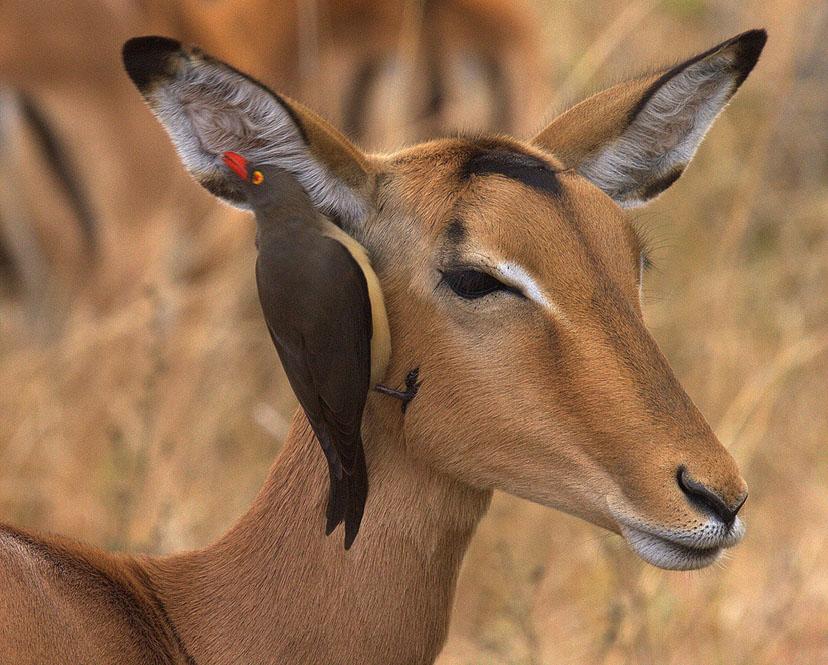
The cattle egret follows herds of cattle and eat the insects that the cattle stir up as they move through the grassland. The cattle appear to be unaffected by the egrets. This is a _____ type of relationship.
Commensalism
Parasitism
Symbiotic
Mutualism
A positive feedback loop occurs
when a system responds to a change by returning to its original state
when feedback into a system decreases a rate of response
when a system is in a steady state
when feedback into a system increases a rate of response
Which best describes the concept of net primary production?
total amount of energy available from the Sun
total amount of cellular respiration conducted within an ecosystem
energy captured minus energy lost
total amount of energy available from the producer

In which biome would you expect to find an area with an average temperature of 10oC and 200 cm of precipitation annually?
Temperate seasonal forest
Temperate rainforest
Woodland/shrubland
Tropical seasonal forest
In which biome would you expect to find an area with an average temperature of 4oC and 50 cm of precipitation annually?
Tundra
Boreal forest
Temperate grassland/cold desert
Woodland/shrubland
Terrestrial biomes are defined by ____ and ____ variables.
temperature; precipitation
temperature; animals
precipitation; plants
animals; plants
An experiment is designed to determine if wheat grows better when it is planted alone or with clover. The design calls for 3 pans of each treatment. Pans A, B, and C contain only wheat. Pans D, E, and F contain clover and wheat planted in alternating rows. Each pan contains a total of
100 seeds. All treatments contain the same type of soil, are planted in the same size pan, are exposed to the same amount of sunlight, and are maintained at the same temperature throughout the course of the experiment.
Which statement provides a hypothesis for this experiment?
Wheat grows better when planted alone than when planted together with clover.
Clover grows better when planted alone than when planted together with clover.
Wheat grows better when planted together with soy beans.
Clover grows better when planted together with wheat.
A community contains
only one species
multiple species
living and non-living components
all the similar biomes across the world
A population contains
only one species
multiple species
living and non-living components
all the similar biomes across the world
Which of the following statements is true?
Primary succession is followed by secondary succession
Primary succession occurs over a shorter time span
Forest fires and hurricanes lead to primary succession because a soil base still exists
Volcanoes creating igneous rock formations lay based for primary succession to take place

Which is true of the location above?
It has low species richness
It has low species evenness
It has high species evenness
It has both low species evenness and richness
None of these
When a spruce tree is harvested so the wood can be used to build a house, the tree is providing
a cultural service.
a provision.
an intrinsic value.
a monetary unit.
Bees are important to ecosystems and humans because they provide
a regulating service through the pollination of crops.
a regulating service that increases crop yields.
a support system through the pollination of food crops.
a support system through promoting biodiversity of crops.

What type of species/community is a redwood forest?
Climax Community
Pioneer Species
Intermediate Species
Tertiary Community
Which type of survivorship curve represents an k-selected species?
Type I survivorship curve
Type II survivorship curve
Type III survivorship curve
Which type of survivorship curve represents animals that have constant mortality?
Type I
Type II
Type III
The definition of fecundity is...
number of offspring
amount of generation time
the carrying capacity
exponential growth
A J-curve represents
exponential growth
logistic growth
no growth
Which type of species would you expect to have a s-curve graph?
k-selected
r-selected
s-selected

What type of plate boundary is shown here?
Convergent
Subduction
Divergent
Transform
Which soil particle is largest in diameter?
Clay
Silt
Sand
Loam
Which gas is there the most of in the atmosphere?
Oxygen
Nitrogen
Water vapor
Carbon dioxide
ENSO events take place in which ocean basin?
Atlantic
Indian
Pacific
Arctic
Why does the Earth have seasons?
Tilt of the Earth on its axis
Earth's shape
Earth's rotation around the Sun
Earth's rotation on its own axis
Which of the following would NOT lead to a decrease in TFR?
Increased access to birth control
Increased women's rights
Increased access to education
Improved drinking water
Surface Mining and Control Reclamation Act
mandates that miners give half of what they find to the government
allows miners to place a stake on public land for $5 per acre
mandates reclamation
is meant to bankrupt mining companies
An ecological footprint is
The amount of wilderness available on the earth
The amount of biologically productive land and water a person uses
A measure of the earth's biological capacity
A measure of a person's contribution to creating a sustainable environment
A mechanism for preventing erosion by planting a row of trees adjacent to farmland
windbreaks
contour plowing
groundcover crops
no till agriculture
Integrated pest management is likely to use all of the following EXCEPT
crop rotation
intercropping
planting herbicide resistant crops
using traditional chemical pesticides
Which is NOT a contaminant associated with CAFOs?
Nitrogen
Phosphorus
Oil spills
E. coli
Thermal inversion can be caused by
Cold air from an ocean
The geographic features like mountains surrounding a city.
A bowl shape area
All of these can cause thermal inversion
Thermal inversion can cause pollutants to be held close the ground level.
True
False

What does the whole right side of the population pyramid represent?
Males
Females
Unemployed
Young people

What age group does the top of the population pyramid represent?
The working people
The rich people
The elderly
The young people

What age groups does the bottom of a population pyramid represent?
The elderly
The working adults
The children
Males

Does this age structure diagram show a country with
Rapid Growth
Decreasing Growth
Zero Growth

Does this age structure diagram show a country with
Zero Growth
Rapid Growth
Decreasing Growth

Does this age structure diagram show a country with
Decreasing Growth
Zero Growth
Which of the following age structure diagrams demonstrates zero growth in the population?


none of the above
Which of the following age structure diagrams demonstrates decreasing growth in the population?
none of the above
Which of the following age structure diagrams demonstrates POSITIVE, RAPID growth in the population?
none of the above

Which country will have the most rapid population growth?
Sweeden
United States
Mexico
None

Does this age structure diagram show a country with
Rapid Growth
Zero Growth
Decreasing Growth

Does this age structure diagram show a country with
Zero Growth
Decreasing Growth

Does this age structure diagram show a country with
Rapid Growth
Zero Growth
Decreasing Growth

Does this age structure diagram show a country with
Rapid Growth
Zero Growth
Decreasing Growth

Does this age structure diagram show a country with
Rapid Growth
Zero Growth
Decreasing Growth

Does this age structure diagram show a country with
Decreasing Growth
Zero Growth
Rapid Growth
Better sanitation (access to clean water)

Predict the future population growth of this country.
Negative Growth (the population will shrink)
Slow/No Growth (the population will stay about the same)
Fast Growth (the population will explode)

Which of the following characteristics is most closely associated with a country that demonstrates the age structure diagram show above?
There is a low infant mortality rate
A high percentage of the population has access to medical care
There is a low population growth
There is a high total fertility rate
What type of age structure diagram represents a population with negative growth rate?


Represents the maximum number of individuals that can be supported by a particular ecosystem on a long-term basis
A
B
C
D
E
Which of the following is a true statement about the total fertility of a society?
The total fertility of a society is the difference between the crude birth rate and the crude death rate.
The total fertility of a society is the number of children necessary for a couple to replace themselves in the next generation.
The total fertility of a society is positively correlated with the average education of women.
The total fertility of a society is negatively correlated with the number of women of child-bearing age.
The total fertility of a society decreases as the society progresses through the demographic transition.
Which of the following is most typically associated with the transition from a rural to an urbanized society?
Reduced birth rates
Reduced need for sewage-treatment facilities
Increased rates of population growth
Increased air quality in urban areas
Increased stabilization of microclimate in urban areas
If a country has a crude birth rate of 24 per 1,000 and a crude death rate of 8 per 1,000, the natural annual percent increase of its population is
0.6%
1.6%
3%
16%
32%

The total fertility rate in country A was 6.8 in 1980. Which of the following statements best supports the change in the total fertility rate in country A between 1980 and 2015?
The total fertility rate increased as a result of improved health care and better nutrition.
The total fertility rate remained constant even though there was improved access to clean water.
The total fertility rate decreased as a result of a delay in age of first marriage and increased contraceptive use.
The total fertility rate decreased as a result of increased infant mortality rate.
Members of an r-selected species characteristically
grow slowly
produce few offspring
reach sexual maturity quickly
have long life spans
are very protective of their offspring

Which of the following characteristics in the table best supports the claim that:
Country A is a more developed country and that Country
B is a less developed country?
population size
land area
infant mortality rate
net migration rate
The crude growth rate, r , of a population is calculated by
multiplying the existing population size by life expectancy
dividing the crude birth rate by 2
dividing the doubling time by 70
adding the crude birth rate to the crude death rate
subtracting the crude death rate from the crude birth rate

Cycads are gymnosperms that were diverse and abundant during the Mesozoic era. Extant species of cycads share many traits with those from the Mesozoic era. Cycads bear cones, are long-lived with slow growth rates, show late reproductive maturity, and have very few offspring. Based on this description, the cycads are
K-strategists with a Type I survivorship curve.
r-strategists with a Type III survivorship curve.
K-strategists with a Type III survivorship curve.
r-strategists with a Type II survivorship curve.
In a certain country, the birth rate is high, the death rate is high, and there are many children that are part of the workforce. The country is most likely in which of the following stages of the demographic transition?
Stage 1
Stage 2
Stage 3
Stage 4

During which stage of the demographic transition shown above does a population begin to experience an explosive increase in growth?
Stage 1
Stage 2
Stage 3
Stage 4
After Stage 4
In a human population undergoing the demographic transition, which of the following generally decreases first?
Birth rate
Death rate
Average family size
Life expectancy
Level of education
If the population of a country grows at a rate of approximately 5 percent per year, the number of years required for the population to double is closest to
5 years
10 years
15 years
25 years
35 years
Factors that affect the total fertility rate of a human population include which of the following?
I. Cultural traditions
II. Government policies and economic incentives
III. Education level and economic opportunities for females
I only
II only
I and II
II and III
I, II and III

Tracks organisms that tend to live long lives (low death rate and high survivorship rate); toward the end of their life expectancies, however, there is a dramatic increase in the death rate.
Type I
Type II
Type III
Type IV
Describes organisms with a high death rate (or low survivorship rate) immediately following birth. Examples include bacteria, fishes, and invertebrates.
Type I
Type II
Type III
Type IV
These organisms have short life spans, are generally small, quick to mature and waste a lot of energy. Typical examples include salmon, corals, insects and bacteria.
K-strategist
r-strategist
m-strategist
s-strategist
These organisms typically live in unstable, unpredictable environments & are able to reproduce rapidly (exponentially). They do not take care of their young & are subject to predation.
K-strategist
r-strategist
m-strategist
s-strategist

