
 Worksheets
Science District Benchmark Review #1
Total questions: 64
Worksheet time: 1hrs 21mins
Which statement is a true comparison of potential and kinetic energy?
Both potential and kinetic energy are exhibited when an object is moving across the ground.
Kinetic and potential energy are alike in that neither one can be created nor destroyed.
Kinetic and potential energy are different because potential energy can be created, and kinetic energy is created from potential energy.
Kinetic and potential energy cannot be transformed, or changed, from one to the other.
What happens to the potential energy of an object as it falls?
Potential energy increases.
Potential energy is destroyed.
Potential energy transforms to kinetic energy.
None of the above

At which point on the roller coaster does the car have the most potential energy?
w
x
y
z

At which point on the roller coaster does the car have the most kinetic energy?
w
x
y
z
Thermal energy transfers heat from -
large objects to small objects
dark objects to light objects
warm objects to cool objects
smooth objects to rough objects

A student noticed that the saucer below the coffee cup became warmer after coffee was poured in the cup. Which type of heat transfer has occurred?
Conduction
Convection
Radiation
Insulation

While seated one meter away, a camper felt the warmth of the camp fire. Which type of energy transfer did the camper experience?
Conduction
Convection
Radiation
Insulation

The diagram below shows how sea breezes form as warm air over the land rises and cool ocean air moves in. This movement of air is an example of -
Conduction
Convection
Radiation
Insulation
What conditions must be present in order for thermal energy to transfer between two objects?
Both objects must be hot.
The objects must be very large.
Each object must have a different temperature.
Energy must be high in both of the objects.
Convection is the transfer of energy
In fluids such as liquids and gases
Between small and large solids
Between objects that are touching
In places where there is no matter
An example of energy transfer by radiation is
A 20 degree C piece of wood touching a 20 degree C rock
Water circulating in a hot pan
A girl putting her foot into a swimming pool
Light traveling through empty space
Which of the following terms is related to the term conduction?
Fluid
Touch
Empty space
Gases mixing
Two objects have different temperatures. Object A has a temperature of 42 degree Celsius and Object B is 37 degree Celsius. Which direction should the energy transfer between Objects A and B?
From Object A to Object B
From Object B to Object A
Energy will not transfer
Energy will transfer both directions

Pyrite has a density of 5.0 g/mL.
Which of the following unknown samples would be pyrite?
Sample A: 5g, 2mL
Sample B: 3g, 15mL
Sample C: 10g, 2mL
Sample D: 1g, 5mL

A mineral has a volume of 15mL and a mass of 60g. What is the density of the mineral?
.25 g/mL
45 g/mL
75 g/mL
4 g/mL

Which of the following is a pure substance?
CO
C02
Co
H2O

Which of the following chemical formulas represents a compound?
C3
O2
CH3CHO
H2

Which one can be found on the periodic table?
Compound
Element
Mineral
Mixture
What does abundant mean?
not much, small
a lot, very much
a little bit
least amount

Which is the most abundant element found in all the Earth's spheres? Look at your Earth's spheres notes in your composition book.
Sodium (Na)
Oxygen (O)
Carbon (C)
Nitrogen (N)
Which of the following energy resources are nonrenewable?
Solar
Hydroelectric
Natural gas
Wind
Which of the following energy resources are renewable?
Natural Gas
Geothermal
Coal
Oil



When you break a cracker into pieces it is a...
Chemical change
Physical change

Rust on an iron bar is an example of chemical change.
True
False

Production of light or heat is resulting from a
Chemical Change
Physical Change
Elizabeth was examining elements and their physical properties. She described an element is her science journal as having no shine, an insulator, and very brittle. What would this element be a metal, nonmetal, or metalloid?
metal
nonmetal
metalloid


Which of the following tables correctly lists the physical properties of metals and nonmetals?
A
B
C
D


Nonmetals occur to the ________of the dark zig-zag on the periodic table.
A. right
B. middle
C. left

Which type of elements touch the zigzag line?
Metals
Nonmetals
Metalloids

Metals appear to the _______ of the dark ziz-zag line on the periodic table.
A. right
B. middle
C. left

A battery converts what type of energy to another?
sound to kinetic
radiant to thermal
mechanical to electrical
chemical to electrical

The glow sticks produce light for a short amount of time. The light from the glow stick is a conversion from ...
thermal to radiant
chemical to electrical
radiant to electrical
chemical to radiant
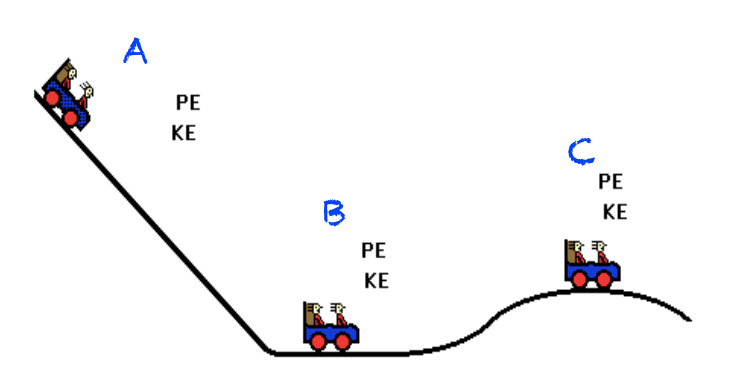
The coaster at A has -
Maximum PE, Minimum KE
Minimum PE, Maximum KE
Minimum PE, High KE
Maximum PE, Maximum KE
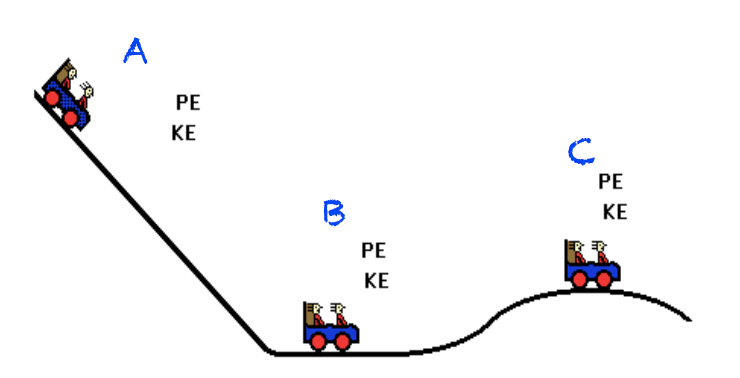
The coaster at B is at -
Maximum PE, Minimum KE
Minimum PE, Minimum KE
Minimum PE, Maximum KE
Maximum PE, Maximum KE
Which of the following energy transformations occur when a lamp that is plugged into a wall socket is functioning correctly?
Chemical to Radiant
Electrical to Chemical
Electrical to Radiant
Chemical to Electrical
Which of the following shows an energy transformation from chemical energy to electrical energy to radiant energy?
A bolt of lightning lights the night sky.
A candle glows brightly in the dark.
A fire in a fireplace lights up a room.
A battery causes a flashlight to shine.
What energy transformations take place when a battery-operated radio is in use?
Electrical to chemical to sound
Sound to chemical to mechanical
Chemical to electrical to sound
Radiant to electrical to thermal
People get energy from the food that they eat and transform that energy as they move. Which energy transformations occur as a student rapidly rubs the palms of his hands together?
mechanical to thermal to electrical
chemical to mechanical to thermal
mechanical to chemical to sound
chemical to sound to electrical
Which of the following devices transforms electrical energy into mechanical energy?
a battery operated fan
a fan plugged into wall socket
a manual pencil sharpener
Ipad charging

The diagram shows a complete circuit with a battery and a buzzer making noise. This circuit works by transforming -
chemical energy to electrical to sound
electrical energy to thermal to radiant
sound energy to electrical to chemical
mechanical energy to electrical to sound
A television works by transforming electrical energy into what other kinds of energy?
Radiant, thermal, and sound
Thermal, chemical, and radiant
Sound, mechanical, and electrical
Radiant, chemical, and mechanical
Which of the following shows the correct order of the energy transformations that occur when green plants produce their food from the Sun’s energy?
chemical to thermal
radiant to chemical
thermal to radiant
chemical to electrical
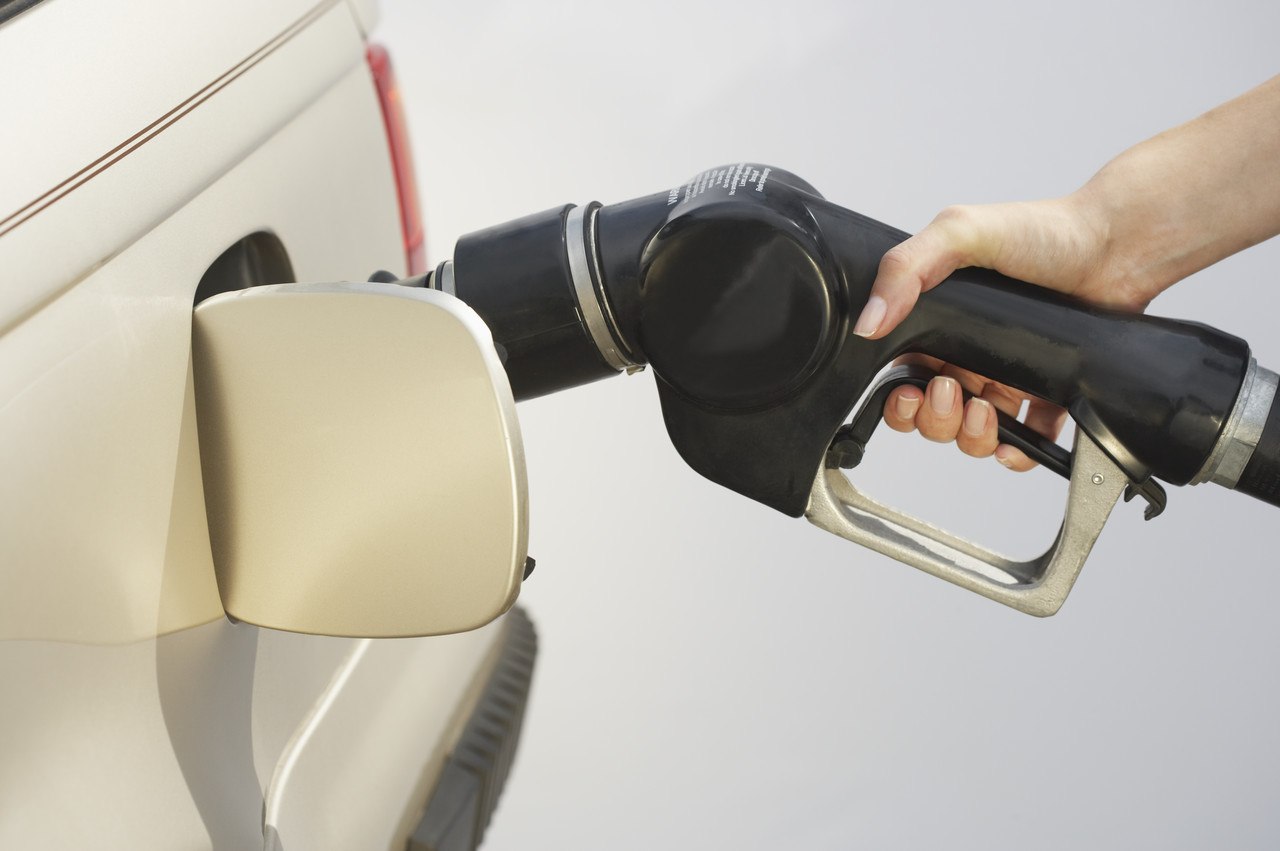
Which energy conversion is taking place when you put gasoline in a car?
thermal -> electrical
mechanical -> electrical
chemical -> mechanical
nuclear -> chemical

Wind turbines and windmills convert what energy to another?
Mechanical to electric
Gravitational to electric
Mechanical to gravitational
Mechanical to Mechanical

The purpose of the solar panels is to change radiant energy into ____________.
thermal energy
electrical energy
chemical energy
mechanical energy

The diagram below shows a hot air balloon rising. Propane gas tanks are seen at the bottom of the balloon. What energy transformations occur when propane gas is used to lift the balloon?
Mechanical to radiant to chemical
Chemical to mechanical to thermal
Thermal to chemical to radiant
Chemical to thermal to mechanical

