wayground logo

Free Printable Worksheets

NEW

Font size

S
M
L
XL
Worksheets

Biology EOC Review Unit 3 and 4 with Mrs. Cheek

Total questions: 75

Worksheet time: 58mins

Name
Class
Date
1.
A frog eats a fly. The frog and fly are demonstrating ________.
a)
mutualism
b)
competition
c)
predator/prey
d)
parasitism
2.
What type of growth is represented behind?
a)
exponential
b)
logistics
c)
a good kind
d)
representative
3.
What point on the graph represents the carrying capacity?
a)
A
b)
B
c)
C
d)
D
4.

Which is the role of respiration in the carbon cycle?

a)

to use carbon to make organic molecules

b)

to release carbon dioxide into the atmosphere

c)

to absorb carbon dioxide from the atmosphere

d)

to use carbon dioxide to break down remains of dead organisms

5.

Certain trees, such as the dogwood, can be inhabited by a fungus that damages their leaves. Which of the following BEST describes the relationship between the tree and the fungus?

a)

Paratism

b)

Commensalism

c)

Mutualism

6.

A prey population typically increases when its primary predator is removed from the ecosystem. What MOST likely happens after this increase in the prey population?

a)

Food shortages and disease reduce the prey population.

b)

Food shortages and disease increase the prey population.

c)

Humans successfully manage the prey population.

d)

Disease transmission affects the prey’s ability to reproduce.

7.

Why are enzymes essential to organisms?

a)

They are catalysts for biochemical reactions in cells.

b)

They provide short term and long term energy for the cells.

c)

They provide instructions for protein synthesis and determine traits.

d)

They create semipermeable barriers in the cell that separates the inside and outside of the cell.

8.

Which color of light would most likely produce the lowest rate of photosynthesis?

a)

Red

b)

Green

c)

Blue

d)

Yellow

9.

Which process uses ATP to pump small molecules and ions across the cell membrane to maintain homeostasis?

a)

Passive Transport

b)

Active Transport

c)

Diffusion

d)

Osmosis

10.

Which organelle would be found in large quantities in muscle cells?

a)

Chloroplast

b)

Glucose

c)

Mitochondria

d)

Stem

11.

Which best describes the hierarchy of cell organization?

a)

cells, tissues, organs, organ systems

b)

organs, cells, organs systems, tissues

c)

tissues, organ systems, cells, organs

d)

organ systems, cells, organs, tissues
12.
What is the source of energy for photosynthesis?
a)
carbohydrates-chemical
b)
sunlight
c)
heat-thermal
d)
electrical
13.
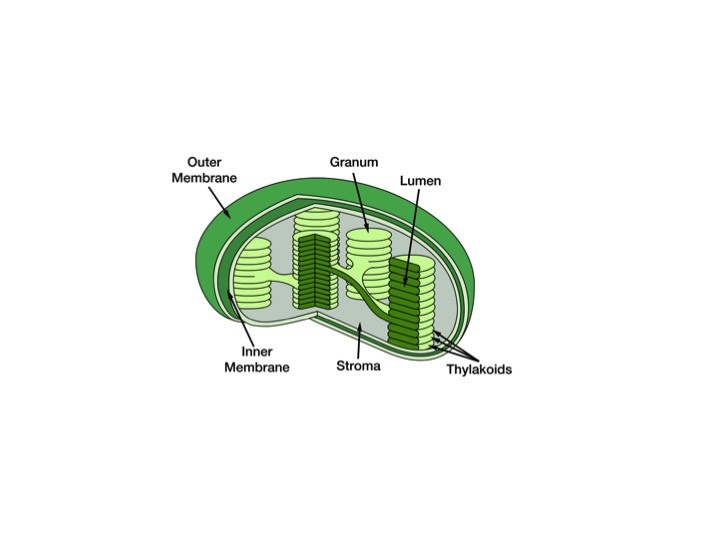
Which organelle does photosynthesis take place in?
a)
Mitochondrion
b)
Chloroplast
c)
Cytoplasm
d)
Nucleus
14.
Chloroplasts are...
a)
Structures of animal cells to produce ATP
b)
Organelles where lipids are elaborated
c)
Specialized structures of plants where food is made
d)
Waste organelle of plants
15.
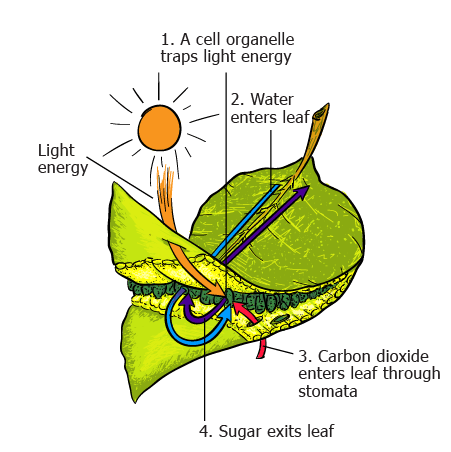
Look at the image
What substances and organelle work together to absorb sunlight to perform photosynthesis in this example?
a)
cell wall and chloroplast
b)
mitochondria and water
c)
vacuole and carbon dioxide
d)
chloroplast and chlorophyll
16.
What three things are needed for a plant to do photosynthesis?
a)
Glucose, Oxygen, Sunlight
b)
CO2, Oxygen, Sunlight
c)
CO2, Water, Sunlight
d)
Oxygen, Water, Sunlight
17.

What is the correct equation for photosynthesis?

a)

6 O2 + C6H12O6 ---->6 CO2 + 6 H2O + Energy

b)

6 CO2 + 6 H2O ---->6 O2 + C6H12O6 + Energy

c)

6 CO2 + 6 H2O + Energy ----> C6H12O6 + 6 O2

d)

6 O2 + C6H12O6 + Energy ----> 6 CO2 + 6 H2O

18.
Why do we see this apple as red?
a)
the apple reflects all visible light
b)
the apple reflects red wavelengths
c)
the apple absorbs all visible light
d)
the apple absorbs red wavelengths
19.
What does a food web represent?
a)
All connections of energy flow throughout all organisms in a habitat.
b)
The specific ways that mutualism is carried out.
c)
A single pathway or energy flow between organisms. 
d)
How carnivores get their food. 
20.
1.  A bee and a flower work together to benefit each other. This is an example of _________________. The bee helps the flower by pollinating it and the flower helps the bee by providing it with nectar. 
a)
commensal relationship 
b)
parasitic relationship 
c)
mutual relationship 
21.
Barnacles create home sites by attaching themselves to whales. This neither harms nor benefits the whales.
a)
Mutualsim 
b)
Parasitism 
c)
Commensalism 
22.
symbiotic relationship in which both organisms benefit
a)
competition
b)
Mutualism
c)
nitrogen fixation
d)
energy pyramid
23.
A living relationship between two species in which one organism is harmed is called...
a)
mutualism
b)
commensalism
c)
parasitism
d)
niche
24.
Grasshopper and Leaf - A grasshopper lands on a plant and eats its leaves for food.
a)
Predation
b)
Mutualism
c)
Commensalism
d)
Parasitism
25.
Bear and Berries - The bear forages through the forest and finds berries for food.
a)
Predation
b)
Mutualism
c)
Commensalism
d)
Parasitism
26.
Mistletoe and Oak Tree - Mistletoe extracts water and nutrients from the oak tree, causing harm to the oak tree.
a)
Predation
b)
Mutualism
c)
Commensalism
d)
Parasitism
27.
Deer and Tick - Ticks feed on deer blood, causing irritation to the deer and potentially giving it various diseases such as lyme disease.
a)
Predation
b)
Mutualism
c)
Commensalism
d)
Parasitism
28.
Black Wasp and Aphids - Black wasps plant eggs in phids. the larvae eat the aphids from the inside.
a)
Predation
b)
Mutualism
c)
Commensalism
d)
Parasitism
29.
Hermit Crabs and Snails -  Hermit crabs live in shells made and then abandoned by snails. 
a)
Predation
b)
Mutualism
c)
Commensalism
d)
Parasitism
30.
Whales and Barnacles -Barnacles create home sites by attaching themselves to whales.
a)
Predation
b)
Mutualism
c)
Commensalism
d)
Parasitism
31.
Cattle Egret and Cattle or Horses - The cattle egret follows cattle or horses and preys on the insects th e animals stir up as they graze.
a)
Predation
b)
Mutualism
c)
Commensalism
d)
Parasitism
32.
Yucca Plant and Yucca Moth - Yucca flowers are pollinated by yucca moths. The moths lay their eggs in the flowers where the larvae hatch and eat some of the devel oping seeds.
a)
Predation
b)
Mutualism
c)
Commensalism
d)
Parasitism
33.
Honeypot Ants and Aphids - Honeypot ants get food by stroking the aphid for their sweet honey dew secretions. The ants provide protection for the aphid by aggressively fighting off predators such as ladybugs.
a)
Predation
b)
Mutualism
c)
Commensalism
d)
Parasitism
34.
Lion and Zebra - The lion hunts and kills the zebra for its food.
a)
Predation
b)
Mutualism
c)
Commensalism
d)
Parasitism
35.

Who is the predator in this image?

a)

The Owl

b)

The mouse

c)

The Snow

d)

The wind

36.

Who is the consumer in this specific case?

a)

The bull

b)

The lion

c)

The grass

d)

The wind

37.
In this tundra food web, if grasses were removed what would happen to the sustainability of the ecosystem?
a)
There would be an overpopulation of arctic hares and lemmings.
b)
Polar bears would move to a new ecosystem.
c)
The ecosystem would collapse, because it lost its main producer.
d)
Wildflowers would die out from the ecosystem.
38.
An organism that lives on or in a host and causes it harm is called
a)
a host
b)
a parasite
c)
a cell
d)
a virus
39.

What is the producer in this food chain?

a)

Python

b)

Frog

c)

Grasshopper

d)

Grass

40.
Which structures shown in the Figure make up the ADP molecule?
a)
A and B
b)
A, B and C
c)
A, B, C, and D
d)
C and D
41.
What is the function of ATP in living things?
a)
provides energy for cells
b)
stores genetic information
c)
provides structure in the nucleus
42.
What are the parts of the ATP molecule?
a)
adenine, thylakoids, stroma
b)
stroma, grana, chlorophyll
c)
adenine, ribose, phosphate groups
d)
NADH, NAHPH, FADH
43.
Using the figure, which parts of the molecule must the bonds be broken to form an ADP molecule?
a)
A and B
b)
B and C
c)
C and D
d)
all of the above
44.
Plants need ________ for photosynthesis
a)
oxygen
b)
soil
c)
carbon dioxide
d)
sugar
45.

In human beings, which factor determines the sex of an individual?

a)

Presence of X chromosome

b)

Presence of Y chromosome

c)

Fertilization

d)

Egg

46.

Meiosis contributes to the process of reproduction by producing what type of cell?

a)

Haploid

b)

Diploid

47.

Radish plants have 18 chromosomes in each of its leaf cells. How many chromosomes would most likely be found in a radish ovary?

a)

9

b)

18

c)

36

d)

21

48.

Which is a result of mitosis?

a)

four sex cells

b)

four haploid cells

c)

two diploid daughter cells

d)

two haploid daughter cells

49.

Why is interphase the longest stage of the cell cycle?

a)

the nucleus takes numerous days to divide

b)

gametes are produced over a long period of time

c)

the cytoplasm and cell membrane separate after telophase

d)

the cell grows, metabolizes, and synthesizes more genetic material

50.

Which event occurs during cytokinesis?

a)

The cell grows.

b)

Cytoplasm splits.

c)

Line up in middle.

d)

Become sister chromotids

51.

Which structure do animal cells form during cytokinesis?

a)

Cleavage

b)

Cell Plate

52.

Which is most likely occurring when animal cells undergo mitosis at an abnormally high rate?

a)

Cancer

b)

Sex cells

c)

Body cells

53.

The image illustrates which process?

a)

Mitosis

b)

Meiosis

c)

Both mitosis and meiosis

d)

Interphase

54.
The image illustrates which process?
a)
Mitosis
b)
Meiosis
55.
Genetic disorders, such as Down's Syndrome, are a result of errors in __________.
a)
Mitosis
b)
Meiosis
c)
Both Mitosis and Meiosis
56.
Produces genetically identical daughter cells.
a)
Mitosis
b)
Meiosis
c)
Both Mitosis and Meiosis
57.

The chromosomes that pair up during meiosis, are called __________ chromosomes.

a)

heterozygous

b)

asexual

c)

homologous pairs

d)

genes

58.
Use the chart. What is the number of chromosomes for haploid frog cells? 
a)
26
b)
13
c)
14
d)
10
59.
Chromosomes line up in the middle of the cell single file during what phase? 
a)
Telophase I
b)
Telophase II
c)
Metaphase I
d)
Metaphase II
60.
In what phase of meiosis would certain gene segments of the homologous pairs of chromosomes "crossover" and exchange genetic information? 
a)
Prophase I
b)
Metaphase I
c)
Anaphase I
d)
Telophase I
61.
Which cells are NOT formed during meosis? 
a)
Sex cells
b)
Sperm cells
c)
Somatic cells
d)
Gametes
62.
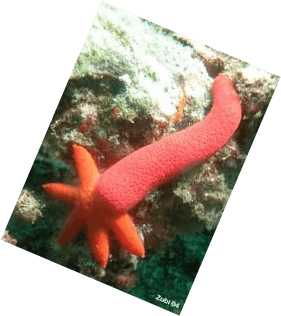
What type of asexual reproduction is taking place?
Fishermen work hard to catch and remove all the starfish that get into their favorite shell fishing beds and the “underwater farms” where they raise clams and oysters. In the past, they put the starfish into their boats, cut them up with knives, and then throw the pieces of starfish overboard. They thought this would kill the starfish. What they did not know was that each piece of starfish will grow into a whole new animal.
a)
Regeneration
b)
Vegetative propagation
c)
Budding
d)
Fission
63.
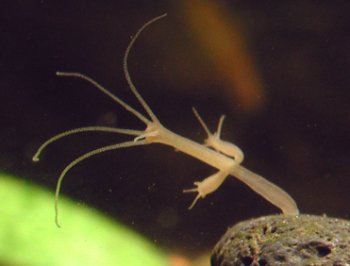
This is when a new organism grows by cell division on the body of its parent. The bud, or offspring is identical to the parent. The bud, when large enough, can break off of the parent and live on its own.  Examples of this include yeast, hydra and potatoes.
 
a)
Regeneration
b)
Vegetative propagation
c)
Fission
d)
Budding
64.
The offspring from asexually reproduced organisms are?
a)
Different than their parents
b)
Identical to parents
c)
Like a combination from both parents
d)
A different species
65.
Meiosis makes sperm and egg cells. In humans, sperm and egg cells each have _____ chromosomes. Therefore a fertilized human egg cell (sperm and egg cell combined) would create a cell with _____ chromosomes.
a)
23, 46
b)
46, 23
c)
2, 4
d)
50, 100
66.
Structure (b) is a ____.
a)
chromosome
b)
chromatid
c)
centromere
67.
Name the phase:
a)
Anaphase
b)
Telophase
c)
Metaphase
d)
Prophase
68.
What is the next phase of mitosis?
a)
Prophase
b)
Metaphase
c)
Anaphase
d)
Telophase
69.
What is the next phase of mitosis?
a)
Prophase
b)
Metaphase
c)
Anaphase
d)
Telophase
70.
Name the phase:
a)
Prophase
b)
Metaphase
c)
Anaphase
d)
Telophase
71.
What phase is  shown in the picture?
a)
anaphase 1
b)
anaphase 2
c)
metaphase 1
d)
telophase 1
72.
When an area of a chromatid is exchanged with the matching area on a chromatid of its homologous chromosome, _________________ occurs
a)
crossing over
b)
mutagenesis
c)
hybridization
d)
fertilization
73.
Necessary for sexual reproduction
a)
Mitosis
b)
Meiosis
c)
Both Mitosis and Meiosis
74.
Takes place only in reproductive organs
a)
Mitosis
b)
Meiosis
c)
Both Mitosis and Meiosis
75.
When comparing the offspring of sexually and asexually reproducing organisms, we would expect the genetic material (DNA) of the sexually reproducing organism to -
a)
contain fewer mutations
b)
be lesser in quantity
c)
be simpler overall
d)
show more variation