Wayground logo

Free Printable Worksheets

Font size

S
M
L
XL
Worksheets

Earth & Space Mid-Term Study Guide 18-19

Total questions: 129

Worksheet time: 6hrs 35mins

Name
Class
Date
1.

What is a mineral

a)

rocks in a bedrock

b)

Strata in sedimentary rocks

c)

solid, naturally occurring inorganic substances

d)

None of the above

2.

What is the softest mineral

a)

Calcite

b)

Fluorite

c)

Talc

d)

None of the above

3.

What is the least effective way to identify a mineral

a)

Streak

b)

Color

c)

Hardness

d)

Luster

4.

How does one test the streak of a mineral

a)

Scratch it with a penny

b)

Look at it's color

c)

Check to see if it has cleavage or fracture

d)

rub mineral on porcelain plate

5.

What is the hardest mineral to scratch

a)

Gold

b)

Diamond

c)

Quartz

d)

Graphite

6.
VR 1.  The _____ of a mineral can be tested by scratching it.
a)
Color
b)
Hardness
c)
Luster
d)
Streak
7.

VR 2. The color that a mineral leaves on a tile is its _____.

a)

Color

b)

Luster

c)

Streak

d)

Hardness

8.
VR 5.  A mineral's _____ may be glassy, pearly, or metallic.
a)
Streak
b)
Color
c)
Luster
d)
Hardness
9.
CR 2.  Mineral A is harder than Mineral B if A _____?
a)
Weighs more than B
b)
Scratches B
c)
Streaks B
10.
CR 4.  Two kinds of luster are _____.
a)
Shiny and Hard
b)
Metallic and Nonmetallic
c)
Yellow and Cube-Shaped
11.
By definition, a mineral has which of the following characteristic(s)?
a)
definite chemical composition
b)
crystal structure
c)
naturally occuring
d)
all of the above
12.

What do we mean when we say a mineral is hard?

a)

It resists being scratched.

b)

It shatters when dropped.

c)

It is hard to break.

d)

It is shiny.

13.

What do all minerals have in common?

a)

They have a definite chemical formula.

b)

They have a shiny surface.

c)

They contain the element carbon.

d)

They are soft and elastic.

14.

According to this chart, will garnet scratch fluorite?

a)

Yes

b)

No

15.
When molten material from a volcano or from deep inside Earth cools, it forms _______________ ________________. 
a)
Granitic
b)
Basaltic
c)
Instrusive
d)
Igneous rock
16.
Rock that form below Earth’s surface are _____________________ igneous rocks. 
a)
Granitic
b)
Intrusive
c)
Extrusive
d)
Lava
17.
_________________ igneous rocks are formed when lava cools on or near Earth’s surface.
a)
Granitic
b)
Intrusive
c)
Extrusive
d)
Lava
18.
When mineral grains flatten and line up in parallel bands, the metamorphic rock has a __________________ texture. 
a)
Nonfoliated
b)
Metamorphic Rock
c)
Foliated
d)
Igneous Rock
19.
___________________ ___________ form when sediments become pressed or cemented together or when sediments precipitate out of solution.
a)
Compaction
b)
Sedimentary Rock
c)
Cementation
d)
Sediment
20.
_________________ are loose materials such as rock fragments, mineral grains, and bit of plant and animal remains that have been moved by wind, water, ice, or gravity. 
a)
Compaction
b)
Sedimentary Rock
c)
Cementation
d)
Sediment
21.
How do metamorphic rocks form? 
a)
Heat and Pressure
b)
Compaction & Cementation
c)
Cooling of Magma
d)
Sediments & Glue
22.
This rock was formed when magma cooled very slowly inside the Earth. What specific type of rock is it?
a)
Intrusive Igneous Rock
b)
Extrusive Igneous Rock
c)
Foliated Metamorphic Rock
d)
Clastic Sedimentary Rock
23.
This rock formed when lava cooled very quickly on Earth's surface. What specific type of rock is it?
a)
Extrusive Igneous Rock
b)
Intrusive Igneous Rock
c)
Non-Foliated Metamorphic Rock
d)
Biochemical Sedimentary Rock
24.
What are the 3 major types of rocks?
a)
Igneous, Metamorphic, Sedimentary
b)
Metamorphic, Igneous, Cementation
c)
Brown, Red, Gray
d)
Streak, Hardness, Breakage
25.
What process is used to form sedimentary rocks?
a)
Lava cools and hardens to form a rock.
b)
Weathering, Erosion, Deposition, Compaction, Cementation
c)
Extreme heat and pressure from inside the Earth turn rocks into new rocks.
d)
Magma trapped under the Earth's surface cools and solidifies.
26.
What type of rocks can fossils be found in?
a)
Igneous
b)
Metamorphic
c)
Sedimentary
27.
What is the incorporation and transportation of material by a mobile agent, such as water, wind, or ice?
a)
deposition
b)
compaction
c)
erosion
28.
Lava that cools so quickly that ions do not have time to arrange themselves into crystals will form igneous rocks with what type of texture?
a)
glassy
b)
coarse-grained
29.
Intrusive Igneous rocks will be 
a)
coarse grain
b)
fine grain
30.
How do Intrusive Igneous rocks cool?
a)
quickly
b)
slowly
c)
really fast
31.
Igneous rock that forms from lava on Earth's surface
a)
Organic Rock
b)
Intrusive Rock
c)
Clastic Rock
d)
Extrusive Rock
32.
The process by which igneous rocks are formed...
a)
heat and pressure deep underneath earth's surface
b)
melting and cooling of magma
c)
compaction and cementation of sediments
33.
A slow cooling igneous rock will have _____ crystals
a)
large
b)
small
c)
average
d)
black
34.
The laccolith, batholith an dike are types of __________ ___________.  These are magma that has pushed into existing layers of rock and cooled there.
a)
extrusive sediments
b)
igneous intrusions
c)
metamorphic layers
35.

The process by which molten material adds new oceanic crust to the ocean floor. At the same time, older strips of rock move outward from either side of the ridge

a)

mid-ocean ridge

b)

sea-floor spreading

c)

Mariana trench

d)

fault lines

36.

A deep valley along the ocean floor beneath which oceanic crust slowly subducts towards the mantle

a)

deep-ocean trenches

b)

mid-ocean ridge

c)

Mariana trench

d)

Mount Everest

37.

A plate boundary where two plates slide past each other horizontally.

a)

transform plate boundary

b)

divergent plate boundary

c)

convergent plate boundary

d)

subduction ridge

38.

Who came up with the theory of Continental Drift?

a)

Tesla

b)

Wegener

c)

Newton

d)

Jameson

39.

What is one piece of evidence that caused Wegener to think that continents moved?

a)

He found similar fossils on different continents that are separated by oceans.

b)

He found a cave painting of Pangea.

c)

The dirt was made of the same minerals

d)

He could see the continents slowly drifting

40.

___________is evidence for sea floor spreading.

a)

Fish dying near the floor.

b)

New mountain ranges underwater

c)

Matching patterns of magnetic stripes found in the crust of the ocean floor

d)

Igneous intrusions protruding from the floor

41.

The process by which oceanic crust sinks beneath continental or oceanic crust, and back into the mantle at a convergent plate boundary

a)

earthquake

b)

rift valley

c)

transformation

d)

subduction

42.

igneous rock feature formed when magma is squeezed into a horizontal crack between layers of rock and hardens underground

a)

batholith

b)

dike

c)

vent

d)

sill

43.

igneous rock feature formed when magma is squeezed into a vertical crack that cuts across rock layers and hardens underground

a)

dike

b)

sill

c)

vent

d)

tephra

44.

largest intrusive igneous rock body that forms when magma being forced upward toward Earth's crust cools slowly and solidifies underground.

a)

batholith

b)

dike

c)

crater

d)

sill

45.

The intrusion that forms when magma flows between rock layers and spreads upwards pushing the overlying rock layers into a dome is called?

a)

batholith

b)

stock

c)

laccolith

d)

sills

46.

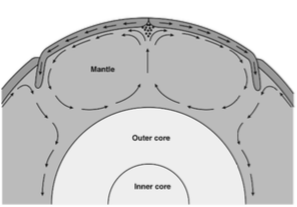
The figure shows part of what scientists think is happening in Earth’s mantle.


What process does the figure show occurring in the mantle?

a)

Hot rock expands, becomes less dense, and rises toward the surface of Earth.

b)

Hot rock expands, becomes more dense, and rises toward the surface of Earth.

c)

Hot rock becomes less dense and moves towards the outer core.

d)

Hot rock becomes more dense and moves towards the lithosphere.

47.

Evelyn is making a model of Earth to show how the physical layers correspond to the compositional(chemical)

layers. Which of the following should Evelyn show in her model?

a)

The physical layers exactly match the compositional layers.

b)

The crust is the only compositional layer not included in the physical layers.

c)

The physical layers of the inner core and outer core form a single compositional layer.

d)

The physical layer of the asthenosphere includes the compositional layer of the crust.

48.

The figure shows a process that takes place on the ocean floor.


Which of the following is most likely to result from the process shown in this figure?

a)

petrification

b)

trace fossil formation

c)

continents moving

d)

glacial melting

49.

Earth’s surface features slowly change over time. For example, sharp, jagged mountain ranges become lower and more rounded over time. What factor(s) is responsible for this change in their shape?

a)

weathering and erosion

b)

depostion

c)

movement of continents

d)

collisions between continental plates

50.

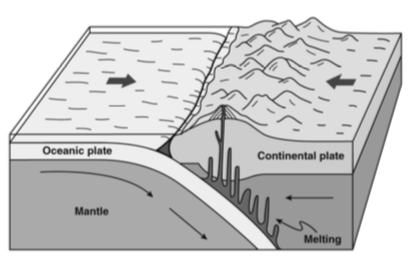
Subduction occurs when one plate slides beneath another plate. The figure below shows the process of subduction. Notice that the oceanic plate slides beneath the continental plate.


What happens when the crustal plates move as shown in the figure?

a)

An ocean forms.

b)

Volcanic mountain ranges form.

c)

Sea-floor spreading occurs as the oceanic plate moves.

d)

A transform boundary forms where the subduction occurs.

51.

The motion of tectonic plates can cause both slow and rapid changes in Earth’s surface. Which is an example of a rapid change?

a)

earthquake

b)

seafloor spreading

c)

mountain range formation

d)

formation of an ocean trench

52.
What is the intrusive igneous rock structure that forms when magma flows between the layers of rock and hardens?  The formation lies parallel to the layers of rock it surrounds and vary in thickness.
a)
batholith
b)
laccolith
c)
sills
d)
dikes
53.
What is the intrusive igneous rock structure that forms when magma forces through rock layers by following existing vertical fractures or creating new ones?  The structure cut across rock layers and are common in areas of volcanic activity.
a)
dike
b)
sils
c)
stock
d)
instruction
54.

What process is the pictures showing?

a)

comprehension

b)

mantle

c)

Earth's layers

d)

convection

e)

melting

55.

What evidence is there of Earth's magnetic field changing directions?

a)

Earth moving through seasons

b)

Minerals aligned to magnetic north in hardened crust

c)

Crust hardening at mid-ocean ridge

d)

magma erupting through mid-ocean ridge

e)

Earth's rotation around the Sun

56.

What phenomena takes place that results in the formation of new crust at mid-ocean ridges?

a)

Earthquakes

b)

Inner Core turbulence

c)

plate tectonics

d)

erosion of mountain ridges

e)

magma rising to the surface

57.

What evidence exists that proves that Earth has layers?

a)

They can be seen from special locations on the Earth

b)

observations of earthquakes and buildings swaying

c)

seismic data from earthquakes on the other side of the Earth

d)

tsunami data from other countries and the impact on the land

e)

rock samples from deep layers

58.

The speed of a seismic wave (from earthquakes) depends on the material it is traveling through.

This has helped us learn about:

a)

Earth's layers

b)

Rotation of the planet

c)

Rock cycle

d)

Fault lines

e)

Subduction zones

59.

The Earth's inner core is solid but the layer around it, the outer core, is a liquid.

Turbulence or movement in that layer can allow the inner core to turn upside down. When this happens:

a)

Earthquakes occur

b)

The tides change

c)

The tectonic plates converge

d)

Magnetic North switches to south

e)

Polar bears hibernate

60.

Earth's layers are not all the same temperature or ________________. This is what causes them to form layers.

a)

age

b)

size

c)

depth

d)

radioactive decay levels

e)

density

61.
What makes the inner core solid?
a)
Metals in the core are very light.
b)
Pressure at the core is very high.
c)
Chemicals in the core are very reactive.
d)
Temperatures in the core are very low.
62.
Which layer contains BOTH the upper mantle and the crust?
a)
lithosphere
b)
atmosphere
c)
mesosphere
d)
athensosphere
63.
What is the correct order (starting from the surface) of Earth's layers?
a)
crust, outer core, inner core, mantle
b)
mantle, outer core, inner core, crust
c)
crust, mantle, outer core, inner core
d)
outer core, inner core, crust, mantle
64.
Which layer of Earth is LIQUID?
a)
upper mantle
b)
lower mantle
c)
outer core
d)
inner core
65.
What is the Earth's core believed to be made of?
a)
Iron
b)
Magnesium
c)
Aluminum
d)
Magma
66.
The crust is the Earth's only solid layer.
a)
True
b)
False
67.
Which layer of Earth is characterized by rock that is plastic, or soft enough to flow?
a)
asthenosphere
b)
crust
c)
lithosphere
d)
inner core
68.
If we compare the temperature and pressure of the Earth’s mantle to the core, what differences can we expect as we move downward into the Earth?
a)
Both the temperature and pressure increase.
b)
Both the temperature and pressure decrease.
c)
The temperature increases and the pressure decrease.
d)
The temperature decreases and the pressure increases.
69.
In which layer of the Earth are convection currents believed to occur?
a)
Outer core
b)
Mesosphere
c)
Asthenosphere
d)
Lithosphere
70.
Which layer is hottest?
a)
Crust
b)
Asthenosphere
c)
Mantle
d)
Core
71.
What creates the magnetic field around the Earth?
a)
The Earth spinning on its axis
b)
The liquid outer core spinning around the solid inner core
c)
The solid outer core spinning around the liquid inner core
d)
Seismic waves
72.
Identify A
a)
Crust
b)
Mantle
c)
Outer Core
d)
Inner Core
73.
Continental crust is made of 
a)
granite
b)
basalt
c)
water
d)
sandstone
74.
Which part of Earth contains plates?
a)
hydrosphere
b)
atmosphere
c)
core
d)
lithosphere
75.
What are the two kinds of crust?
a)
lithospheric and asthenospheric
b)
silicon based and iron based
c)
continental and oceanic
d)
outer and inner
76.
Basalt is a dark, fine-grained rock that that is mostly associated with...
a)
Earth's core
b)
Continental crust
c)
Earth's mantle
d)
Oceanic crust
77.
Earth's oceanic crust is ______ than continental crust.
a)
thinner but denser
b)
thicker and denser
c)
thicker but less dense
d)
thinner and less dense
78.
Name this boundary
a)
Convergent
b)
Divergent
c)
Transform
d)
Sergent
79.
Name the boundary
a)
divergent
b)
convergent
c)
transform
d)
sergent
80.
Name the boundary
a)
convergent
b)
transform
c)
divergent
d)
sergent
81.
Which of the following is associated with transform boundary?
a)
volcanoes
b)
mountains
c)
trenches
d)
earthquakes and fault line
82.
Which of the following land formation occurs at a divergent continental/continental boundary?
a)
mid-ocean ridge
b)
deep ocean trench
c)
Pacific hot spot
d)
rift valley
83.
Mountains form from....
a)
Plates sliding past one another
b)
collision of plates
c)
plates moving away from each other
d)
none of these
84.
Oceanic crust is.....
a)
Younger and less dense than continental crust
b)
Thinner, younger, and more dense than continental crust
c)
older, thicker, and less dense than continental crust
d)
Bigger and younger than continental crust
85.
Earth's plates are....
a)
Constantly moving and changing the face of the Earth
b)
Never moved
c)
Move seldom and very fast
d)
move when they feel like it
86.
What was the name given to all the continents when they were joined as one super continent?
a)
Supreme Continent
b)
Eurasia
c)
Plate tectonics
d)
Pangea
87.
Created by a divergent boundary
a)
rocky mountain
b)
Mariana's Trench
c)
mid-Atlantic ridge
d)
volano
88.
Plates moving apart would be...
a)
convergent
b)
divergent
c)
transform
89.
What type of boundary creates a new seafloor?
a)
convergent continental to continental
b)
convergent ocean to continental
c)
convergent ocean to ocean
d)
divergent 
90.

Which of these types of rock would most likely be the youngest?

a)

rock on an oceanic plate that is close to a mid-ocean ridge

b)

rock on an oceanic plate that is farthest from a mid-ocean ridge

c)

rock on a continental plate that is next to a deep ocean trench

d)

rock on a continental plate that is colliding with another continental plate

91.
6 of the plates are named for continents embedded within them. Which one below was NOT? 
a)
South American
b)
African
c)
Nazca
d)
Australian
92.
When two oceanic plates converge what landform is produced?
a)
A lake
b)
A river
c)
A mountain range
d)
A trench
93.
India and Asia crashed about 55 million years ago. What mountain range was produced?
a)
The Rockies
b)
The Alps
c)
The Himalayas
d)
The Andes
94.
The deepest point on Earth(The Mariana Trench) was created by what plate movement?
a)
Oceanic/Oceanic
b)
Continental/Continental
c)
Oceanic/Continental
d)
Pacifica/Continental
95.

Continental crust consists mainly of the rock _____.

a)

nickel

b)

mantle

c)

basalt

d)

granite

96.

Subduction is

a)

the process by which oceanic crust sinks beneath trenches.

b)

the direct transfer of heat through solid materials.

c)

the process that continually adds ocean floor.

d)

a device that bounces sound waves off underwater objects.

97.

Who first proposed the theory of continental drift?

a)

Harry Hess

b)

Alfred Wegener

c)

Pangea

d)

J. Tuzo Wilson

98.
Identify the Major Plate labeled J
a)
African Plate
b)
Antarctic Plate
c)
Pacific Plate
d)
Eurasian Plate 
99.
Identify the Major Plate labeled B
a)
African Plate
b)
Antarctic Plate
c)
Pacific Plate
d)
Eurasian Plate 
100.
Identify the Major Plate labeled I
a)
African Plate
b)
Antarctic Plate
c)
Pacific Plate
d)
Eurasian Plate 
101.
Identify the Major Plate labeled N
a)
African Plate
b)
Antarctic Plate
c)
Pacific Plate
d)
Eurasian Plate 
102.
Identify the Major Plate labeled D
a)
Indo-Australian Plate
b)
North American Plate
c)
South Americana Plate
d)
Eurasian Plate 
103.

Identify the Major Plate labeled G

a)

Indo-Australian Plate

b)

North American Plate

c)

South American Plate

d)

Eurasian Plate

104.

What is plate number 7?

a)

Nazca

b)

Pacific

c)

Cocos

d)

Caribbean

105.

What is plate letter A?

a)

Juan de Fuca

b)

Caribbean

c)

Nazca

d)

Cocos

106.

What is plate letter K?

a)

Eurasian

b)

African

c)

Indian

d)

Arabian

107.

What is plate letter C?

a)

Juan de Fuca

b)

Nazca

c)

Cocos

d)

Eurasian

108.
Physically breaking down rocks and materials is called__________weathering.
a)
Chemical
b)
Mechanical
c)
Biological
d)
Permeable
109.
The layer of soil which the topsoil is found.
a)
Horizon A
b)
Horizon B
c)
Horizon C
d)
Horizon D or R
110.
In which horizon is the Bedrock
a)
Horizon A
b)
Horizon B
c)
Horizon C
d)
Horizon D or R
111.

The size and number of open spaces in soil that let water flow through determine which soil quality?

a)

pH

b)

profile

c)

composition

d)

permeability

112.
Water gets into the cracks of rock and freezes, causing the rock to break.  What is this an example of?
a)
erosion
b)
weathering
113.

40 % Sand

50% Silt

10% Clay

a)

Clay

b)

Clay Loam

c)

Silt Loam

d)

Sandy Loam

114.

70 % Sand

15% Silt

15% Clay

a)

Sandy Loam

b)

Clay

c)

Silt Loam

d)

Clay Loam

115.

35 % Sand

15% Silt

50% Clay

a)

Clay Loam

b)

Sandy Loam

c)

Silt Loam

d)

Clay

116.

20 % Sand

60% Silt

20% Clay

a)

Sandy Loam

b)

Silt Loam

c)

Clay Loam

d)

Clay

117.

Soil is composed of three particle sizes. Which answer shows the arrangement from smallest to largest?

a)

Sand, Silt, Clay

b)

Clay, Silt, Sand

c)

Sandy, Clay, Silt

d)

Silt, Sand, Clay

118.
Which of the following is the largest particle in soil?
a)
sand
b)
silt
c)
humus
d)
clay
119.

Sandy soils are:

a)

Fast draining

b)

Slow draining

c)

prone to drainage problems in winter

d)

hard to cultivate

120.
Porosity refers to...
a)
the shape of the particles
b)
The sorting of the particles
c)
% of pore space in a material
d)
% of cement in a material
121.
Which of the following has the lowest porosity?
a)
Clay
b)
Silt
c)
Gravel
d)
Sand
122.
If porosity is low then permeability is ______________.
a)
low
b)
high
123.
The ___________________ the grain size, the faster the water will move through the soil.
a)
more mixed
b)
smaller
c)
larger
124.
A soil sample with a large amount of space between the particles will have a
a)
High Porosity
b)
Low permeability rate
c)
High capillarity
d)
Low infiltration rate
125.
Which container has the lowest porosity?
a)
A
b)
B
c)
C
d)
A and B
126.
What variable is the same between all three containers?
a)
Porosity
b)
Permeability
c)
Capillarity
d)
Infiltration Rate
127.
Why does D have a lower porosity than the rest?
a)
It has bigger sediments
b)
It has rounded sediments
c)
It is poorly sorted
d)
It is loosely packed
128.
The diagram represents three containers, A, B, and C, which were filled with equal volumes of uniformly sorted plastic beads.  Water was poured into each container to determine porosity and infiltration time.  See picture for question
a)
1
b)
2
c)
3
d)
4
129.
What are the two types of weathering?
a)
Intrusive & Extrusive
b)
Chemical & Mechanical
c)
Fast & Slow
d)
Erosion & Deposition