Wayground logo

Free Printable Worksheets

Font size

S
M
L
XL
Worksheets

Semester Exam Review

Total questions: 117

Worksheet time: 2hrs 39mins

Name
Class
Date
1.
At position A, which hemisphere would have summer?
a)
Northern hemisphere
b)
Southern hemisphere
2.
What happens when the area in which you live tilts away from the sun?
a)
It is summer.
b)
It is spring.
c)
It is winter.
d)
It is fall.
3.
The term equinox means....
a)
equal amount of day light and equal amount of night
b)
Equal amount of winter and summer
c)
Equal amounts of hot dogs for everyone
d)
The longest day of the year
4.
Why do we experience the changing of the season on the earth?
a)
distance from the sun
b)
rotation of the earth
c)
change in solar output
d)
tilt of the earth's axix
5.
Which season is taking place in the Southern Hemisphere in Position 1?
a)
Winter
b)
Spring
c)
Summer
d)
Fall
6.
What model is where the earth is in the middle of our universe?
a)
Heliocentric Model
b)
Geocentric Model
c)
Moon phases
d)
Tidal Phases
7.

What is the Big Bang Theory

a)

a theory of how our solar system was produced

b)

a TV show

c)

a big bang that happened in space

d)

a theory of how our planets formed in space

8.
According to the Big Bang Theory, which graph best represents the relationship between time and the size of the universe from the beginning of the universe to the present?
a)
Size decreasing as time increases
b)
Size and time both increasing
c)
Size does not change as time increases
d)
Size increases, then decreases as time increases
9.
What is the Cosmic Microwave Background Radiation?
a)
The shape of the universe
b)
The first primordial elements
c)
Red shifted galaxies
d)
Leftover heat from the Big Bang 
10.
As part of the modern theory of the origins of the elements, it is hypothesized that before the formation of the stars, most of the matter in the universe consisted of what atoms?
a)
hydrogen and helium
b)
nitrogen and carbon
c)
silicon and lithium
d)
uranium and radium
11.

Which statement is true?

a)

The galaxies are moving toward us.

b)

The galaxies are moving away from us.

c)

The universe remains static or unchanged in motion.

d)

None of the above

12.

Light emitted from a star or galaxy can be separated into a band of colors, called a ________.

a)

Red Shift

b)

Wave Length

c)

Spectrum

d)

Microwave

13.

Cosmic Microwave Background Radiation is a form of _________.

a)

Matter

b)

Energy

c)

Visible Light

d)

Water

14.
If a star is being observed from Earth and it's light has shifted towards the blue side of the electromagnetic spectrum it would be...
a)
Moving towards the Earth
b)
Moving away from the Earth
c)
This is a trick question that cannot be answered
d)
It isn't a star, it is a very large blueberry.
15.
The vast majority of galaxies in our universe are moving away from us.  We know this because we observe __________ in the galaxies absorption spectra.
a)
Redshift
b)
Blueshift
c)
Turbulance
d)
Superposition
16.
As a whole, Giants are considered hotter than White Dwarfs.
a)
True
b)
False
17.
A large cloud of gas and dust in interstellar space; the predecessor to stars...
a)
Constellation
b)
Black hole
c)
Nebula
d)
Galaxy
18.
In the diagram given, what happens as we move to the left?
a)
Stars Get Larger
b)
Stars get Colder
c)
Stars get hotter
19.
Compared to the rest of the stars, our sun is considered...
a)
Extremely Large and Cold
b)
Small with a medium temperature
c)
Medium size with medium temperature
20.
Which category is our Sun located in?
a)
White Dwarfs
b)
Supergiants
c)
Main Sequence
d)
Giants
21.
What makes a massive star and low/medium mass star different?
a)
temperature
b)
luminosity 
c)
color
d)
mass/size
22.
Low/medium stars, like our Sun, are likely formed directly from a 
a)
nebula
b)
supernova
c)
red giant
d)
black dwarf
23.
Eventually, our Sun will run out of ____ and become a ____.
a)
hydrogen, red dwarf
b)
hydrogen, red giant
c)
hydrogen, blue giant
d)
helium, white dwarf
24.
A[n] ______________ tide occurs when the sun is at right angles to the line between Earth and the moon. 
a)
high
b)
neap
c)
low
d)
spring
25.
A[n] ___________ tide occurs when the sun, Earth, and the moon are nearly in a line. 
a)
spring
b)
high
c)
low
d)
neap
26.
Which body has the greater effect on Earth's tides?
a)
Sun
b)
Saturn
c)
Moon 
d)
Venus
27.

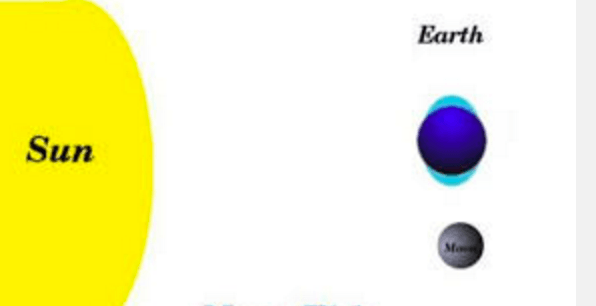
Wha type of tide would this arrangement of earth-moon-sun create?

a)

full moon tide

b)

new moon tide

c)

neap tide

d)

spring tide

28.
What type of tides would this arrangement of earth-moon-sun create?
a)
neap tide
b)
spring tide
c)
new moon tide
d)
full moon tide
29.
Phases of the moon in which the moon appears to be getting larger are referred to as _.
a)
waxing
b)
waning
c)
new
d)
eclipse
30.
What Moon phase is this?
a)
Full Moon
b)
Waxing Gibbous
c)
New Moon
d)
Half Moon
31.
What Moon phase is this?
a)
Waxing Crescent
b)
Waning Gibbous
c)
Waning Crescent
d)
Waxing Gibbous
32.
Which moon phase is shown in this diagram?
a)
new moon
b)
1st quarter
c)
full moon
d)
last quarter/3rd quarter
33.
Which moon phase is shown in this diagram?
a)
new moon
b)
first quarter
c)
full moon
d)
last quarter/3rd quarter
34.
As distance between two objects increase the pull of gravity 
a)
Increases
b)
Decreases
c)
Stays the same
35.
Any object with mass has gravity.
a)
True
b)
Sometimes
c)
False
d)
Never
36.
Two factors effecting the magnitude of the force of gravity between 2 objects are...
a)
mass and distance 
b)
mass and matter
c)
distance and weight 
d)
weight and mass
37.
When a planet is closest to the sun, this is called 
a)
perihelion
b)
aphelion
c)
barycenter
d)
orbit
38.
A planet moves __________ when it is farthest from the sun.
a)
faster
b)
slower
39.
What did Kepler discover about planets and their orbital speed?
a)
Planets closest to the Sun will orbit with the fastest orbital speed.
b)
Planets with the greatest mass will orbit the Sun with the fastest orbital speed.
c)
Planets furthest from the Sun will orbit with the fastest orbital speed.
d)
Planets with the least mass will orbit the Sun with the fastest orbital speed.
40.
In simplest terms, what does Kepler's 3rd law state? 
a)
planets take a long time to orbit the sun
b)
there is no relationship between the distance of planet from the sun and the time it takes to orbit the sun
c)
there is a mathematical relationship between the distance of a planet from the sun and the time it takes to orbit the sun
d)
every planet has the same orbital period
41.
What type of galaxy is this?
a)
Spiral
b)
Elliptical
c)
Irregular
d)
Irrational
42.
Galaxies are composed of (best answer)
a)
stars
b)
stars and gas
c)
stars, dust, and gas
d)
stars, dust, and gas held together by gravity
43.
What type of galaxy is this?
a)
Spiral
b)
Elliptical
c)
Irregular 
d)
Irrational
44.
Distance measurement used by astronomers for distant objects.
a)
Kilometers
b)
Light Years
c)
Miles
d)
Light Seconds
45.
In the energy pyramid here, which organisms have the most energy available?
a)
Producers
b)
Carnivores
c)
Herbivores
d)
Top Predator
46.
In the energy pyramid here, how much of the energy in each level gets lost as heat or used by the organism for survival?
a)
80%
b)
90%
c)
10%
d)
20%
47.
If there is 1000 Kcal available in the producers in trophic level 1, how much energy is available in the herbivores in trophic level 2?
a)
10 Kcal
b)
1 Kcal
c)
100 Kcal
d)
1000 Kcal
48.

What are the 3 Features above the suns's sun surface?

a)

Sunspots,Prominence, Solar Flares

b)

Solar Wind, Chromosphere, Nuclear Fusion

c)

Corona, Solar Flare, Prominence

d)

Radiation Zone, Electromagnetic, Sun

49.

Explosions on the sun are known as.......?

a)

Corona

b)

Electromagnetic

c)

Solar Flare

d)

White Dwarf

50.
The particles of the corona extends into space for millions of kilometers and spreads into streams of electrically charged particles called:
a)
coronal discharge
b)
solar flares
c)
coronal ejection
d)
solar winds
51.

Which can disrupt radio, televisions, and telephone signals

a)

Prominence

b)

Solar flares

c)

Sunspots

d)

Solar Winds

52.
Which structures are found in every living cell?
a)
cell membrane and cytoplasm
b)
chloroplasts and mitochondria
c)
a cell wall and nucleus
d)
chloroplasts and cell wall
53.
What is one basic function of the vacuoles?
a)
circulating oxygen
b)
producing food
c)
controlling cell processes
d)
storing water
54.
Which letter or letter combo indicates the central vacuole
a)
B
b)
C
c)
CD
d)
BD
55.

Which letter or letter combo indicates an organelle that makes energy for the cell? (the powerhouse)

a)

B

b)

C

c)

CD

d)

E

56.
Which of the following is the correct order of organization in living things from most basic (simple) to most complex?
a)
a.  Organism, cell, tissue, organ, organ system
b)
a.  Organ system, organ, tissue, cell, organism
c)
a.  Cell, tissue, organ, organ system, organism
d)
a.  Cell, organ, tissue, organ, organism, organ system
57.

________ are heterogeneous forms of matter.

a)

Compounds

b)

Mixtures

c)

Both A and B

d)

Neither

58.

Which of the following are properties of compounds? Check all that apply.

a)

It takes a large amount of energy to separates the elements of a compound.

b)

The proportions of the elements in a compound are always fixed

c)

It is easy to separate the elements of a compound.

d)

The elements/components of a compound do not retain their individual properties.

59.

Which of the following are examples of mixtures?

a)

Air

b)

Ocean Water

c)

table salt

d)

all of the above

60.

All matter can be classifed into two main categories: pure substances and mixtures.

a)

True

b)

False

61.

When atoms of different elements are joined together into groups, they create __________.

a)

compounds

b)

mixtures

c)

molecules

d)

none of the above

62.

The law of constant composition states that the ratio by mass of the elements in a chemical compound is always the same, regardless of the source of the compound (i.e. the proportions are constant). This law applies to which of the following?

a)

compounds

b)

mixtures

c)

both

d)

neither

63.
An acid is a substance that releases
a)
H+ is water
b)
H- in water
64.

Acids typically taste

a)

sour

b)

sweet

c)

both

65.
Bases are substances that ...
a)
accept hydrogen atoms
b)
reject hydrogen atoms
66.
Which of the following is a base?
a)
Tums
b)
oranges
c)
lemons
d)
batteries
67.
If you have a substance with a pH of 8 it is a(n).....
a)
Acid
b)
base
68.
If you have a substance with a pH of 7.1 it is a(n).....
a)
Acid
b)
base
69.
Isotopes have different numbers of
a)
protons
b)
neutrons
c)
electron
d)
properties
70.
How many protons does an Aluminum atom have? (use the picture to help you)
a)
27
b)
13
c)
14
d)
40
71.
How many neutrons in C-14?
a)
6
b)
7
c)
14
d)
8
72.
How many neutrons does an atom of the isotope Oxygen-16 have?
a)
8
b)
16
c)
32
d)
4
73.
How many neutrons does the isotope of lithium have?
a)
8
b)
3
c)
4
d)
5
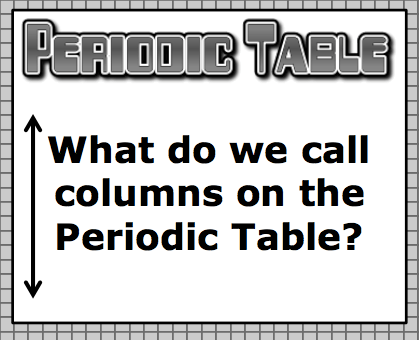
74.
a)
Periods
b)
Groups
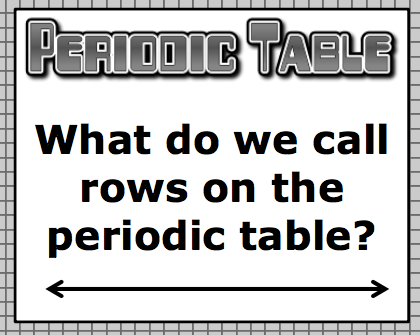
75.
a)
Periods
b)
Groups
76.
In the modern periodic table elements are arranged by:
a)
atomic mass
b)
atomic number
c)
valence electrons
d)
number of isotopes
77.
Each column in the periodic table is called a 
a)
period
b)
group
c)
cluster
d)
unit
78.
How many Valance electrons does Iodine Have?
a)
6
b)
16
c)
7
d)
17
79.
Which of the following terms identifies the change from a liquid to gas?
a)
Vaporization
b)
Condensation
c)
Deposition
d)
Sublimation
80.
Which of the following terms identifies the change from a liquid to solid?
a)
Melting
b)
Condensation
c)
Vaporization
d)
Freezing
81.
No Definite Shape and No Definite Volume
a)
Gas
b)
Liquid
c)
Solid
82.
Definite shape and a definite volume.
a)
Gas
b)
Liquid
c)
Solid
83.
When the temperature of matter decreases the particles ...
a)
speed up and move farther apart
b)
speed up and move closer together
c)
slow down and move farther apart
d)
slow down and move closer together
84.
A gas
a)
has a definite shape but no definite volume
b)
has a definite volume but no definite shape
c)
has fast-moving particles
85.
5. What is it called when a solid turns directly into a gas?
a)
Sublimation
b)
Condensation
c)
Liquid
86.
A block has a mass of 54g and a volume of 20cm3.  What is the density of the block?
a)
74 g/cm3
b)
1080 g/cm3
c)
34 g/cm3
d)
2.7 g/cm3
87.
An object with which of the following densities will float on water?
a)
0.7 g/cm3
b)
1.2 g/cm3
c)
3.5 g/cm3
d)
11.4 g/cm3
88.
Why do ice cubes float in a  glass of water?
a)
the ice cubes are more dense than the water
b)
the water is more dense than the ice cubes
c)
the water is more dense than the glass
d)
the ice is more dense than the glass
89.
Veal finds a gold colored rock in a river.  It has a mass of 9.65 grams and a volume of 0.5 cm3.  What is the density of the rock?
a)
10.15 g/cm3
b)
19.3 g/cm3
c)
9.15 g/cm3
d)
4.825 g/cm3
90.
Which property of matter is determined by dividing its mass by its volume?
a)
elasticity
b)
buoyancy
c)
density
d)
viscosity
91.
What is a substance that is dissolved in another substance? 
a)
solution
b)
solute
c)
solvent
d)
compound
92.
This is the part of a solution that dissolves
a)
Solute
b)
Solvent
c)
Solution
d)
Mixture 
93.
The concentration of a mixture can be increased in which of the following ways?
a)
Heating the mixture
b)
Adding more water “solvent”
c)
Adding more powder “solute”
d)
Stirring the mixture
94.
In the above picture, a powder is about to be poured into the liquid. Which of the following should be done to make this powder dissolve faster?

a)
stir the powder in the liquid
b)
freeze the mixture
c)
add more powder to the liquid
d)
store the mixture in a dark place
95.
A solution that is considered dilute would be....
a)
Dark in color
b)
Have a strong scent
c)
Have a large amount of solute
d)
Have a small amount of solute
96.
air is a 
a)
compound
b)
element
c)
heterogeneous mixture
d)
solution
97.
salt water is a 
a)
compound
b)
element
c)
heterogeneous mixture
d)
solution
98.
Another name for a homogeneous mixture is 
a)
an element.
b)
a solution.
c)
a compound.
99.
Kool-Aid - Powder, sugar, and water
Identify the solvent 
a)
water
b)
powder
c)
sugar
d)
powder and sugar
100.
When solute dissolves into a solvent it is called a _____________.
a)
mixture
b)
solution
c)
element
101.

You can make a solute dissolve more quickly in a solvent by

a)

adding more solute.

b)

adding ice.

c)

heating the solvent.

d)

removing some solvent.

102.

A solution that contains all of the solute it can hold at a given temperature is

a)

diluted.

b)

saturated.

c)

supersaturated.

d)

unsaturated.

103.

A student pours mineral salts into a bottle of cold water. Which of the following best explains why shaking the bottle will affect the dissolving rate of the salt?

a)

Shaking exposes the salts to the solvent more quickly.

b)

Shaking helps more water evaporate.

c)

Shaking equalizes the water temperature.

d)

Shaking causes more ions to precipitate out of solution.
104.
What happens in ALL chemical changes?
a)
Change in state of matter
b)
A new substance is formed
c)
Bubbles are produced
d)
An explosion
105.
The Law of Conservation of Mass tells us matter can't  ______________.
a)
change color
b)
change state of matter
c)
be created or destroyed
d)
change temperature
106.
In a chemical equation, is it true that -
a)
the reactant side and product side can have different numbers of atoms for each element
b)
there can be different elements on the reactant side and the product side
c)
an element or compound must be accompanied by a phase change
d)
the coefficients indicate the number of molecules of each reactant used and the number of molecules of each product made
107.
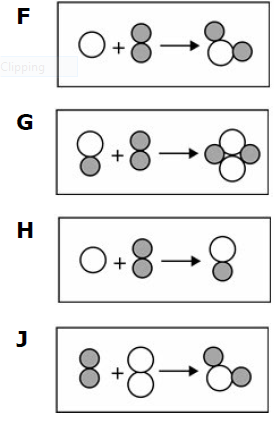
Which of the following models best demonstrates a balanced chemical equation?
a)
F
b)
G
c)
H
d)
J
108.
what is the definition of chemical change?
a)
any change that results in the formation of new chemical substances. 
b)
changing clothes
c)
matter cannot be created or destroyed, only change form
d)
changes affecting the form of a chemical substance, but not its chemical composition.
109.
which one is a chemical change?
a)
density
b)
color
c)
respiration
110.
Explaining the color of a chemical would be what kind of observation?
a)
Qualitative 
b)
Quanitative
111.
What is the part of the experiment that is left alone or “natural", and is used to compare back to?
a)
Independent Variable
b)
Dependent Variable
c)
Control Group
d)
Experimental Group 
112.
What is a factor that the experimenter has full control over and changes to see what happens?
a)
Dependent Variable
b)
Independent Variable
c)
Control group 
d)
Hypothesis
113.
Nick wanted to see how high an ice cube would float in different temperatures of water. Identify the DEPENDENT variable
-Amount of water
-Height of Ice cube
-Temperature the ice cube was at its highest height
-Temperature of the water
-Size of the ice cube
a)
Amount of water 
b)
Height of Ice cube
c)
Temperature the ice cube was at its highest height 
d)
Size of the ice cube
114.
Mario studied how far room temperature water would spurt out of a plastic milk carton when 3mm holes were punched at different heights from the bottom of the container. Identify the DEPENDENT variable
-3mm holes
-Distant water traveled out of carton
-Different heights of the holes in the container
-Ice water from Iceland
a)
3mm holes
b)
Distant water traveled out of carton
c)
Different heights of the holes in the container 
d)
Ice water from Iceland
115.
In this graph, what is the independent variable? 
a)
Population
b)
Day
c)
Species 5
116.
Which of the following can be used to test a hypothesis?
a)
experiment
b)
theory
c)
law
d)
variable
117.
A possible explanation to a problem that has not yet been tested. 
a)
data
b)
theory
c)
hypothesis
d)
fact