wayground logo

Free Printable Worksheets

Font size

S
M
L
XL
Worksheets

Midterm Study Guide

Total questions: 144

Worksheet time: 2hrs 49mins

Name
Class
Date
1.
Explaining the color of a chemical would be what kind of observation?
a)
Qualitative 
b)
Quanitative
2.
What is the part of the experiment that is left alone or “natural", and is used to compare back to?
a)
Independent Variable
b)
Dependent Variable
c)
Control Group
d)
Experimental Group 
3.
You will want your experiment to have ____ independent variable(s) in it for the experiment to be valid.
a)
1
b)
2
c)
3
d)
4
4.
What is a factor that the experimenter has full control over and changes to see what happens?
a)
Dependent Variable
b)
Independent Variable
c)
Control group 
d)
Hypothesis
5.
What is a factor that changes because of what the experimenter does?
a)
Dependent Variable
b)
Independent Variable
c)
Control Group
d)
Hypothesis
6.
Nick wanted to see how high an ice cube would float in different temperatures of water. Identify the DEPENDENT variable
-Amount of water
-Height of Ice cube
-Temperature the ice cube was at its highest height
-Temperature of the water
-Size of the ice cube
a)
Amount of water 
b)
Height of Ice cube
c)
Temperature the ice cube was at its highest height 
d)
Size of the ice cube
7.
Mario studied how far room temperature water would spurt out of a plastic milk carton when 3mm holes were punched at different heights from the bottom of the container. Identify the DEPENDENT variable
-3mm holes
-Distant water traveled out of carton
-Different heights of the holes in the container
-Ice water from Iceland
a)
3mm holes
b)
Distant water traveled out of carton
c)
Different heights of the holes in the container 
d)
Ice water from Iceland
8.
The following statement is a hypothesis formed about marsh grass: 
If the amount of nitrogen marsh grass receives is increased, then the height of the grass will increase, because nitrogen is an essential nutrient needed for marsh grass to grow.
What is the independent variable of the statement above? 
a)
Height of grass
b)
Amount of nitrogen
c)
Essential nutrient
d)
Amount of growth
9.
What skill is a scientist using when she listens to the sounds that an elephant makes?
a)
drawing conclusions
b)
making observations
c)
interpreting data
d)
making a hypothesis
10.
When you decide whether or not the data supports the original hypothesis, you are
a)
drawing conclusions
b)
forming a hypothesis
c)
asking questions
d)
making observations
11.
______ are examples of carbohydrates
a)
glucose & fructose
b)
guanine & cytosine
c)
glycine & glutamine
d)
samose & deanose
12.
__________ are nucleic acid functions
a)
store & transfer genetic info
b)
store & create energy
c)
structure & energy for cells
d)
membrane structure and nutrient transfer
13.
___________ are some functions of lipids.
a)
storing energy and  cell membrane structure
b)
providing actin & providing myosin
c)
cellulose structure and digestive assistance
d)
storing & transferring genetic info
14.
________ are the main components of fats and oils.
a)
lipids
b)
amino acids
c)
nucleic acids
d)
carbohydrates
15.
A(n) __________  is the part of the enzyme the substrate fits into.
a)
product
b)
active site
c)
enzyme
d)
substrate
16.
Amino acids are the monomers of
a)
Carbohydrates 
b)
Lipids
c)
Proteins 
d)
Nucleic Acids
17.
Waterproofs, insulates, and stores energy long-term
a)
Carbohydrates
b)
Lipids
c)
Proteins
d)
Nucleic Acids
18.
Enzymes are considered to be 
a)
Lipids
b)
Carbohydrate
c)
Protein
d)
Nucleic Acid
19.
What is the purpose  of an enzyme?
a)
give permission for the reaction
b)
raise activation energy
c)
speed up reactions
d)
control how many reactions occur
20.
The energy needed to start a reaction
a)
activation energy
b)
adhesion energy
c)
chemical energy
d)
cohesion energy
21.
Which of the following statements about enzymes is NOT true?
a)
enzymes are reusable
b)
enzymes work best at specific pH and temperatures
c)
enzymes are lipids
d)
enzymes are proteins
22.
Which is not a use or function of protein?
a)
forms enzymes and hormones
b)
forms transport channel in cell membrane
c)
forms structural proteins in the body
d)
quick energy
23.
The element _______is found in all of the organic compounds.
a)
Iron
b)
Nitrogen
c)
Carbon
d)
Oxygen
24.

How do enzymes speed up chemical reaction?

a)

Increasing activation energy

b)

Decreasing activation energy

c)

Increasing deactivation energy

d)

Decreasing deactivation energy

25.
With what 3 letters do enzymes typically end?
a)
-ose
b)
-ase
c)
-ese
d)
-tic
26.
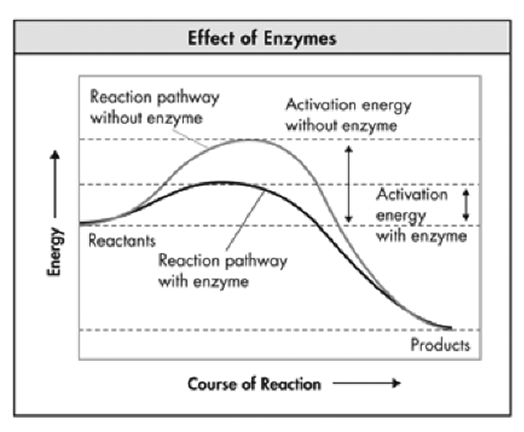
The graph shows how enzymes affect reactions in cells. Which statement best summarizes the information shown in the graph?
a)
Enzymes increase the energy of the reactants.
b)
Enzymes decrease the energy level of the products.
c)
Enzyme decrease the activation energy of the reaction.
d)
Enzymes reverse the direction of the reaction.
27.
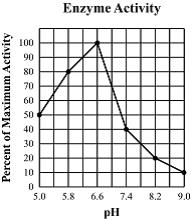
Which of the following conclusions can be drawn from this graph?
a)
The optimum pH of the enzyme is 6.6.
b)
The optimum pH of the enzyme is 5.8
c)
The enzyme’s activity increases as pH increases 5.0 to 9.0
d)
The enzyme’s activity is greater around pH of 8.0 .
28.
Any substance that is acted upon by an enzyme is called a(n)?
a)
Coenzyme
b)
Substrate
c)
Vitamin
d)
Polypeptide
29.
What happens when enzymes are heated to a high temperature?
a)
The enzymes die.
b)
The shapes of the enzyme are altered denature
c)
The enzymes' amino acid sequence changes.
d)
The enzymes remain the same
30.
Capillary action is the result of adhesion. Which aspect of water is responsible for this?
a)
Nonpolar covalent bonds that enable water to dissolve other substances
b)
Polar covalent bonds that join molecules of water to other substances
c)
Hydrogen bonds between water and another substance
d)
Ionic bonds that enable electrons to flow through water and into another substance
31.
Why does ice float?
a)
As water freezes, it expands and its density decreases.
b)
As water freezes, it takes up more hydrogen from the atmosphere, causing it to have a greater buoyancy.
c)
As water freezes, air becomes trapped between the hydrogen bonds of water molecules.
d)
As water freezes, it takes up more oxygen from the atmosphere, causing it to have a greater buoyancy.
32.
What property of water helps to moderate earth's temperature?
a)
adhesion
b)
chohesion
c)
Specific heat capacity
d)
Latent heat of vaporization
33.
Water is a universal solvent because it...
a)
It can be found anywhere
b)
It freezes when it gets cold
c)
floats when frozen
d)
Dissolves most substances
34.
What is the reason why oil and water don't mix?
a)
Oil is too heavy to mix with water
b)
Water can only mix with polar molecules 
c)
Water can only mix with non-polar molecules
d)
Oil is too light to mix with water 
35.
What is diffusion?
a)
when molecules move from a low concentration to a high concentration 
b)
when molecules move from a high concentration to a low concentration.
c)
no movement 
d)
molecules move everywhere
36.
What is the definition of  Selective Permeability?
a)
The movement of materials across the cell membrane that requires NO ENERGY from the cell.
b)
The movement of materials through (or across) the cell membrane
c)
The ability of the cell membrane to allow some things to pass through while preventing other things from passing through.
d)
The movement of molecules from an area of high concentration (where the molecules are more crowded together) to a area of low concentration (where molecules are more spread apart)
37.
Osmosis
a)
diffusion of water molecules through a semi-permeable mebrane from an area of low concentration to an area of high concentration
b)
the diffusion of particles from an area of high concentration to an area of low concentration
c)
diffusion of water molecules through a semi-permeable membrane from an area of high concentration to an area of low concentration
d)
the diffusion of particles from an area of low concentration to an area of high concentration
38.
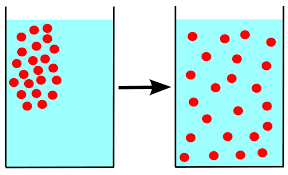
The picture below is an example of _________________.
a)
osmosis
b)
isotonic
c)
diffusion
d)
active transport
39.
Osmosis is the movement of _____ across a membrane.
a)
food
b)
energy
c)
oxygen
d)
water
40.

Which of the Followng glass has hyper tonic solution

a)

A

b)

B

c)

C

d)

All the three

41.
How does a cell maintain homeostasis?
a)
Regulates what enters and leaves the cell
b)
Flexibility
c)
Protective barrier
d)
Structure and support
42.
What is it called when molecules move across the cell membrane from an area of high concentration to an area of low concentration through a carrier protein?
a)
Diffusion
b)
Osmosis
c)
Active Transport
d)
Facilitated Diffusion
43.
A cell will __________________ in a hypotonic solution.
a)
swell and perhaps burst (lyse)
b)
shrink
c)
the size of the cell will not change
d)
the size of the cell will change from large to small and from small to large
44.
A cell will _____________________ in a hypertonic solution.
a)
swell
b)
shrink
c)
will not change
d)
will explode
45.

Spraying Axe body spray in a corner of the room and someone on the opposite corner smells it is an example of what?

a)

Osmosis

b)

Facilitated diffusion

c)

Active transport

d)

Diffusion

46.
What are the products of photosynthesis?
a)
Carbon dioxide and water
b)
Carbon dioxide and oxygen
c)
Glucose and oxygen
d)
Glucose and water
47.
What pigment absorbs sunlight for photosynthesis?
a)
chloroplast
b)
thylakoid
c)
grana
d)
chlorophyll
48.
Which of the following is the correct equation for PHOTOSYNTHESIS?
a)
6CO2 + 6H2O --> 6O+ C6H12O6
b)
6CO+ C6H12O6 + 6H2O --> O
c)
6O2 + 6H2O --> 6CO+ C6H12O6
d)
C6H12O6 + 6O2 ---> 6H2O + 6CO2 
49.
Which gas is removed from the atmosphere during photosynthesis?
a)
hydrogen
b)
oxygen
c)
nitrogen
d)
carbon dioxide
50.
Where do the light-dependent reactions occur? 
a)
thylakoid membrane
b)
stroma
c)
mesophyll
d)
mitochondria
51.
Which of the following is NOT a product of the light-dependent reactions?
a)
ATP
b)
NADPH
c)
Oxygen
d)
Glucose
52.
What is the primary function of the light-dependent reactions of photosynthesis?
a)
To produce glucose
b)
To produce NADPH and ATP
c)
To use ATP
d)
To produce RuBP
53.
Use the diagram to answer the question. Between which parts of the molecule must the bonds be broken to form an ADP molecule?
a)
A and B
b)
A and C
c)
B and C
d)
C and D
54.
Plants need carbon dioxide from their environment to produce glucose during which stage of photosynthesis? 
a)
The light-dependent stage
b)
The light-independent stage (The Calvin Cycle)
c)
The electron transport chain
d)
ATP formation
55.
Is ADP or ATP more like a fully charged battery, and why?
a)
ADP, because it has three phosphate groups; breaking and reforming the bonds among them releases energy.
b)
ATP, because it has three phosphate groups; breaking and reforming the bonds among them releases energy.
c)
ADP, because it has two phosphate groups; breaking and reforming the bonds among them releases energy.
d)
ATP, because it has two phosphate groups; breaking and reforming the bonds among them releases energy.
56.
Which of the following best describes photosynthesis?
a)
Photosynthesis converts radiant energy into chemical energy.
b)
Photosynthesis produces carbohydrates.
c)
Plants need sunlight, carbon dioxide, water, nutrients, and chlorophyll to complete photosynthesis.
d)
Plants use chlorophyll, water, and carbon dioxide to make sugar.
57.
In which  organelle does photosynthesis occur?
a)
mitochondria
b)
stomata
c)
xylem
d)
chloroplast
58.
Which product is produced during the light-dependent reactions?
a)
water
b)
oxygen
c)
glucose
d)
carbon dioxide
59.
Which of the following is considered a waste product of photosynthesis?
a)
glucose
b)
oxygen
c)
carbon dioxide
d)
sunlight
60.
Animal cells do not have chloroplasts.
a)
TRUE
b)
FALSE
61.
Light energy is used to 
a)
split water into H and O
b)
weld C, H and O together
c)
make water
62.
All living things do which of the following?
a)
Chemosynthesis
b)
Respiration
c)
photosynthesis
d)
all of the answers
63.
What is one of the reactants of cellular respiration?
a)
energy
b)
glucose
c)
carbon dioxide
d)
water
64.
______________ produces the most ATP.
a)
photosnthesis
b)
aerobic respiration
c)
anaerobic respiration
d)
glycolysis
65.
What are the products of aerobic respiration?
a)
Glucose and oxygen
b)
Carbon dioxide and water
c)
Lactic acid
d)
Carbon monoxide
66.
The mitochondria is responsible for ...
a)
photosynthesis
b)
anaerobic respiration
c)
aerobic respiration
d)
fermentation
67.
Aerobic respiration is different from anaerobic respiration in that aerobic respiration needs...
a)
chlorophyll
b)
carbon dioxide
c)
glucose
d)
oxygen
68.

How many ATP are produced in aerobic respiration?

a)

2

b)

28

c)

4

d)

36

69.
In which way are photosynthesis and cellular respiration different?
a)
Cellular respiration stores ATP, while photosynthesis releases ATP.
b)
Cellular respiration produces oxygen, while photosynthesis uses oxygen.
c)
Photosynthesis releases energy, while cellular respiration stores energy.
d)
Photosynthesis used carbon dioxide, while cellular respiration produces carbon dioxide.
70.
What is the correct equation for cellular respiration?
a)
6O2 + C6H12O6 -> 6CO2 + 6H2O + Energy
b)
6O2 + C6H12O6 + Energy -> 6CO2 + 6H2O
c)
6CO2 + 6H2O -> 6O2 + C6H12O6 + Energy
d)
6CO2 + 6H2O + Energy -> 6O2 + C6H12O6
71.
Anaerobic respiration.....
a)
doesn't require CO2
b)
requires CO2
c)
doesn't require oxygen
d)
requires oxygen
72.
Cellular Respiration's goal is to
a)
make water
b)
make ATP
c)
make glucose
d)
make  oxygen
73.
What is cellular respiration?
a)
the breakdown of glucose  to release ATP
b)
the breakdown of glucose to release NADH
c)
the breakdown of glucose to release FADH
d)
the breakdown of glucose to release carbon
74.
Glycolysis results in a net gain of how many ATP?
a)
0
b)
2
c)
4
d)
1
75.
 The expression "feel the burn" means that a person exercising is doing 
a)
lactic acid fermentation
b)
alcoholic fermentation
c)
photosynthesis
d)
aerobic respiration
76.
The energy carrier that the cell uses to power its day to day activities is 
a)
ATP
b)
NADH
c)
FADH2
d)
glucose
77.

What comes next after glycolysis if oxygen is present

a)

Krebs cycle

b)

Electron transport chain

c)

Alcoholic Fermentation

d)

Lactic Acid Fermentation

78.
This is referred to as the energy currency of the cell
a)
ADP
b)
ATP
c)
Mitochondria
d)
Nucleus
79.
This molecule contains three phosphate groups
a)
ADP
b)
ATP
c)
Mitochondria
d)
Nucleus
80.
This process releases chemical energy from sugars and other carbon-based molecules to make ATP when oxygen is present.
a)
photosynthesis
b)
light-independent reaction
c)
cellular respiration
d)
light-dependent reaction
81.
Glycolysis 
a)
does not need oxygen
b)
does need oxygen
82.
Glycolysis takes place in the 
a)
mitochondria
b)
cell membrane
c)
cytoplasm
d)
nucleus
83.
This is the first step of cellular respiration
a)
Glycolysis
b)
Lactic Acid Fermentation
c)
Alcoholic Fermentation
d)
Aerobic Respiration
84.
Which is not a waste product of cellular respiration?
a)
Water
b)
Heat
c)
Carbon Dioxide
d)
Oxygen
85.
This process does not make ATP alone, but it allows glycolysis to continue making ATP when oxygen is unavailable for cellular respiration.
a)
Fermentation
b)
Electron Transport Chain
c)
Glycolysis
d)
Kreb's cycle
86.
This means that oxygen is needed
a)
anaerobic 
b)
aerobic
87.
This means that oxygen is not needed
a)
anaerobic 
b)
aerobic
88.
What is one of the reactants of cellular respiration?
a)
energy
b)
glucose
c)
carbon dioxide
d)
water
89.
Cellular Respiration's goal is to
a)
make water
b)
make ATP
c)
make glucose
d)
make  oxygen
90.
What can lead to genetic diversity?
a)
crossing over (prophase 1)
b)
mutations
c)
chromosome arrangement (metaphase 1)
d)
all of the above
91.
How many stages of the cell cycle are there?
a)
1
b)
2
c)
3
d)
4
92.
 First stage of cell cycle.
a)
mitosis
b)
interphase
c)
meiosis
d)
cytokinesis
93.
What is the correct order of mitosis?
a)
prophase, anaphase, metaphase, telophase
b)
prophase, G1, telophase, cytokineses
c)
prophase, metaphase, anaphase, telophase
d)
metaphase II, apoptosis
94.
Order of meiotic phases.
a)
P1, M1, A1, T1, P2, M2, A2, T2
b)
M1, M2, A1, A2, T1, T2, P1, P2
95.
What type of cell does meiosis produce? 
a)
gamete 
b)
somatic
96.
What does the spindle apparatus connect to during metaphase?
a)
cyclins
b)
chromatin
c)
chromatid
d)
centromeres
97.
Proper order of Interphase.
a)
G2, S, G1
b)
S, G1, G2
c)
G1, S, G2
d)
G1, G2, S
98.
Sister chromatids - structures containing identical DNA copies and are formed during prophase.
a)
True
b)
False
99.
How do cells undergo cytokinesis? 
a)
Plant - cleavage furrow, Animal - cell plate
b)
Animal - cleavage furrow, Plant - cell plate 
c)
Animal - cell furrow, Plant - cleavage plate
d)
Plant - cleavage plate, Animal - cell furrow
100.
"A diploid cell resulting from the fusion of two haploid gametes."
a)
tumor
b)
zygote
c)
ovum
d)
sperm
101.

Which phase is the period of growth that occurs between cell division?

a)

interphase

b)

metaphase

c)

anaphase

d)

telephase

102.

During __________ stage, the sister chromatids separate into individual chromosomes and are moved apart.

a)

cytokinesis

b)

metaphase

c)

interphase

d)

anaphase

103.

which is a reason why cells remain small?

a)

large cells have difficulty diffusing nutrients rapidly enough

b)

as cells grow, their ratio of surface area to volume increases

c)

transportation of wastes becomes a problem for large cells

d)

all of the above

104.
What causes genetic variation in meiosis?
a)
chromosomes lining up
b)
crossing over of chromosomes
c)
separation of chromosomes
d)
chromosomes pulling apart
105.
This process produces cells with only 1/2 of the chromosomes as body cells.
a)
mitosis
b)
meiosis
106.
This produces sex cells.
a)
mitosis
b)
meiosis
107.
This produces 2 identical cells.
a)
mitosis
b)
meiosis
108.
Contact inhibition is when cells stop dividing because...
a)
They are touching each other
b)
They are too far apart
c)
The DNA is turned off
d)
None of the above
109.
What does meiosis cause?
a)
growth
b)
repair
c)
genetic variation
d)
contact inhibition
110.
Why is DNA important?
a)
it is very small and very complicated
b)
it's in everything
c)
it serves as the blueprint for traits of all living things
d)
because we eat it every day for energy
111.
What determines the code, or information, of a DNA molecule?
a)
the shape (structure) of the nitrogen bases
b)
the order (sequence) of the nitrogen bases
c)
the color of the nitrogen bases
d)
the frequency (number) of nitrogen bases
112.
Replicate the following strand of DNA: 
AATCATGGA
a)
AATCATGGA
b)
TTAGTACCT
c)
UUAGUACCU
d)
GGATAUCUA
113.
The enzyme that unzips the DNA to prepare for replication
a)
helicase
b)
replicase
c)
polymerase
d)
synthase
114.
DNA replication results in two DNA molecules,
a)
each one with two original strands
b)
each one with two new strands
c)
each one with one new strand and one original strand
d)
one with two new strands and the other with two original strands
115.
order of replication
a)
3, 2, 1, 4
b)
2, 1, 4, 3
c)
2, 3, 1, 4
d)
3, 4, 1, 2
116.
In what phase of the cell cycle does DNA replication take place?
a)
G1
b)
S
c)
G2
d)
M
117.

The name DNA comes from the sugar it contains which is

a)

Ribose

b)

Glucose

c)

Deoxyribose

d)

Sucrose

118.

Where is DNA found

a)

Prokaryotes don't have DNA and eukaryotes have it in the nucleolus.

b)

In the nucleus of a prokaryote and the nucleolus of a eukaryote

c)

In the cytoplasm of an eukaryote and the nucleus of a prokaryote

d)

In the cytoplasm of a prokaryote and the nucleus of a eukaryote

119.

What makes your DNA different from the person next to you

a)

The amount of DNA you have

b)

The number of copies of DNA each cell has

c)

The order of your nitrogen bases

d)

The type of nitrogen bases in your DNA

120.

Which is the correct order for DNA replication

a)

new nucleotides added, it unzips, proof reads, strands zip back up

b)

Unzips, new nucleotides added, proof reads, zips back up

c)

zips back up, unzips, proof reads, new nucleotides added

d)

proof reads, unzips, new nucleotides added, zips back up
121.
The process to go from DNA to mRNA is _______
a)
translation
b)
transcription
c)
replication
122.
The process to go from mRNA to a protein is called ____
a)
transcription
b)
rRNA
c)
replication
d)
translation
123.
DNA holds the code for
a)
lipids
b)
carbohydrates
c)
protein
d)
sugar
124.
The main function of tRNA is to...
a)
carry a message that, when translated, forms proteins
b)
form a portion of ribosomes
c)
string together complementary RNA and DNA strands
d)
bring amino acids from the cytoplasm to the ribosomes
125.
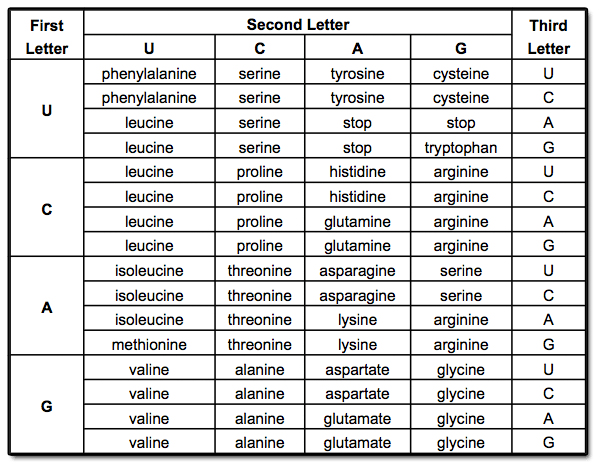
What amino acid is represented by the codon UUA?
a)
Phenylalanine
b)
Tyrosine
c)
Leucine
d)
Stop codon
126.
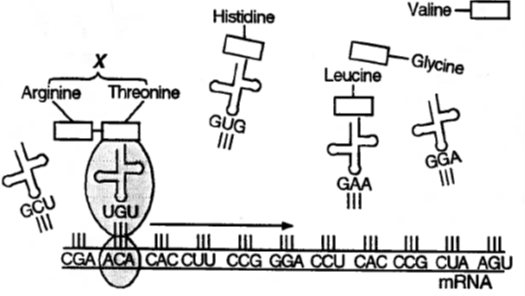
What process is going on in this photo? 
a)
Transcription 
b)
Translation 
c)
Replication 
d)
All the above 
127.
What is the location in the cell for translation?
a)
nucleus
b)
mitochondria
c)
ribosome
d)
chloroplast
128.
Translation is the process where
a)
mRNA is created in the Nucleus
b)
mRNA is decoded to form a protein 
c)
glucose molecules are made
d)
is where lipids are synthesised
129.

The process of DNA copying itself is

a)

conservative - one original and one new DNA molecule

b)

semi-conservative - 2 DNA molecules with one new and one original strand

c)

dispersive - 2 DNA molecules with each strand consisting of alternating segments of new and original DNA parts

d)

partial - one complete DNA molecule and one partial DNA molecule

130.

The segment of DNA that has the directions for making a protein is called?

a)

chromosome

b)

strand

c)

gene

d)

nucleotide

131.

In DNA, the code or directions for making a protein is

a)

the order of nitrogen containing bases in DNA

b)

the order of phosphates and sugars in DNA

c)

the type of sugar in each nucleotide

d)

the number of phosphate groups

132.

Which most accurately describes the process of protein synthesis?

a)

mRNA --> DNA --> tRNA --> protein

b)

DNA --> mRNA --> tRNA --> protein

c)

translation --> transcription --> DNA --> protein

d)

translation --> transcription --> protein --> DNA

133.

How does DNA help to form proteins?

a)

It creates proteins using nucleotides.

b)

It forms the bonds between amino acids.

c)

It creates reactants for proteins to be made.

d)

It gives instructions for the amino acid sequence.

134.

A chemical is applied to cells which prevents the formation of RNA. A disruption of this process would most likely have a direct impact on which other process within the cell?

a)

ATP production

b)

photosynthesis

c)

DNA replication

d)

protein synthesis

135.

What type of mutation results when a single nucleotide is exchanged for a different nucleotide?

a)

deletion

b)

addition

c)

substitution

d)

translocation

136.

Transcription and Translation are two important processes of protein synthesis. Read through the following descriptions. Which ones occur in Transcription?

a)

Uses DNA as a template to create mRNA

b)

Assembles amino acids into proteins

c)

Occurs in the nucleus

d)

Occurs in the ribosome which is found in the cytoplasm

e)

Occurs in the mitochrondria

137.

Transcription and Translation are two important processes of protein synthesis. Read through the following descriptions. Which ones occur in Translation?

a)

Uses DNA as a template to create mRNA

b)

Assembles amino acids into proteins

c)

Occurs in the nucleus

d)

Occurs in the ribosome which is found in the cytoplasm

e)

Occurs in the mitochrondria

138.

Which characteristic can best distinguish between two different proteins?

a)

the presence of nitrogen in the proteins

b)

the sequence of amino acids in the proteins

c)

the number of amino acids found in the proteins

d)

the location of the peptide bonds in the proteins

139.

Which best summarizes the process of protein synthesis for all organisms?

a)

DNA replicates and carries the code to tRNA for protein construction.

b)

DNA replicates and carries the code to a ribosome for protein

construction.

c)

DNA serves as the template for mRNA, which carries the code to a

ribosome for protein construction.

d)

DNA serves as the template for a ribosome, which carries the code to mRNA for protein construction.

140.

How does tRNA deliver the appropriate amino acid?

a)

It carries multiple amino acids to the nucleus to build DNA molecules.

b)

It carries multiple amino acids to the nucleus to build the protein.

c)

Its anticodon matches with the codon on mRNA.

d)

Its anticodon matches with the codon on DNA.

141.

What is the relationship between nucleic acids and proteins?

a)

Nucleic acids and proteins both contain peptide bonds.

b)

Nucleic acids are the basic building blocks for proteins.

c)

Nucleic acids provide the instructions on how to build proteins.

d)

Nucleic acids store energy used by proteins during chemical reactions.

142.

An original strand of DNA has the sequence: GGC ATG AAC. A point mutation results in a change in the sequence: GGC ATG AAT.

Using the mRNA codon chart above, what is the most likely result from this change?

a)

One amino acid will change to asparagine.

b)

One amino acid will change to phenylalanine.

c)

All three amino acids in the sequence will change.

d)

All three amino acids in the sequence will remain the same.

143.

An amoeba, a single-celled protist, is exposed to a chemical known to cause DNA mutations. A segment of DNA changes from TAC CCC CAT ACG to TAC CCC CCA TACG. What type of mutation was caused by the mutagen?

a)

base substitution

b)

insertion

c)

inversion

d)

deletion

144.

Observe the amino acid sequence below.

Before: METHIONINE – VALINE – PROLINE – LYSINE – LEUCINE

After: METHIONINE – VALINE – PROLINE – SERINE – LEUCINE

What type of mutation is shown above?

a)

deletion

b)

insertion

c)

substitution

d)

frame shift