wayground logo

Free Printable Worksheets

Font size

S
M
L
XL
Worksheets

Anatomy Semester 1 Final

Total questions: 116

Worksheet time: 2hrs 32mins

Name
Class
Date
1.

What is the body's largest organ

a)

Heart

b)

Small Intestine

c)

Liver

d)

Skin

2.

What is Keratin

a)

A protein that makes up your hair and nails

b)

A protein that helps build muscles

c)

A vitamin for your heart

d)

What clogs your pores and how you get acne

3.

What is the mineral that makes your bones strong

a)

Zinc

b)

Calcium

c)

Vit. A

d)

Vit. B

4.

True/False -- Red Marrow is where all the blood cells are made

a)

True - It makes all the blood cells in the body

b)

False - It only makes red blood cells

5.

What is the tough outer membrane that covers and protects a bone

a)

Zinc

b)

Periosteum

c)

Calcium

d)

Enzyme

6.

Where do you find a fixed (immovable) joint?

a)

Your spine

b)

Your skull

c)

Your nose

d)

Your shoulder

7.

What do Platelets do?

a)

Fight off infection

b)

Stops the body from bleeding by building cells on top of each other to form scabs

c)

They are the reason why blood is red

d)

They repair brain cells

8.

Pick 2 answers! What are the two structures that line your nose to trap dirt?

a)

Cilia

b)

Nose Hairs

c)

Mucus

d)

Water

9.

This fluid lubricates joints

a)

pericardial fluid

b)

plasma fluid

c)

synovial fluid

d)

connective fluid

10.

The _______ of a muscle does the moving

a)

axis

b)

origin

c)

insertion

d)

fixator

11.

Erythrocytes are ____________

a)

WBCs

b)

RBCs

c)

leukocytes

d)

memory cells

12.

movement of a limb away from the body

a)

adduction

b)

extension

c)

flexion

d)

abduction

13.

the pericardium is the __________________

a)

tissue around the stomach

b)

top part of aorta

c)

halves of the heart

d)

bag around the heart

14.

What are the 3 parts of the sternum. Select all that apply.

a)

manubrium

b)

sternum

c)

clavicle

d)

xiphoid process

15.
The study of the functions of living organisms and their parts is:
a)
anatomy
b)
histology
c)
physiology
d)
epidermiology
16.
Blood and bone are examples of______ tissue.
a)
epithelial
b)
nervous
c)
connective
d)
muscle
17.
The bone of the upper leg is the 
a)
femur
b)
humerus
c)
tibia
d)
metacarpal
18.
Which is an example of a hinge joint?
a)
shoulder
b)
wrist
c)
elbow
d)
neck
19.
how many bones are in the human body?
a)
200
b)
206
c)
205
d)
204
20.
Your tailbone is called your
a)
Coccyx
b)
Cervix
c)
Sacrum
d)
Hyoid
21.
THE HEART AND THE BLOOD VESSELS AND THE BLOOD MAKE UP WHAT SYSTEM?
a)
URINARY
b)
SKELETAL
c)
CIRCULATORY
d)
MUSCULAR
22.
What bone is this?
a)
Frontal
b)
Temporal
c)
Sphenoid
d)
Occipital
23.
What bone is this?
a)
Temporal
b)
Parietal
c)
Frontal
d)
Occipital
24.
Which muscle type is found in your stomach, bladder, and intestines?
a)
Skeletal
b)
Smooth
c)
Cardiac
d)
Straight
25.
When a muscle contracts, it _______
a)
gets longer
b)
gets shorter
c)
gets thinner
d)
grows hair
26.

There is over how many skeletal muscles in the body?

a)

220

b)

350

c)

400

d)

100

27.

RICE is an acronym that means

a)

Rest, Ice, Contraction, Elevation

b)

Range, Ice, Compression, Eversion

c)

Rest, Ice, Compression, Elevation

d)

Roll, Ice, Contract, Elevate

28.

The functional unit of a muscle cell is called a/an

a)

actin

b)

sarcomere

c)

myosin

d)

Z-line

29.

When bending down into a squat, the angle at the knee joint decreases. This is an example of

a)

extension

b)

flexion

c)

adduction

d)

abduction

30.

The thin filaments in a muscle fiber are _____ and the thick filaments are ____.

a)

troponin; tropomyosin

b)

tropomyosin; actin

c)

actin; myosin

d)

myosin; actin

31.

Muscle fatigue occurs when muscles are no longer able to produce _____ quickly enough, resulting in the muscle fibers struggling to contract.

a)

oxygen

b)

lactic acid

c)

calcium ions

d)

ATP

32.

A muscle contraction is initiated when a _____ stimulates a muscle cell and _____ ions flood in.

a)

sensory neuron; sodium

b)

motor neuron; sodium

c)

sensory neuron; calcium

d)

motor neuron; calcium

33.

Once calcium binds to a binding site in the thin filament, the _______ head is able to bind and to initiate a power stroke.

a)

ATP

b)

actin

c)

Z line

d)

myosin

34.

Which muscle movement type is depicted above?

a)

rotation

b)

extension

c)

abduction

d)

adduction

35.

When a muscle is used to move your leg away from your body, the movement is called

a)

rotation

b)

abduction

c)

extension

d)

adduction

36.
___________ connects muscle to bone.
a)
ligaments
b)
tendon
c)
cartilage
37.
Turning a body part around on its own axis
a)
circumduction
b)
adduction 
c)
rotation
38.
The outermost layer of your skin is the 
a)
exodermata
b)
dermis
c)
epidermis
d)
echinodermata
39.
the protein that makes skin and hair tough and waterproof is 
a)
melanin
b)
aminoin
c)
keratin
d)
replacoin
40.
A person's skin color is determined by the amount of _____________ in their skin.
a)
alpha amylase
b)
keratin
c)
melain
d)
pepsin
41.
Oil glands in dermis release _______, an oily secretion that lubricates your skin.
a)
sebum
b)
waxum
c)
oilat
d)
oilathe
42.
The type of skin cancer that has extra pigment is  ______________________
a)
carcinoma
b)
basal cell sarcoma
c)
melanoma
d)
dermisoma
43.
The mechanism of muscle contraction.
a)
sarcoplasmic reticulum
b)
fasciitis
c)
sliding filament mechanism
d)
muscle cramps
44.
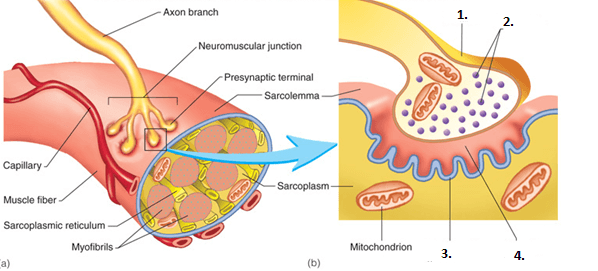
Region where a motor neuron comes in close contact with a muscle cell.
a)
neurotransmitter
b)
muscular dystrophy
c)
muscle tension
d)
neuromuscular junction
45.
When a muscle fiber contracts, the I bands diminish in size.
a)
True
b)
False
46.
What type of bone is longer in length than it is in width?
a)
Flat Bone
b)
Short Bone
c)
Irregular Bone
d)
Long Bone
47.
What region of the skeleton is made up of; cranium, rib cage, sternum and the vertebral column?
a)
Axial Skeleton
b)
Appendicular Skeleton
c)
Axal Skeleton
d)
Apendicular Skeleton
48.
Phosphorus and what... are the most abundant minerals stored in the bones? 
a)
Sodium
b)
Zinc
c)
Iron
d)
Calcium
49.
Which regions in the abdominopelvic cavity are medial?
a)
umbilical, right and left lumbar
b)
epigastric, right and left hypochondriac
c)
iliac (inguinal), lumbar, hypogastric
d)
epigastric, umbilical, hypogastric
50.
Which of the following terms have the same meaning?
a)
anterior and ventral
b)
medial and lateral
c)
ventral and dorsal
d)
distal and proximal
51.
The homeostatic feedback mechanism that reverses the original stimulus is known as...
a)
negative feedback
b)
positive feedback
52.
Of the characteristics of life, which represents the bodies ability to react to stimulus?
a)
excretion
b)
reproduction
c)
digestion
d)
responsiveness
53.
A horizontal plane dividing the body into superior and inferior sections is called...
a)
oblique
b)
parasagittal
c)
coronal/frontal
d)
transverse
54.

What level of structural organization is a group of similar cells?

a)

Tissue

b)

Organ

c)

Cell group

d)

Organ system

55.

Which body system consists of glands that secrete hormones to regulate other structures?

a)

excretory

b)

digestive

c)

endocrine

d)

nervous

56.

What are the primary structures of the reproductive system

a)

Bowels and Bladder

b)

Testes and Ovaries

c)

Bones and Heart

d)

Sleen and Lymph nodes

57.

How does a coronal plane cut the body

a)

Dorsal and ventrical

b)

Left and right

c)

Below the skin

d)

Through the bones

58.

Body plane that divides the body into equal left and right portions

a)

frontal

b)

transverse

c)

mid-sagittal

d)

para-sagittal

59.

The nose is ___ to the ears.

a)

lateral

b)

medial

60.

The brain is ___ to the spinal cord.

a)

superior

b)

inferior

61.

The elbow is more ____ than the hand in relation to the shoulder.

a)

proximal

b)

distal

62.

The eyes are ___ to the mouth.

a)

inferior

b)

superior

63.

Body system that protects the body and includes the skin.

a)

muscular

b)

reproductive

c)

nervous

d)

integumentary

64.

Which body system is responsible for obtaining oxygen.

a)

nervous

b)

respiratory

c)

cardiovascular

d)

nervous

65.
Name the membrane that covers the entire ventral body cavity: 
a)
Peritoneum 
b)
Pleura 
c)
Visceral 
d)
Serous 
66.
Homeostasis
a)
allows for a wildly fluctuating internal environment
b)
is impossible in vertebrates
c)
is the maintenance of a relatively stable internal environment and often incorporates a form of feedback regulation
d)
is the maintenance of a relatively stable external environment and often incorporates a form of feedback regulation
67.
Body is standing straight, facing forward, upper limbs at side and palms facing forward. 
*right and left refer to "right" and "left" of the body in position.
a)
Sagittal
b)
Anatomical Position
c)
Anterior Position
d)
Anatomical Plane
68.
Which type of tissue lines body cavities and has many layers of cells packed together and fused with cell junctions?
a)
Nervous tissue
b)
Muscular tissue
c)
Connective tissue
d)
Epithelial tissue
69.
Which type of tissue is avascular (no blood supply)?
a)
Epithelial tissue
b)
Connective tissue
c)
Nervous tissue
d)
Muscle tissue
70.
A single layer of epithelial cells which are taller than wide would be referenced as
a)
stratified cuboidal epithelium
b)
simple columnar epithelium
c)
pseudostratified cuboidal epithelium
d)
stratified squamous epithelium
71.
Osteo is to bone as chrondro is to
a)
blood
b)
muscle
c)
cartilage
d)
epithelium
72.
Name the Sample.
a)
Simple Columnar
b)
Simple Cuboidal
c)
Simple Squamous
d)
Stratified Columnar
73.
Name the Tissue.
a)
Simple Squamous
b)
Simple Columnar
c)
Simple Cuboidal
d)
Stratified Squamous
74.
What's my Name?
a)
Simple Cuboidal
b)
Simple Columnar
c)
Adipose Tissue
d)
Stratified Squamous
75.
Who am I?
a)
Stratified Squamous
b)
Stratified Cuboidal
c)
Transitional
d)
Pseudostratified
76.
Name the Tissue.
a)
Transitional
b)
Pseudostratified Columnar
c)
Simple Columnar
d)
Stratified Cuboidal
77.
Name the Sample.
a)
Adipose Tissue
b)
Collagen Fibers
c)
Reticular Fibers
d)
Adult loose areolar
78.
Who am I?
a)
Reticular fibers
b)
Adult loose areolar
c)
Adult Dense Regular
d)
Stratified Cuboidal
79.
Name the Tissue
a)
Adult Loose areolar
b)
Adult Dense Irregular
c)
Skeletal Muscle
d)
Smooth Muscle
80.
Skeletal Muscle True or False?
a)
True
b)
False
81.
Cardiac Muscle True or False?
a)
True
b)
False
82.
Name the Sample.
a)
Neuron
b)
Hyaline
c)
Blood
d)
Cardiac Muscle
83.
Who am I?
a)
Blood
b)
Hyaline
c)
Bone Tissue
d)
Dense Irregular
84.
The plasma membrane of a skeletal muscle cell is called the:
a)
sarcomere
b)
myofilament
c)
sarcolemma
d)
sarcoplasm
85.
The functional unit of the muscle cell is the: 
a)
Sarcomere
b)
Osteon
c)
Myofilament
d)
Muscle fiber
86.
The A-band is represented by the number
a)
2
b)
5
c)
6
d)
7
87.
The I band is represented by the number
a)
4
b)
5
c)
6
d)
7
88.
The Z disc is represented by the number
a)
1
b)
2
c)
3
d)
4
89.
The H-Zone is represented by the number
a)
1
b)
2
c)
3
d)
4
90.

There are repeating units along a myofibril.

These are the basic structural and functional unit of skeletal muscle.

What are these units called?

a)

sarcomeres

b)

myofibrils

c)

synapses

d)

troponins

91.
The gap between a neuron and a muscle cell: (#4 in the diagram)
a)
synaptic cleft
b)
sarcolemma
c)
vesicle
d)
Ca2+ ion
92.

When an epithelial tissue has 2 or more layers of cells it is said to be...

a)

simple

b)

stratified

c)

pseudostratified

d)

columnar

93.

This type of tissue is mostly avascular and provides support to all body tissues:

a)

Epithelial

b)

Muscular

c)

Nervous

d)

Connective

94.

Areolar, Adipose, & Reticular are all types of...

a)

cartilage

b)

loose connective tissue

c)

dense connective tissue

d)

epithelium

95.

Tendons & ligaments are types of this...

a)

cartilage

b)

loose connective tissue

c)

dense regular connective tissue

d)

dense irregular connective tissue

96.

Hyaline, elastic, & fibro- are all types of this...

a)

cartilage

b)

loose connective tissue

c)

dense regular connective tissue

d)

dense irregular connective tissue

97.
The formation of blood in bone is called
a)
hematopoiesis
b)
hematoma
c)
hepatitis
d)
erythrocytoma
98.
Which of the following epithelial functions is a primary activity of glandular epithelium?
a)
Protection
b)
Secretion
c)
Sensation
d)
Excretion
99.
Oil-producing glands that self destruct in order to release their product are referred to as ____________.
a)
holocrine
b)
merocrine
c)
apocrine
100.
The type of tissue referred to as loose connective is _____________________
a)
areolar
b)
adipose
c)
reticular
d)
dense
101.
lines body cavities
a)
epithelial
b)
connective
c)
muscle
d)
nervous
102.
Intercalated disks
a)
cardiac
b)
smooth
c)
skeletal
103.
Multinucleated
a)
smooth
b)
skeletal
c)
cardiac
104.
most abundant cartilage
a)
hyaline
b)
fibrocartilage
c)
elastic
105.
a)
areolar
b)
dense fibrous 
c)
hyaline
d)
reticular
106.
a)
keratinized stratified squamos
b)
non-keratinized stratified squamos
c)
cuboidal
107.
found in intervertebral discs
a)
hyaline
b)
fibrocartilage
c)
eleastic
108.
a)
hyaline
b)
elastic
c)
fibrocartilage
d)
stratified squamos
109.

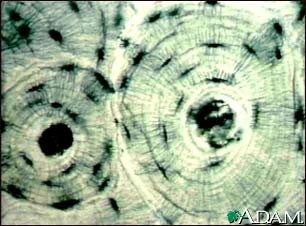
Identify this tissue.

a)

smooth muscle

b)

bone

c)

nerve

d)

blood

110.
What is the function of epithelial cells?
a)
Act as barriers between the external environment, or between organs and fluidfilled cavities
b)
Provide movement by pulling on bones
c)
Provide secretions which help to digest food
d)
Act as the messaging pathway between different areas of the body
111.
Name this tissue
a)
Bone
b)
Cartilage
c)
Blood
d)
Adipose
112.

List the layers of the Epidermis in order from top to bottom.

a)

5,2,3,4,1

b)

1,2,3,4,5

c)

4,5,3,1,2

d)

1,4,3,2,5

113.

What is structure D in the picture?

a)

Adipose

b)

Eccrine Gland

c)

Sebaceous gland

d)

Arrector pilli

e)

Hypodermis

114.

What is structure G in the picture?

a)

Adipose

b)

Eccrine Gland

c)

Sebaceous gland

d)

Arrector pilli

e)

Hypodermis

115.

Which vitamin does your skin synthesize?

a)

Vitamin A

b)

Vitamin B

c)

Vitamin D

d)

Vitamin E

116.
Where is thick skin located?
a)
palms
b)
scalp
c)
arms
d)
face