wayground logo

Free Printable Worksheets

Font size

S
M
L
XL
Worksheets

.3 Chemistry Test 4 Review

Total questions: 134

Worksheet time: 3hrs 6mins

Name
Class
Date
1.
For an atom to be electrically neutral, it must contain the same number of _____
a)
protons and neutrons
b)
neutrons and electrons
c)
protons and electrons
d)
nucleons and electrons
2.
In the Bohr model of the atom, what is the maximum number of electrons in the first shell?
a)
1
b)
2
c)
6
d)
8
3.

Which energy state has more energy?

a)

Ground State

b)

Excited State

4.

When can atoms emit photons?

a)

When the electron is in the ground state

b)

When the electron is in the excited state

c)

When an electron is going from the ground state to the excited state

d)

When an electron is going from the excited state to the ground state

5.
What's a valence electron?
a)
electrons in the second energy level
b)
electrons in the outermost energy level
c)
the atomic number
d)
electrons in the first level
6.
What group does this element belong to?
a)
Group 1: Alkali metals
b)
Group 18: Noble Gases
c)
Group 2: Alkaline-Earth Metals
d)
Group 17: Halogens
7.
The characteristic color bands that a hot, dilute gas emits are called...
a)
emission spectra
b)
absorption spectra
c)
continuous spectra
d)
black body radiation
8.
_______ carry the greatest amount of energy. 
a)
x-rays
b)
gamma rays
c)
infrared rays
d)
visible light
9.
The shortest wavelength in visible light is______.
a)
violet
b)
red
c)
blue
d)
yellow
10.
Emission of light from an atom occurs when an electron
a)
drops from a higher to a lower energy level.
b)
   jumps from a lower to a higher energy level.   
c)
   moves within its atomic orbital.
d)
falls into the nucleus.
11.
Which drawing represents the process by which an emission line is formed?
a)
A
b)
B
c)
C
d)
D
12.
An element with five valence electrons is
a)
phosphorus
b)
oxygen
c)
beryllium
d)
rubidium
13.
How many electrons are in the outer (valence) shell of Chlorine (Cl)?
a)
1
b)
3
c)
6
d)
7
14.
The period for Bromine is ___________.
a)
3
b)
2
c)
4
15.
Which types of elements have intermediate properties of metals and nonmetals?
a)
metals
b)
nonmetals
c)
metalloids
d)
gases
16.
How many Valance electrons does Iodine Have?
a)
6
b)
16
c)
7
d)
17
17.

What is the maximum number of electrons that can be present in each principal energy level of hydrogen?

a)

n

b)

n2

c)

2n

d)

2n2

18.

What is the lowest energy state of an atom called?

a)

the ground state

b)

the excited state

c)

the solid state

d)

the chaotic state

19.
Which principle states that we cannot know the location AND momentum of an electron simultaneously?
a)
Bohr
b)
Hesienberg
c)
Shrodinger
d)
Einstein
20.
The area of 3D space where an electron is likely to be found is called a(n)
a)
orbit
b)
ring
c)
nucleus
d)
orbital
21.
What orbital shapes are found at the 2nd energy level
a)
s only
b)
s and p
c)
s, p, d and f
d)
p only
22.
How many orbitals are at the "p-sublevel"?
a)
1
b)
3
c)
5
d)
7
23.

How many electrons can fit into a d- orbital?

a)

6

b)

2

c)

8

d)

10

24.

__________ is the distance between corresponding points on adjacent waves.

a)

Electromagnetic radiation

b)

Electromagnetic spectrum

c)

Wavelength

d)

Frequency

25.

A state in which an atom has a higher potential energy that it has in its ground state.

a)

ground state

b)

excited state

c)

normal state

26.

The _______________________ states that it is impossible to determine simultaneously both the position and the velocity of an electron or any other particle.

a)

Heisenberg uncertainty principle

b)

Quantum theory

c)

Aufbau principle

d)

Pauli exclusion principle

27.

The ________________ states that an electron occupies the lowest energy orbital that can receive it.

a)

Heisenberg uncertainty principle

b)

Quantum theory

c)

Aufbau principle

d)

Pauli exclusion principle

28.
Who created the uncertainty principle?
a)
Heisenberg
b)
DeBrogile
c)
Dalton
d)
Bohr
29.
Who discovered that electrons orbit on rings?
a)
Thompson
b)
Democritus
c)
Bohr
d)
Dalton
30.

Are electrons found between energy levels?

a)

Yes, electrons have energy levels that are continuous

b)

No, electrons are found only in discrete energy levels because these levels are quantized

c)

only on certain occasions

31.

Which sublevel contains ONE orbital?

a)

s

b)

p

c)

d

d)

f

32.

How many electrons can the p orbital hold?

a)

1

b)

2

c)

6

d)

10

33.

which SUBLEVEL contains 3 orbitals?

a)

s

b)

p

c)

d

d)

f

34.

The higher the energy level, the _____________ the distance from the nucleus.

a)

larger

b)

smaller

c)

neither, the energy level has nothing to with the distance from the nucleus

35.

How many electrons does the 2nd principal energy level have?


Formula = 2n2

a)

2

b)

4

c)

6

d)

8

36.

Groups 1-2 are part of the

a)

s subshell

b)

p subshell

c)

d subshell

d)

f subshell

37.

How many electrons can occupy a single orbital?

a)

1

b)

3

c)

6

d)

2

38.

the symbol "n" represents

a)

the principal energy level

b)

sublevel

c)

orbital

d)

shape

39.

The n = 3 energy level contains what subshells?

a)

s

b)

s and p

c)

s, p, and d

d)

s, p, d, and f

40.

How many orbitals does the second energy level contain? (Note that orbitals are not the same as subshells.)

a)

2

b)

3

c)

4

d)

8

41.

Which orbital is shaped like a dumbbell?

a)

s

b)

p

c)

d

d)

f

42.

How many electrons inhabit the n = 2 energy level?

a)

2

b)

8

c)

18

d)

32

43.

How many orbitals inhabit the d subshell?

a)

1

b)

3

c)

5

d)

7

44.

How many electrons can inhabit the f subshell?

a)

6

b)

7

c)

10

d)

14

45.

Electrons fill the 3d orbital before the 4s orbital

a)

True

b)

False

46.
What atom matches this electron configuration?
1s22s22p63s23p64s23d10
a)
Zinc
b)
Copper
c)
Nickel
d)
Germanium
47.
What atom matches this electron configuration?
1s22s22p63s2
a)
Neon
b)
Magnesium
c)
Aluminum
d)
Potassium
48.
What electron configuration matches an oxygen atom?
a)
1s22s22p63s2, 3p64s23d104p5
b)
1s22s22p4
c)
1s22s22p6
d)
1s22s22p63s23p64s23d1
49.
How many electrons can the first energy level hold?
a)
1
b)
2
c)
8
d)
0
50.
What do you start electron configuration with?
a)
1s2
b)
1d10
c)
1f14
d)
1p6
51.
What is this element?
1s22s22p63s2
a)
Neon
b)
Magnesium
c)
Aluminum
d)
Potassium
52.
Which electron configuration belongs to Chlorine (Cl)?
a)
1s2s2p3s3p5
b)
1s2s2p3s3p6
c)
1s2s2p3s3p7
53.
There are 4 different types of subshells s,p,d,f
a)
true
b)
false
54.
Identify the Electron Configuration for Aluminum (Al)
a)
1s2s2p3s3p1
b)
1s2s2p3s3p3
c)
1s2s2p3s4p1
55.
Electrons occupy orbitals of lowest energy first is part of what electron configuration rule?
a)
Hund’s Rule
b)
Aufbau Principle
c)
Pauli Exclusion Principle
56.
Electron arrangement that uses arrows
a)
Electron configuration
b)
Shorthand configuration
c)
Lewis dot structure
d)
Orbital diagram
57.
What is the shorthand electron configuration for Sulfur atom?
a)
[Ar] 3p4
b)
[He] 3s23p4
c)
[Ne] 3s23p4
d)
[Na] 3s23p3
58.
What is the noble gas configuration for boron?
a)
[He]1s22s2
b)
[He]2s22p2
c)
[He]2s22p1
d)
[Li]2s22p1
59.
What is the noble gas configuration for phosphorus?
a)
[Ar] 3p5
b)
[He] 3s2 3p5
c)
[Ne] 3s2 3p3
d)
[Na] 3s2 3p5
60.
[Ne]3s23p5 is the noble gas configuration for which element?
a)
chlorine
b)
fluorine
c)
sulfur
d)
aluminum
61.
[Ne]3s23p5 is the noble gas configuration for which element?
a)
chlorine
b)
fluorine
c)
sulfur
d)
aluminum
62.
What atom matches this electron configuration?
1s22s22p63s2
a)
Neon
b)
Magnesium
c)
Aluminum
d)
Potassium
63.

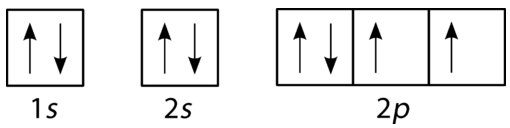
This orbital diagram represents:

a)

C

b)

B

c)

N

d)

O

64.

Which orbital shows a violation of the Pauli Exclusion Principle?

a)

A

b)

B

c)

C

d)

D

65.

Which is associated with more energy?

a)

2p

b)

2s

c)

3p

d)

1s

66.
All orbitals of equal energy are occupied by one electron before any single orbital is occupied by a second electron.
a)
Aufbau principle
b)
Pauli exclusion principle
c)
Hund’s rule
d)
Core Notation
67.
An electron occupies the lowest energy orbital that can receive it.
a)
Hund’s rule
b)
Pauli exclusion principle
c)
Bohr model of the atom
d)
Aufbau principle
68.
What is this element? 
[Ar]4s2
a)
Calcium
b)
Sodium
c)
Scandium
d)
Titanium
69.
Which orbital shows a violation of Hund's Rule?
a)
A
b)
B
c)
C
d)
D
70.

Which orbital shows a violation of the Aufbau Principle?

a)

A

b)

B

c)

C

d)

D

71.
a)
2
b)
8
c)
3
d)
13
72.
a)
2
b)
3
c)
5
73.
a)
3
b)
13
c)
4
d)
14
74.
a)
16
b)
32
c)
6
d)
4
75.
a)
15
b)
16
c)
5
d)
6
76.
a)
10
b)
2
c)
8
d)
18
77.

For representative elements (Groups 1A - 8A), the number of valence electrons is equal to

a)

the group number

b)

the period number

c)

the atomic number

d)

the group number minus 10

78.

When at atom loses electrons, it becomes a(n)

a)

cation

b)

anion

c)

isotope

79.

When at atom gains electrons, it becomes a(n)

a)

cation

b)

anion

c)

isotope

80.

The charge of any ion is always equal to

a)

protons - electrons

b)

electrons - protons

c)

protons + neutrons

d)

protons + electrons

81.
Valence electrons are: 
a)
Electrons farthest away from the nucleus
b)
Electrons closest to the nucleus
c)
Electrons that just come and go - they don't stay with the atom
d)
Electrons in the second shell
82.
How is helium different from the other noble gases?
a)
It will react with other elements.
b)
It has 10 valence electrons.
c)
It has 2 valence electrons.
d)
It is heavier than the other noble gases.
83.
A(n) _________ is an ion with a positive (+) charge.
a)
anion
b)
cation
c)
ion
d)
solute
84.
A(n) _________ is an ion with a Negative (-) charge.
a)
anion
b)
cation
c)
ion
d)
solute
85.

__________ is the distance between corresponding points on adjacent waves.

a)

Electromagnetic radiation

b)

Electromagnetic spectrum

c)

Wavelength

d)

Frequency

86.

The lowest energy state of an atom is its _____________.

a)

ground state

b)

excited state

c)

normal state

87.

A state in which an atom has a higher potential energy that it has in its ground state.

a)

ground state

b)

excited state

c)

normal state

88.

Light from the sun, energy used to cook food in a microwave, and the X rays used by dentists are all examples of...

a)

electromagnetic radiation

b)

wavelength

c)

frequency

d)

Planck's constant

89.

The distance between two consecutive peaks or troughs in a wave is:

a)

frequency

b)

wavelength

c)

quantization

d)

photon

90.

a particle representing a quantum of light or other electromagnetic radiation

a)

radiand

b)

molecule

c)

quantum

d)

photon

91.
Lowest energy state of an atom
a)
Ground
b)
Excited
92.
The energy of an electron __________ as it moves further away from the nucleus
a)
increases
b)
decreases
93.
When an atom has all of its electrons in the lowest energy orbitals available, the atom is  
a)
in ground state
b)
in excited state
c)
giving off light energy
d)
unstable
94.
Every element has its own unique atomic spectra.
a)
True
b)
False
95.
Emission lines create _____ spectral lines on a visible light spectra due to the electrons moving into their _____ state.
a)
dark; excited
b)
dark; ground
c)
bright; excited
d)
bright; ground
96.
For an electron to change from ground state to an excited stated it must...
a)
Absorb energy
b)
Release energy
97.
Why are line emission spectrums useful?
a)
they allow us to identify elements
b)
they tell us how many protons there are in a nucleus
c)
they represent the true color of the element
d)
to draw straight lines in our cornell notebooks
98.
An electron moves ___________ the nucleus when it moves to its excited state
a)
towards
b)
away from
c)
inside
d)
around
99.
Light is emitted when an electron moves from the ________ state to the _________ state
a)
excited, ground
b)
ground, excited
100.
Which of the following elements make up the unknown sample?
a)
A and B
b)
B and C
c)
C and D
d)
B and C
101.
The _______________ determines the color of visible light. 
a)
wavelength
b)
speed
c)
amplitude
d)
light
102.
Which type of shell has electrons with the most energy?
a)
furtherst away from the nucleus
b)
 closest to the nucleus
c)
middle shells
103.
Release of energy by an electron results in 
a)
it moving from the ground to an excited state
b)
it moving from an excited to the ground state
c)
the emission of a photon
d)
it moving from an excited to the ground state and the emission of a photon
104.

When an atom _______________ _____________, its electrons can use this energy to move to a higher energy level.

a)

releases energy

b)

absorbs energy

c)

emits radiation

d)

gets rid

105.
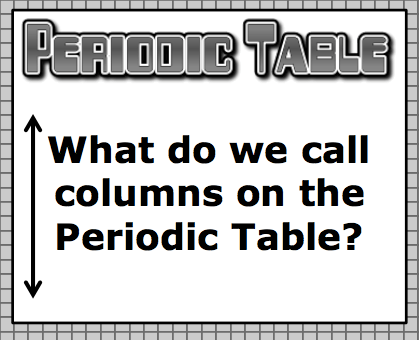
a)
Periods
b)
Groups
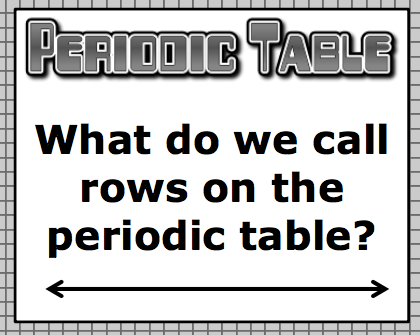
106.
a)
Periods
b)
Groups
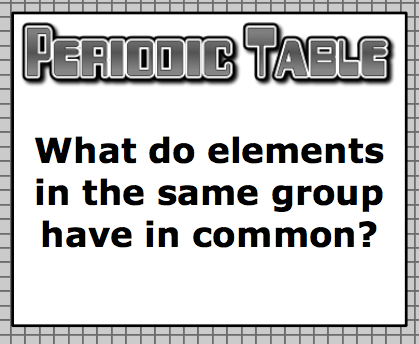
107.
a)
energy levels
b)
valence electrons
c)
protons
d)
neutrons
108.
a)
energy levels
b)
valence electrons
c)
protons
d)
neutrons
109.
a)
Same group
b)
Same period
110.
a)
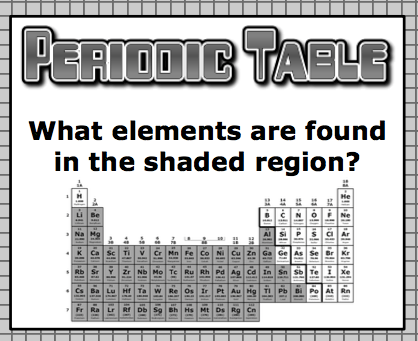
Metals
b)
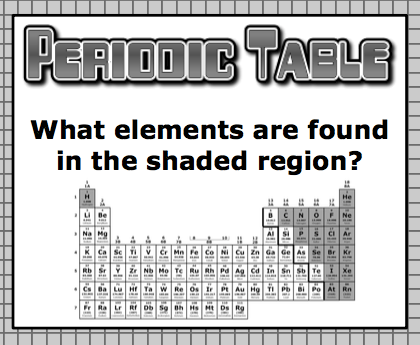
Nonmetals
c)
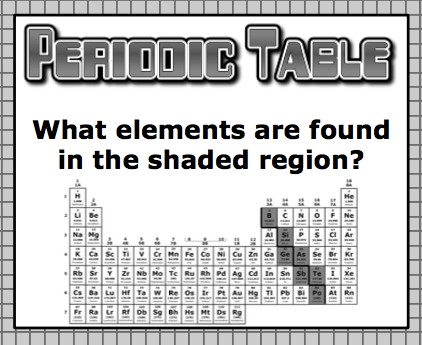
Metalloids
111.
a)
Metals
b)
Nonmetals
c)
Metalloids
112.
a)
Metals
b)
Nonmetals
c)
Metalloids
113.
a)
Metals
b)
Nonmetals
c)
Metalloids
114.
Elements in a ..................have similar chemical properties.  
a)
period
b)
group
c)
row
115.
Is Hydrogen a metal or nonmetal?
a)
Metal
b)
Nonmetal
116.
Is Na a metal or nonmetal
a)
metal
b)
nonmetal
117.
Is C a metal or nonmetal
a)
metal
b)
nonmetal
118.
Is O a metal or nonmetal
a)
metal
b)
nonmetal
119.
Is I a metal or nonmetal
a)
metal
b)
nonmetal
120.
Is Al a metal or nonmetal
a)
metal
b)
nonmetal
121.
Is Ag a metal or nonmetal
a)
metal
b)
nonmetal
122.
Is S a metal or nonmetal
a)
metal
b)
nonmetal
123.
Is Rb a metal or nonmetal
a)
metal
b)
nonmetal
124.
What element is special in that it is on the left but is not a metal?
a)
H
b)
Mg
c)
Na
d)
Sr
125.

what is silicon (Si)

a)

metal

b)

nonmetal

c)

metalloid

d)

its a chemical change

126.

Is Silicon a

a)

Nonmetal

b)

Metalloid

c)

Metal

127.
What is an ion?
a)
A Charged Atom
b)
A Large Atom
c)
A Small Atom
d)
A Cute Atom
128.
An atom becomes _________ when it gains electrons.
a)
Positive
b)
Negative
c)
Neutral
d)
Invinsible
129.
Elements on the LEFT side of the periodic table will most likely form:
a)
Positive ions
b)
Negative ions
c)
Neutral Ions
d)
None of these
130.
Cations are...
a)
Positive
b)
Negative
c)
Neutral
d)
Purring
131.
Anions are...
a)
Positive
b)
Negative
c)
Neutral
d)
Crying
132.
An atom becomes _______ when it loses electrons.
a)
Positive
b)
Negative
c)
Neutral
d)
Invinsible
133.
The _________ never change in ions and neutral atoms.
a)
Neutrons
b)
Electrons
c)
Protons
d)
Atomic Mass
134.
Negative ions are called
a)
Cations
b)
Electrons
c)
Anions
d)
Neutrons