Wayground logo

Free Printable Worksheets

Font size

S
M
L
XL
Worksheets

ESS SEM 1 REVIEW: EARTHQUAKES

Total questions: 70

Worksheet time: 43mins

Name
Class
Date
1.
The epicenter of an earthquake is
a)
The point below the surface where rock begins to break and the first motion occurs
b)
The seismic station closest to the earthquake
c)
The place where the greatest damage occurs
d)
The point on the surface directly above the focus
2.
This famous transform fault is located in the western United States creates significant earthquake activity for California
a)
New Madrid
b)
Denali Fault
c)
Ramapo Seismic Zone
d)
San Andreas
3.
The Richter scale measures:
a)
the amount of radon gas released
b)
the movement of plates
c)
the strength of an earthquake
d)
the weight of tectonic plates
4.
The Modified Mercalli scale rates the amount of damage from an earthquake
a)
true
b)
false
5.
Which travels fastest, always being the first detected by seismic stations?
a)
P waves
b)
S waves
6.
An earthquake scored high on the Richter scale but low on the Mercalli scale. Why?
a)
it probably happened in an area with no people
b)
it was a fast earthquake
c)
because it damaged a lot
d)
impossible to tell
7.
Liquefaction is when...
a)
the soil behaves like liquid
b)
the ground becomes liquid
c)
magma rises to the surface
d)
buildings are damaged, crumbling like liquid
8.
An instrument that detects and measures earthquakes is a 
a)
seismogram
b)
focus seismic map
c)
focus
d)
seismograph 
9.
How much bigger is a magnitude 8 earthquake compared to magnitude 7 one on the Richter Scale?
a)
1 time bigger
b)
10 times bigger
c)
100 times bigger
d)
1000 times bigger
10.
Stress that pushes a mass of rock in two opposite directions is called
a)
deformation
b)
tension
c)
compression
d)
shearing
11.
Tension causes what type of fault to form?
a)
folds
b)
reverse fault
c)
strike slip fault
d)
normal fault
12.
What type of fault is shown in this picture?
a)
normal
b)
reverse
c)
strike slip
d)
tension
13.
What is a large ocean wave that results from an underwater earthquake, landslide, or volcanic eruption?
a)
Aftershock
b)
Liquefaction
c)
Seismic Gap
d)
Tsunami
14.
The point where movement occurred which triggered an earthquake is the ________.
a)
Slip
b)
Focus
c)
Epicenter
d)
Fault
15.
Which of the following sequences correctly list the different arrivals from first to last?
a)
P waves, surface waves, L waves
b)
P waves, S waves, Surface waves
c)
S waves, Surface waves, L waves
d)
Surface waves, S waves, P waves
16.
What is the minimum number of  seismograph stations that are needed to accurately locate the epicenter?
a)
1
b)
2
c)
3
d)
4
17.
The point labeled A is called the 
a)
Epicenter
b)
Focus
c)
Slip
d)
Fault 
18.
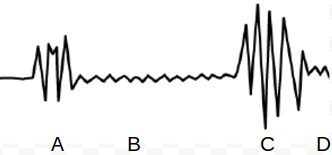
Using the picture, what are the waves labeled A?
a)
P waves
b)
S waves
c)
Q waves
d)
Surface Waves 
19.
Surface waves are labeled with which letter? 
a)
a
b)
b
c)
c
20.
According to the seismograms, which station was the closest to the epicenter?
a)
x
b)
y
c)
z
21.
Where is the epicenter?
a)
A
b)
B
c)
C
d)
D
22.
Base your answers to questions 5 through 7 on the cross section of Earth below and on your knowledge of Earth science. The cross section represents the pattern of seismic wave movement away from an earthquake. Point W represents a location at the boundary between two layers of Earth’s interior. Points X, Y, and Z represent seismic stations on Earth’s surface.
The diagram below represents the seismograms of this earthquake recorded at seismic stations X, Y, and Z.Which table best matches each seismic station with its likely seismogram?
a)
diagram 1 
b)
diagram 2 
c)
diagram 3 
d)
diagram 4 
23.
spot or origin where the earthquake began -- often below the surface of the earth
a)
focus
b)
core
c)
epicenter
d)
fault
24.
amount of damage caused by an earthquake
a)
magnitude
b)
intensity
c)
scale
d)
mercalli
25.
measure of the strength of an earthquake
a)
intensity
b)
scale
c)
magnitude
d)
mercalli
26.
magnitude scale that is more accurate for larger earthquakes
a)
Richter Scale
b)
seismogram
c)
Modified Mercalli Scale
d)
Moment Magnitude Scale
27.
a seismic wave that shakes the ground back and forth (compression) in the direction the wave is moving
a)
P-Wave
b)
S-Wave
c)
L-Wave
d)
R-Wave
28.
a tracing of earthquake motion (paper with squiggly lines)
a)
seismograph
b)
seismogram
c)
seismometer
d)
richter scale
29.
the instrument that records vibrations in the ground (writes or prints information on paper)
a)
seismometer
b)
richter scale
c)
seismograph
d)
seismogram
30.
the study of earthquakes and the structure of the Earth, by both naturally and artificially generated earthquakes
a)
seismology
b)
richter
c)
geology
d)
volcanology
31.
instrument buried in the ground to detect earthquake vibrations
a)
seismogram
b)
seismograph
c)
richter scale
d)
seismometer
32.
the time gap between earthquake arrivals, used to calculate distance to the epicenter
a)
P-S Interval
b)
S-P interval
c)
L-R Interval
d)
R-L Interval
33.
a seismic wave that shakes the ground up and down as it travels forward
a)
P-Wave
b)
L-Wave
c)
S-Wave
d)
R-Wave
34.
the process of determining the location of a point by measuring angles to it from three known points
a)
triangulation
b)
location process
c)
pin-pointing
d)
GPS Monitoring
35.
a sea wave caused by large oceanic earthquakes, major submarine slides, or exploding volcanic islands
a)
tidal wave
b)
tsunami
c)
typhoon
d)
hurricane
36.
Here is a picture of a seismogram. Which seismic wave reaches the station first?
a)
P Wave
b)
S Wave
c)
H Wave
d)
L Wave
37.
Look at the picture. What is the location called where all three circles intersect?
a)
focus
b)
earthquake
c)
epicenter
d)
seismograph
38.
P Waves can move through which of the following?
a)
Gas
b)
Liquid
c)
Solid
d)
All of these
39.
S Waves can move through which of the following?
a)
Gas
b)
Liquid
c)
Solid
d)
All of these
40.
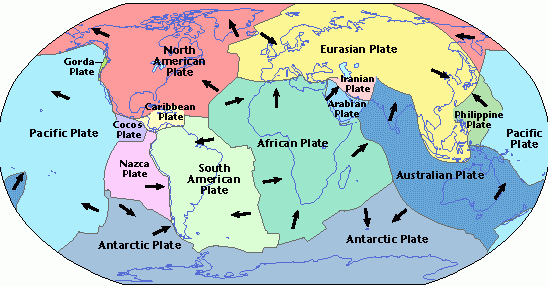
Many earthquakes happen along the borders of...
a)
Countries
b)
Tectonic Plates
c)
Climate Zones
d)
None of the above.
41.
P waves move ___________ than S waves.
a)
slower
b)
faster
c)
the same speed
d)
around
42.
With the help of a graph, the time difference between P and S waves can tell you ____________.
a)
how big the earthquake is
b)
how long the earthquake lasted
c)
how far away the earthquake is
d)
how deep the earthquake is
43.

Two blocks of rock slide horizontally past each other in opposite directions

a)

Normal Fault

b)

Strike-Slip Fault

c)

Reverse Fault

d)

Tension Fault

44.

•compression waves that travel through solids and liquids, compressing and expanding the material they pass through, temporarily changing volume

a)

P-Wave

b)

Seismic Waves

c)

S- Wave

d)

Surface Waves

45.

only travel through solids and temporarily change the shape, but not the volume of the material they pass through; move slower than P waves

a)

P-Wave

b)

Seismic Waves

c)

S- Wave

d)

Surface Waves

46.

•move slower than P and S waves, but can produce severe ground movement with a wavelike motion

a)

P-Wave

b)

Seismic Waves

c)

S- Wave

d)

Surface Waves

47.

Sudden movement of rock that relieves stress

a)

Strike Slip

b)

Earthquake

c)

Focus

d)

Epicenter

48.

What does a seismograph record?

a)

the Mercalli scale rating for an earthquake

b)

the speed of seismic waves

c)

the ground movements caused by seismic waves

d)

the location of the epicenter

49.

In what direction do seismic waves carry the energy of an earthquake?

a)

away from the focus

b)

from the surface to the interior

c)

toward the focus

d)

through the mantle only

50.

Picture A Represents?

a)

Normal Fault

b)

Reverse Fault

c)

Strike-Slip Fault

d)

Damage Fault

51.

Picture B Represents?

a)

Normal Fault

b)

Reverse Fault

c)

Strike-Slip Fault

d)

Damage Fault

52.

Picture C Represents?

a)

Normal Fault

b)

Reverse Fault

c)

Strike-Slip Fault

d)

Damage Fault

53.

#1 Represents

a)

Fault

b)

Epicenter

c)

Focus

d)

Fold

54.

#2 Represents

a)

Fault

b)

Epicenter

c)

Focus

d)

Fold

55.

#3 Represents

a)

Fault

b)

Epicenter

c)

Focus

d)

Fold

56.
Which body wave squeezes and stretches rock materials as they pass through the Earth?
a)
Body Waves
b)
P Waves
c)
S Waves
d)
Surface Waves
57.
Which body waves cause particles of rock material to move at right angles to the direction in which the waves are traveling?
a)
Body Waves
b)
P Waves
c)
S Waves
d)
Surface Waves
58.
Where are the P-waves located on this seismogram?
a)
A
b)
B
c)
C
d)
D
59.
What is an area along a seismically active fault where no earthquake activity has occurred over a long period of time?
a)
Aftershock
b)
Liquefaction
c)
Seismic Gap
d)
Tsunami
60.

How can scientists learn about Earth's interior?

a)

by drilling down into the mantle

b)

by analyzing seismic data

c)

by reviewing weather patterns

61.

What would scientists use a seismograph/seismogram for?

a)

Locating the epicenter of an earthquake.

b)

Learning more about where the earthquake originated

c)

Learning more about the depth and density of the layers of Earth.

d)

To analyze the speed of an earthquake to learn about the depth of Earth's interior.

62.

Why would scientists need seismic data from a location that wasn't directly effected by an earthquake?

a)

They wouldn't. That's silly.

b)

This information can help them find the epicenter.

c)

Because scientists just like data.

d)

This information can help them make more graphs, which is their hobby.

63.
Earthquakes are caused by 
a)
sudden movements of rock along a fault
b)
sudden movement of water
c)
seismic gaps
d)
too much drilling along plate boundaries
64.
When an underwater earthquake causes a giant wave to come ashore, that wave is known as a __
a)
tsunami
b)
seismic wave
c)
shearing
d)
focus wave
65.
If two earthquakes have the same magnitude and epicenter, which type would cause more damage?
a)
the earthquake with the shallowest focus
b)
the earthquake with the deepest focus
c)
the damage would be the same
d)
there is no way to tell
66.
Measuring the time between the arrival of __ and __ helps a scientist to determine the distance between the recording seismograph and the earthquake's epicenter.
a)
primary and secondary waves
b)
primary and surface waves
c)
secondary and surface waves
d)
surface and body waves
67.
How are the outer and inner cores different?
a)
The inner core is liquid and the outer core is solid.
b)
The inner core is solid and the outer core is liquid.
c)
Both of them are made of iron and nickel.
d)
The outer core will not allow primary waves to go through it.
68.
This image is a ___.
a)
seismogram
b)
seismograph
c)
teleprompter
d)
spirograph
69.
This image is an example of a __.
a)
seismograph
b)
seismogram
c)
telegram
d)
triangulation
70.
Which tool would be best to use when demonstrating the motion of a primary wave?
a)
slinky
b)
rope
c)
chain
d)
rod